Page 1
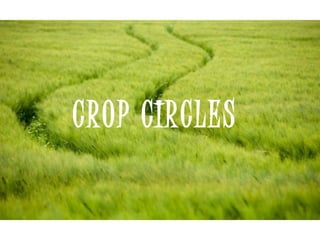
CROP CIRCLES
Page 2
Thesun setson afield in southern England.
When it rises again the following
morning, that field has been transformed
into an enormous work of art. A large
section of thecrop hasbeen tamped into a
pattern of circles, ringsand other intricate
geometric shapes. But who created it?
•Arecrop circlesthe work of alien
visitors?
• Are they a natural phenomenon,
created by electrically charged currents of
air? Or
•Arethey elaborate hoaxes perpetrated
by savvy, talented and very determined circle
Page 3
What are Crop Circles?
Crop circlesarepatternsthat appear in fields. The
pattern is created when certain areas of the
crops are tamped down, but others are left
intact. The edge is so clean that it looks like it
was created with a machine. Even though the
stalks are bent, they are not damaged. Most of
the time, the crop continues to grow as normal.
Farmershavereported finding strangecirclesin their
fieldsfor centuries. The earliest mention of a crop
circle dates back to the 1500s. A 17th-century
English woodcut showsadevilish creaturemaking a
crop circle. Peoplewho lived in theareacalled the
creaturethe"mowing devil."
Page 4
Crop Circle Designs
Crop circlesarenot just circles-- they can comein
many different shapes. The most basic (and the
most common) crop circle is the single circle.
The stalks inside a crop circle are typically bent
into what is known as a swirl pattern.
Crop circles can range in size from a few
inches to a few hundred feet across. Most
early crop circlesweresimplecircular designs.
But after1990, the circles became more
elaborate. More complex crop patterns,
called pictograms, emerged. Cropscan be
madeto look likejust about anything - smiling
faces, flowers oreven words.
Page 5
Some of the more sophisticated patterns are
based on mathematical equations. In one crop
circle that had an outerand an innercircle, the
area of the outercircle was exactly fourtimes
that of the innercircle.
Page 6
Crop Circle Locations
Most circles are concentrated in the south of
England, primarily in the counties of Hampshire
and Wiltshire. Many of them havebeen found near
Avebury and Stonehenge, two mystical sites
containing largestonemonuments. But crop circles
arenot confined to England. They have been
spotted in the United States, Canada, Australia,
Japan, India and otherparts of the world.
The "season" forcrop circles runs from April to
September, which coincides with the growing
season. Circles tend to be created at night,
hiding theircreators (human orotherwise) from
curious eyes Crop circles can be found in many
different types of fields -- wheat, corn, oats,
rice, oil-seed rape, barley, rye, tobacco even
weeds.
Page 7
Who Makes Crop Circles?
1)UFOs and Aliens ?
Possibly themost controversial
theory isthat crop circlesarethe
work of visitorsfrom other
planets-- sort of likealien
calling cards.
Peoplewho agreewith this
theory say that the circles are
eitherthe imprint left by
landing spacecraft or
messages brought from afar
forus earthlings. Some
eyewitnessesclaim to haveseen
UFO-like lights and strange
noises emanating from crop
circle sites.
Page 8
2) Winds
Probably themost scientific theory saysthat crop
circlesarecreated by small currents of swirling
winds called vortices. The spinning columns
force a burst of airdown to the ground, which
flattens the crops. They are charged with
energy. When dust particles get caught up in the
spinning, charged air, they can appearto glow,
which may explain the UFO-like glowing lights
many witnesses have seen nearcrop circles. But
the question remains -- how can a few seconds
worth of spinning aircreate such intricate and
perfectly defined crop circles?
Page 9
3) Earth Energy
Some researchers believe that the earth
creates its own energy, which formsthecircles.
Onepossibleform of earth energy is
electromagnetic radiation. In fact, scientists
have measured strong magnetic fields inside
crop circles, and visitors have sometimes
reported feeling a tingling sensation in their
body while in ornearthe circles.4) Humans
Among themost famoushoaxersaretheBritish
team of Doug Bowerand Dave Chorley, known
as"Doug and Dave." In 1991, theduo cameout
and announced that they had made hundreds
of crop circles since 1978. To prove that they
were responsible, they filmed themselves for
the BBC making a circle with a rope-and-
plank contraption in a Wiltshire field.
Page 10
How Do Researchers Study Crop
Circles?
When researcherscometo thesceneof acrop
circle, they conduct a thorough investigation,
including thefollowing methods:
•Talking to possibleeyewitnessesand residents
living nearby
•Examining thelocation and theweather where
circleshaveformed
•Examining theaffected cropsand thesurrounding
soil with sophisticated techniquessuch asx-ray
diffraction analysis
•Taking electromagnetic energy readingsinsideand
near thecrop circles
•Analyzing thecirclepatterns
Page 11
Researchershavebeen still
pondering over thequestion
of crop circlesfor several
decades, but they still haven't
comeup with areal answer
asto why they exist ?
Page 12
Page 13
Page 14
Page 15
Page 16

crop circles

  • 1.
  • 2.
    Page 2 Thesun setsonafield in southern England. When it rises again the following morning, that field has been transformed into an enormous work of art. A large section of thecrop hasbeen tamped into a pattern of circles, ringsand other intricate geometric shapes. But who created it? •Arecrop circlesthe work of alien visitors? • Are they a natural phenomenon, created by electrically charged currents of air? Or •Arethey elaborate hoaxes perpetrated by savvy, talented and very determined circle
  • 3.
    Page 3 What areCrop Circles? Crop circlesarepatternsthat appear in fields. The pattern is created when certain areas of the crops are tamped down, but others are left intact. The edge is so clean that it looks like it was created with a machine. Even though the stalks are bent, they are not damaged. Most of the time, the crop continues to grow as normal. Farmershavereported finding strangecirclesin their fieldsfor centuries. The earliest mention of a crop circle dates back to the 1500s. A 17th-century English woodcut showsadevilish creaturemaking a crop circle. Peoplewho lived in theareacalled the creaturethe"mowing devil."
  • 4.
    Page 4 Crop CircleDesigns Crop circlesarenot just circles-- they can comein many different shapes. The most basic (and the most common) crop circle is the single circle. The stalks inside a crop circle are typically bent into what is known as a swirl pattern. Crop circles can range in size from a few inches to a few hundred feet across. Most early crop circlesweresimplecircular designs. But after1990, the circles became more elaborate. More complex crop patterns, called pictograms, emerged. Cropscan be madeto look likejust about anything - smiling faces, flowers oreven words.
  • 5.
    Page 5 Some ofthe more sophisticated patterns are based on mathematical equations. In one crop circle that had an outerand an innercircle, the area of the outercircle was exactly fourtimes that of the innercircle.
  • 6.
    Page 6 Crop CircleLocations Most circles are concentrated in the south of England, primarily in the counties of Hampshire and Wiltshire. Many of them havebeen found near Avebury and Stonehenge, two mystical sites containing largestonemonuments. But crop circles arenot confined to England. They have been spotted in the United States, Canada, Australia, Japan, India and otherparts of the world. The "season" forcrop circles runs from April to September, which coincides with the growing season. Circles tend to be created at night, hiding theircreators (human orotherwise) from curious eyes Crop circles can be found in many different types of fields -- wheat, corn, oats, rice, oil-seed rape, barley, rye, tobacco even weeds.
  • 7.
    Page 7 Who MakesCrop Circles? 1)UFOs and Aliens ? Possibly themost controversial theory isthat crop circlesarethe work of visitorsfrom other planets-- sort of likealien calling cards. Peoplewho agreewith this theory say that the circles are eitherthe imprint left by landing spacecraft or messages brought from afar forus earthlings. Some eyewitnessesclaim to haveseen UFO-like lights and strange noises emanating from crop circle sites.
  • 8.
    Page 8 2) Winds Probablythemost scientific theory saysthat crop circlesarecreated by small currents of swirling winds called vortices. The spinning columns force a burst of airdown to the ground, which flattens the crops. They are charged with energy. When dust particles get caught up in the spinning, charged air, they can appearto glow, which may explain the UFO-like glowing lights many witnesses have seen nearcrop circles. But the question remains -- how can a few seconds worth of spinning aircreate such intricate and perfectly defined crop circles?
  • 9.
    Page 9 3) EarthEnergy Some researchers believe that the earth creates its own energy, which formsthecircles. Onepossibleform of earth energy is electromagnetic radiation. In fact, scientists have measured strong magnetic fields inside crop circles, and visitors have sometimes reported feeling a tingling sensation in their body while in ornearthe circles.4) Humans Among themost famoushoaxersaretheBritish team of Doug Bowerand Dave Chorley, known as"Doug and Dave." In 1991, theduo cameout and announced that they had made hundreds of crop circles since 1978. To prove that they were responsible, they filmed themselves for the BBC making a circle with a rope-and- plank contraption in a Wiltshire field.
  • 10.
    Page 10 How DoResearchers Study Crop Circles? When researcherscometo thesceneof acrop circle, they conduct a thorough investigation, including thefollowing methods: •Talking to possibleeyewitnessesand residents living nearby •Examining thelocation and theweather where circleshaveformed •Examining theaffected cropsand thesurrounding soil with sophisticated techniquessuch asx-ray diffraction analysis •Taking electromagnetic energy readingsinsideand near thecrop circles •Analyzing thecirclepatterns
  • 11.
    Page 11 Researchershavebeen still ponderingover thequestion of crop circlesfor several decades, but they still haven't comeup with areal answer asto why they exist ?
  • 12.
  • 13.
  • 14.
  • 15.
  • 16.