Dr Muneeb Muhammed Ali
Tutor
Nethaji College
Email:muneebmu7@gmail.com
 Echinococcus causes hydatid disease.
 There are four species of Echinococcus
known to infect humans.
1. E. granulosus: Causes cystic hydatid
disease
2. E. multilocularis: Causes alveolar
hydatid disease
3. E. vogeli and E. oligarthrus : Cause
polycystic hydatid disease.
Dr Muneeb Muhammed Ali
Echinococcus granulosus, also called dog tape
worm or hydatid worm
E. granulosus causes cystic echinococcosis or
hydatid disease in livestock and humans
beings which acts as intermediate hosts and
parasitize the small intestines of adult canids i.e.
definitive hosts.
It is a zoonotic disease.
Dr Muneeb Muhammed Ali
• The disease is prevalent in most parts of the world,
though it is most extensive in the sheep and cattle
raising areas of Australia, Africa, and SouthAmerica.
• It is also common in Europe, China, the Middle East
and India.
• It is seen more often in temperate than in tropical
regions.
Dr Muneeb Muhammed Ali
• The adult worm lives in the jejunum and
duodenum of dogs and other canine
carnivora (wolf and fox).
• The larval stage (hydatid cyst) is found in liver
and other visceral organs of humans and
herbivorous animals (sheep, goat, cattle and
horse)
Dr Muneeb Muhammed Ali
Adult worm :
The adult tapeworm ranges in length from 3 mm to
6 mm.
It comprises of a scolex (head) , neck and strobilla
or proglottids consisting of 3 or 4 segments.
The 1st segment is immature , 2nd is mature and the
last one or two is gravid.
The terminal segment is by far the biggest (2-3mm x
0.6mm)
The scolex bears four suckers and also has a
rostellum with two rows of hooks.
The neck is short and thick.
Dr Muneeb Muhammed Ali
Echinococcus is triploblastic, anus is
absent and it has no digestive system.
Its body is covered by tegument and the worm
is divided into a scolex, a short neck, and
three to six proglottids.
The adult worm lives for 6–30 months
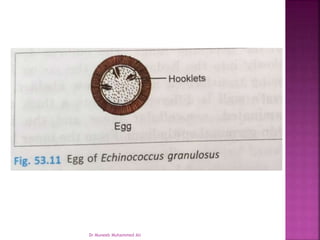
Egg :
ovoid in shape and resembles other taenia.
Measures 32-36 μm x 25-32 μm and contains
a hexacanth embryo with 3 pairs of hooks.
Dr Muneeb Muhammed Ali
• Found within the hydatid cyst developing inside
various organs of the intermediate host.
• Represents the structure of the scolex of adult
worm and remains invaginated within a
vesicular body.
• After entering the definitive host, the scolex
with suckers and rostellar hooklets, becomes
evaginated and develops into adult worm.
Dr Muneeb Muhammed Ali
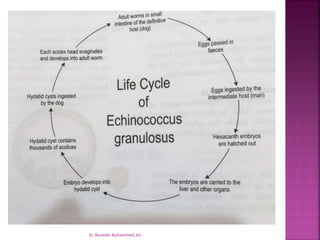
Host: E. granulosus life cycle passes
through two hosts:
1.Definitive host: Dogs and other canine
animals
2.Intermediate host: Sheep and other
herbivores. Man acts as an accidental
intermediate host (dead end).
Mode of transmission: Men (and other
intermediate hosts) acquire the infection by
ingestion of food contaminated with dog’s
feces containing E. granulosus eggs. Rarely
flies serve as a mechanical vector of the
eggs.
Dr Muneeb Muhammed Ali
Eggs transform to larva (hydatid cyst):
 In duodenum of man or sheep and cattle , the
oncosphere is released by the rupture of ova.
 Onchosphere hatches and penetrates into the
intestinal wall, enters the portal circulation and
carries to the liver (60–70% of cases) or lungs or
rarely to other organs.
Host immune response may destroy many
oncospheres, but few may escape destruction and
develop into hydatid cyst.
The oncospheres are encysted by the fibrous tissue
(produced by fibroblasts) and transform into fluid filled
bladder like cyst called as hydatid cysts
Dr Muneeb Muhammed Ali
This stage is infective to dog and
other definitive hosts
Man is a dead end (as dogs don’t feed
on human viscera)
Development in Dog
Dog and other canine animals acquire infection
by consumption of the contaminated viscera of
intermediate hosts (sheep and cattles)
containing mature hydatid cysts.
The hydatid cyst (larva) transforms into
adult worm in dog’s intestine.
The adult worm becomes sexually mature, self
Dr Muneeb Muhammed Ali
Pathogenicity is related to the deposition of the
hydatid cysts (larval form of the parasite) in
various organs.
Hydatid cyst : Fully developed hydatid cyst of E.
granu losus is unilocular, subspherical in shape
and size varies from few milimeters to more than
30 cm (usual size 5–8 cm).
It appears as fluid filled bladder like cyst.
Dr Muneeb Muhammed Ali
Cyst wall consists of three layers:
a. Pericyst (outer layer, host derived): Consists of
fibrous tissue and blood vessels produced by the
host cellular reaction
b. Ectocyst (middle layer, parasite derived): It is a
tough elastic, glycan rich acellular hyaline layer of
variable thickness (1 mm). It resembles the white of a
hardboiled egg
c. Endocyst ( inner layer, parasite derived): Germinal
layer, 22–25 μm thickness. It consists of number of
nuclei embedded in protoplasmic mass. Its function is
Dr Muneeb Muhammed Ali
It is clear, colorless to pale yellow
It has a pH of 6.7 and specific gravity of 1.005 to
1.010
Chemical composition : sodium chloride, sodium
sulfate, sodium phosphate and succinates
It is antigenic, toxic and anaphylactic
Brood capsules : arise from the inner side of the
endocyst and contains number of protoscolices
(future head)
Hydatid sand: Some of the brood capsules and
protoscolices break off and gets deposited at the
bottom as granular deposit to form
Dr Muneeb Muhammed Ali
Acephalocyst: Cysts without
brood capsules and
protoscolices
Endogenous daughter cysts: Formed
by the breakage of the brood capsule
into the hydatid fluid; surrounded by
ectocyst and endocyst
Dr Muneeb Muhammed Ali
Infection usually occurs in childhood but gets
manifested in adult life.
Site: Most common site of location of the cyst is
liver (60–70%, right lobe) or lung (20–30%) but
may be found in any organs like spleen and
kidney (3–5%), brain and heart (1–1.5%) and
rarely bones
They grow upto 5–10 cm in size within the
first year and can survive for years or even
decades
Asymptomatic: Many cases are asymptomatic
and infection is detected only incidentally by
imaging studies
Dr Muneeb Muhammed Ali
Symptoms occur due to:
a. Pressure effect of the enlarging cyst: Leads to
palpable abdominal mass, hepatomegaly,
abdominal tenderness, portal hypertension and
ascites
b. Obstruction: Daughter cyst may erode into the
biliary tree or a bronchus and enter into the
lumen to cause cholestasis and dyspnea
c. Secondary bacterial infection can cause
pyogenic abscess formation in the hydatid
cysts
d. Anaphylactic reactions: Cyst leakage or rupture
may be associated with a severe allergic reaction
to hydatid fluid antigens; leading to hypotension,
syncope and fever
a. Younger children are more associated with
extrahepatic cysts in lungs, brain and orbital sitesDr Muneeb Muhammed Ali
Dr Muneeb Muhammed Ali
It is an immediate hypersensitivity reaction to
hydatid fluid antigens. Developed by Casoni in
1911
Antigen used: Sterile hydatid fluid
Procedure: 0.2 mL of the antigen is injected in one arm;
sterile saline is injected to the other arm as control
Interpretation: Sensitive patients develop large wheal
measuring 5 cm or more with formation of pseudopodia
within 30 minutes with no reaction in the control arm
Disadvantage:
It has low sensitivity (60-80%) and gives false positive
results in cross reactive cestode infections
It is obsolete now days and replaced largely by the
serological tests.
Dr Muneeb Muhammed Ali
Screening tests: Various antibody detection methods
are evaluated using crude E. granulosus cyst fluid
antigen. They show variable results (60–90%
sensitivity) .These tests are:
a. Indirect hemagglutination (IHA)
b. Latex agglutination test (LAT)
c. Indirect fluorescent antibody tests (IFA)
d. ELISA
Confirmatory tests:
a. Immunodiffusion and electro immunodiffusion
b.Western blot:
Dr Muneeb Muhammed Ali
ELISA , CIEP and LAT are available to detect specific
antigens in serum and urine.
Imaging methods : Imaging methods play an
important role as they are noninvasive methods,
which can detect the cysts incidentally in
asymptomatic individuals and in seronegative cases.
a.Xrays: to detect hepatomegaly
b.Ultrasound (USG): detects both single and
multiple cystic lesions
c. Computed tomography (CT scan): It can
detect 90–100% of cases. It detects more accurately
the number,
Dr Muneeb Muhammed Ali
Aspirated hydatid fluid is examined for brood
capsules by direct microscopy or staining with
acid fast stain.
Purulent material can be examined after treating
with hydrochloric acid
Histological examination : Surgically removed
cysts can be subjected to histopathological stains
like Giemsa, hematoxylin and eosin (H & E) and
Periodic acid Schiff (PAS) stain to demonstrate the
three layers
Dr Muneeb Muhammed Ali
Molecular Methods : PCR
Other tests
Eosinophilia is present in 20–25% cases
Hypergammaglobulinemia.
Dr Muneeb Muhammed Ali
Surgical Removal of Hydatid Cyst : 90%
effective but can be risky depending on
location, size, and advancement of cyst
It may need chemotherapy to prevent recurrance
Chemotherapy: Albendazole is preferred
treatment because it penetrates into hyatid
cysts. Dosage: 10mg/kg body
weight or 400mg 2x daily for 4 weeks
Mebendazole Dosage: 40mg/kg body weight
3x daily for 3-6 months
Dogs are effectively treated with Praziquental
Dr Muneeb Muhammed Ali
In order to prevent transmission to dogs from
intermediate hosts, dogs can be given
anthelminthic vaccinations
Clean slaughter and high surveillance of potential
intermediate host during slaughter
Proper disposal of carcass and offal after slaughter
to prevent dogs access to offal from livestock
Boiling livers and lungs which contain hydatid cysts
for 30 minutes has been proposed as a simple,
efficient and saving way to kill
Dr Muneeb Muhammed Ali

Echinococcus granulosus

  • 1.
    Dr Muneeb MuhammedAli Dr Muneeb Muhammed Ali Tutor Nethaji College Email:muneebmu7@gmail.com
  • 2.
     Echinococcus causeshydatid disease.  There are four species of Echinococcus known to infect humans. 1. E. granulosus: Causes cystic hydatid disease 2. E. multilocularis: Causes alveolar hydatid disease 3. E. vogeli and E. oligarthrus : Cause polycystic hydatid disease. Dr Muneeb Muhammed Ali
  • 3.
    Echinococcus granulosus, alsocalled dog tape worm or hydatid worm E. granulosus causes cystic echinococcosis or hydatid disease in livestock and humans beings which acts as intermediate hosts and parasitize the small intestines of adult canids i.e. definitive hosts. It is a zoonotic disease. Dr Muneeb Muhammed Ali
  • 4.
    • The diseaseis prevalent in most parts of the world, though it is most extensive in the sheep and cattle raising areas of Australia, Africa, and SouthAmerica. • It is also common in Europe, China, the Middle East and India. • It is seen more often in temperate than in tropical regions. Dr Muneeb Muhammed Ali
  • 5.
    • The adultworm lives in the jejunum and duodenum of dogs and other canine carnivora (wolf and fox). • The larval stage (hydatid cyst) is found in liver and other visceral organs of humans and herbivorous animals (sheep, goat, cattle and horse) Dr Muneeb Muhammed Ali
  • 6.
    Adult worm : Theadult tapeworm ranges in length from 3 mm to 6 mm. It comprises of a scolex (head) , neck and strobilla or proglottids consisting of 3 or 4 segments. The 1st segment is immature , 2nd is mature and the last one or two is gravid. The terminal segment is by far the biggest (2-3mm x 0.6mm) The scolex bears four suckers and also has a rostellum with two rows of hooks. The neck is short and thick. Dr Muneeb Muhammed Ali
  • 7.
    Echinococcus is triploblastic,anus is absent and it has no digestive system. Its body is covered by tegument and the worm is divided into a scolex, a short neck, and three to six proglottids. The adult worm lives for 6–30 months Egg : ovoid in shape and resembles other taenia. Measures 32-36 μm x 25-32 μm and contains a hexacanth embryo with 3 pairs of hooks. Dr Muneeb Muhammed Ali
  • 8.
  • 9.
  • 10.
    • Found withinthe hydatid cyst developing inside various organs of the intermediate host. • Represents the structure of the scolex of adult worm and remains invaginated within a vesicular body. • After entering the definitive host, the scolex with suckers and rostellar hooklets, becomes evaginated and develops into adult worm. Dr Muneeb Muhammed Ali
  • 11.
    Host: E. granulosuslife cycle passes through two hosts: 1.Definitive host: Dogs and other canine animals 2.Intermediate host: Sheep and other herbivores. Man acts as an accidental intermediate host (dead end). Mode of transmission: Men (and other intermediate hosts) acquire the infection by ingestion of food contaminated with dog’s feces containing E. granulosus eggs. Rarely flies serve as a mechanical vector of the eggs. Dr Muneeb Muhammed Ali
  • 12.
  • 13.
    Eggs transform tolarva (hydatid cyst):  In duodenum of man or sheep and cattle , the oncosphere is released by the rupture of ova.  Onchosphere hatches and penetrates into the intestinal wall, enters the portal circulation and carries to the liver (60–70% of cases) or lungs or rarely to other organs. Host immune response may destroy many oncospheres, but few may escape destruction and develop into hydatid cyst. The oncospheres are encysted by the fibrous tissue (produced by fibroblasts) and transform into fluid filled bladder like cyst called as hydatid cysts Dr Muneeb Muhammed Ali
  • 14.
    This stage isinfective to dog and other definitive hosts Man is a dead end (as dogs don’t feed on human viscera) Development in Dog Dog and other canine animals acquire infection by consumption of the contaminated viscera of intermediate hosts (sheep and cattles) containing mature hydatid cysts. The hydatid cyst (larva) transforms into adult worm in dog’s intestine. The adult worm becomes sexually mature, self Dr Muneeb Muhammed Ali
  • 15.
    Pathogenicity is relatedto the deposition of the hydatid cysts (larval form of the parasite) in various organs. Hydatid cyst : Fully developed hydatid cyst of E. granu losus is unilocular, subspherical in shape and size varies from few milimeters to more than 30 cm (usual size 5–8 cm). It appears as fluid filled bladder like cyst. Dr Muneeb Muhammed Ali
  • 16.
    Cyst wall consistsof three layers: a. Pericyst (outer layer, host derived): Consists of fibrous tissue and blood vessels produced by the host cellular reaction b. Ectocyst (middle layer, parasite derived): It is a tough elastic, glycan rich acellular hyaline layer of variable thickness (1 mm). It resembles the white of a hardboiled egg c. Endocyst ( inner layer, parasite derived): Germinal layer, 22–25 μm thickness. It consists of number of nuclei embedded in protoplasmic mass. Its function is Dr Muneeb Muhammed Ali
  • 17.
  • 18.
    It is clear,colorless to pale yellow It has a pH of 6.7 and specific gravity of 1.005 to 1.010 Chemical composition : sodium chloride, sodium sulfate, sodium phosphate and succinates It is antigenic, toxic and anaphylactic Brood capsules : arise from the inner side of the endocyst and contains number of protoscolices (future head) Hydatid sand: Some of the brood capsules and protoscolices break off and gets deposited at the bottom as granular deposit to form Dr Muneeb Muhammed Ali
  • 19.
    Acephalocyst: Cysts without broodcapsules and protoscolices Endogenous daughter cysts: Formed by the breakage of the brood capsule into the hydatid fluid; surrounded by ectocyst and endocyst Dr Muneeb Muhammed Ali
  • 20.
    Infection usually occursin childhood but gets manifested in adult life. Site: Most common site of location of the cyst is liver (60–70%, right lobe) or lung (20–30%) but may be found in any organs like spleen and kidney (3–5%), brain and heart (1–1.5%) and rarely bones They grow upto 5–10 cm in size within the first year and can survive for years or even decades Asymptomatic: Many cases are asymptomatic and infection is detected only incidentally by imaging studies Dr Muneeb Muhammed Ali
  • 21.
    Symptoms occur dueto: a. Pressure effect of the enlarging cyst: Leads to palpable abdominal mass, hepatomegaly, abdominal tenderness, portal hypertension and ascites b. Obstruction: Daughter cyst may erode into the biliary tree or a bronchus and enter into the lumen to cause cholestasis and dyspnea c. Secondary bacterial infection can cause pyogenic abscess formation in the hydatid cysts d. Anaphylactic reactions: Cyst leakage or rupture may be associated with a severe allergic reaction to hydatid fluid antigens; leading to hypotension, syncope and fever a. Younger children are more associated with extrahepatic cysts in lungs, brain and orbital sitesDr Muneeb Muhammed Ali
  • 22.
  • 23.
  • 24.
    It is animmediate hypersensitivity reaction to hydatid fluid antigens. Developed by Casoni in 1911 Antigen used: Sterile hydatid fluid Procedure: 0.2 mL of the antigen is injected in one arm; sterile saline is injected to the other arm as control Interpretation: Sensitive patients develop large wheal measuring 5 cm or more with formation of pseudopodia within 30 minutes with no reaction in the control arm Disadvantage: It has low sensitivity (60-80%) and gives false positive results in cross reactive cestode infections It is obsolete now days and replaced largely by the serological tests. Dr Muneeb Muhammed Ali
  • 25.
    Screening tests: Variousantibody detection methods are evaluated using crude E. granulosus cyst fluid antigen. They show variable results (60–90% sensitivity) .These tests are: a. Indirect hemagglutination (IHA) b. Latex agglutination test (LAT) c. Indirect fluorescent antibody tests (IFA) d. ELISA Confirmatory tests: a. Immunodiffusion and electro immunodiffusion b.Western blot: Dr Muneeb Muhammed Ali
  • 26.
    ELISA , CIEPand LAT are available to detect specific antigens in serum and urine. Imaging methods : Imaging methods play an important role as they are noninvasive methods, which can detect the cysts incidentally in asymptomatic individuals and in seronegative cases. a.Xrays: to detect hepatomegaly b.Ultrasound (USG): detects both single and multiple cystic lesions c. Computed tomography (CT scan): It can detect 90–100% of cases. It detects more accurately the number, Dr Muneeb Muhammed Ali
  • 27.
    Aspirated hydatid fluidis examined for brood capsules by direct microscopy or staining with acid fast stain. Purulent material can be examined after treating with hydrochloric acid Histological examination : Surgically removed cysts can be subjected to histopathological stains like Giemsa, hematoxylin and eosin (H & E) and Periodic acid Schiff (PAS) stain to demonstrate the three layers Dr Muneeb Muhammed Ali
  • 28.
    Molecular Methods :PCR Other tests Eosinophilia is present in 20–25% cases Hypergammaglobulinemia. Dr Muneeb Muhammed Ali
  • 29.
    Surgical Removal ofHydatid Cyst : 90% effective but can be risky depending on location, size, and advancement of cyst It may need chemotherapy to prevent recurrance Chemotherapy: Albendazole is preferred treatment because it penetrates into hyatid cysts. Dosage: 10mg/kg body weight or 400mg 2x daily for 4 weeks Mebendazole Dosage: 40mg/kg body weight 3x daily for 3-6 months Dogs are effectively treated with Praziquental Dr Muneeb Muhammed Ali
  • 30.
    In order toprevent transmission to dogs from intermediate hosts, dogs can be given anthelminthic vaccinations Clean slaughter and high surveillance of potential intermediate host during slaughter Proper disposal of carcass and offal after slaughter to prevent dogs access to offal from livestock Boiling livers and lungs which contain hydatid cysts for 30 minutes has been proposed as a simple, efficient and saving way to kill Dr Muneeb Muhammed Ali
  • 31.