GESTATIONAL
TROPHOBLASTIC DISEASE
02/24/25 med-trainings.com 1
02/24/25 med-trainings.com 2
GESTATIONAL TROPHOBLASTIC
DISEASES
• GTD encompasses a spectrum of proliferative
abnormalities of trophoblasts associated with
pregnancy
02/24/25 med-trainings.com 3
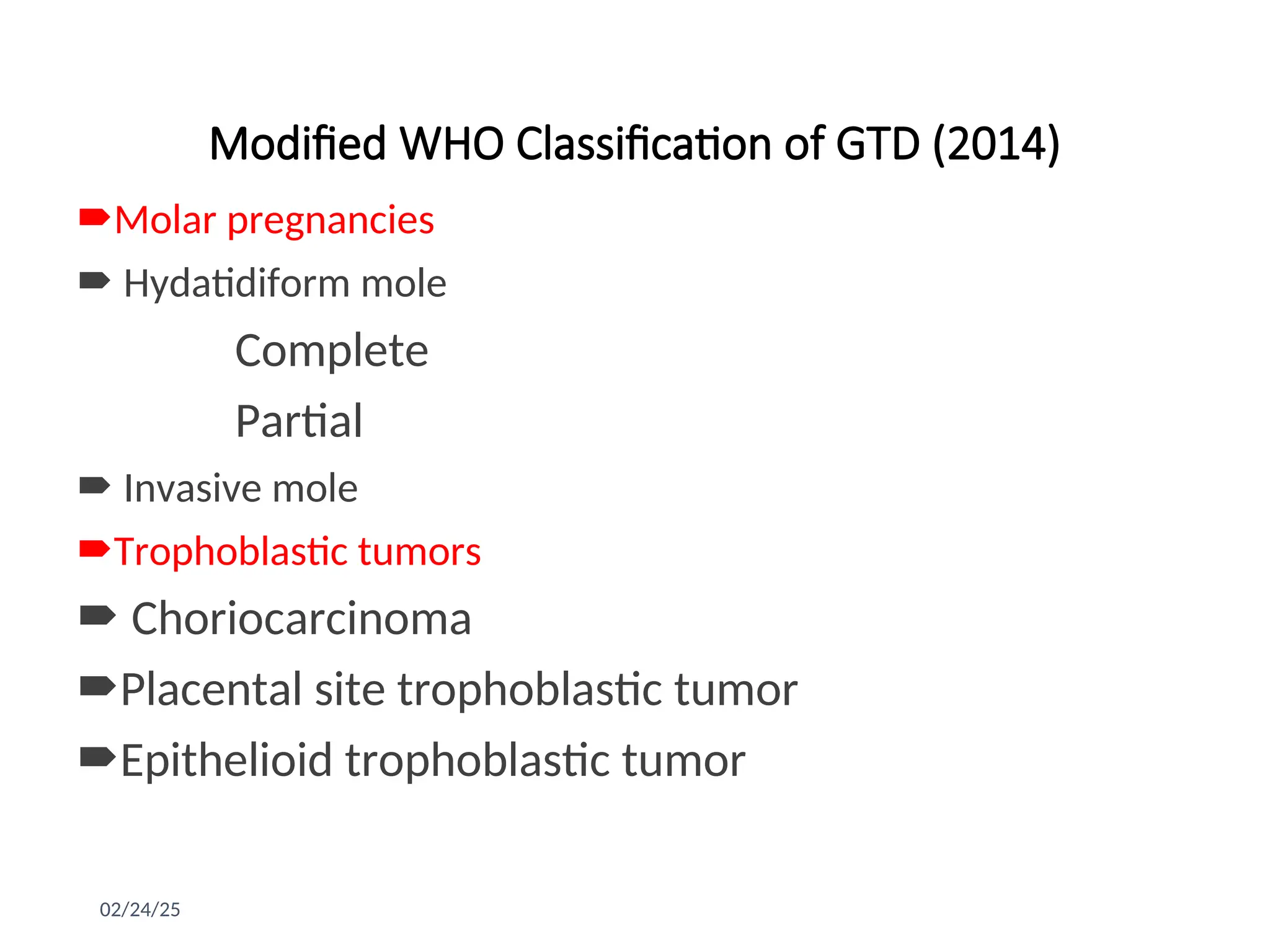
Modified WHO Classification of GTD (2014)
Molar pregnancies
 Hydatidiform mole
Complete
Partial
 Invasive mole
Trophoblastic tumors
 Choriocarcinoma
Placental site trophoblastic tumor
Epithelioid trophoblastic tumor
02/24/25 4
PREVALANCE
• Molar pregnancy is the most common form of GTD
• Relatively rare condition, with an estimated worldwide
incidence of around 1–3 cases for every 1000 live births.
• Incidence vary significantly across different
geographical regions and racial groups,
• 1–3 cases per 1000 are reported in nearly every
worldwide series.
• Higher at the extremes of reproductive age, at
approximately 1 in 30 (under 15) and as high as 1 in 5 in
late 40s or early 50s
5
• Gestational trophoblastic neoplasia (GTN)
Refers to the subset of GTD that develops malignant
sequel.
• Tumors require normal staging and typically
respond favorably to chemotherapy.
• Most commonly, GTN develops after a molar
pregnancy but may follow any gestation
02/24/25 6
02/24/25 med-trainings.com 7
02/24/25 med-trainings.com 8
Pathology
02/24/25 med-trainings.com 9
• The uterus is distended by thin walled,
translucent, grape-like vesicles of different
sizes. These are degenerated chorionic villi
filled with fluid.
• There is no vasculature in the chorionic villi
leads to early death and absorption of the
embryo.
The uterus is distended by thin
walled, translucent, grape-like
vesicles of different sizes.
•These are degenerated
chorionic villi filled with fluid.
•There is no vasculature in the
chorionic villi leads to early
death of the embryo.
02/24/25 med-trainings.com 10
Hydatidiform
• Vesicular mole
• Benign neoplasia of the chorion with malignant
potential
• Abnormal condition of the placenta where there
are partly degenerative and partly proliferative
changes in the young chorionic villi
• Hydropic swelling of all villi –formation
• Formation of clusters of small cyts
02/24/25 med-trainings.com 11
Epidemiology
02/24/25 12
• It is a benign neoplasm of the chorionic villi.
Incidence:
• Philippines:1 in 80
• Europe:1 in 752
• USA : 1:2000 pregnancies in United States
• In India 1 in 400
ETIOLOGY
• Unknown
• Teenage pregnancy
• Age >35yrs
• Race & ethnic
• Faculty nutrition-Low protein,animal fat,carotene
• History of previous HM
• Cytogenetic abnormality
• Disturbed maternal immune mechanism-Rise in
gammaglobulin ,Blood group
02/24/25 med-trainings.com 13
02/24/25 med-trainings.com 14
Pathology
High hCG causes multiple theca lutein cysts in the
ovaries in about 50% of cases.
Cysts may reach a large size 10 cm or more.
02/24/25 med-trainings.com 15
• Cysts disappear
within few months(2-3),
after evacuation of the mole.
Complete Mole
02/24/25 med-trainings.com 16
Complete mole
02/24/25 med-trainings.com 17
Partial mole
02/24/25 med-trainings.com 18
A part of trophoblastic tissue only shows molar changes.
There is a foetus or at least an amniotic sac.
It is the result of fertilization of an ovum by 2 sperms so
the chromosomal numberis 69 chromosomes
Partial mole
02/24/25 med-trainings.com 19
Partial mole
02/24/25 med-trainings.com 20
DIFFERENTIATION BETWEEN
COMPLETE AND PARTIAL MOLE
Feature Complete Mole Partial Mole
Karyotype 46 XX (96%) or 46
XY (4%)
69 XXY or 69 XYY
Pathology
Embryonic or foetal
tissue
Absent Present
Swelling of the villi Diffuse Focal
Trophoblastic
hyperplasia
Diffuse Focal
p57Kip2 immunostaining Negative Positive
Karyotype 46 XX (96%) or 46
XY (4%)
69 XXY or 69 XYY
02/24/25 med-trainings.com 21
DIFFERENTIATION BETWEEN
COMPLETE AND PARTIAL MOLE
Feature Complete
Mole
Partial Mole
Clinical
presentation
Typical diagnosis
Molar
pregnancy
Missed abortion
Postmolar
malignant sequelae 15% 4-6%
Malignant Changes 5-10% Rare
02/24/25 med-trainings.com 22
Partial moles are optimally diagnosed when three or More
major diagnostic criteria are demonstrated:
(1) two populations o villi,
(2) enlarged, irregular, dysmorphic villi (with trophoblast
inclusions),
(3) enlarged, cavitated villi (≥ 3 to 4 mm), and
(4) syncytiotrophoblast hyperplasia/atypia
02/24/25 med-trainings.com 23
DIAGNOSIS
02/24/25 med-trainings.com 24
Symptoms
•Amenorrhoea: usually of short period (2-3 months).
•Exaggerated symptoms of pregnancy especially
vomiting.
•Vaginal discharge
•Abdominal pain:
Discharge
Due to separation of vesicles from uterine wall
 There may be a blood stained watery discharge, the
watery part is from ruptured vesicles.
White currant in red currant juice
•Prune juice disharge may occur.
The blood is brown because it has retained for
sometime in the uterine cavity.
•passage of vesicles is diagnostic.
• The blood may be concealed causing enlargement &
tenderness of uterus.
02/24/25 med-trainings.com 25
Abdominal pain :
- dull-aching due to rapid distension of the uterus by the mole
or by concealed haemorrhage.
-Colicky due to starting expulsion,
-Sudden And Severe due to perforating mole
-Ovarian pain due to stretching of the ovarian capsule or
complication in the cystic ovary as torsion
02/24/25 med-trainings.com 26
SIGNS
Pre-eclampsia in 20-30% of cases, usually before 20 weeks’ gestation.
Pallor indicating anemia may be present.
Hyperthyroidism in 3-10% of cases manifested by enlarged thyroid gland,
tachycardia (due to chorionic thyrotropin secreted by trophoplast &HCG
also has a thyroid stimulating effect.
Breast signs of pregnancy
Patient looks ill
02/24/25 med-trainings.com 27
ON Abdominal examination:
• Size : Uterus is larger than the period of
amenorrhoea in 50% of cases, corresponds to
it in 25% and smaller in 25% with inactive or
dead mole.
• Consistency: The uterus is firm elastic due to
absence of AF
• Foetal parts: FP,heart sound cannot be
detected except in partial mole.
02/24/25 med-trainings.com 28
PER VAGINAL EXAMINATION
> Passage of vesicles (sure sign).
>Bilateral palpable ovarian cysts (5-20 cm) in
50%of cases.
Internal ballottement cannot be elicited
If os open, blood clot or vesicles present
02/24/25 med-trainings.com 29
Investigations
02/24/25 med-trainings.com 30
• Urine pregnancy test:
• Serum β-hCG level: is highly elevated (>100000 mIU/ml).
• Ultrasonography reveals:
o The characteristic intrauterine "snow storm" appearance,
o no identifiable foetus,
o bilateral ovarian cysts may be detected.
• X-ray: shows no foetal skeleton.
• CBC,ABO,Grouping
• LFT,KFT Elect
• Usg pelvis,kidney ,spleen
• Chest Xray
• CT ,MRI not routine
• Definitive : histopathological examination
02/24/25 med-trainings.com 31
02/24/25 med-trainings.com 32
Complications
02/24/25 med-trainings.com 33
• Haemorrhage & Shock-massive intraperitoneal H.
• Infection due to absence of the amniotic sac.
• Perforation of the uterus.
• Pregnancy induced hypertension/preeclampsia
• Hyperthyroidism.
• Subsequent development of choriocarcinoma(late)
• Sepsis
• Acute pulmonary insufficiency –pul embolization of
trophoblastic cells
• Coagulation failure
MANAGEMENT
Principles:
•Suction & evacuation
•Supportive therapy-anemia & infection
•Counselling
02/24/25 med-trainings.com 34
Treatment
02/24/25 med-trainings.com 35
• As soon as the diagnosis of vesicular mole is
established the uterus should be evacuated.
• Selected method depends on the size of the
uterus, whether partial expulsion has
already occur or not, the patient's age and
fertility desire.
• Cross- matched blood should be available
before starting.
Suction evacuation
• Group A: Cervix favorable
• Group B : Cervix tubular & closed
• suction cannula
• Negative pressure of 200-250 mmHg
• Inj Methargine
• Antibiotics
• Rh D-negative women.
02/24/25 med-trainings.com 36
Hysterotomy
02/24/25 med-trainings.com 37
• It may be needed for evacuation of a large
mole to minimize and facilitate control of
bleeding.
Hysterectomy:
• women over 40 years
• Uncontrolled hemorrhage
• completed family
• Reduce developing choriocarcinoma.
Follow
Follow up
up
02/24/25 med-trainings.com 38
• HCG level regress to normal within 3 months
• As choriocarcinoma may complicate the
vesicular mole after its evacuation,
detection of serum ß-hCG by
radioimmunoassay for 1 years is essential.
• About 3-5% of H.Mole develop
choriocarcinoma & 15-20% become locally
invasive.
Follow
Follow up-HCG
up-HCG
02/24/25 med-trainings.com 39
• hCG levels
hCG levels: obtained within 48 hrs of
evacuation
• Weekly until not detectable for three
consecutive weeks.
Once Neg-
• Monthly till 6-12 months( partial or comp)
• Risk of GTN is <1% after an undectable hCG is
attained.
Follow
Follow up
up
02/24/25 med-trainings.com 40
Pelvic Ultrasound:
•Performed with hCG values to monitor
involution of pelvic structures and identify
persistent disease.
Follow
Follow up
up
02/24/25 med-trainings.com 41
Reliable contraception:
•Hormonal or Barrier recommended.
•IUCD has risk of perforation.
•Pregnancy should be avoided until 1 yr
because it will obscure value of monitoring hCG
levels.
•If hCG remains undectable for 6-12 months
woman desirous of pregnancy may discontinue
contraception
• Persistent high level indicates remnants of
molar tissues which necessitate
chemotherapy (methotrexate) with or
without curettage.
• Hysterectomy is indicated if women had
enough children.
PROPHYLACTIC CHEMOTHERAPY
02/24/25 med-trainings.com 42
Persistent GTD
After evacuation of complete or partial mole hCG levels
show a plateau or rise over several weeks(days 1,7,14,21)
more than 4 values in 3 weeks
Rise in serum hCG >10% during these weeks
Serum hCG remains detectable for 6 months or more
Histological of chorioarcinoma or invasive mole
Identification of clinical or radiological metastasis.
02/24/25 med-trainings.com 43
02/24/25 med-trainings.com 44
02/24/25 med-trainings.com 45
02/24/25 med-trainings.com 46
02/24/25 med-trainings.com 47
02/24/25 med-trainings.com 48
02/24/25 med-trainings.com 49
02/24/25 med-trainings.com 50
02/24/25 med-trainings.com 51

MOLAR pregnancy presentation in nursing

  • 1.
  • 2.
  • 3.
    GESTATIONAL TROPHOBLASTIC DISEASES • GTDencompasses a spectrum of proliferative abnormalities of trophoblasts associated with pregnancy 02/24/25 med-trainings.com 3
  • 4.
    Modified WHO Classificationof GTD (2014) Molar pregnancies  Hydatidiform mole Complete Partial  Invasive mole Trophoblastic tumors  Choriocarcinoma Placental site trophoblastic tumor Epithelioid trophoblastic tumor 02/24/25 4
  • 5.
    PREVALANCE • Molar pregnancyis the most common form of GTD • Relatively rare condition, with an estimated worldwide incidence of around 1–3 cases for every 1000 live births. • Incidence vary significantly across different geographical regions and racial groups, • 1–3 cases per 1000 are reported in nearly every worldwide series. • Higher at the extremes of reproductive age, at approximately 1 in 30 (under 15) and as high as 1 in 5 in late 40s or early 50s 5
  • 6.
    • Gestational trophoblasticneoplasia (GTN) Refers to the subset of GTD that develops malignant sequel. • Tumors require normal staging and typically respond favorably to chemotherapy. • Most commonly, GTN develops after a molar pregnancy but may follow any gestation 02/24/25 6
  • 7.
  • 8.
  • 9.
    Pathology 02/24/25 med-trainings.com 9 •The uterus is distended by thin walled, translucent, grape-like vesicles of different sizes. These are degenerated chorionic villi filled with fluid. • There is no vasculature in the chorionic villi leads to early death and absorption of the embryo.
  • 10.
    The uterus isdistended by thin walled, translucent, grape-like vesicles of different sizes. •These are degenerated chorionic villi filled with fluid. •There is no vasculature in the chorionic villi leads to early death of the embryo. 02/24/25 med-trainings.com 10
  • 11.
    Hydatidiform • Vesicular mole •Benign neoplasia of the chorion with malignant potential • Abnormal condition of the placenta where there are partly degenerative and partly proliferative changes in the young chorionic villi • Hydropic swelling of all villi –formation • Formation of clusters of small cyts 02/24/25 med-trainings.com 11
  • 12.
    Epidemiology 02/24/25 12 • Itis a benign neoplasm of the chorionic villi. Incidence: • Philippines:1 in 80 • Europe:1 in 752 • USA : 1:2000 pregnancies in United States • In India 1 in 400
  • 13.
    ETIOLOGY • Unknown • Teenagepregnancy • Age >35yrs • Race & ethnic • Faculty nutrition-Low protein,animal fat,carotene • History of previous HM • Cytogenetic abnormality • Disturbed maternal immune mechanism-Rise in gammaglobulin ,Blood group 02/24/25 med-trainings.com 13
  • 14.
  • 15.
    Pathology High hCG causesmultiple theca lutein cysts in the ovaries in about 50% of cases. Cysts may reach a large size 10 cm or more. 02/24/25 med-trainings.com 15 • Cysts disappear within few months(2-3), after evacuation of the mole.
  • 16.
  • 17.
  • 18.
    Partial mole 02/24/25 med-trainings.com18 A part of trophoblastic tissue only shows molar changes. There is a foetus or at least an amniotic sac. It is the result of fertilization of an ovum by 2 sperms so the chromosomal numberis 69 chromosomes
  • 19.
  • 20.
  • 21.
    DIFFERENTIATION BETWEEN COMPLETE ANDPARTIAL MOLE Feature Complete Mole Partial Mole Karyotype 46 XX (96%) or 46 XY (4%) 69 XXY or 69 XYY Pathology Embryonic or foetal tissue Absent Present Swelling of the villi Diffuse Focal Trophoblastic hyperplasia Diffuse Focal p57Kip2 immunostaining Negative Positive Karyotype 46 XX (96%) or 46 XY (4%) 69 XXY or 69 XYY 02/24/25 med-trainings.com 21
  • 22.
    DIFFERENTIATION BETWEEN COMPLETE ANDPARTIAL MOLE Feature Complete Mole Partial Mole Clinical presentation Typical diagnosis Molar pregnancy Missed abortion Postmolar malignant sequelae 15% 4-6% Malignant Changes 5-10% Rare 02/24/25 med-trainings.com 22
  • 23.
    Partial moles areoptimally diagnosed when three or More major diagnostic criteria are demonstrated: (1) two populations o villi, (2) enlarged, irregular, dysmorphic villi (with trophoblast inclusions), (3) enlarged, cavitated villi (≥ 3 to 4 mm), and (4) syncytiotrophoblast hyperplasia/atypia 02/24/25 med-trainings.com 23
  • 24.
    DIAGNOSIS 02/24/25 med-trainings.com 24 Symptoms •Amenorrhoea:usually of short period (2-3 months). •Exaggerated symptoms of pregnancy especially vomiting. •Vaginal discharge •Abdominal pain:
  • 25.
    Discharge Due to separationof vesicles from uterine wall  There may be a blood stained watery discharge, the watery part is from ruptured vesicles. White currant in red currant juice •Prune juice disharge may occur. The blood is brown because it has retained for sometime in the uterine cavity. •passage of vesicles is diagnostic. • The blood may be concealed causing enlargement & tenderness of uterus. 02/24/25 med-trainings.com 25
  • 26.
    Abdominal pain : -dull-aching due to rapid distension of the uterus by the mole or by concealed haemorrhage. -Colicky due to starting expulsion, -Sudden And Severe due to perforating mole -Ovarian pain due to stretching of the ovarian capsule or complication in the cystic ovary as torsion 02/24/25 med-trainings.com 26
  • 27.
    SIGNS Pre-eclampsia in 20-30%of cases, usually before 20 weeks’ gestation. Pallor indicating anemia may be present. Hyperthyroidism in 3-10% of cases manifested by enlarged thyroid gland, tachycardia (due to chorionic thyrotropin secreted by trophoplast &HCG also has a thyroid stimulating effect. Breast signs of pregnancy Patient looks ill 02/24/25 med-trainings.com 27
  • 28.
    ON Abdominal examination: •Size : Uterus is larger than the period of amenorrhoea in 50% of cases, corresponds to it in 25% and smaller in 25% with inactive or dead mole. • Consistency: The uterus is firm elastic due to absence of AF • Foetal parts: FP,heart sound cannot be detected except in partial mole. 02/24/25 med-trainings.com 28
  • 29.
    PER VAGINAL EXAMINATION >Passage of vesicles (sure sign). >Bilateral palpable ovarian cysts (5-20 cm) in 50%of cases. Internal ballottement cannot be elicited If os open, blood clot or vesicles present 02/24/25 med-trainings.com 29
  • 30.
    Investigations 02/24/25 med-trainings.com 30 •Urine pregnancy test: • Serum β-hCG level: is highly elevated (>100000 mIU/ml). • Ultrasonography reveals: o The characteristic intrauterine "snow storm" appearance, o no identifiable foetus, o bilateral ovarian cysts may be detected. • X-ray: shows no foetal skeleton.
  • 31.
    • CBC,ABO,Grouping • LFT,KFTElect • Usg pelvis,kidney ,spleen • Chest Xray • CT ,MRI not routine • Definitive : histopathological examination 02/24/25 med-trainings.com 31
  • 32.
  • 33.
    Complications 02/24/25 med-trainings.com 33 •Haemorrhage & Shock-massive intraperitoneal H. • Infection due to absence of the amniotic sac. • Perforation of the uterus. • Pregnancy induced hypertension/preeclampsia • Hyperthyroidism. • Subsequent development of choriocarcinoma(late) • Sepsis • Acute pulmonary insufficiency –pul embolization of trophoblastic cells • Coagulation failure
  • 34.
    MANAGEMENT Principles: •Suction & evacuation •Supportivetherapy-anemia & infection •Counselling 02/24/25 med-trainings.com 34
  • 35.
    Treatment 02/24/25 med-trainings.com 35 •As soon as the diagnosis of vesicular mole is established the uterus should be evacuated. • Selected method depends on the size of the uterus, whether partial expulsion has already occur or not, the patient's age and fertility desire. • Cross- matched blood should be available before starting.
  • 36.
    Suction evacuation • GroupA: Cervix favorable • Group B : Cervix tubular & closed • suction cannula • Negative pressure of 200-250 mmHg • Inj Methargine • Antibiotics • Rh D-negative women. 02/24/25 med-trainings.com 36
  • 37.
    Hysterotomy 02/24/25 med-trainings.com 37 •It may be needed for evacuation of a large mole to minimize and facilitate control of bleeding. Hysterectomy: • women over 40 years • Uncontrolled hemorrhage • completed family • Reduce developing choriocarcinoma.
  • 38.
    Follow Follow up up 02/24/25 med-trainings.com38 • HCG level regress to normal within 3 months • As choriocarcinoma may complicate the vesicular mole after its evacuation, detection of serum ß-hCG by radioimmunoassay for 1 years is essential. • About 3-5% of H.Mole develop choriocarcinoma & 15-20% become locally invasive.
  • 39.
    Follow Follow up-HCG up-HCG 02/24/25 med-trainings.com39 • hCG levels hCG levels: obtained within 48 hrs of evacuation • Weekly until not detectable for three consecutive weeks. Once Neg- • Monthly till 6-12 months( partial or comp) • Risk of GTN is <1% after an undectable hCG is attained.
  • 40.
    Follow Follow up up 02/24/25 med-trainings.com40 Pelvic Ultrasound: •Performed with hCG values to monitor involution of pelvic structures and identify persistent disease.
  • 41.
    Follow Follow up up 02/24/25 med-trainings.com41 Reliable contraception: •Hormonal or Barrier recommended. •IUCD has risk of perforation. •Pregnancy should be avoided until 1 yr because it will obscure value of monitoring hCG levels. •If hCG remains undectable for 6-12 months woman desirous of pregnancy may discontinue contraception
  • 42.
    • Persistent highlevel indicates remnants of molar tissues which necessitate chemotherapy (methotrexate) with or without curettage. • Hysterectomy is indicated if women had enough children. PROPHYLACTIC CHEMOTHERAPY 02/24/25 med-trainings.com 42
  • 43.
    Persistent GTD After evacuationof complete or partial mole hCG levels show a plateau or rise over several weeks(days 1,7,14,21) more than 4 values in 3 weeks Rise in serum hCG >10% during these weeks Serum hCG remains detectable for 6 months or more Histological of chorioarcinoma or invasive mole Identification of clinical or radiological metastasis. 02/24/25 med-trainings.com 43
  • 44.
  • 45.
  • 46.
  • 47.
  • 48.
  • 49.
  • 50.
  • 51.

Editor's Notes

  • #11 Hyperplasia of trophobasitc cells
  • #13 AB blood groupNo ABO antibody
  • #14 There is trophoblastic proliferation, with mitotic activity affecting both syncytial and cytotrophoblastic layers. Distention of villi to small vesiclesNo blood supply hand, oestrogen production is low due to absence of the foetal supply of precursors. Vesicles are filled with interstitial fluid similar to ascetic rich in hcg
  • #16 Ovum nucleus either absent or inactivated get fertilized by haploid sperm-gets duplicated by own chromosomes after meosis -androgenesis
  • #25 Blood get mixed with gelatinous fluid from ruputured cysts
  • #27 Edema, proteinuriahtm
  • #30 Peak by 10-14 wks
  • #33 Separation of vesicles from attatchment of decidua,during evacuation-atony orinjury