Topics:
a. Communication Breakdown
b. Strategies to Avoid It
Prepared by:
Roselyn E. Lazalita
Mantangale Senior High School
Learning Competencies
The learners:
 explain why there is a breakdown of
communication – EN11/12OC-Ia-5
 use various strategies in order to
avoid communication breakdown –
EN11/12OC-Ia-6
Day 1- 1 hour –discussion/short activity
Day 2- 1 hour Performance Task 2
Review- Oral Recitation
a. Name various model of
communication.
b. Differentiate Linear Model and
Aristotle Model
c. What are the 7 C’s of
Communication?
d. What are the feature of
communication? Distinguish
each.
Communication Breakdown
Stereotypes
A natural result of communication is the
development of stereotypes, which are attitudes
or judgments we make about people based
not on personal experience but rather on what
we have learned about them through
communication.
American journalist Walter Lippman (1884-
1974) called them “pictures in our heads.”
Through stereotypes, we categorize people,
presume to understand their characteristics,
and thus make sense of a complex world.
Thus they can enhance communication and
relationships.
Communication Breakdown
Stereotypes, which can be
positive or negative, usually are
associated with our attitudes about
people and ideas, both our own and
others’.
The problem with stereotypes is that,
particularly when they negatively prejudge
others, they make it difficult to correctly
interpret information we see and hear.
Rather than accepting information at
face value and interpreting the other in a
favorable or neutral light, negative
stereotypes lead us to presume the worst
in others.
This is an example of
communication breakdown, a
phenomenon in which the normal
process of communication is thwarted
because inappropriate and erroneous
interpretations are given to incoming
information.
We use stereotypes every day to make
judgments about people. For example, in
personal, family and social contexts,
stereotypes play a role in parents’
decisions about their children’s
playmates.
Stereotyping likewise plays a public
role, such as diplomatic relationships
between nations or the ethnic profiling
that law-enforcement agencies use to
identify who might be committing a crime.
Barriers to Effective Communication
Fred C. Lunenberg
1. Process Barriers
2. Physical Barriers
3. Semantic Barriers
4. Psychosocial Barriers
Lunenburg, Fred C, Communication
Schooling V1 N1 2010.pdf (p.4-6)
How to Communicate Effectively
1. Connect
2. Listen
3. Communicate
4. Speak
Strategies and Intercultural
Communication.pdf (p.4)
Communication strategies are
'techniques of coping with difficulties in
communicating in an imperfectly known
second language' (Stern, 1983: 411).
Encyclopedic Dictionary of Applied Linguistics (Keith
Johnson and Helen Johnson)
Sender's Responsibilities
• Several communication theorists (Cheney,
2011; Keyton, 2011; Tourish, 2010) have
gleaned ten commandments of good
communication, which are particularly
applicable to the sender. These
commandments, together with a basic
understanding of the communication process
itself, should provide a good foundation for
developing and maintaining an effective set of
interpersonal communication skills.
need to clarify their ideas before
communicating
need to examine the true purpose ofeach
communication
need to consider the total physical and
human setting
need to consult with others, when
appropriate, in planning
communications.
need to be mindful, while
communicating, of the overtones as
well as the basic content of the
message.
need to take the opportunity, when it
arises, to convey something
of help or value to the receiver.
need to follow up their communication
need to communicate for tomorrow
as well as today
need to be sure that their actions
support their communications
need to seek, not only to be
understood, but to
understand—be a
good listener.
Receiver's Responsibilities
Communication depends on the ability
not only to send but also to receive
messages. So the ability to listen
effectively greatly enhances the
communication process. But many of us
are not good listeners. Effective
listening skills can be developed,
however. Summarized following are ten
rules for good listening (Kneen, 2011)):
Stop talking.
Put the talker at ease.
Show a talker that you want to
listen
Remove distractions.
Empathize with talkers.
Hold your temper
Go easy on argument and criticism
Ask questions.
Let us Summarize
 Give a situation of stereotyping.
Explain why the situation is
stereotyping and what is your
strategies to avoid the communication
breakdown?
 What are the responsibilities of the
sender and receiver in communication
to address the problem of
communication breakdown?
Day 2- Performance Task 2
Each group are ask to portray
at least two practical situations
why communication fails and
reasons for it . Thereafter,
propose a strategies to avoid
communication breakdown
based on that situation.
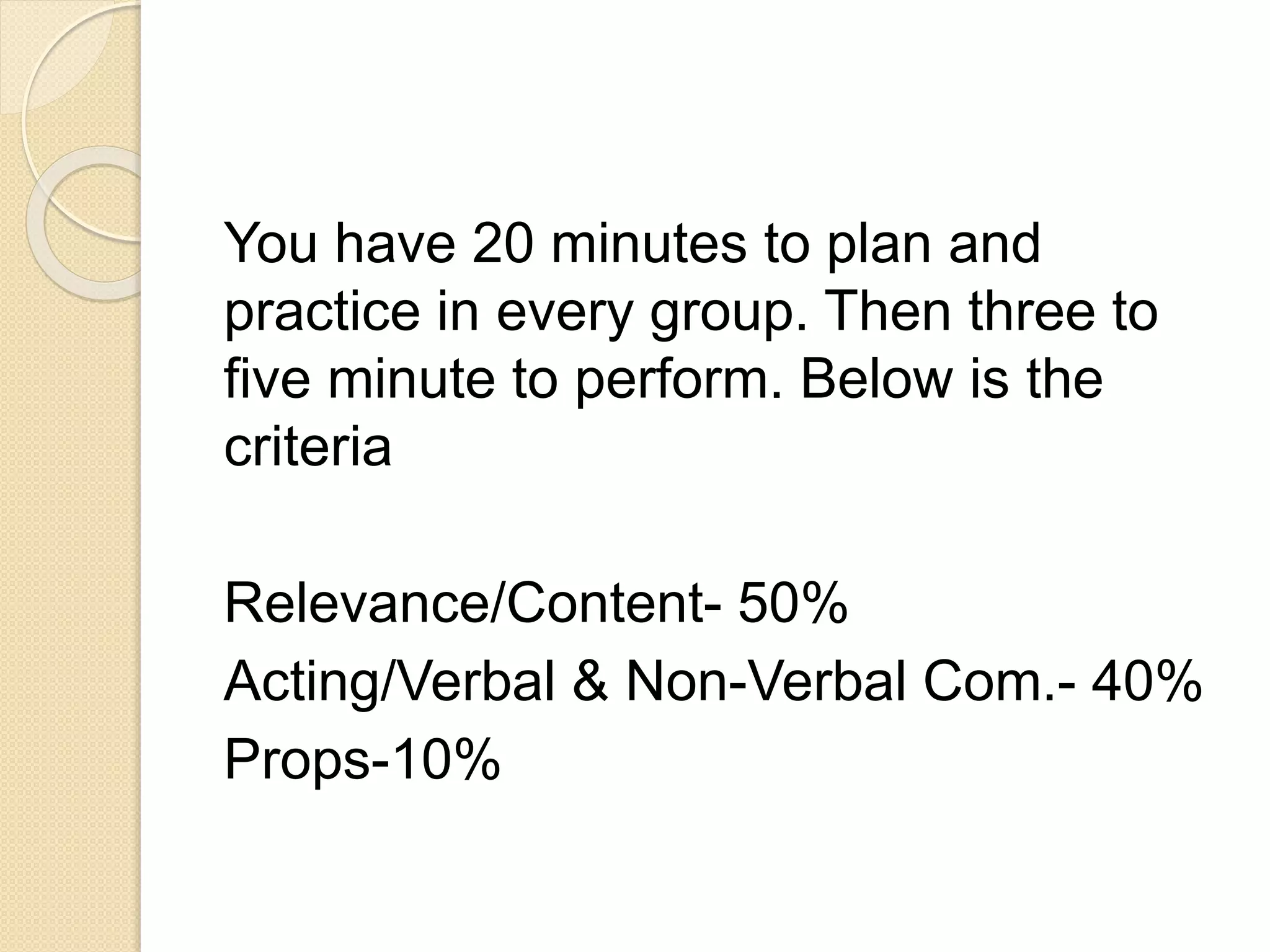
You have 20 minutes to plan and
practice in every group. Then three to
five minute to perform. Below is the
criteria
Relevance/Content- 50%
Acting/Verbal & Non-Verbal Com.- 40%
Props-10%
Thank you so
much for listening
and Participating
Planning and Practice Time
20 minutes
Performance Task Time
Giving Observation & Score
3. communication breakdown and strategies to avoid it

3. communication breakdown and strategies to avoid it

  • 1.
    Topics: a. Communication Breakdown b.Strategies to Avoid It Prepared by: Roselyn E. Lazalita Mantangale Senior High School
  • 2.
    Learning Competencies The learners: explain why there is a breakdown of communication – EN11/12OC-Ia-5  use various strategies in order to avoid communication breakdown – EN11/12OC-Ia-6 Day 1- 1 hour –discussion/short activity Day 2- 1 hour Performance Task 2
  • 3.
    Review- Oral Recitation a.Name various model of communication. b. Differentiate Linear Model and Aristotle Model c. What are the 7 C’s of Communication? d. What are the feature of communication? Distinguish each.
  • 4.
    Communication Breakdown Stereotypes A naturalresult of communication is the development of stereotypes, which are attitudes or judgments we make about people based not on personal experience but rather on what we have learned about them through communication. American journalist Walter Lippman (1884- 1974) called them “pictures in our heads.” Through stereotypes, we categorize people, presume to understand their characteristics, and thus make sense of a complex world. Thus they can enhance communication and relationships.
  • 5.
    Communication Breakdown Stereotypes, whichcan be positive or negative, usually are associated with our attitudes about people and ideas, both our own and others’.
  • 6.
    The problem withstereotypes is that, particularly when they negatively prejudge others, they make it difficult to correctly interpret information we see and hear. Rather than accepting information at face value and interpreting the other in a favorable or neutral light, negative stereotypes lead us to presume the worst in others.
  • 7.
    This is anexample of communication breakdown, a phenomenon in which the normal process of communication is thwarted because inappropriate and erroneous interpretations are given to incoming information.
  • 8.
    We use stereotypesevery day to make judgments about people. For example, in personal, family and social contexts, stereotypes play a role in parents’ decisions about their children’s playmates. Stereotyping likewise plays a public role, such as diplomatic relationships between nations or the ethnic profiling that law-enforcement agencies use to identify who might be committing a crime.
  • 9.
    Barriers to EffectiveCommunication Fred C. Lunenberg 1. Process Barriers 2. Physical Barriers 3. Semantic Barriers 4. Psychosocial Barriers Lunenburg, Fred C, Communication Schooling V1 N1 2010.pdf (p.4-6)
  • 10.
    How to CommunicateEffectively 1. Connect 2. Listen 3. Communicate 4. Speak Strategies and Intercultural Communication.pdf (p.4)
  • 11.
    Communication strategies are 'techniquesof coping with difficulties in communicating in an imperfectly known second language' (Stern, 1983: 411). Encyclopedic Dictionary of Applied Linguistics (Keith Johnson and Helen Johnson)
  • 12.
    Sender's Responsibilities • Severalcommunication theorists (Cheney, 2011; Keyton, 2011; Tourish, 2010) have gleaned ten commandments of good communication, which are particularly applicable to the sender. These commandments, together with a basic understanding of the communication process itself, should provide a good foundation for developing and maintaining an effective set of interpersonal communication skills.
  • 13.
    need to clarifytheir ideas before communicating need to examine the true purpose ofeach communication need to consider the total physical and human setting need to consult with others, when appropriate, in planning communications.
  • 14.
    need to bemindful, while communicating, of the overtones as well as the basic content of the message. need to take the opportunity, when it arises, to convey something of help or value to the receiver. need to follow up their communication
  • 15.
    need to communicatefor tomorrow as well as today need to be sure that their actions support their communications need to seek, not only to be understood, but to understand—be a good listener.
  • 16.
    Receiver's Responsibilities Communication dependson the ability not only to send but also to receive messages. So the ability to listen effectively greatly enhances the communication process. But many of us are not good listeners. Effective listening skills can be developed, however. Summarized following are ten rules for good listening (Kneen, 2011)):
  • 17.
    Stop talking. Put thetalker at ease. Show a talker that you want to listen Remove distractions.
  • 18.
    Empathize with talkers. Holdyour temper Go easy on argument and criticism Ask questions.
  • 19.
    Let us Summarize Give a situation of stereotyping. Explain why the situation is stereotyping and what is your strategies to avoid the communication breakdown?  What are the responsibilities of the sender and receiver in communication to address the problem of communication breakdown?
  • 20.
    Day 2- PerformanceTask 2 Each group are ask to portray at least two practical situations why communication fails and reasons for it . Thereafter, propose a strategies to avoid communication breakdown based on that situation.
  • 21.
    You have 20minutes to plan and practice in every group. Then three to five minute to perform. Below is the criteria Relevance/Content- 50% Acting/Verbal & Non-Verbal Com.- 40% Props-10%
  • 22.
    Thank you so muchfor listening and Participating
  • 23.
    Planning and PracticeTime 20 minutes
  • 24.
  • 25.