MODALITY
P R E P A R E D B Y
F A T I M A H A L Y A M I
L E C T U R E R I N A P P L I E D L I N G U I S T I C S
MODALITY
• In English, modality is expressed primarily by modal auxiliaries: may, might, must,
should, could, ought to, etc.
• modality can be thought of as an operator that combines with a basic proposition (p)
to form a new proposition (It is possible that p or It is necessarily the case that p).
THE RANGE OF MEANINGS EXPRESSIBLE BY GRAMMATICAL
MARKERS OF MODALITY VARIES ALONG TWO BASIC SEMANTIC
DIMENSIONS
• First, some markers are “stronger” than others
• Second, it turns out that the concepts of “possibility” and “necessity”, which are used
to define modality, each include a variety of sub-types.
EPISTEMIC VS. DEONTIC MODALITY
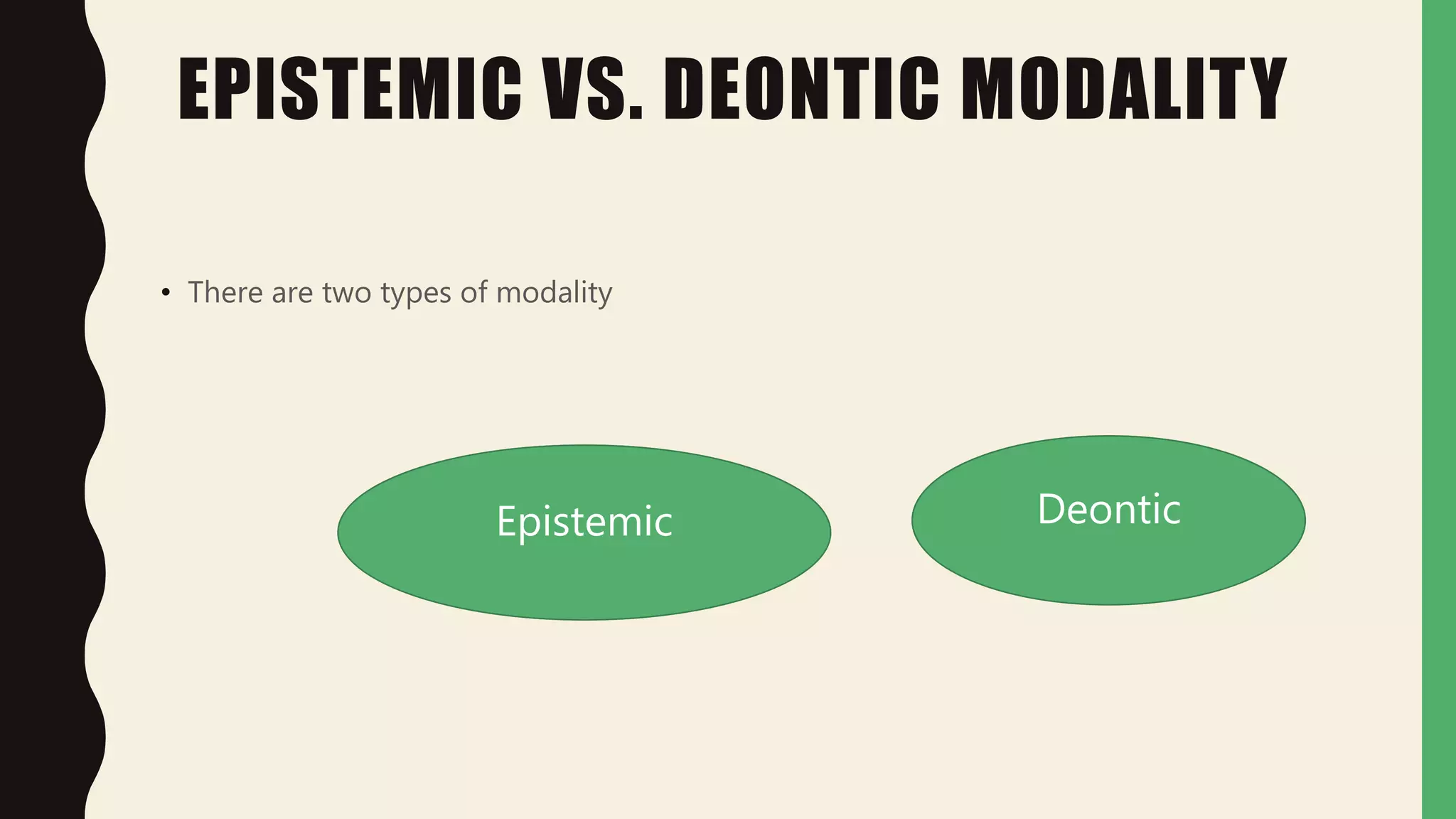
• There are two types of modality
Epistemic Deontic
EXAMPLES
• (2) a. John didn’t show up for work. He must be sick.
• [spoken by co-worker; Epistemic]
• b. John didn’t show up for work. He must be fired.
• [spoken by boss; Deontic]
• (3) a. The older students may leave school early (unless the teachers watch
• them carefully).
• b. The older students may leave school early (if they inform the
• headmaster first).
EPISTEMIC VS. DEONTIC MODALITY
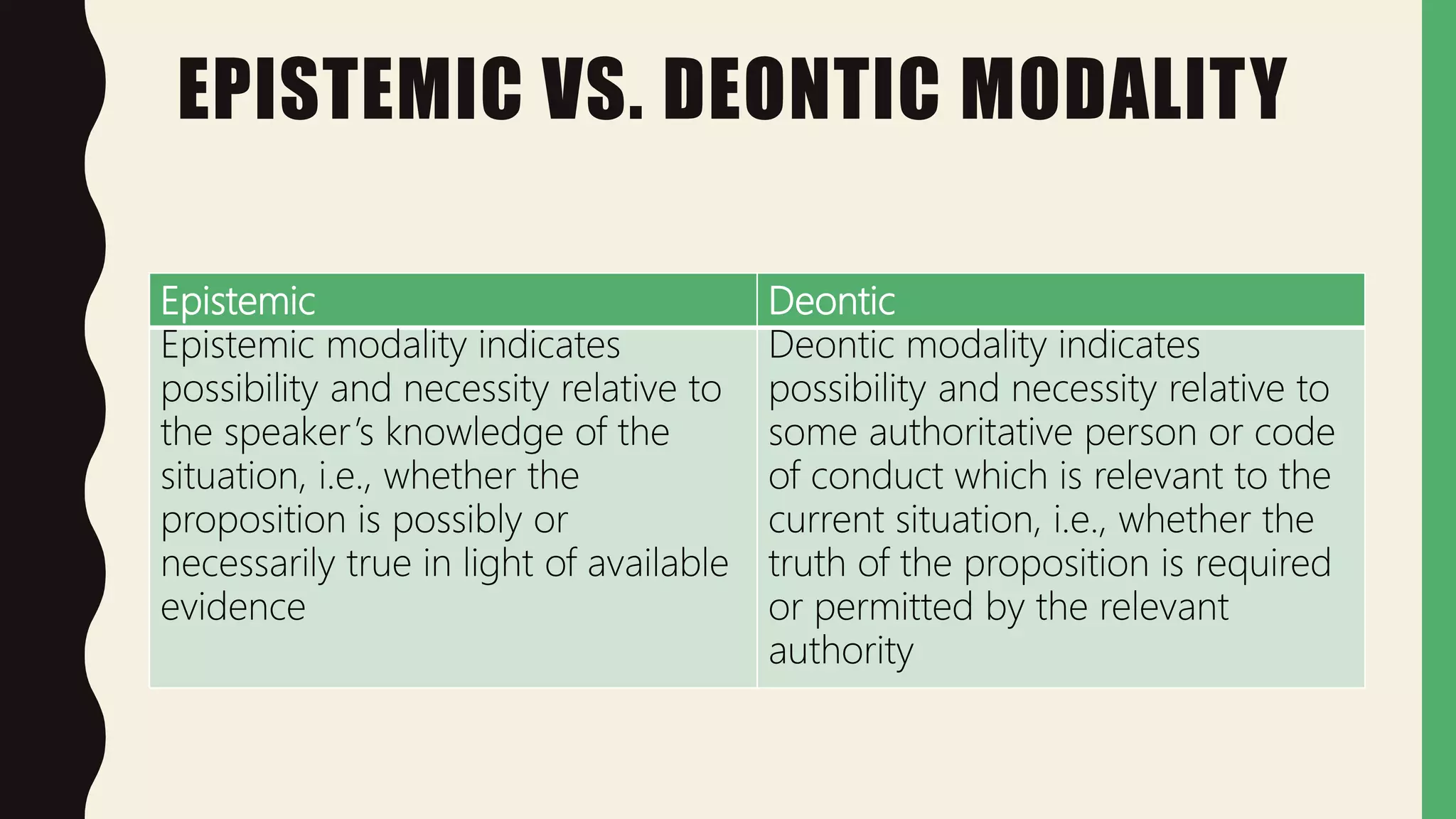
Epistemic Deontic
Epistemic modality indicates
possibility and necessity relative to
the speaker’s knowledge of the
situation, i.e., whether the
proposition is possibly or
necessarily true in light of available
evidence
Deontic modality indicates
possibility and necessity relative to
some authoritative person or code
of conduct which is relevant to the
current situation, i.e., whether the
truth of the proposition is required
or permitted by the relevant
authority
FORCE &FLAVOR
• The strength of modality (possibility vs. necessity) is
often referred to as the modal “force”, and the type of
modality (e.g. epistemic vs. deontic) is often referred
to as the modal “flavor”.
ARE MODALS POLYSEMOUS?
• Angelika Kratzer (1981; 1991) proposed that the English
modals are not in fact polysemous. On the contrary, she
suggested that English (like a number of other languages) has
only one set of modal operators, which are underspecified
(indeterminate) regarding the type of modality (epistemic,
deontic, etc.).
KRATZER’S ANALYSIS OF
QUANTIFICATION
• The first, which she calls the modal base, specifies the
class of worlds which are eligible for consideration,
i.e., worlds that are accessible.
-The second component, which she calls the ordering
source, specifies a ranking among the accessible
worlds.
• Another important part of Kratzer’s proposal is the claim that the modal
auxiliaries in languages like English and French are not in fact
polysemous.
• Kratzer suggests that the lexical entry for words like must and may
specifies only the strength of modality (i.e., the choice of quantifier
operator), and that they are indeterminate as to the type or “flavor” of
modality (epistemic vs. deontic, etc.).
• The type of modality depends on the choice of modal base and
ordering source, which are determined by context (linguistic or general)
TYPES OF MODALITY WHICH COULD
BE INFERRED FROM THE CONTEXT
• a. Epistemic:
• (In view of the available evidence,) John must/may be the murderer.
• b. Deontic:
• (In view of his parents’ orders,) John may watch TV, but he must go
• to bed at 8pm.
• c. Ability:
• (In view of his physical abilities,) John can lift 200 lbs.
• d. Teleological:
• (In view of his goal to get a PhD,) John must write a dissertation.
• e. Bouletic:
• (In view of his desire to retire at age 50,) John should work hard now.
DIFFERENCES BETWEEN EPISTEMIC
MODALITY AND ROOT MODALITY
Epistemic modality Root modality
“epistemic deal with possibilities that follow
from the speaker’s knowledge,
roots deal with possibilities that follow
from the circumstances surrounding the
main event and its participants.”
Epistemic modality is often said to be
“speaker-oriented”, because it encodes
possibility or necessity in light of the
speaker’s knowledge
Non-epistemic modal marking reflects
some facet of the circumstances
surrounding the described situation or
event, such as the requirements of an
authoritative person or code (deontic), or
the agent’s abilities (dynamic), goals
(teleological), or desires (bouletic).
CONCLUSION
• Under Kratzer’s analysis, the English modals are not in fact polysemous,
but rather indeterminate for type of modality. The strength of the modal
(necessary vs. possible) is lexically entailed, but the type of modality
(epistemic vs. deontic etc.) is determined by context
• Epistemic modality is different in certain ways from all the other types
(known collectively as root modality). Some authors have claimed that
epistemic modality is not part of the propositional content of the
utterance.
Modality

Modality

  • 1.
    MODALITY P R EP A R E D B Y F A T I M A H A L Y A M I L E C T U R E R I N A P P L I E D L I N G U I S T I C S
  • 2.
    MODALITY • In English,modality is expressed primarily by modal auxiliaries: may, might, must, should, could, ought to, etc. • modality can be thought of as an operator that combines with a basic proposition (p) to form a new proposition (It is possible that p or It is necessarily the case that p).
  • 3.
    THE RANGE OFMEANINGS EXPRESSIBLE BY GRAMMATICAL MARKERS OF MODALITY VARIES ALONG TWO BASIC SEMANTIC DIMENSIONS • First, some markers are “stronger” than others • Second, it turns out that the concepts of “possibility” and “necessity”, which are used to define modality, each include a variety of sub-types.
  • 4.
    EPISTEMIC VS. DEONTICMODALITY • There are two types of modality Epistemic Deontic
  • 5.
    EXAMPLES • (2) a.John didn’t show up for work. He must be sick. • [spoken by co-worker; Epistemic] • b. John didn’t show up for work. He must be fired. • [spoken by boss; Deontic] • (3) a. The older students may leave school early (unless the teachers watch • them carefully). • b. The older students may leave school early (if they inform the • headmaster first).
  • 6.
    EPISTEMIC VS. DEONTICMODALITY Epistemic Deontic Epistemic modality indicates possibility and necessity relative to the speaker’s knowledge of the situation, i.e., whether the proposition is possibly or necessarily true in light of available evidence Deontic modality indicates possibility and necessity relative to some authoritative person or code of conduct which is relevant to the current situation, i.e., whether the truth of the proposition is required or permitted by the relevant authority
  • 7.
    FORCE &FLAVOR • Thestrength of modality (possibility vs. necessity) is often referred to as the modal “force”, and the type of modality (e.g. epistemic vs. deontic) is often referred to as the modal “flavor”.
  • 8.
    ARE MODALS POLYSEMOUS? •Angelika Kratzer (1981; 1991) proposed that the English modals are not in fact polysemous. On the contrary, she suggested that English (like a number of other languages) has only one set of modal operators, which are underspecified (indeterminate) regarding the type of modality (epistemic, deontic, etc.).
  • 9.
    KRATZER’S ANALYSIS OF QUANTIFICATION •The first, which she calls the modal base, specifies the class of worlds which are eligible for consideration, i.e., worlds that are accessible. -The second component, which she calls the ordering source, specifies a ranking among the accessible worlds.
  • 10.
    • Another importantpart of Kratzer’s proposal is the claim that the modal auxiliaries in languages like English and French are not in fact polysemous. • Kratzer suggests that the lexical entry for words like must and may specifies only the strength of modality (i.e., the choice of quantifier operator), and that they are indeterminate as to the type or “flavor” of modality (epistemic vs. deontic, etc.). • The type of modality depends on the choice of modal base and ordering source, which are determined by context (linguistic or general)
  • 11.
    TYPES OF MODALITYWHICH COULD BE INFERRED FROM THE CONTEXT • a. Epistemic: • (In view of the available evidence,) John must/may be the murderer. • b. Deontic: • (In view of his parents’ orders,) John may watch TV, but he must go • to bed at 8pm. • c. Ability: • (In view of his physical abilities,) John can lift 200 lbs. • d. Teleological: • (In view of his goal to get a PhD,) John must write a dissertation. • e. Bouletic: • (In view of his desire to retire at age 50,) John should work hard now.
  • 12.
    DIFFERENCES BETWEEN EPISTEMIC MODALITYAND ROOT MODALITY Epistemic modality Root modality “epistemic deal with possibilities that follow from the speaker’s knowledge, roots deal with possibilities that follow from the circumstances surrounding the main event and its participants.” Epistemic modality is often said to be “speaker-oriented”, because it encodes possibility or necessity in light of the speaker’s knowledge Non-epistemic modal marking reflects some facet of the circumstances surrounding the described situation or event, such as the requirements of an authoritative person or code (deontic), or the agent’s abilities (dynamic), goals (teleological), or desires (bouletic).
  • 13.
    CONCLUSION • Under Kratzer’sanalysis, the English modals are not in fact polysemous, but rather indeterminate for type of modality. The strength of the modal (necessary vs. possible) is lexically entailed, but the type of modality (epistemic vs. deontic etc.) is determined by context • Epistemic modality is different in certain ways from all the other types (known collectively as root modality). Some authors have claimed that epistemic modality is not part of the propositional content of the utterance.