SPEECH ACTS
Prepared by:
Aef
sugihartoni
Budi SetyadiTMA
OVERVIEW
What is Speech Acts?
Analysis of Speech Acts
Type of Speech Acts
TMA
Speech Act is an action performed in saying something
A speech act is an act that a speaker performs when making an
utterance.
(Searle, John. 1969.Speech acts: An essay in the philosophy of language. Cambridge, England: Cambridge
University., p.22)
TMA
ANALYSIS OF SPEECH
ACT
by J.L. Austin
by Paul Grice
TMA
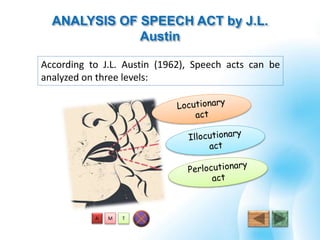
According to J.L. Austin (1962), Speech acts can be
analyzed on three levels:
ANALYSIS OF SPEECH ACT by J.L.
Austin
TMA
what is said/act of saying.
It’s hot in here It’s so cold in this room
TMA
What the speaker intends to communicate to the
addressee/hearer.
It’s hot in here1)
 Could be : an indirect request for
someone to open the window.
 an indirect refusal to close the
window
TMA
It’s so cold in this room2)
 Could be : an indirect request for
someone to close the window or
to turn off the air condition.
 a complaint implying that
someone should know better
than to keep the air condition on.
TMA
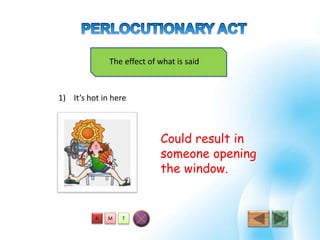
The effect of what is said
It’s hot in here1)
Could result in
someone opening
the window.
TMA
Could result in someone
close the window or
someone turn off the air
condition
It’s so cold in this room2)
TMA
ANALYSIS OF SPEECH ACT
by PAUL GRICE
Maxim is a set of norms which language users adhere to in order to
uphold the effectiveness and efficiency of communication.
(Hatim and Mason, 1990: 242).
According to Herbert Paul Grice (1975), in order to efficiency
communication it should be based on a Principle of Cooperation.
This principle was fleshed out in a series of maxims.
TMA
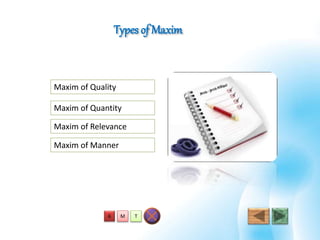
There are four maxims, namely, maxim of quantity, maxim of
quality, maxim of relevance, and maxim of manner.
Types of Maxim
T
Maxim of Quantity
Maxim of Relevance
Maxim of Manner
Maxim of Quality
MA
T
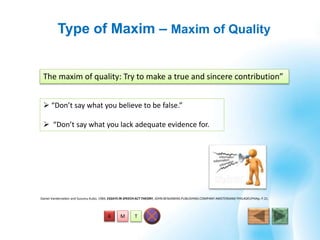
Type of Maxim – Maxim of Quality
MA
The maxim of quality: Try to make a true and sincere contribution”
Daniel Vanderveken and Susumu Kubo, 1984, ESSAYS IN SPEECH ACT THEORY, JOHN BENJAMINS PUBLISHING COMPANY AMSTERDAM/ PHILADELPHIAp. P.21.
 “Don’t say what you believe to be false.”
 “Don’t say what you lack adequate evidence for.
T
Mother: Did you study all day long?
Son: Yes, I've been studying till now!
Type of Maxim – Maxim of Quality
Example:
MA
In the example, The son was in fact really learned all day long. This
means fulfilling the maxim of quality.
If the boy is not truthful, he violates the maxim of quality. He is lies to
avoid unpleasant consequences such as; punishment or to be forced to
study for the rest of the day.
Type of Maxim – Maxim of Quantity
TMA
The maxim of quantity: Make your contribution as informative
as is required (neither less nor more informative than
required) for the current purpose of the exchange
 “Make your contribution as informative as required.”
 “Don't make your contribution more informative than is required.”
T
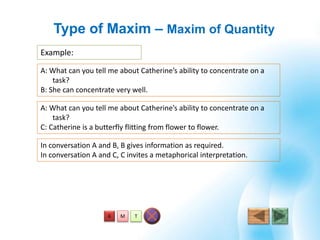
Type of Maxim – Maxim of Quantity
Example:
MA
A: What can you tell me about Catherine’s ability to concentrate on a
task?
B: She can concentrate very well.
A: What can you tell me about Catherine’s ability to concentrate on a
task?
C: Catherine is a butterfly flitting from flower to flower.
In conversation A and B, B gives information as required.
In conversation A and C, C invites a metaphorical interpretation.
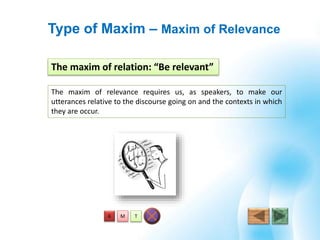
Type of Maxim – Maxim of Relevance
T
The maxim of relevance requires us, as speakers, to make our
utterances relative to the discourse going on and the contexts in which
they are occur.
MA
The maxim of relation: “Be relevant”
T
Example:
Type of Maxim – Maxim of Relevance
MA
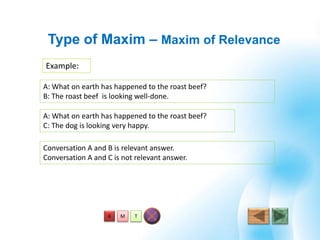
A: What on earth has happened to the roast beef?
C: The dog is looking very happy.
A: What on earth has happened to the roast beef?
B: The roast beef is looking well-done.
Conversation A and B is relevant answer.
Conversation A and C is not relevant answer.
T
Type of Maxim – Maxim of Manner
MA
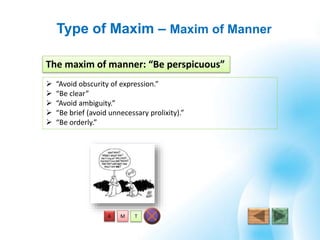
The maxim of manner: “Be perspicuous”
 “Avoid obscurity of expression.”
 “Be clear”
 “Avoid ambiguity.”
 “Be brief (avoid unnecessary prolixity).”
 “Be orderly.”
T
A: What are you baking?
B: I am baking chicken, beef and fish.
In conversation A and B, B gives answer perspicuous (the maxim
of manner) : because B gives a clear, brief, orderly to explanation.
Type of Maxim – Maxim of Manner
Example:
MA
A: What are you baking?
C: Be I are tea aitch deeay wyesee ay kayee.
In conversation A and C, C does not give answer perspicuous
(violation of the maxim of manner): because C does not gives a
clear, brief, orderly to explanation.
TYPES OF SPEECH ACTS
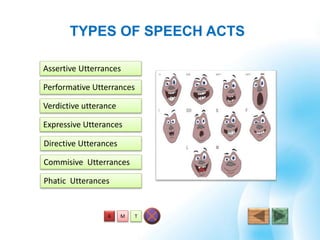
Assertive Utterrances
Performative Utterrances
Expressive Utterances
Directive Utterances
Commisive Utterrances
Phatic Utterances
Verdictive utterance
TMA
Assertive utterances are concerned with facts. The function is
to tell what the speaker know or believe. The purpose is to
inform.
T
ASSERTIVE UTTERANCES
MA
Example:
We declare that most
plastic are made
from soy beans.
I voted for
Obama in the last
election
ASSERTIVE UTTERANCES
TMA
Bogor is 60 km
from Jakarta
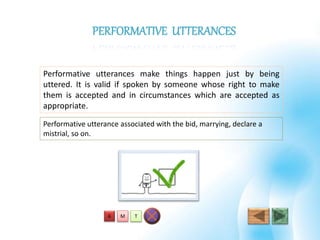
Performative utterances make things happen just by being
uttered. It is valid if spoken by someone whose right to make
them is accepted and in circumstances which are accepted as
appropriate.
T
PERFORMATIVE UTTERANCES
Performative utterance associated with the bid, marrying, declare a
mistrial, so on.
MA
Example:
I pronounce you husband &
wife
I declare this meeting adjourned
T
PERFORMATIVE UTTERANCES
MA
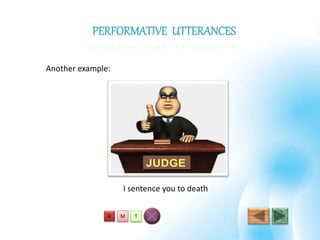
I sentence you to death
Another example:
PERFORMATIVE UTTERANCES
TMA
Verdictive utterance is speech acts in which the speaker makes an
assessment or judgement about the acts of the addressee.
Include: ranking, assessing, appraising, condoning.
The action viewed positively:
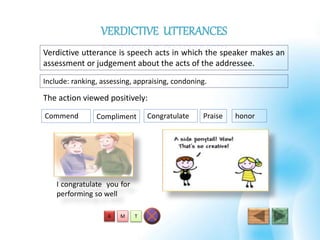
Commend Compliment Congratulate
I congratulate you for
performing so well
Praise honor
T
VERDICTIVE UTTERANCES
MA
The action is beneficial to the speaker:
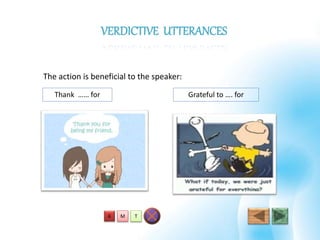
Thank …… for Grateful to …. for
VERDICTIVE UTTERANCES
TMA
The action viewed negatively:
accuse Blame criticize
I blame you for coming late
VERDICTIVE UTTERANCES
TMA
An Expressive utterances springs from the previous actions or failure
to act of the speaker. In other words, Expressive utterances occur
when speakers tell of their own past deeds and present feelings.
Expressive utterances are thus retrospective and speaker-involved.
Acknowledge, admit, confess, deny, apologize
I am sorry for what I have done
ConfessingFor example:
T
EXPRESSIVE UTTERANCES
MA
I confess that killed the girl.
Directive utterances are those in which the speaker tries to get the
addressee to perform some act or refrain from performing an act.
Three kinds of directive utterances: commands, requests, and
suggestions.
T
DIRECTIVE UTTERANCES
MA
Three kinds of directive utterance
A command is effective only if the speaker has some degree of
control over the actions of the addressee.
You must appear in court next Monday at 10 am
Don’t waste your time on that
A request is an expression of what the speaker wants the addressee
to do or refrain from doing.
Smoking is not permitted in the lavatories
The boss demands that these letters (should) go out today.
TMA
Suggestions are the utterances we make to other persons to give
our opinions as to what they should or should not do.
I advise you to take my advice.
We suggest you (should) pay more attention to what you’re doing.
T
Three kinds of directive utterance
MA
Agree, ask, offer, refuse, swear, promises, pledges, threats, and
vows.
I promise to be on time I agree to your terms.
COMMISIVE UTTERANCES
Commissive are utterances in which the speaker binds himself to
perform (or refrain from doing) some act at a later time. In other
words, They are prospective and concerned with the speaker’s
commitment to future action (Kreidler, 1998:192).
TMA
PHATIC UTTERANCES
Phatic utterances is the exchange of greetings and goodbyes, the
polite chitchat about whatever is expected in the particular society.
A phatic expression is one that doesn't require an answer because
it is just "social talk" or responses, much like small talk
The purpose is to maintain social bonds.
TMA
PHATIC UTTERANCES
Example
TMA
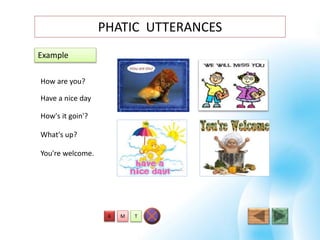
How are you?
Have a nice day
How's it goin'?
What's up?
You're welcome.
THE END
M TA

Speech acts

  • 1.
  • 2.
    OVERVIEW What is SpeechActs? Analysis of Speech Acts Type of Speech Acts TMA
  • 3.
    Speech Act isan action performed in saying something A speech act is an act that a speaker performs when making an utterance. (Searle, John. 1969.Speech acts: An essay in the philosophy of language. Cambridge, England: Cambridge University., p.22) TMA
  • 4.
    ANALYSIS OF SPEECH ACT byJ.L. Austin by Paul Grice TMA
  • 5.
    According to J.L.Austin (1962), Speech acts can be analyzed on three levels: ANALYSIS OF SPEECH ACT by J.L. Austin TMA
  • 6.
    what is said/actof saying. It’s hot in here It’s so cold in this room TMA
  • 7.
    What the speakerintends to communicate to the addressee/hearer. It’s hot in here1)  Could be : an indirect request for someone to open the window.  an indirect refusal to close the window TMA
  • 8.
    It’s so coldin this room2)  Could be : an indirect request for someone to close the window or to turn off the air condition.  a complaint implying that someone should know better than to keep the air condition on. TMA
  • 9.
    The effect ofwhat is said It’s hot in here1) Could result in someone opening the window. TMA
  • 10.
    Could result insomeone close the window or someone turn off the air condition It’s so cold in this room2) TMA
  • 11.
    ANALYSIS OF SPEECHACT by PAUL GRICE Maxim is a set of norms which language users adhere to in order to uphold the effectiveness and efficiency of communication. (Hatim and Mason, 1990: 242). According to Herbert Paul Grice (1975), in order to efficiency communication it should be based on a Principle of Cooperation. This principle was fleshed out in a series of maxims. TMA There are four maxims, namely, maxim of quantity, maxim of quality, maxim of relevance, and maxim of manner.
  • 12.
    Types of Maxim T Maximof Quantity Maxim of Relevance Maxim of Manner Maxim of Quality MA
  • 13.
    T Type of Maxim– Maxim of Quality MA The maxim of quality: Try to make a true and sincere contribution” Daniel Vanderveken and Susumu Kubo, 1984, ESSAYS IN SPEECH ACT THEORY, JOHN BENJAMINS PUBLISHING COMPANY AMSTERDAM/ PHILADELPHIAp. P.21.  “Don’t say what you believe to be false.”  “Don’t say what you lack adequate evidence for.
  • 14.
    T Mother: Did youstudy all day long? Son: Yes, I've been studying till now! Type of Maxim – Maxim of Quality Example: MA In the example, The son was in fact really learned all day long. This means fulfilling the maxim of quality. If the boy is not truthful, he violates the maxim of quality. He is lies to avoid unpleasant consequences such as; punishment or to be forced to study for the rest of the day.
  • 15.
    Type of Maxim– Maxim of Quantity TMA The maxim of quantity: Make your contribution as informative as is required (neither less nor more informative than required) for the current purpose of the exchange  “Make your contribution as informative as required.”  “Don't make your contribution more informative than is required.”
  • 16.
    T Type of Maxim– Maxim of Quantity Example: MA A: What can you tell me about Catherine’s ability to concentrate on a task? B: She can concentrate very well. A: What can you tell me about Catherine’s ability to concentrate on a task? C: Catherine is a butterfly flitting from flower to flower. In conversation A and B, B gives information as required. In conversation A and C, C invites a metaphorical interpretation.
  • 17.
    Type of Maxim– Maxim of Relevance T The maxim of relevance requires us, as speakers, to make our utterances relative to the discourse going on and the contexts in which they are occur. MA The maxim of relation: “Be relevant”
  • 18.
    T Example: Type of Maxim– Maxim of Relevance MA A: What on earth has happened to the roast beef? C: The dog is looking very happy. A: What on earth has happened to the roast beef? B: The roast beef is looking well-done. Conversation A and B is relevant answer. Conversation A and C is not relevant answer.
  • 19.
    T Type of Maxim– Maxim of Manner MA The maxim of manner: “Be perspicuous”  “Avoid obscurity of expression.”  “Be clear”  “Avoid ambiguity.”  “Be brief (avoid unnecessary prolixity).”  “Be orderly.”
  • 20.
    T A: What areyou baking? B: I am baking chicken, beef and fish. In conversation A and B, B gives answer perspicuous (the maxim of manner) : because B gives a clear, brief, orderly to explanation. Type of Maxim – Maxim of Manner Example: MA A: What are you baking? C: Be I are tea aitch deeay wyesee ay kayee. In conversation A and C, C does not give answer perspicuous (violation of the maxim of manner): because C does not gives a clear, brief, orderly to explanation.
  • 21.
    TYPES OF SPEECHACTS Assertive Utterrances Performative Utterrances Expressive Utterances Directive Utterances Commisive Utterrances Phatic Utterances Verdictive utterance TMA
  • 22.
    Assertive utterances areconcerned with facts. The function is to tell what the speaker know or believe. The purpose is to inform. T ASSERTIVE UTTERANCES MA
  • 23.
    Example: We declare thatmost plastic are made from soy beans. I voted for Obama in the last election ASSERTIVE UTTERANCES TMA Bogor is 60 km from Jakarta
  • 24.
    Performative utterances makethings happen just by being uttered. It is valid if spoken by someone whose right to make them is accepted and in circumstances which are accepted as appropriate. T PERFORMATIVE UTTERANCES Performative utterance associated with the bid, marrying, declare a mistrial, so on. MA
  • 25.
    Example: I pronounce youhusband & wife I declare this meeting adjourned T PERFORMATIVE UTTERANCES MA
  • 26.
    I sentence youto death Another example: PERFORMATIVE UTTERANCES TMA
  • 27.
    Verdictive utterance isspeech acts in which the speaker makes an assessment or judgement about the acts of the addressee. Include: ranking, assessing, appraising, condoning. The action viewed positively: Commend Compliment Congratulate I congratulate you for performing so well Praise honor T VERDICTIVE UTTERANCES MA
  • 28.
    The action isbeneficial to the speaker: Thank …… for Grateful to …. for VERDICTIVE UTTERANCES TMA
  • 29.
    The action viewednegatively: accuse Blame criticize I blame you for coming late VERDICTIVE UTTERANCES TMA
  • 30.
    An Expressive utterancessprings from the previous actions or failure to act of the speaker. In other words, Expressive utterances occur when speakers tell of their own past deeds and present feelings. Expressive utterances are thus retrospective and speaker-involved. Acknowledge, admit, confess, deny, apologize I am sorry for what I have done ConfessingFor example: T EXPRESSIVE UTTERANCES MA I confess that killed the girl.
  • 31.
    Directive utterances arethose in which the speaker tries to get the addressee to perform some act or refrain from performing an act. Three kinds of directive utterances: commands, requests, and suggestions. T DIRECTIVE UTTERANCES MA
  • 32.
    Three kinds ofdirective utterance A command is effective only if the speaker has some degree of control over the actions of the addressee. You must appear in court next Monday at 10 am Don’t waste your time on that A request is an expression of what the speaker wants the addressee to do or refrain from doing. Smoking is not permitted in the lavatories The boss demands that these letters (should) go out today. TMA
  • 33.
    Suggestions are theutterances we make to other persons to give our opinions as to what they should or should not do. I advise you to take my advice. We suggest you (should) pay more attention to what you’re doing. T Three kinds of directive utterance MA
  • 34.
    Agree, ask, offer,refuse, swear, promises, pledges, threats, and vows. I promise to be on time I agree to your terms. COMMISIVE UTTERANCES Commissive are utterances in which the speaker binds himself to perform (or refrain from doing) some act at a later time. In other words, They are prospective and concerned with the speaker’s commitment to future action (Kreidler, 1998:192). TMA
  • 35.
    PHATIC UTTERANCES Phatic utterancesis the exchange of greetings and goodbyes, the polite chitchat about whatever is expected in the particular society. A phatic expression is one that doesn't require an answer because it is just "social talk" or responses, much like small talk The purpose is to maintain social bonds. TMA
  • 36.
    PHATIC UTTERANCES Example TMA How areyou? Have a nice day How's it goin'? What's up? You're welcome.
  • 37.

Editor's Notes

  • #12 Maxim adalah seperangkat norma yang pengguna bahasa mematuhi untuk menegakkan efektivitas dan efisiensi komunikasi '(Hatim dan Mason, 1990: 242).