
SPEECH ACTS
Oral Communication
in Context
SPEECH ACTS
• A speech act is an utterance
that a speaker makes to
achieve an intended effect.
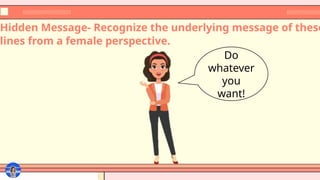
Hidden Message- Recognize the underlying message of these
lines from a female perspective.
Do
whatever
you
want!
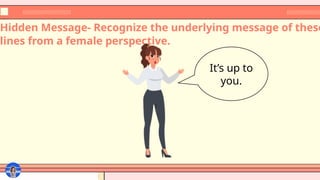
Hidden Message- Recognize the underlying message of these
lines from a female perspective.
It’s up to
you.
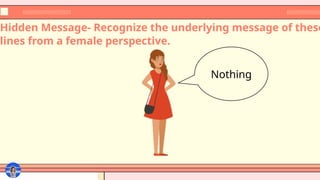
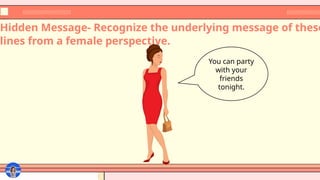
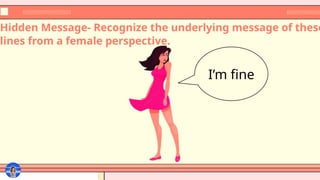
Hidden Message- Recognize the underlying message of these
lines from a female perspective.
Nothing
Hidden Message- Recognize the underlying message of these
lines from a female perspective.
You can party
with your
friends
tonight.
Hidden Message- Recognize the underlying message of these
lines from a female perspective.
I’m fine
SPEECH ACTS
• Some of the functions which
are carried out using speech
acts are offering an apology
greeting, request, complaint
invitation, compliment, or
refusal.
SPEECH ACTS
A speech act might contain just one
word or several words or sentences. Fo
example, “Thanks” and “Thank you fo
always being there for me. I really
appreciate it” both show appreciation
regardless of the length of the statement.
THREE TYPES OF SPEECH ACTS
According to J. L. Austin (1962), a
philosopher of language and the
developer of the Speech Act Theory, there
are three types of acts in every utterance
given the right circumstances or context.
THREE TYPES OF SPEECH ACTS
1. Locutionary act is the actual act o
uttering.
Example: “Please do the dishes.”
THREE TYPES OF SPEECH ACTS
2. Illocutionary act is the social function
of what is said.
Example: By uttering the locution “Please
do the dishes,” the speaker requests the
addressee to wash the dishes.
THREE TYPES OF SPEECH ACTS
3. Perlocutionary act is the resulting ac
of what is said. This effect is based on the
particular context in which the speech ac
was mentioned.
Example:“Please do the dishes” would
lead to the addressee washing the dishes
THREE TYPES OF SPEECH ACTS
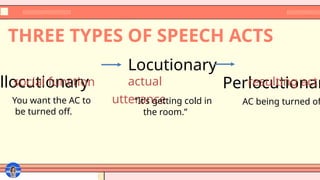
Illocutionary
Locutionary
Perlocutionar
social function actual
utterance
resulting act
You want the AC to
be turned off.
“It’s getting cold in
the room.”
AC being turned off
Performatives
verbs that execute the speech act tha
they intend to effect
statements which enable the speaker t
perform something just by stating it
Performative utterances
A performative utterance said by the
right person under the right
circumstances results in a change in the
world. Note that certain conditions have
to be met when making a performative
Performative utterances
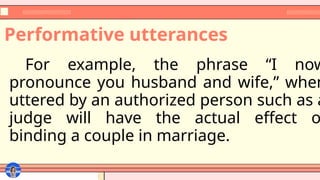
For example, the phrase “I now
pronounce you husband and wife,” when
uttered by an authorized person such as a
judge will have the actual effect o
binding a couple in marriage.
Performative utterances
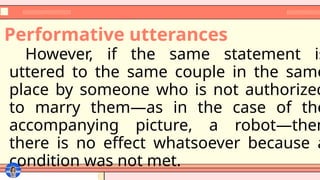
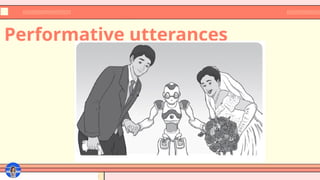
However, if the same statement is
uttered to the same couple in the same
place by someone who is not authorized
to marry them—as in the case of the
accompanying picture, a robot—then
there is no effect whatsoever because a
condition was not met.
Performative utterances
Searle’s Classifications of Speech
Act
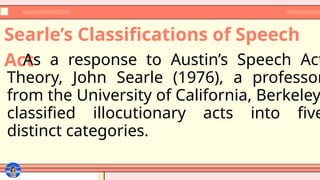
As a response to Austin’s Speech Act
Theory, John Searle (1976), a professor
from the University of California, Berkeley,
classified illocutionary acts into five
distinct categories.
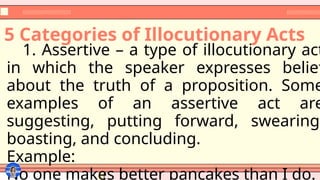
5 Categories of Illocutionary Acts
1. Assertive – a type of illocutionary act
in which the speaker expresses belief
about the truth of a proposition. Some
examples of an assertive act are
suggesting, putting forward, swearing,
boasting, and concluding.
Example:
No one makes better pancakes than I do.
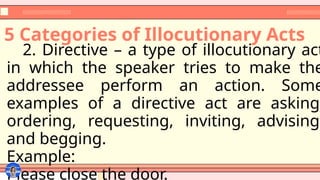
5 Categories of Illocutionary Acts
2. Directive – a type of illocutionary act
in which the speaker tries to make the
addressee perform an action. Some
examples of a directive act are asking,
ordering, requesting, inviting, advising,
and begging.
Example:
Please close the door.
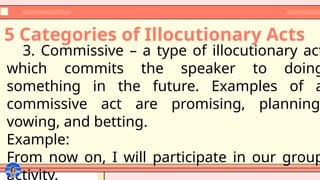
5 Categories of Illocutionary Acts
3. Commissive – a type of illocutionary act
which commits the speaker to doing
something in the future. Examples of a
commissive act are promising, planning
vowing, and betting.
Example:
From now on, I will participate in our group
activity.
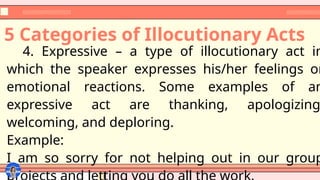
5 Categories of Illocutionary Acts
4. Expressive – a type of illocutionary act in
which the speaker expresses his/her feelings or
emotional reactions. Some examples of an
expressive act are thanking, apologizing
welcoming, and deploring.
Example:
I am so sorry for not helping out in our group
5 Categories of Illocutionary Acts
5. Declaration – a type of illocutionary act which
brings a change in the external situation. Simply
put, declarations bring into existence or cause the
state of affairs which they refer to. Some examples
of declarations are blessing, firing, baptizing
bidding, passing a sentence, and
excommunicating.
Example:
You are fired!
(By saying that someone is fired, an employer
causes or brings about the person’s
unemployment, thus changing his externa
 Communicative competence (i.e., the
ability
to use linguistic knowledge to effectively
communicate with others) is essential for a
speaker to be able to use and understand
speech acts.
 Idioms and other nuances in a certain
language might be lost or misunderstood
by someone who does not fully grasp the
language yet.
Discern the meaning behind the utterance.
1. Consider the phrase: “I now declare Martial Law
Who among the following can say this
phrase and make martial law actually happen?
a. President of the country
b. My pregnant neighbor
c. A retired veterinarian
d. A famous rock star
2. What do you think does the speaker mean when
he/she says, “Can you open the door?”
a. The speaker wants to know if I have the ability
to open the door.
b. The speaker is requesting me to open the door.
c. The speaker does not make sense.
d. The speaker is asking me a question.
3.You and your friend who has a fever enter your
room. She shivers and tells you, “It’s cold in here!”
How would you interpret what she said?
a. She feels cold.
b. She wants me to increase the temperature in
the room.
c. She does not feel well because of the cold.
d. She is complimenting the temperature in my
room.
4. Based on the scenario in item number 3, what
would your next action be?
a. I will thank my friend.
b. I will agree with her and say that the room is
cold.
c. I will increase the temperature to decrease the
coldness.
d. I will ignore my friend.
5. In which of the following statements is the
speaker making a commitment? a. “I checked her
Facebook profile yesterday.”
b. “I’m in love and I’m happy!”
c. “I promise to love you for better or for worse.”
d. “I think following my suggestion will get us a
high grade.”
GROUP TASK
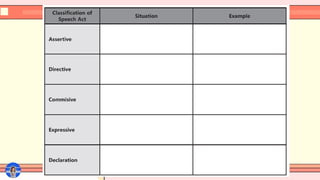
Accomplish the table in the next
slide with your groupmates.
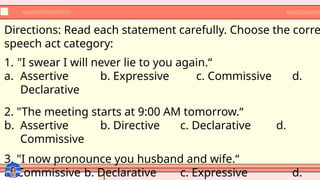
Directions: Read each statement carefully. Choose the corre
speech act category:
1. "I swear I will never lie to you again.“
a. Assertive b. Expressive c. Commissive d.
Declarative
2. "The meeting starts at 9:00 AM tomorrow.“
b. Assertive b. Directive c. Declarative d.
Commissive
3. "I now pronounce you husband and wife.“
a. Commissive b. Declarative c. Expressive d.
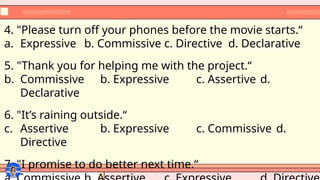
4. "Please turn off your phones before the movie starts.“
a. Expressive b. Commissive c. Directive d. Declarative
5. "Thank you for helping me with the project.“
b. Commissive b. Expressive c. Assertive d.
Declarative
6. "It’s raining outside.“
c. Assertive b. Expressive c. Commissive d.
Directive
7. "I promise to do better next time.“
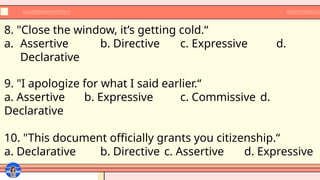
8. "Close the window, it’s getting cold.“
a. Assertive b. Directive c. Expressive d.
Declarative
9. "I apologize for what I said earlier.“
a. Assertive b. Expressive c. Commissive d.
Declarative
10. "This document officially grants you citizenship.“
a. Declarative b. Directive c. Assertive d. Expressive
THANK YOU
Follow me on my Youtube Channel
https://www.youtube.com/@educstream

SPEECH ACTS PPT- LESSON AND ACTIVTIES.pptx

  • 1.
  • 2.
    SPEECH ACTS • Aspeech act is an utterance that a speaker makes to achieve an intended effect.
  • 3.
    Hidden Message- Recognizethe underlying message of these lines from a female perspective. Do whatever you want!
  • 4.
    Hidden Message- Recognizethe underlying message of these lines from a female perspective. It’s up to you.
  • 5.
    Hidden Message- Recognizethe underlying message of these lines from a female perspective. Nothing
  • 6.
    Hidden Message- Recognizethe underlying message of these lines from a female perspective. You can party with your friends tonight.
  • 7.
    Hidden Message- Recognizethe underlying message of these lines from a female perspective. I’m fine
  • 8.
    SPEECH ACTS • Someof the functions which are carried out using speech acts are offering an apology greeting, request, complaint invitation, compliment, or refusal.
  • 9.
    SPEECH ACTS A speechact might contain just one word or several words or sentences. Fo example, “Thanks” and “Thank you fo always being there for me. I really appreciate it” both show appreciation regardless of the length of the statement.
  • 10.
    THREE TYPES OFSPEECH ACTS According to J. L. Austin (1962), a philosopher of language and the developer of the Speech Act Theory, there are three types of acts in every utterance given the right circumstances or context.
  • 11.
    THREE TYPES OFSPEECH ACTS 1. Locutionary act is the actual act o uttering. Example: “Please do the dishes.”
  • 12.
    THREE TYPES OFSPEECH ACTS 2. Illocutionary act is the social function of what is said. Example: By uttering the locution “Please do the dishes,” the speaker requests the addressee to wash the dishes.
  • 13.
    THREE TYPES OFSPEECH ACTS 3. Perlocutionary act is the resulting ac of what is said. This effect is based on the particular context in which the speech ac was mentioned. Example:“Please do the dishes” would lead to the addressee washing the dishes
  • 14.
    THREE TYPES OFSPEECH ACTS Illocutionary Locutionary Perlocutionar social function actual utterance resulting act You want the AC to be turned off. “It’s getting cold in the room.” AC being turned off
  • 15.
    Performatives verbs that executethe speech act tha they intend to effect
  • 16.
    statements which enablethe speaker t perform something just by stating it Performative utterances A performative utterance said by the right person under the right circumstances results in a change in the world. Note that certain conditions have to be met when making a performative
  • 17.
    Performative utterances For example,the phrase “I now pronounce you husband and wife,” when uttered by an authorized person such as a judge will have the actual effect o binding a couple in marriage.
  • 18.
    Performative utterances However, ifthe same statement is uttered to the same couple in the same place by someone who is not authorized to marry them—as in the case of the accompanying picture, a robot—then there is no effect whatsoever because a condition was not met.
  • 19.
  • 20.
    Searle’s Classifications ofSpeech Act As a response to Austin’s Speech Act Theory, John Searle (1976), a professor from the University of California, Berkeley, classified illocutionary acts into five distinct categories.
  • 21.
    5 Categories ofIllocutionary Acts 1. Assertive – a type of illocutionary act in which the speaker expresses belief about the truth of a proposition. Some examples of an assertive act are suggesting, putting forward, swearing, boasting, and concluding. Example: No one makes better pancakes than I do.
  • 22.
    5 Categories ofIllocutionary Acts 2. Directive – a type of illocutionary act in which the speaker tries to make the addressee perform an action. Some examples of a directive act are asking, ordering, requesting, inviting, advising, and begging. Example: Please close the door.
  • 23.
    5 Categories ofIllocutionary Acts 3. Commissive – a type of illocutionary act which commits the speaker to doing something in the future. Examples of a commissive act are promising, planning vowing, and betting. Example: From now on, I will participate in our group activity.
  • 24.
    5 Categories ofIllocutionary Acts 4. Expressive – a type of illocutionary act in which the speaker expresses his/her feelings or emotional reactions. Some examples of an expressive act are thanking, apologizing welcoming, and deploring. Example: I am so sorry for not helping out in our group
  • 25.
    5 Categories ofIllocutionary Acts 5. Declaration – a type of illocutionary act which brings a change in the external situation. Simply put, declarations bring into existence or cause the state of affairs which they refer to. Some examples of declarations are blessing, firing, baptizing bidding, passing a sentence, and excommunicating. Example: You are fired! (By saying that someone is fired, an employer causes or brings about the person’s unemployment, thus changing his externa
  • 26.
     Communicative competence(i.e., the ability to use linguistic knowledge to effectively communicate with others) is essential for a speaker to be able to use and understand speech acts.  Idioms and other nuances in a certain language might be lost or misunderstood by someone who does not fully grasp the language yet.
  • 27.
    Discern the meaningbehind the utterance. 1. Consider the phrase: “I now declare Martial Law Who among the following can say this phrase and make martial law actually happen? a. President of the country b. My pregnant neighbor c. A retired veterinarian d. A famous rock star
  • 28.
    2. What doyou think does the speaker mean when he/she says, “Can you open the door?” a. The speaker wants to know if I have the ability to open the door. b. The speaker is requesting me to open the door. c. The speaker does not make sense. d. The speaker is asking me a question.
  • 29.
    3.You and yourfriend who has a fever enter your room. She shivers and tells you, “It’s cold in here!” How would you interpret what she said? a. She feels cold. b. She wants me to increase the temperature in the room. c. She does not feel well because of the cold. d. She is complimenting the temperature in my room.
  • 30.
    4. Based onthe scenario in item number 3, what would your next action be? a. I will thank my friend. b. I will agree with her and say that the room is cold. c. I will increase the temperature to decrease the coldness. d. I will ignore my friend.
  • 31.
    5. In whichof the following statements is the speaker making a commitment? a. “I checked her Facebook profile yesterday.” b. “I’m in love and I’m happy!” c. “I promise to love you for better or for worse.” d. “I think following my suggestion will get us a high grade.”
  • 32.
    GROUP TASK Accomplish thetable in the next slide with your groupmates.
  • 34.
    Directions: Read eachstatement carefully. Choose the corre speech act category: 1. "I swear I will never lie to you again.“ a. Assertive b. Expressive c. Commissive d. Declarative 2. "The meeting starts at 9:00 AM tomorrow.“ b. Assertive b. Directive c. Declarative d. Commissive 3. "I now pronounce you husband and wife.“ a. Commissive b. Declarative c. Expressive d.
  • 35.
    4. "Please turnoff your phones before the movie starts.“ a. Expressive b. Commissive c. Directive d. Declarative 5. "Thank you for helping me with the project.“ b. Commissive b. Expressive c. Assertive d. Declarative 6. "It’s raining outside.“ c. Assertive b. Expressive c. Commissive d. Directive 7. "I promise to do better next time.“
  • 36.
    8. "Close thewindow, it’s getting cold.“ a. Assertive b. Directive c. Expressive d. Declarative 9. "I apologize for what I said earlier.“ a. Assertive b. Expressive c. Commissive d. Declarative 10. "This document officially grants you citizenship.“ a. Declarative b. Directive c. Assertive d. Expressive
  • 37.
    THANK YOU Follow meon my Youtube Channel https://www.youtube.com/@educstream