TARDIVE DYSKINESIA
What is Tardive Dyskinesia (TD)?

  o Neurological syndrome caused by long-term use of drugs to treat psychiatric
    disorders
  o Presents as repetitive, involuntary, and purposeless movements
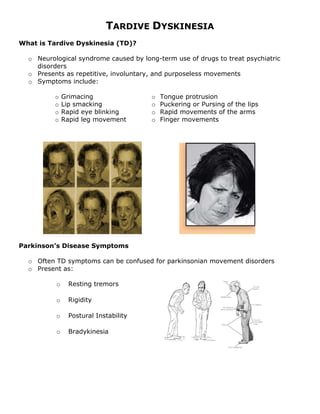
  o Symptoms include:

          o   Grimacing                o   Tongue protrusion
          o   Lip smacking             o   Puckering or Pursing of the lips
          o   Rapid eye blinking       o   Rapid movements of the arms
          o   Rapid leg movement       o   Finger movements


Parkinson’s Disease Symptoms

  o Often TD symptoms can be confused for parkinsonian movement disorders
  o Present as:

          o    Resting tremors

          o    Rigidity

          o    Postural Instability

          o    Bradykinesia
Psycosis
  o Dysfunction of the mesolimbic
     system caused by too much
     dopamine in the brain
     according to the dopaminergic
     hyperactivity theory
  o Medications for the treatment
     mental conditions block
     dopamine receptors
  o Blocking dopamine results in
     reduced amounts of dopamine
     or malfunctioning of receptors
     and causes extrapyramidal
     side effects
  o End result is decreased
     dopamine in
     mesocorticolimbic pathway
     and nigrostriatal pathway of
     the brain


Parkinson’s Disease
  o Dysfunction in the nigrostriatal
     pathway caused by too little
     dopamine working in the body
  o For treatment, medications
     are used that provide extra
     dopamine
  o Side effects of the medication
     can cause psycosis from the
     increased dopamine in the
     mesocorticolimbic pathway in
     the brain
What medications cause TD?

        o Metoclopramide (Reglan®)         o   Trifluoperazine (Stelazine®)
        o Prochlorperazine (Compazine®)    o   Perphenazine (Trilafon®)
        o Promethazine (Phenergan®)        o   Fluphenazine (Prolixin®)
        o Chlorpromazine (Thorazine®)      o   Thiothixene (Navane®)
        o Haloperidol (Haldol®)            o   Thioridazine (Mellaril®)
         Olanzapine (Zyprexa®)               Quetiapine (Seroquel®)
         Risperidone (Risperdal®)            Amisulpride (Solian®)


Selectivity of Psychiatric Medications
  o First Generation Antipsychotics
        o Known as DOPAMINE ANTAGONISTS
        o Bind and block multiple receptors in the brain including D1, D2, D4, and
           serotinergic receptors
        o When 60% of the D2 receptors are blocked, efficacy is reached. At 80% D2
           receptor blockade, extrapyramidal side effects can be seen
  o Atypical Antipsychotics (Second Generation)
        o Known as SEROTONIN-DOPAMINE ANTAGONISTS
        o Have higher affinities for 5-HT2, D1 and D4 rather than D2
        o Cause fewer extrapyramidal side effects
               o More specific for mesolimbic pathway
               o Thought to have faster dissociation from D2 receptors

Treatment of TD:
  o Three basic approaches
       o Prevention
       o Diagnosis
       o Management
             o Discontinue medication or reduce dose
             o Change to different antipsychotic
             o Initiating benzodiazepine or vitamin E may relieve some of the
                patient’s symptoms
             o Benztropine may be used to treat extrapyramidal symptoms


Distinguishing TD from other Movement disorders:
   o Youtube video demonstrates the symptoms of Parkinson’s disease
           http://www.youtube.com/watch?v=xuVY7wS25rc&feature=related
   o Youtube video demonstrates various TD symptoms and how to score them
           http://www.youtube.com/watch?v=rqsKGTBB8Ag&feature=related

  o Using forms and scoring techniques, it is easier to document symptoms patients
    have and track progression
  o Remember that people with Parkinson’s Disease have difficulty moving, while
    those with tardive dyskinesia have difficulty not moving
References:
"Bjeaaan213 - Parkinson's." Bjeaaan213 - Home. Web. 13 July 2010.
      <http://bjeaaan213.wikispaces.com/parkinson's>.

Hsiung, Robert. "Abnormal Involuntary Movement Scale." The Dr. Bob Home Page. Web.
     13 July 2010. <http://www.dr-bob.org/tips/aims.html>.

"Neuroleptics - Tardive Dyskinesia Causes." Tardive Dyskinesia & Reglan - Symptoms,
     Side Effects & Treatments. 14 May 2010. Web. 13 July 2010.
     <http://www.tardivedyskinesia.com/causes/neuroleptics.php>.

"Nutritional Treatment of Tardive Dyskinesia." Pharmaceuticals Anonymous. Web. 13
      July 2010. <http://pharmaceuticalsanonymous.blogspot.com/2008/03/nutritional-
      treatment-of-tardive.html>.

"Parkinson's Disease - Homepage." BIO349, CSB/EEB/BIOTA, University of Toronto. 13
      Mar. 2009. Web. 13 July 2010.
      <http://bio349.biota.utoronto.ca/20089/20089bio349graham/parkinsons/index.ht
      ml>.

Rang, H. P. Rang and Dale's Pharmacology. 6th ed. Philadelphia, PA: Churchill
     Livingstone/Elsevier, 2007. Print.

Sadock, Benjamin J., Harold I. Kaplan, and Virginia A. Sadock. Kaplan & Sadock's
     Synopsis of Psychiatry: Behavioral Sciences/clinical Psychiatry. 10th ed.
     Philadelphia: Wolter Kluwer/Lippincott Williams & Wilkins, 2007. Print.

"Tardive Dyskinesia: EMedicine Neurology." EMedicine - Medical Reference. Web. 13 July
      2010. <http://emedicine.medscape.com/article/1151826-overview>.

"Tardive Dyskinesia Information Page." National Institute of Neurological Disorders and
      Stroke (NINDS). 14 Feb. 2007. Web. 10 July 2010.
<http://www.ninds.nih.gov/disorders/tardive/tardive.htm>.

"YouTube - Tardive Dyskinesia Diagnosis - (AIMSDVD.com)." YouTube - Broadcast
     Yourself. Web. 10 July 2010.
     <http://www.youtube.com/watch?v=rqsKGTBB8Ag&feature=related>.

"YouTube - Tardive Dyskinesia Diagnosis - (AIMSDVD.com)." YouTube - Broadcast
     Yourself. Web. 13 July 2010.
     <http://www.youtube.com/watch?v=rqsKGTBB8Ag&feature=player_embedded>.

Tardive Dyskinesia

  • 1.
    TARDIVE DYSKINESIA What isTardive Dyskinesia (TD)? o Neurological syndrome caused by long-term use of drugs to treat psychiatric disorders o Presents as repetitive, involuntary, and purposeless movements o Symptoms include: o Grimacing o Tongue protrusion o Lip smacking o Puckering or Pursing of the lips o Rapid eye blinking o Rapid movements of the arms o Rapid leg movement o Finger movements Parkinson’s Disease Symptoms o Often TD symptoms can be confused for parkinsonian movement disorders o Present as: o Resting tremors o Rigidity o Postural Instability o Bradykinesia
  • 2.
    Psycosis oDysfunction of the mesolimbic system caused by too much dopamine in the brain according to the dopaminergic hyperactivity theory o Medications for the treatment mental conditions block dopamine receptors o Blocking dopamine results in reduced amounts of dopamine or malfunctioning of receptors and causes extrapyramidal side effects o End result is decreased dopamine in mesocorticolimbic pathway and nigrostriatal pathway of the brain Parkinson’s Disease o Dysfunction in the nigrostriatal pathway caused by too little dopamine working in the body o For treatment, medications are used that provide extra dopamine o Side effects of the medication can cause psycosis from the increased dopamine in the mesocorticolimbic pathway in the brain
  • 3.
    What medications causeTD? o Metoclopramide (Reglan®) o Trifluoperazine (Stelazine®) o Prochlorperazine (Compazine®) o Perphenazine (Trilafon®) o Promethazine (Phenergan®) o Fluphenazine (Prolixin®) o Chlorpromazine (Thorazine®) o Thiothixene (Navane®) o Haloperidol (Haldol®) o Thioridazine (Mellaril®)  Olanzapine (Zyprexa®)  Quetiapine (Seroquel®)  Risperidone (Risperdal®)  Amisulpride (Solian®) Selectivity of Psychiatric Medications o First Generation Antipsychotics o Known as DOPAMINE ANTAGONISTS o Bind and block multiple receptors in the brain including D1, D2, D4, and serotinergic receptors o When 60% of the D2 receptors are blocked, efficacy is reached. At 80% D2 receptor blockade, extrapyramidal side effects can be seen o Atypical Antipsychotics (Second Generation) o Known as SEROTONIN-DOPAMINE ANTAGONISTS o Have higher affinities for 5-HT2, D1 and D4 rather than D2 o Cause fewer extrapyramidal side effects o More specific for mesolimbic pathway o Thought to have faster dissociation from D2 receptors Treatment of TD: o Three basic approaches o Prevention o Diagnosis o Management o Discontinue medication or reduce dose o Change to different antipsychotic o Initiating benzodiazepine or vitamin E may relieve some of the patient’s symptoms o Benztropine may be used to treat extrapyramidal symptoms Distinguishing TD from other Movement disorders: o Youtube video demonstrates the symptoms of Parkinson’s disease http://www.youtube.com/watch?v=xuVY7wS25rc&feature=related o Youtube video demonstrates various TD symptoms and how to score them http://www.youtube.com/watch?v=rqsKGTBB8Ag&feature=related o Using forms and scoring techniques, it is easier to document symptoms patients have and track progression o Remember that people with Parkinson’s Disease have difficulty moving, while those with tardive dyskinesia have difficulty not moving
  • 4.
    References: "Bjeaaan213 - Parkinson's."Bjeaaan213 - Home. Web. 13 July 2010. <http://bjeaaan213.wikispaces.com/parkinson's>. Hsiung, Robert. "Abnormal Involuntary Movement Scale." The Dr. Bob Home Page. Web. 13 July 2010. <http://www.dr-bob.org/tips/aims.html>. "Neuroleptics - Tardive Dyskinesia Causes." Tardive Dyskinesia & Reglan - Symptoms, Side Effects & Treatments. 14 May 2010. Web. 13 July 2010. <http://www.tardivedyskinesia.com/causes/neuroleptics.php>. "Nutritional Treatment of Tardive Dyskinesia." Pharmaceuticals Anonymous. Web. 13 July 2010. <http://pharmaceuticalsanonymous.blogspot.com/2008/03/nutritional- treatment-of-tardive.html>. "Parkinson's Disease - Homepage." BIO349, CSB/EEB/BIOTA, University of Toronto. 13 Mar. 2009. Web. 13 July 2010. <http://bio349.biota.utoronto.ca/20089/20089bio349graham/parkinsons/index.ht ml>. Rang, H. P. Rang and Dale's Pharmacology. 6th ed. Philadelphia, PA: Churchill Livingstone/Elsevier, 2007. Print. Sadock, Benjamin J., Harold I. Kaplan, and Virginia A. Sadock. Kaplan & Sadock's Synopsis of Psychiatry: Behavioral Sciences/clinical Psychiatry. 10th ed. Philadelphia: Wolter Kluwer/Lippincott Williams & Wilkins, 2007. Print. "Tardive Dyskinesia: EMedicine Neurology." EMedicine - Medical Reference. Web. 13 July 2010. <http://emedicine.medscape.com/article/1151826-overview>. "Tardive Dyskinesia Information Page." National Institute of Neurological Disorders and Stroke (NINDS). 14 Feb. 2007. Web. 10 July 2010. <http://www.ninds.nih.gov/disorders/tardive/tardive.htm>. "YouTube - Tardive Dyskinesia Diagnosis - (AIMSDVD.com)." YouTube - Broadcast Yourself. Web. 10 July 2010. <http://www.youtube.com/watch?v=rqsKGTBB8Ag&feature=related>. "YouTube - Tardive Dyskinesia Diagnosis - (AIMSDVD.com)." YouTube - Broadcast Yourself. Web. 13 July 2010. <http://www.youtube.com/watch?v=rqsKGTBB8Ag&feature=player_embedded>.