
KULDEEP MATHUR
M.B.A. JIWAJI UNIVERSITY GWALIOR
WHAT IS HUMAN RESOURCE PLANNING
5-2
H.R.P—is concerned with the flow of people into, through,
and out of an organisation. HR planning involves anticipating
the need for labor and the supply of labour and then
planning the programs necessary to ensure that the
organisation will have the right mix of employees and skills
when and where they are needed.
HRP offers an estimate of the number of employees required with
matching skill requirements to meet organisational objectives. HRP is
a forward looking function as human resource estimates are made
well in advance. It is, of course, subject to revision.
Human Resource Planning
Objective
The basic purpose of HRP is to decide what positions the
organisation will have to fill and how to fill them.
Objectives of human resource planning
Forecast personnel requirements
Cope with changes
Use existing manpower productively
Promote employees in a systematic way
Obtains and retains the quantity & quality
of human resources it needs at the right
time and place
Makes optimum utilization of these
resources
Significance of HRP
 Competitive business environment
 Government legislations and regulations
 Labour market changes
 Productivity increases
 Knowledge economy and knowledge workers
 Technological advancements
 Growth of services economy
Human Resource Planning Model
Collect information
A. From the external environment
economy – general and specific industry
technology
competition
Benchmarking & best practice information
labor markets
Demographic & social trends
Government regulations
B. From inside the organization
Strategy
Business plans
Current human resources
Rates of turnover and mobility
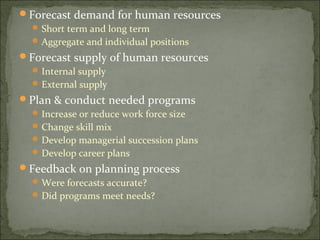
Forecast demand for human resources
 Short term and long term
 Aggregate and individual positions
Forecast supply of human resources
 Internal supply
 External supply
Plan & conduct needed programs
 Increase or reduce work force size
 Change skill mix
 Develop managerial succession plans
 Develop career plans
Feedback on planning process
 Were forecasts accurate?
 Did programs meet needs?
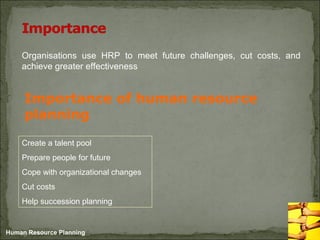
Organisations use HRP to meet future challenges, cut costs, and
achieve greater effectiveness
Human Resource Planning
Importance of human resource
planning
Create a talent pool
Prepare people for future
Cope with organizational changes
Cut costs
Help succession planning
Human Resource Planning
The Process Of HRP
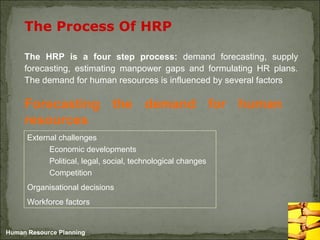
The HRP is a four step process: demand forecasting, supply
forecasting, estimating manpower gaps and formulating HR plans.
The demand for human resources is influenced by several factors
Forecasting the demand for human
resources
External challenges
Economic developments
Political, legal, social, technological changes
Competition
Organisational decisions
Workforce factors
Human Resource Planning
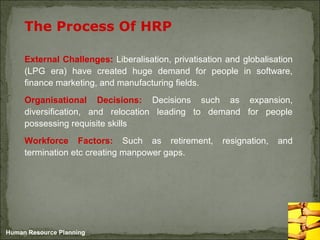
External Challenges: Liberalisation, privatisation and globalisation
(LPG era) have created huge demand for people in software,
finance marketing, and manufacturing fields.
Organisational Decisions: Decisions such as expansion,
diversification, and relocation leading to demand for people
possessing requisite skills
Workforce Factors: Such as retirement, resignation, and
termination etc creating manpower gaps.
The Process Of HRP
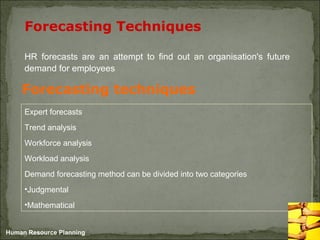
Forecasting Techniques
HR forecasts are an attempt to find out an organisation's future
demand for employees
Human Resource Planning
Forecasting techniques
Expert forecasts
Trend analysis
Workforce analysis
Workload analysis
Demand forecasting method can be divided into two categories
•Judgmental
•Mathematical
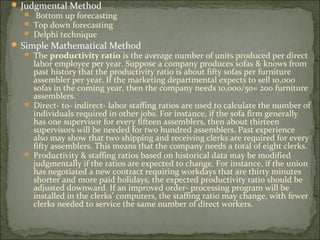
 Judgmental Method
 Bottom up forecasting
 Top down forecasting
 Delphi technique
 Simple Mathematical Method
 The productivity ratio is the average number of units produced per direct
labor employee per year. Suppose a company produces sofas & knows from
past history that the productivity ratio is about fifty sofas per furniture
assembler per year. If the marketing departmental expects to sell 10,000
sofas in the coming year, then the company needs 10,000/50= 200 furniture
assemblers.
 Direct- to- indirect- labor staffing ratios are used to calculate the number of
individuals required in other jobs. For instance, if the sofa firm generally
has one supervisor for every fifteen assemblers, then about thirteen
supervisors will be needed for two hundred assemblers. Past experience
also may show that two shipping and receiving clerks are required for every
fifty assemblers. This means that the company needs a total of eight clerks.
 Productivity & staffing ratios based on historical data may be modified
judgmentally if the ratios are expected to change. For instance, if the union
has negotiated a new contract requiring workdays that are thirty minutes
shorter and more paid holidays, the expected productivity ratio should be
adjusted downward. If an improved order- processing program will be
installed in the clerks’ computers, the staffing ratio may change, with fewer
clerks needed to service the same number of direct workers.
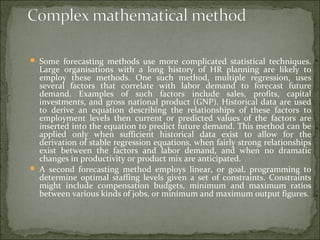
 Some forecasting methods use more complicated statistical techniques.
Large organisations with a long history of HR planning are likely to
employ these methods. One such method, multiple regression, uses
several factors that correlate with labor demand to forecast future
demand. Examples of such factors include sales, profits, capital
investments, and gross national product (GNP). Historical data are used
to derive an equation describing the relationships of these factors to
employment levels then current or predicted values of the factors are
inserted into the equation to predict future demand. This method can be
applied only when sufficient historical data exist to allow for the
derivation of stable regression equations, when fairly strong relationships
exist between the factors and labor demand, and when no dramatic
changes in productivity or product mix are anticipated.
 A second forecasting method employs linear, or goal, programming to
determine optimal staffing levels given a set of constraints. Constraints
might include compensation budgets, minimum and maximum ratios
between various kinds of jobs, or minimum and maximum output figures.
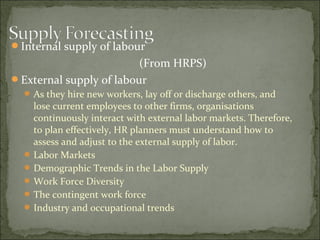
Internal supply of labour
(From HRPS)
External supply of labour
 As they hire new workers, lay off or discharge others, and
lose current employees to other firms, organisations
continuously interact with external labor markets. Therefore,
to plan effectively, HR planners must understand how to
assess and adjust to the external supply of labor.
 Labor Markets
 Demographic Trends in the Labor Supply
 Work Force Diversity
 The contingent work force
 Industry and occupational trends
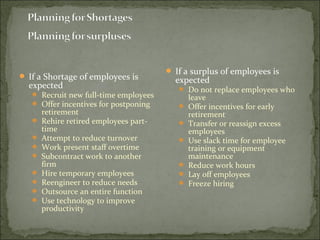
 If a Shortage of employees is
expected
 Recruit new full-time employees
 Offer incentives for postponing
retirement
 Rehire retired employees part-
time
 Attempt to reduce turnover
 Work present staff overtime
 Subcontract work to another
firm
 Hire temporary employees
 Reengineer to reduce needs
 Outsource an entire function
 Use technology to improve
productivity
 If a surplus of employees is
expected
 Do not replace employees who
leave
 Offer incentives for early
retirement
 Transfer or reassign excess
employees
 Use slack time for employee
training or equipment
maintenance
 Reduce work hours
 Lay off employees
 Freeze hiring
Human Resource Planning
Expert Forecasts: These are based on the judgements of those who
possess good knowledge of future human resource needs
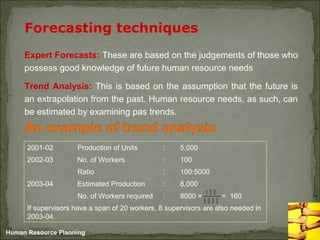
Trend Analysis: This is based on the assumption that the future is
an extrapolation from the past. Human resource needs, as such, can
be estimated by examining pas trends.
Forecasting techniques
2001-02 Production of Units : 5,000
2002-03 No. of Workers : 100
Ratio : 100:5000
2003-04 Estimated Production : 8,000
No. of Workers required : 8000 × = 160
If supervisors have a span of 20 workers, 8 supervisors are also needed in
2003-04.
1 0 0
5 0 0 0
5-9
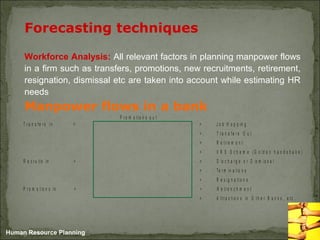
Workforce Analysis: All relevant factors in planning manpower flows
in a firm such as transfers, promotions, new recruitments, retirement,
resignation, dismissal etc are taken into account while estimating HR
needs
Human Resource Planning
Forecasting techniques
Manpower flows in a bank
P r o m o t io n s o u t
T r a n s fe r s I n > > J o b H o p p in g
> T r a n s fe r s O u t
> R e tir e m e n t
> V R S S c h e m e ( G o ld e n h a n d s h a k e )
R e c r u it s In > > D is c h a r g e o r D is m is s a l
> Te r m in a tio n s
> R e s ig n a tio n s
P r o m o tio n s In > > R e tr e n c h m e n t
> A t tr a c tio n s in O t h e r B a n k s , e tc .
Human Resource Planning
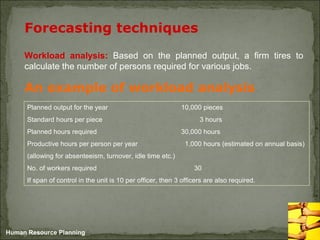
Workload analysis: Based on the planned output, a firm tires to
calculate the number of persons required for various jobs.
Forecasting techniques
An example of workload analysis
Planned output for the year 10,000 pieces
Standard hours per piece 3 hours
Planned hours required 30,000 hours
Productive hours per person per year 1,000 hours (estimated on annual basis)
(allowing for absenteeism, turnover, idle time etc.)
No. of workers required 30
If span of control in the unit is 10 per officer, then 3 officers are also required.
Human Resource Planning
Supply Forecasting
A) Internal labour supply: a manpower inventory in terms of
the size and quality of personnel available (their age, sex,
education, training, experience, job performance, etc) is usually
prepared by HR departments. Several techniques are used
while ascertaining the internal supply of manpower (a supply of
employees to fill projected vacancies can come from within the
firm or from new hires )
Human Resource Planning
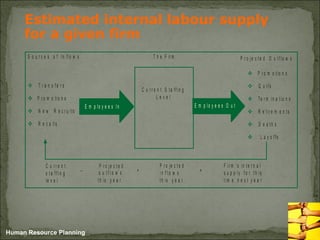
Estimated internal labour supply
for a given firm
T h e F ir mS o u r c e s o f In flo w s
 T r a n s f e r s
 P r o m o tio n s
 N e w R e c r u its
 R e c a lls
 P r o m o t io n s
 Q u its
 Te r m in a tio n s
 R e tir e m e n ts
 D e a th s
 L a y o ffs
E m p lo y e e s In E m p lo y e e s O u t
C u r r e n t
s t a f f i n g
le v e l
P r o je c t e d
o u t f l o w s
th is y e a r
P r o je c t e d
i n f l o w s
th is y e a r
F ir m ’s in te r n a l
s u p p ly f o r t h is
tim e n e x t y e a r
– + =
P r o je c te d O u t f lo w s
C u r r e n t S ta ffin g
L e v e l
5-13
Human Resource Planning
Staffing table: Shows the number of employees in each job, how
they are utilised and the future employment needs for each type of
job.
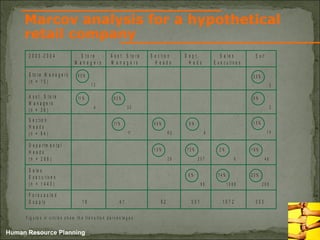
Marcov analysis: Uses historical information from personnel
movements of the internal labour supply to predict what will happen
in the future
Supply Forecasting
5-14
Marcov analysis for a hypothetical
retail company
Human Resource Planning
F ig u r e s in c ir c le s s h o w t h e t r a n s itio n p e r c e n ta g e s
8 0 %
1 2
2 0 %
3
6 %
2
11 %
4
8 3 %
3 0
11 %
11
6 6 %
6 3
8 %
8
1 0 %
2 9
7 2 %
2 0 7
2 %
6
1 6 %
4 6
6 %
8 6
7 4 %
1 0 6 6
2 0 %
2 8 8
1 5 %
1 4
2 0 0 3 - 2 0 0 4 S t o r e A s s t . S t o r e S e c t i o n D e p t . S a l e s E x it
M a n a g e r s M a n a g e r s H e a d s H e d s E x e c u t iv e s
S to r e M a n a g e r s
( n = 1 5 )
A s s t . S t o r e
M a n a g e r s
( n = 3 6 )
S e c t io n
H e a d s
( n = 9 4 )
D e p a r tm e n ta l
H e a d s
( n = 2 8 8 )
S a le s
E x e c u t iv e s
( n = 1 4 4 0 )
F o r e c a s t e d
S u p p ly 1 6 4 1 9 2 3 0 1 1 0 7 2 3 5 3
5-15
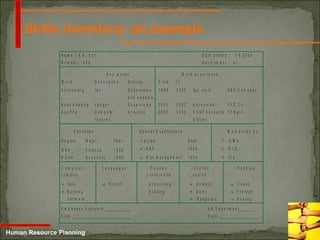
Skills inventory: It is a summary of the skills and abilities of non
managerial employees used in forecasting supply.
Human Resource Planning
Supply Forecasting
5-16
Human Resource Planning
Skills inventory: an example
N a m e : A . K . S e n D a te p r in t e d : 1 - 4 - 2 0 0 4
N u m b e r : 4 2 9 D e p a r tm e n t : 4 1
K e y w o r d s W o r k e x p e r i e n c e
W o r d D e s c r i p t i o n A c t iv it y F r o m T o
A c c o u n t in g Ta x S u p e r v is io n 1 9 9 8 2 0 0 0 Ta x c le r k A B C C o m p a n y
a n d a n a ly s is
B o o k K e e p in g L e d g e r S u p e r v is io n 2 0 0 0 2 0 0 2 A c c o u n t a n t X Y Z C o .
A u d it in g C o m p u te r A n a l y s i s 2 0 0 2 2 0 0 3 C h ie f A c c o u n t s T T B a n k
r e c o r d s O f f i c e r
E d u c a tio n S p e c ia l Q u a lific a tio n s M e m b e r s h i p s
D e g r e e M a jo r Y e a r C o u r s e D a te 1 . A IM A
M B A F in a n c e 1 9 9 8 D B F 1 9 9 6 2 . I S T D
B .C o m A c c o u n t s 1 9 9 5 R is k M a n a g e m e n t 1 9 9 9 3 . I C A
C o m p u t e r L a n g u a g e s P o s i t io n L o c a t i o n H o b b ie s
L i t e r a c y p r e f e r e n c e c h o i c e
 Ta lly F r e n c h A c c o u n t in g K o lk a t a C h e s s
 B a n k in g A u d it in g D e lh i F o o t b a ll
S o f tw a r e B a n g a lo r e B o a t in g
E m p lo y e e s S ig n a tu r e _ _ _ _ _ _ _ _ _ _ H R D e p a r tm e n t_ _ _ _ _ _ _ _
D a te _ _ _ _ _ _ _ _ _ _ _ _ _ _ _ _ _ _ _ _ _ _ _ D a t e _ _ _ _ _ _ _ _ _ _ _ _ _ _ _ _
5-17
Human Resource Planning
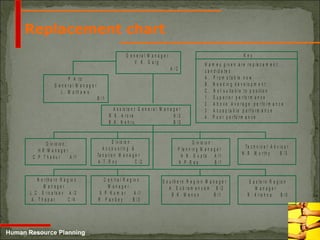
Replacement chart: It is a visual representation of who will replace
whom in the event of a job opening.
Supply Forecasting
5-18
Human Resource Planning
Replacement chart
G e n e r a l M a n a g e r
V . K . G a r g
A / 2
K e y
N a m e s g iv e n a r e r e p la c e m e n t
c a n d id a te s
A . P r o m o t a b le n o w
B . N e e d in g d e v e lo p m e n t
C . N o t s u ita b le t o p o s it io n
1 . S u p e r io r p e r fo r m a n c e
2 . A b o v e A v e r a g e p e r f o r m a n c e
3 . A c c e p ta b le p e r f o r m a n c e
4 . P o o r p e r fo r m a n c e
P A to
G e n e r a l M a n a g e r
L . M a t h e w s
B / 1
A s s is ta n t G e n e r a l M a n a g e r
R .K . A r o r a A / 2
B . K . N e h r u B / 3
D iv is io n :
H R M a n a g e r
C .P. T h a k u r A /1
D iv is io n :
A c c o u n t in g &
Ta x a t io n M a n a g e r
A .T. R o y C /2
D iv is io n :
P la n n in g M a n a g e r
A .N . G u p t a A /1
K .P. R a o B /1
Te c h n ic a l A d v is o r
N . R . M u r t h y B /3
N o r t h e r n R e g io n
M a n a g e r
L .C . S r iv a ts a v A / 2
A . T h a p a r C /4
C e n tr a l R e g io n
M a n a g e r
S .P. K u m a r A /1
R . P a n d e y B / 3
S o u t h e r n R e g io n M a n a g e r
A . S u b r a m a n y a m B / 2
B .K . M e n o n B /1
E a s te r n R e g io n
M a n a g e r
R . K r is h n a B /3
5-19
B) External Labour supply: External hires need to be contacted
when suitable internal replacements are not available. A growing
number of firms are now using computerised human resource
information systems to track the qualifications of hundreds or
thousands of employees. HRIS can provide managers with a
listing of candidates with required qualifications after scanning the
data base.
Human Resource Planning
Supply Forecasting
5-20
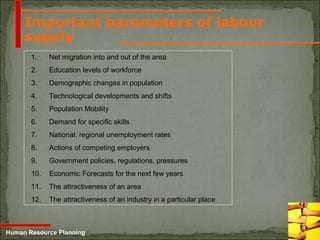
Important barometers of labour
supply
Human Resource Planning
1. Net migration into and out of the area
2. Education levels of workforce
3. Demographic changes in population
4. Technological developments and shifts
5. Population Mobility
6. Demand for specific skills
7. National, regional unemployment rates
8. Actions of competing employers
9. Government policies, regulations, pressures
10. Economic Forecasts for the next few years
11. The attractiveness of an area
12. The attractiveness of an industry in a particular place
5-21
Human Resource Planning
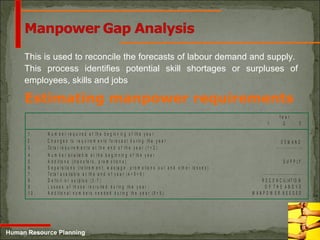
This is used to reconcile the forecasts of labour demand and supply.
This process identifies potential skill shortages or surpluses of
employees, skills and jobs
Estimating manpower requirements
Y e a r
1 2 3
1 . N u m b e r r e q u ir e d a t th e b e g in n in g o f t h e y e a r
2 . C h a n g e s to r e q u ir e m e n ts f o r e c a s t d u r in g t h e y e a r D E M A N D
3 . To ta l r e q u ir e m e n t s a t t h e e n d o f t h e y e a r ( 1 + 2 ) - - - - - - - - - - - - -
4 . N u m b e r a v a ila b le a t t h e b e g in n in g o f th e y e a r
5 . A d d it io n s ( t r a n s fe r s , p r o m o t io n s ) S U P P LY
6 . S e p a r a t io n s ( r e tir e m e n t, w a s ta g e , p r o m o t io n s o u t a n d o th e r lo s s e s )
7 . To ta l a v a ila b le a t th e e n d o f y e a r ( 4 + 5 + 6 ) - - - - - - - - - - - - - - - - - - - -
8 . D e fic it o r s u r p lu s ( 3 - 7 ) R E C O N C IL IA T IO N
9 . L o s s e s o f th o s e r e c r u ite d d u r in g th e y e a r O F T H E A B O V E
1 0 . A d d itio n a l n u m b e r s n e e d e d d u r in g th e y e a r ( 8 + 9 ) M A N P O W E R N E E D E D
5-22
Formulating HR Plans
Human Resource Planning
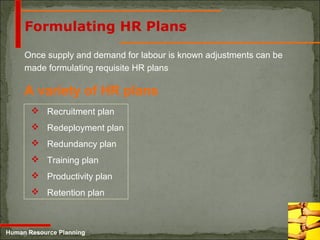
Once supply and demand for labour is known adjustments can be
made formulating requisite HR plans
A variety of HR plans
 Recruitment plan
 Redeployment plan
 Redundancy plan
 Training plan
 Productivity plan
 Retention plan
5-23
Responsibility For Human Resource
Planning
HRP is a top management job. HR plans are usually made by the
HR division in consultation with other corporate heads. Any
deviations from the formulated plans and their causes must be
looked into, from time to time in order to assess whether the plans
require revision or modification.
Human Resource Planning
5-24
Limitations Of Human Resource
Planning
HR professionals are basically confronted with three problems while
preparing and administering HR plans: accuracy, inadequate top
management support, lopsided focus on quantitative aspects.
Human Resource Planning
5-25
Effective Human Resource Planning
HR plans must fit in with overall objectives of a firm. They must get
consistent support from top management. Computerised human resource
information systems must be used for applicant tracking, succession
planning, building skills inventories etc. The whole exercise must be
carried out in coordination with operating managers.
Human Resource Planning

Hr planning

  • 1.
    KULDEEP MATHUR M.B.A. JIWAJIUNIVERSITY GWALIOR
  • 2.
    WHAT IS HUMANRESOURCE PLANNING 5-2 H.R.P—is concerned with the flow of people into, through, and out of an organisation. HR planning involves anticipating the need for labor and the supply of labour and then planning the programs necessary to ensure that the organisation will have the right mix of employees and skills when and where they are needed. HRP offers an estimate of the number of employees required with matching skill requirements to meet organisational objectives. HRP is a forward looking function as human resource estimates are made well in advance. It is, of course, subject to revision. Human Resource Planning
  • 3.
    Human Resource Planning Objective Thebasic purpose of HRP is to decide what positions the organisation will have to fill and how to fill them. Objectives of human resource planning Forecast personnel requirements Cope with changes Use existing manpower productively Promote employees in a systematic way Obtains and retains the quantity & quality of human resources it needs at the right time and place Makes optimum utilization of these resources
  • 4.
    Significance of HRP Competitive business environment  Government legislations and regulations  Labour market changes  Productivity increases  Knowledge economy and knowledge workers  Technological advancements  Growth of services economy
  • 5.
    Human Resource PlanningModel Collect information A. From the external environment economy – general and specific industry technology competition Benchmarking & best practice information labor markets Demographic & social trends Government regulations B. From inside the organization Strategy Business plans Current human resources Rates of turnover and mobility
  • 6.
    Forecast demand forhuman resources  Short term and long term  Aggregate and individual positions Forecast supply of human resources  Internal supply  External supply Plan & conduct needed programs  Increase or reduce work force size  Change skill mix  Develop managerial succession plans  Develop career plans Feedback on planning process  Were forecasts accurate?  Did programs meet needs?
  • 7.
    Organisations use HRPto meet future challenges, cut costs, and achieve greater effectiveness Human Resource Planning Importance of human resource planning Create a talent pool Prepare people for future Cope with organizational changes Cut costs Help succession planning
  • 8.
    Human Resource Planning TheProcess Of HRP The HRP is a four step process: demand forecasting, supply forecasting, estimating manpower gaps and formulating HR plans. The demand for human resources is influenced by several factors Forecasting the demand for human resources External challenges Economic developments Political, legal, social, technological changes Competition Organisational decisions Workforce factors
  • 9.
    Human Resource Planning ExternalChallenges: Liberalisation, privatisation and globalisation (LPG era) have created huge demand for people in software, finance marketing, and manufacturing fields. Organisational Decisions: Decisions such as expansion, diversification, and relocation leading to demand for people possessing requisite skills Workforce Factors: Such as retirement, resignation, and termination etc creating manpower gaps. The Process Of HRP
  • 10.
    Forecasting Techniques HR forecastsare an attempt to find out an organisation's future demand for employees Human Resource Planning Forecasting techniques Expert forecasts Trend analysis Workforce analysis Workload analysis Demand forecasting method can be divided into two categories •Judgmental •Mathematical
  • 11.
     Judgmental Method Bottom up forecasting  Top down forecasting  Delphi technique  Simple Mathematical Method  The productivity ratio is the average number of units produced per direct labor employee per year. Suppose a company produces sofas & knows from past history that the productivity ratio is about fifty sofas per furniture assembler per year. If the marketing departmental expects to sell 10,000 sofas in the coming year, then the company needs 10,000/50= 200 furniture assemblers.  Direct- to- indirect- labor staffing ratios are used to calculate the number of individuals required in other jobs. For instance, if the sofa firm generally has one supervisor for every fifteen assemblers, then about thirteen supervisors will be needed for two hundred assemblers. Past experience also may show that two shipping and receiving clerks are required for every fifty assemblers. This means that the company needs a total of eight clerks.  Productivity & staffing ratios based on historical data may be modified judgmentally if the ratios are expected to change. For instance, if the union has negotiated a new contract requiring workdays that are thirty minutes shorter and more paid holidays, the expected productivity ratio should be adjusted downward. If an improved order- processing program will be installed in the clerks’ computers, the staffing ratio may change, with fewer clerks needed to service the same number of direct workers.
  • 12.
     Some forecastingmethods use more complicated statistical techniques. Large organisations with a long history of HR planning are likely to employ these methods. One such method, multiple regression, uses several factors that correlate with labor demand to forecast future demand. Examples of such factors include sales, profits, capital investments, and gross national product (GNP). Historical data are used to derive an equation describing the relationships of these factors to employment levels then current or predicted values of the factors are inserted into the equation to predict future demand. This method can be applied only when sufficient historical data exist to allow for the derivation of stable regression equations, when fairly strong relationships exist between the factors and labor demand, and when no dramatic changes in productivity or product mix are anticipated.  A second forecasting method employs linear, or goal, programming to determine optimal staffing levels given a set of constraints. Constraints might include compensation budgets, minimum and maximum ratios between various kinds of jobs, or minimum and maximum output figures.
  • 13.
    Internal supply oflabour (From HRPS) External supply of labour  As they hire new workers, lay off or discharge others, and lose current employees to other firms, organisations continuously interact with external labor markets. Therefore, to plan effectively, HR planners must understand how to assess and adjust to the external supply of labor.  Labor Markets  Demographic Trends in the Labor Supply  Work Force Diversity  The contingent work force  Industry and occupational trends
  • 14.
     If aShortage of employees is expected  Recruit new full-time employees  Offer incentives for postponing retirement  Rehire retired employees part- time  Attempt to reduce turnover  Work present staff overtime  Subcontract work to another firm  Hire temporary employees  Reengineer to reduce needs  Outsource an entire function  Use technology to improve productivity  If a surplus of employees is expected  Do not replace employees who leave  Offer incentives for early retirement  Transfer or reassign excess employees  Use slack time for employee training or equipment maintenance  Reduce work hours  Lay off employees  Freeze hiring
  • 15.
    Human Resource Planning ExpertForecasts: These are based on the judgements of those who possess good knowledge of future human resource needs Trend Analysis: This is based on the assumption that the future is an extrapolation from the past. Human resource needs, as such, can be estimated by examining pas trends. Forecasting techniques 2001-02 Production of Units : 5,000 2002-03 No. of Workers : 100 Ratio : 100:5000 2003-04 Estimated Production : 8,000 No. of Workers required : 8000 × = 160 If supervisors have a span of 20 workers, 8 supervisors are also needed in 2003-04. 1 0 0 5 0 0 0
  • 16.
    5-9 Workforce Analysis: Allrelevant factors in planning manpower flows in a firm such as transfers, promotions, new recruitments, retirement, resignation, dismissal etc are taken into account while estimating HR needs Human Resource Planning Forecasting techniques Manpower flows in a bank P r o m o t io n s o u t T r a n s fe r s I n > > J o b H o p p in g > T r a n s fe r s O u t > R e tir e m e n t > V R S S c h e m e ( G o ld e n h a n d s h a k e ) R e c r u it s In > > D is c h a r g e o r D is m is s a l > Te r m in a tio n s > R e s ig n a tio n s P r o m o tio n s In > > R e tr e n c h m e n t > A t tr a c tio n s in O t h e r B a n k s , e tc .
  • 17.
    Human Resource Planning Workloadanalysis: Based on the planned output, a firm tires to calculate the number of persons required for various jobs. Forecasting techniques An example of workload analysis Planned output for the year 10,000 pieces Standard hours per piece 3 hours Planned hours required 30,000 hours Productive hours per person per year 1,000 hours (estimated on annual basis) (allowing for absenteeism, turnover, idle time etc.) No. of workers required 30 If span of control in the unit is 10 per officer, then 3 officers are also required.
  • 18.
    Human Resource Planning SupplyForecasting A) Internal labour supply: a manpower inventory in terms of the size and quality of personnel available (their age, sex, education, training, experience, job performance, etc) is usually prepared by HR departments. Several techniques are used while ascertaining the internal supply of manpower (a supply of employees to fill projected vacancies can come from within the firm or from new hires )
  • 19.
    Human Resource Planning Estimatedinternal labour supply for a given firm T h e F ir mS o u r c e s o f In flo w s  T r a n s f e r s  P r o m o tio n s  N e w R e c r u its  R e c a lls  P r o m o t io n s  Q u its  Te r m in a tio n s  R e tir e m e n ts  D e a th s  L a y o ffs E m p lo y e e s In E m p lo y e e s O u t C u r r e n t s t a f f i n g le v e l P r o je c t e d o u t f l o w s th is y e a r P r o je c t e d i n f l o w s th is y e a r F ir m ’s in te r n a l s u p p ly f o r t h is tim e n e x t y e a r – + = P r o je c te d O u t f lo w s C u r r e n t S ta ffin g L e v e l
  • 20.
    5-13 Human Resource Planning Staffingtable: Shows the number of employees in each job, how they are utilised and the future employment needs for each type of job. Marcov analysis: Uses historical information from personnel movements of the internal labour supply to predict what will happen in the future Supply Forecasting
  • 21.
    5-14 Marcov analysis fora hypothetical retail company Human Resource Planning F ig u r e s in c ir c le s s h o w t h e t r a n s itio n p e r c e n ta g e s 8 0 % 1 2 2 0 % 3 6 % 2 11 % 4 8 3 % 3 0 11 % 11 6 6 % 6 3 8 % 8 1 0 % 2 9 7 2 % 2 0 7 2 % 6 1 6 % 4 6 6 % 8 6 7 4 % 1 0 6 6 2 0 % 2 8 8 1 5 % 1 4 2 0 0 3 - 2 0 0 4 S t o r e A s s t . S t o r e S e c t i o n D e p t . S a l e s E x it M a n a g e r s M a n a g e r s H e a d s H e d s E x e c u t iv e s S to r e M a n a g e r s ( n = 1 5 ) A s s t . S t o r e M a n a g e r s ( n = 3 6 ) S e c t io n H e a d s ( n = 9 4 ) D e p a r tm e n ta l H e a d s ( n = 2 8 8 ) S a le s E x e c u t iv e s ( n = 1 4 4 0 ) F o r e c a s t e d S u p p ly 1 6 4 1 9 2 3 0 1 1 0 7 2 3 5 3
  • 22.
    5-15 Skills inventory: Itis a summary of the skills and abilities of non managerial employees used in forecasting supply. Human Resource Planning Supply Forecasting
  • 23.
    5-16 Human Resource Planning Skillsinventory: an example N a m e : A . K . S e n D a te p r in t e d : 1 - 4 - 2 0 0 4 N u m b e r : 4 2 9 D e p a r tm e n t : 4 1 K e y w o r d s W o r k e x p e r i e n c e W o r d D e s c r i p t i o n A c t iv it y F r o m T o A c c o u n t in g Ta x S u p e r v is io n 1 9 9 8 2 0 0 0 Ta x c le r k A B C C o m p a n y a n d a n a ly s is B o o k K e e p in g L e d g e r S u p e r v is io n 2 0 0 0 2 0 0 2 A c c o u n t a n t X Y Z C o . A u d it in g C o m p u te r A n a l y s i s 2 0 0 2 2 0 0 3 C h ie f A c c o u n t s T T B a n k r e c o r d s O f f i c e r E d u c a tio n S p e c ia l Q u a lific a tio n s M e m b e r s h i p s D e g r e e M a jo r Y e a r C o u r s e D a te 1 . A IM A M B A F in a n c e 1 9 9 8 D B F 1 9 9 6 2 . I S T D B .C o m A c c o u n t s 1 9 9 5 R is k M a n a g e m e n t 1 9 9 9 3 . I C A C o m p u t e r L a n g u a g e s P o s i t io n L o c a t i o n H o b b ie s L i t e r a c y p r e f e r e n c e c h o i c e  Ta lly F r e n c h A c c o u n t in g K o lk a t a C h e s s  B a n k in g A u d it in g D e lh i F o o t b a ll S o f tw a r e B a n g a lo r e B o a t in g E m p lo y e e s S ig n a tu r e _ _ _ _ _ _ _ _ _ _ H R D e p a r tm e n t_ _ _ _ _ _ _ _ D a te _ _ _ _ _ _ _ _ _ _ _ _ _ _ _ _ _ _ _ _ _ _ _ D a t e _ _ _ _ _ _ _ _ _ _ _ _ _ _ _ _
  • 24.
    5-17 Human Resource Planning Replacementchart: It is a visual representation of who will replace whom in the event of a job opening. Supply Forecasting
  • 25.
    5-18 Human Resource Planning Replacementchart G e n e r a l M a n a g e r V . K . G a r g A / 2 K e y N a m e s g iv e n a r e r e p la c e m e n t c a n d id a te s A . P r o m o t a b le n o w B . N e e d in g d e v e lo p m e n t C . N o t s u ita b le t o p o s it io n 1 . S u p e r io r p e r fo r m a n c e 2 . A b o v e A v e r a g e p e r f o r m a n c e 3 . A c c e p ta b le p e r f o r m a n c e 4 . P o o r p e r fo r m a n c e P A to G e n e r a l M a n a g e r L . M a t h e w s B / 1 A s s is ta n t G e n e r a l M a n a g e r R .K . A r o r a A / 2 B . K . N e h r u B / 3 D iv is io n : H R M a n a g e r C .P. T h a k u r A /1 D iv is io n : A c c o u n t in g & Ta x a t io n M a n a g e r A .T. R o y C /2 D iv is io n : P la n n in g M a n a g e r A .N . G u p t a A /1 K .P. R a o B /1 Te c h n ic a l A d v is o r N . R . M u r t h y B /3 N o r t h e r n R e g io n M a n a g e r L .C . S r iv a ts a v A / 2 A . T h a p a r C /4 C e n tr a l R e g io n M a n a g e r S .P. K u m a r A /1 R . P a n d e y B / 3 S o u t h e r n R e g io n M a n a g e r A . S u b r a m a n y a m B / 2 B .K . M e n o n B /1 E a s te r n R e g io n M a n a g e r R . K r is h n a B /3
  • 26.
    5-19 B) External Laboursupply: External hires need to be contacted when suitable internal replacements are not available. A growing number of firms are now using computerised human resource information systems to track the qualifications of hundreds or thousands of employees. HRIS can provide managers with a listing of candidates with required qualifications after scanning the data base. Human Resource Planning Supply Forecasting
  • 27.
    5-20 Important barometers oflabour supply Human Resource Planning 1. Net migration into and out of the area 2. Education levels of workforce 3. Demographic changes in population 4. Technological developments and shifts 5. Population Mobility 6. Demand for specific skills 7. National, regional unemployment rates 8. Actions of competing employers 9. Government policies, regulations, pressures 10. Economic Forecasts for the next few years 11. The attractiveness of an area 12. The attractiveness of an industry in a particular place
  • 28.
    5-21 Human Resource Planning Thisis used to reconcile the forecasts of labour demand and supply. This process identifies potential skill shortages or surpluses of employees, skills and jobs Estimating manpower requirements Y e a r 1 2 3 1 . N u m b e r r e q u ir e d a t th e b e g in n in g o f t h e y e a r 2 . C h a n g e s to r e q u ir e m e n ts f o r e c a s t d u r in g t h e y e a r D E M A N D 3 . To ta l r e q u ir e m e n t s a t t h e e n d o f t h e y e a r ( 1 + 2 ) - - - - - - - - - - - - - 4 . N u m b e r a v a ila b le a t t h e b e g in n in g o f th e y e a r 5 . A d d it io n s ( t r a n s fe r s , p r o m o t io n s ) S U P P LY 6 . S e p a r a t io n s ( r e tir e m e n t, w a s ta g e , p r o m o t io n s o u t a n d o th e r lo s s e s ) 7 . To ta l a v a ila b le a t th e e n d o f y e a r ( 4 + 5 + 6 ) - - - - - - - - - - - - - - - - - - - - 8 . D e fic it o r s u r p lu s ( 3 - 7 ) R E C O N C IL IA T IO N 9 . L o s s e s o f th o s e r e c r u ite d d u r in g th e y e a r O F T H E A B O V E 1 0 . A d d itio n a l n u m b e r s n e e d e d d u r in g th e y e a r ( 8 + 9 ) M A N P O W E R N E E D E D
  • 29.
    5-22 Formulating HR Plans HumanResource Planning Once supply and demand for labour is known adjustments can be made formulating requisite HR plans A variety of HR plans  Recruitment plan  Redeployment plan  Redundancy plan  Training plan  Productivity plan  Retention plan
  • 30.
    5-23 Responsibility For HumanResource Planning HRP is a top management job. HR plans are usually made by the HR division in consultation with other corporate heads. Any deviations from the formulated plans and their causes must be looked into, from time to time in order to assess whether the plans require revision or modification. Human Resource Planning
  • 31.
    5-24 Limitations Of HumanResource Planning HR professionals are basically confronted with three problems while preparing and administering HR plans: accuracy, inadequate top management support, lopsided focus on quantitative aspects. Human Resource Planning
  • 32.
    5-25 Effective Human ResourcePlanning HR plans must fit in with overall objectives of a firm. They must get consistent support from top management. Computerised human resource information systems must be used for applicant tracking, succession planning, building skills inventories etc. The whole exercise must be carried out in coordination with operating managers. Human Resource Planning