Management
Development
   2013
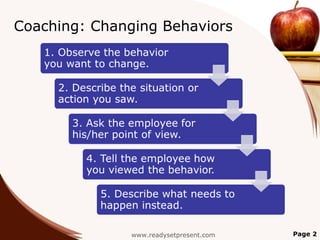
Coaching: Changing Behaviors


               www.readysetpresent.com   Page 2
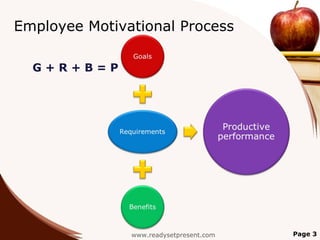
Employee Motivational Process

  G+R+B=P


               www.readysetpresent.com   Page 3
Program Objectives         (1 of 2)

     Be able to identify management
      styles.
     Know how to communicate
      effectively.
     Learn about the behavior
      changing coaching process.
     Understand motivation and how
      to inspire it.


                    www.readysetpresent.com   Page 4
Program Objectives          (1 of 2)

     Know how to set goals
     Understand how to manage time
      and avoid procrastination.
     Learn how to delegate effectively.
     Be able to problem-solve.
     Know how to brainstorm.


                     www.readysetpresent.com   Page 5
Definition


     Management: The process of
      dealing with and controlling
      people and situations

     Development: The process of
      growing and changing, and
      increasing abilities


                    www.readysetpresent.com   Page 6
Management, Leadership &
Coaching

     Can you identify your own and
      different management styles?
     How can you improve your
      communication skills?
     What are some elements of
      positive leadership?


                    www.readysetpresent.com   Page 7
Effective Leadership Is
A Process

     As a leader, you continually
      increase your ability to realize the
      best in yourself and to bring out
      the best in others.


                      www.readysetpresent.com   Page 8
Six Ways To Foster Trust               (1 of 3)


  1.   Be reliable. Follow through, and
       keep your promises.
  2.   Have ethics. Deal with associates
       fairly and honestly.
  3.   Show respect for your employees.
       Treat them as adults, and show
       appreciation.


                     www.readysetpresent.com      Page 9
Three Managerial Areas
Of Competency

  1.   Technical: Understanding
       methods, processes, procedures
       and techniques
  2.   Human: Handling people and
       interactions
  3.   Conceptual: The ability to view
       the organization as a whole, deal
       with abstractions, develop ideas
       and see causes and effects


                     www.readysetpresent.com   Page 10
Hints For Effective
Communication (2 of 2)

     When you give advice or
      directions, do it directly and
      politely.
     Phrase statements as questions:
      "Have you thought about doing it
      this way?"
     Use "I" or "me" statements: "I do
      it this way" or "I try to ..."
     Express your feelings rather than
      blaming: "I'm bothered when ...
      It makes me feel ... "

                    www.readysetpresent.com   Page 11
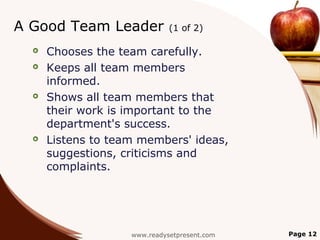
A Good Team Leader            (1 of 2)

     Chooses the team carefully.
     Keeps all team members
      informed.
     Shows all team members that
      their work is important to the
      department's success.
     Listens to team members' ideas,
      suggestions, criticisms and
      complaints.


                    www.readysetpresent.com   Page 12
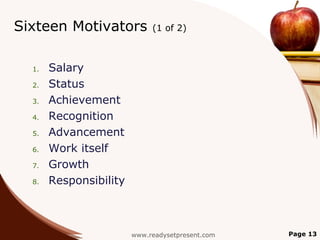
Sixteen Motivators           (1 of 2)


  1.   Salary
  2.   Status
  3.   Achievement
  4.   Recognition
  5.   Advancement
  6.   Work itself
  7.   Growth
  8.   Responsibility


                        www.readysetpresent.com   Page 13
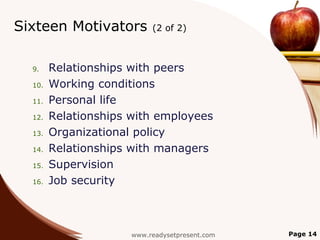
Sixteen Motivators         (2 of 2)


  9.    Relationships with peers
  10.   Working conditions
  11.   Personal life
  12.   Relationships with employees
  13.   Organizational policy
  14.   Relationships with managers
  15.   Supervision
  16.   Job security


                      www.readysetpresent.com   Page 14
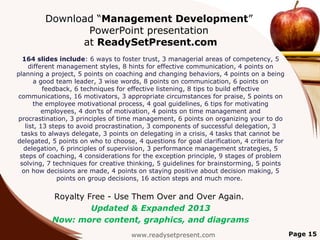
Download “Management Development”
                PowerPoint presentation
               at ReadySetPresent.com
  164 slides include: 6 ways to foster trust, 3 managerial areas of competency, 5
     different management styles, 8 hints for effective communication, 4 points on
planning a project, 5 points on coaching and changing behaviors, 4 points on a being
       a good team leader, 3 wise words, 8 points on communication, 6 points on
          feedback, 6 techniques for effective listening, 8 tips to build effective
communications, 16 motivators, 3 appropriate circumstances for praise, 5 points on
       the employee motivational process, 4 goal guidelines, 6 tips for motivating
          employees, 4 don’ts of motivation, 4 points on time management and
procrastination, 3 principles of time management, 6 points on organizing your to do
   list, 13 steps to avoid procrastination, 3 components of successful delegation, 3
 tasks to always delegate, 3 points on delegating in a crisis, 4 tasks that cannot be
delegated, 5 points on who to choose, 4 questions for goal clarification, 4 criteria for
  delegation, 6 principles of supervision, 3 performance management strategies, 5
 steps of coaching, 4 considerations for the exception principle, 9 stages of problem
 solving, 7 techniques for creative thinking, 5 guidelines for brainstorming, 5 points
  on how decisions are made, 4 points on staying positive about decision making, 5
               points on group decisions, 16 action steps and much more.


           Royalty Free - Use Them Over and Over Again.
                    Updated & Expanded 2013
           Now: more content, graphics, and diagrams
                                     www.readysetpresent.com                               Page 15

Management Development (Modern) PowerPoint Content

  • 1.
  • 2.
    Coaching: Changing Behaviors www.readysetpresent.com Page 2
  • 3.
    Employee Motivational Process G+R+B=P www.readysetpresent.com Page 3
  • 4.
    Program Objectives (1 of 2)  Be able to identify management styles.  Know how to communicate effectively.  Learn about the behavior changing coaching process.  Understand motivation and how to inspire it. www.readysetpresent.com Page 4
  • 5.
    Program Objectives (1 of 2)  Know how to set goals  Understand how to manage time and avoid procrastination.  Learn how to delegate effectively.  Be able to problem-solve.  Know how to brainstorm. www.readysetpresent.com Page 5
  • 6.
    Definition  Management: The process of dealing with and controlling people and situations  Development: The process of growing and changing, and increasing abilities www.readysetpresent.com Page 6
  • 7.
    Management, Leadership & Coaching  Can you identify your own and different management styles?  How can you improve your communication skills?  What are some elements of positive leadership? www.readysetpresent.com Page 7
  • 8.
    Effective Leadership Is AProcess  As a leader, you continually increase your ability to realize the best in yourself and to bring out the best in others. www.readysetpresent.com Page 8
  • 9.
    Six Ways ToFoster Trust (1 of 3) 1. Be reliable. Follow through, and keep your promises. 2. Have ethics. Deal with associates fairly and honestly. 3. Show respect for your employees. Treat them as adults, and show appreciation. www.readysetpresent.com Page 9
  • 10.
    Three Managerial Areas OfCompetency 1. Technical: Understanding methods, processes, procedures and techniques 2. Human: Handling people and interactions 3. Conceptual: The ability to view the organization as a whole, deal with abstractions, develop ideas and see causes and effects www.readysetpresent.com Page 10
  • 11.
    Hints For Effective Communication(2 of 2)  When you give advice or directions, do it directly and politely.  Phrase statements as questions: "Have you thought about doing it this way?"  Use "I" or "me" statements: "I do it this way" or "I try to ..."  Express your feelings rather than blaming: "I'm bothered when ... It makes me feel ... " www.readysetpresent.com Page 11
  • 12.
    A Good TeamLeader (1 of 2)  Chooses the team carefully.  Keeps all team members informed.  Shows all team members that their work is important to the department's success.  Listens to team members' ideas, suggestions, criticisms and complaints. www.readysetpresent.com Page 12
  • 13.
    Sixteen Motivators (1 of 2) 1. Salary 2. Status 3. Achievement 4. Recognition 5. Advancement 6. Work itself 7. Growth 8. Responsibility www.readysetpresent.com Page 13
  • 14.
    Sixteen Motivators (2 of 2) 9. Relationships with peers 10. Working conditions 11. Personal life 12. Relationships with employees 13. Organizational policy 14. Relationships with managers 15. Supervision 16. Job security www.readysetpresent.com Page 14
  • 15.
    Download “Management Development” PowerPoint presentation at ReadySetPresent.com 164 slides include: 6 ways to foster trust, 3 managerial areas of competency, 5 different management styles, 8 hints for effective communication, 4 points on planning a project, 5 points on coaching and changing behaviors, 4 points on a being a good team leader, 3 wise words, 8 points on communication, 6 points on feedback, 6 techniques for effective listening, 8 tips to build effective communications, 16 motivators, 3 appropriate circumstances for praise, 5 points on the employee motivational process, 4 goal guidelines, 6 tips for motivating employees, 4 don’ts of motivation, 4 points on time management and procrastination, 3 principles of time management, 6 points on organizing your to do list, 13 steps to avoid procrastination, 3 components of successful delegation, 3 tasks to always delegate, 3 points on delegating in a crisis, 4 tasks that cannot be delegated, 5 points on who to choose, 4 questions for goal clarification, 4 criteria for delegation, 6 principles of supervision, 3 performance management strategies, 5 steps of coaching, 4 considerations for the exception principle, 9 stages of problem solving, 7 techniques for creative thinking, 5 guidelines for brainstorming, 5 points on how decisions are made, 4 points on staying positive about decision making, 5 points on group decisions, 16 action steps and much more. Royalty Free - Use Them Over and Over Again. Updated & Expanded 2013 Now: more content, graphics, and diagrams www.readysetpresent.com Page 15