M .HIMABINDU
Contents:
 Unit-1:
1.   Introduction
2.   Significance
3.   Process
4.   Systems approach to human resource planning
5.   Micro level man power planning
6.   Labour market analysis
7.   Man power inventorying-methods
INTRODUCTION:
 Human Resource is an important corporate asset and the
 overall performance of companies depends upon the way
 it is put to use.

 Globally Major issues in today’s organizations are skill
 shortages, competency gaps, redundancies, downsizing,
 rightsizing.
INTRODUCTION:
 Causes of the issues are Inadequate Business Planning,
 Inflexibility of Job, Job Descriptions, Absence of Training &
 Development Programmes.
 In order to realize company objectives. It is essential to have a
 human resource planning (HRP) is essentially the process of
 getting the right number of qualified people into the right job at
 the right time so that an organization can meet its objectives.
PLANNING?
 Making schedule in advance

 Example:-Plan how to study for

    exams

            WHAT to study ?

            WHEN to study?
HUMAN RESOURCE PLANNING
 HUMAN RESOURCE PLANNING(HRP) is a process by
 which an organization strikes a balance between the
 human resources REQUIRED and ACQUIRED in the
 organization.
Contd.,
 “HRP includes estimation of how many qualified people
 are necessary to carry out the assigned activities, how
 many people will be available, and what , if anything,
 must be done to ensure that personnel supply equals
 personnel demand at the appropriate time in the future.”

                          -Terry L.Leap and Michael
Contd..,
 “HRP is a process of determining and assuming that the
  organization will have an adequate number of qualified
  persons , available at the proper times, performing jobs
  which meet the needs of the enterprise and which provide
  satisfaction for the individuals involved.”

                              -Dales Beach
Contd..,
 “HRP is the process – including forecasting, developing
  and controlling – by which a firm ensures that it has the
  right number of people at the right places at the right time
  doing work for which they are economically most useful.”

                                      -G.B.Geisler
OBJECTIVES OF HRP:
1. Ensure adequate supply of manpower as and WHEN
   required.

2. Ensure proper use of existing human resources in the
   organization.
OBJECTIVES OF HRP:
 Forecast future requirements of human resources with
   different levels of skills.

 Assess surplus or shortage, if any, human resources
   available over a specified period of time.
Contd..,
 Anticipate the impact of technology on job and
   requirements for human resources.

 The ultimate objective is to relate future human
   resources to future enterprise needs so as to maximize
   the future return on investment in human resources.
Contd..,
 Control the human resources already deployed in the
   organization.

 Provide lead time available to select and train the
   required additional human resource over a specified time
   period.
NEED AND IMPORTANCE OF HRP
1. The paradox often is that even with growing
   unemployment, there has been shortage of human
   resources with the required skills, qualifications and
   capability to do various work. Hence, the need for HRP.
NEED AND IMPORTANCE OF HRP
 Large numbers of employees who retire, die, leave
  organizations, or become incapacitated because of
  physical or mental ailments, need to be replaced by new
  employees. Human Resource Planning ensures smooth
  supply of workers without interruption
Contd..,
   Human Resource Planning is also essential to replace
    workforce turnover. These cause a constant ebb and flow
    in the workforce in many organizations.

   Required to meet the needs of expansion and
    diversification of organization.
Contd..,
   Technological changes and globalization usher in change
    in the methods of production, distribution and servicing
    of goods/products. These changes may require change of
    skills as well as the change in the number of employees
    required.HRP helps management to adjust and cope with
    such changes.
Contd..,
5. Identifies areas of surplus personnel and also areas
   where there are shortage of people. Steps can then be
   taken to redeploy and/or recruit or downsize (downsize
   means giving VRS etc).
Significance of HRP
 Uncertainties can be managed through planning

 Helps   the   organization     develop   action   plan   for
 achievement of company’s objective for future

 For strategic implementation
Significance of HRP
 To minimize destruction/ disruption of organization
 process

 Helps to focus sharper at your competitive posture or
 position

 Focuses on short & long term people requirements
FACTORS AFFECTING HRP
1.   Type and strategy of the organization

2.   Organizational growth cycles and planning

3.   Environmental uncertainties

4.   Time horizons

5.   Type and quality of forecasting information

6.   Nature of jobs being filled

7.   Off loading the work
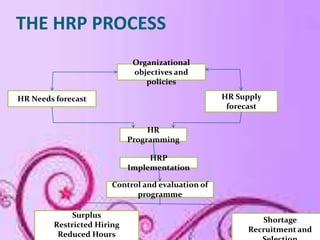
THE HRP PROCESS
                             Organizational
                             objectives and
                                policies

HR Needs forecast                                  HR Supply
                                                    forecast

                                 HR
                            Programming

                                 HRP
                            Implementation

                       Control and evaluation of
                             programme

             Surplus
                                                            Shortage
        Restricted Hiring
                                                         Recruitment and
         Reduced Hours
FORECASTING TECHNIQUES
1. Managerial judgment

2. Ratio – trend analysis

3. Work study techniques

4. Delphi technique

5. Flow models

6. Mathematical models
HR SUPPLY FORECASTING
 The analysis for supply of manpower covers:

  - Existing Human Resources(skill & management
    inventories)

  - Internal sources of supply

  - External sources of supply
HR SUPPLY FORECASTING
 The demand and supply forecast have to be balanced and
  the steps taken to eliminate any mismatch.

 Monitoring/Audit and control have to be maintained for
  keeping the quality and quantity equilibrium
LABOUR MARKET ANALYSIS
 Analysis of labour markets are carried out for different
 occupational segments .
 Investigating markets for knowledgeable and skilled
 workers, differentiating supply and demand forces in the
 markets.
 Macro changes in wages and unemployment over a given
 period.
LABOUR MARKET ANALYSIS
 In India, pioneering studies in labour economics are
 institutionally being carried out by Indian Society Labour
 Economics(ISLE)

 It is trying to develop this as a discipline having
 importance both in academic and professional research to
 understanding human beings
MANPOWER INVENTORY
 Manpower inventory is the record of staffs in a
  commercial organization.

 Manpower inventory involves the classification of
  characteristics of personnel in an organization, in addition
  to counting there numbers.
MANPOWER INVENTORY
 The first step in Manpower inventory is to decide who
  should form a part of it, whether inventory should be in
  relation to only executives or it should cover all persons in
  the organization.
Contd…
 The factual information such as age, sex, experience,
 education, wealth, health, etc. is noted from the records.

 The brief interview with a person helps in understanding
 his caliber, mind-set, aspirations, etc
Contd…
 A summary statement of information is prepared about
  each person and is kept ready for consultation.

The next step is to pass on to talent catalogue.
 The present and future capabilities of persons are
  assessed.
 Some scale is prepared for the appraisal of persons.
Contd…
 Besides appraisal tests, remarks about persons are also
  given.
 The remarks may relate to their talent, choice taking
  ability, training required, etc.
 In this way promotions are also dealt with easily as
  manpower inventory says much about job specialization
  of the concerned persons.
Manpower Inventory Methods
 Man –to- man Comparison


 Man-to-hour Method


 Man-to-Behaviors

HUMAN RESOURCE PLANNING

  • 1.
  • 2.
    Contents:  Unit-1: 1. Introduction 2. Significance 3. Process 4. Systems approach to human resource planning 5. Micro level man power planning 6. Labour market analysis 7. Man power inventorying-methods
  • 3.
    INTRODUCTION: Human Resourceis an important corporate asset and the overall performance of companies depends upon the way it is put to use. Globally Major issues in today’s organizations are skill shortages, competency gaps, redundancies, downsizing, rightsizing.
  • 4.
    INTRODUCTION: Causes ofthe issues are Inadequate Business Planning, Inflexibility of Job, Job Descriptions, Absence of Training & Development Programmes. In order to realize company objectives. It is essential to have a human resource planning (HRP) is essentially the process of getting the right number of qualified people into the right job at the right time so that an organization can meet its objectives.
  • 5.
    PLANNING?  Making schedulein advance  Example:-Plan how to study for exams WHAT to study ? WHEN to study?
  • 6.
    HUMAN RESOURCE PLANNING HUMAN RESOURCE PLANNING(HRP) is a process by which an organization strikes a balance between the human resources REQUIRED and ACQUIRED in the organization.
  • 7.
    Contd.,  “HRP includesestimation of how many qualified people are necessary to carry out the assigned activities, how many people will be available, and what , if anything, must be done to ensure that personnel supply equals personnel demand at the appropriate time in the future.” -Terry L.Leap and Michael
  • 8.
    Contd..,  “HRP isa process of determining and assuming that the organization will have an adequate number of qualified persons , available at the proper times, performing jobs which meet the needs of the enterprise and which provide satisfaction for the individuals involved.” -Dales Beach
  • 9.
    Contd..,  “HRP isthe process – including forecasting, developing and controlling – by which a firm ensures that it has the right number of people at the right places at the right time doing work for which they are economically most useful.” -G.B.Geisler
  • 10.
    OBJECTIVES OF HRP: 1.Ensure adequate supply of manpower as and WHEN required. 2. Ensure proper use of existing human resources in the organization.
  • 11.
    OBJECTIVES OF HRP: Forecast future requirements of human resources with different levels of skills.  Assess surplus or shortage, if any, human resources available over a specified period of time.
  • 12.
    Contd..,  Anticipate theimpact of technology on job and requirements for human resources.  The ultimate objective is to relate future human resources to future enterprise needs so as to maximize the future return on investment in human resources.
  • 13.
    Contd..,  Control thehuman resources already deployed in the organization.  Provide lead time available to select and train the required additional human resource over a specified time period.
  • 14.
    NEED AND IMPORTANCEOF HRP 1. The paradox often is that even with growing unemployment, there has been shortage of human resources with the required skills, qualifications and capability to do various work. Hence, the need for HRP.
  • 15.
    NEED AND IMPORTANCEOF HRP  Large numbers of employees who retire, die, leave organizations, or become incapacitated because of physical or mental ailments, need to be replaced by new employees. Human Resource Planning ensures smooth supply of workers without interruption
  • 16.
    Contd..,  Human Resource Planning is also essential to replace workforce turnover. These cause a constant ebb and flow in the workforce in many organizations.  Required to meet the needs of expansion and diversification of organization.
  • 17.
    Contd..,  Technological changes and globalization usher in change in the methods of production, distribution and servicing of goods/products. These changes may require change of skills as well as the change in the number of employees required.HRP helps management to adjust and cope with such changes.
  • 18.
    Contd.., 5. Identifies areasof surplus personnel and also areas where there are shortage of people. Steps can then be taken to redeploy and/or recruit or downsize (downsize means giving VRS etc).
  • 19.
    Significance of HRP Uncertainties can be managed through planning Helps the organization develop action plan for achievement of company’s objective for future For strategic implementation
  • 20.
    Significance of HRP To minimize destruction/ disruption of organization process Helps to focus sharper at your competitive posture or position Focuses on short & long term people requirements
  • 21.
    FACTORS AFFECTING HRP 1. Type and strategy of the organization 2. Organizational growth cycles and planning 3. Environmental uncertainties 4. Time horizons 5. Type and quality of forecasting information 6. Nature of jobs being filled 7. Off loading the work
  • 22.
    THE HRP PROCESS Organizational objectives and policies HR Needs forecast HR Supply forecast HR Programming HRP Implementation Control and evaluation of programme Surplus Shortage Restricted Hiring Recruitment and Reduced Hours
  • 23.
    FORECASTING TECHNIQUES 1. Managerialjudgment 2. Ratio – trend analysis 3. Work study techniques 4. Delphi technique 5. Flow models 6. Mathematical models
  • 24.
    HR SUPPLY FORECASTING The analysis for supply of manpower covers: - Existing Human Resources(skill & management inventories) - Internal sources of supply - External sources of supply
  • 25.
    HR SUPPLY FORECASTING The demand and supply forecast have to be balanced and the steps taken to eliminate any mismatch.  Monitoring/Audit and control have to be maintained for keeping the quality and quantity equilibrium
  • 26.
    LABOUR MARKET ANALYSIS Analysis of labour markets are carried out for different occupational segments . Investigating markets for knowledgeable and skilled workers, differentiating supply and demand forces in the markets. Macro changes in wages and unemployment over a given period.
  • 27.
    LABOUR MARKET ANALYSIS In India, pioneering studies in labour economics are institutionally being carried out by Indian Society Labour Economics(ISLE) It is trying to develop this as a discipline having importance both in academic and professional research to understanding human beings
  • 28.
    MANPOWER INVENTORY  Manpowerinventory is the record of staffs in a commercial organization.  Manpower inventory involves the classification of characteristics of personnel in an organization, in addition to counting there numbers.
  • 29.
    MANPOWER INVENTORY  Thefirst step in Manpower inventory is to decide who should form a part of it, whether inventory should be in relation to only executives or it should cover all persons in the organization.
  • 30.
    Contd…  The factualinformation such as age, sex, experience, education, wealth, health, etc. is noted from the records.  The brief interview with a person helps in understanding his caliber, mind-set, aspirations, etc
  • 31.
    Contd…  A summarystatement of information is prepared about each person and is kept ready for consultation. The next step is to pass on to talent catalogue.  The present and future capabilities of persons are assessed.  Some scale is prepared for the appraisal of persons.
  • 32.
    Contd…  Besides appraisaltests, remarks about persons are also given.  The remarks may relate to their talent, choice taking ability, training required, etc.  In this way promotions are also dealt with easily as manpower inventory says much about job specialization of the concerned persons.
  • 33.
    Manpower Inventory Methods Man –to- man Comparison  Man-to-hour Method  Man-to-Behaviors