Foundations of HRM
Lesson 01
Introduction
• People, not the building make a company successful.
• People are the common element in every organization
• Let us see what is meant by three terms:
 Human: Homo-sapiens; Social Animal
 Resource: Financial, Physical, informational and Human
 Management: is the process of doing things efficiently and
effectively with through other people.
• Process consists of:
Planning: establishing goals, and strategies to achieve them
Organizing: determining what activities need to be completed
to achieve these goals
Leading: ensuring right people are right job with appropriate
skills (staffing) and motivating them to high levels of
productivity.
Controlling: monitoring activities to ensure that goals are met
Essence of HRM
• ‘EMPLOYEES ARE THE MOST IMPORTANT ASSET OF
THE ORGANIZATION’
• The quality and effectiveness of the organization is
determined by the quality of the people that are
employed.
• Success for most organizations depends on finding the
employees with the skills to successfully perform the
tasks required to attain the company’s strategic goals.
What is HRM?
• HRM is Human Resource management----it is the management
of the people/humans/individuals in an organization
• HRM is a managerial function that tries to match an
organization’s needs to the skills and abilities of its employees.
• In a layman language, the process of hiring and developing
employees so that they become more valuable to the
organization is human resource management
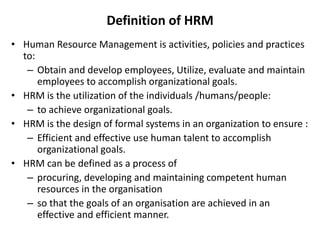
Definition of HRM
• Human Resource Management is activities, policies and practices
to:
– Obtain and develop employees, Utilize, evaluate and maintain
employees to accomplish organizational goals.
• HRM is the utilization of the individuals /humans/people:
– to achieve organizational goals.
• HRM is the design of formal systems in an organization to ensure :
– Efficient and effective use human talent to accomplish
organizational goals.
• HRM can be defined as a process of
– procuring, developing and maintaining competent human
resources in the organisation
– so that the goals of an organisation are achieved in an
effective and efficient manner.
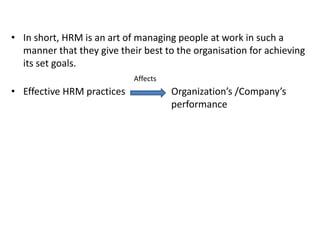
• In short, HRM is an art of managing people at work in such a
manner that they give their best to the organisation for achieving
its set goals.
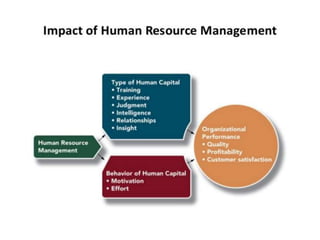
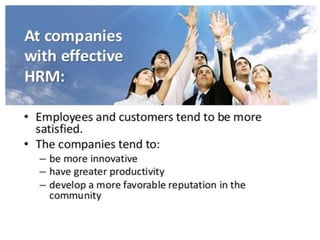
• Effective HRM practices Organization’s /Company’s
performance
Affects
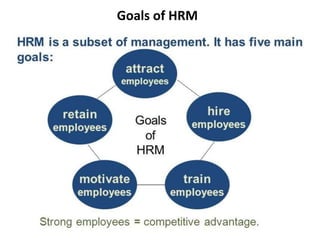
Goals of HRM
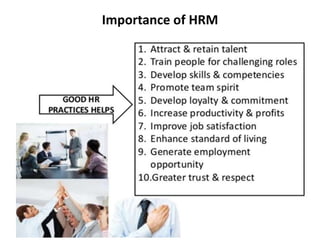
Importance of HRM
Importance of HRM (additional)
• As a necessary part of the organizing function of management
– Selecting, training, and evaluating the work force
• As an important strategic tool
– HRM helps establish an organization’s sustainable competitive
advantage.
• Adds value to the firm
– High performance work practices lead to both high individual
and high organizational performance.
Examples of High-Performance Work Practices
• Self-managed teams
• Decentralized decision making
• Training programs to develop knowledge, skills, and abilities
• Flexible job assignments
• Open communication
• Performance-based compensation
• Staffing based on person–job and person–organization fit
Example of High performance Work Practices
 Self-managed teams
 Decentralized decision making
 Training programs to develop knowledge, skills, and abilities
 Flexible job assignments
 Open communication
 Performance-based compensation
 Staffing based on person–job and person–organization fit
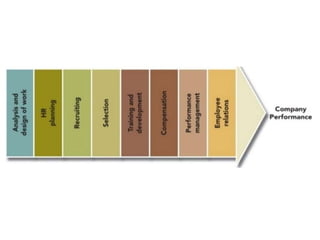
HRM Practices
• Job Analysis: analysis and design of jobs/work; HRM practices
that support organization’s goals and strategies.
• Human Resource planning (HRP): determining how many
employees with specific skills, and knowledge are needed.
• Recruiting: Attracting potential employees
• Selection: choosing employees
• Training and development: teaching employees how to perform
their jobs and prepare them for future
• Compensation and Benefits: Rewarding employees
• Performance Management: Evaluating their performance
• Employee retention: Creating positive work environment
• Company’s Performance
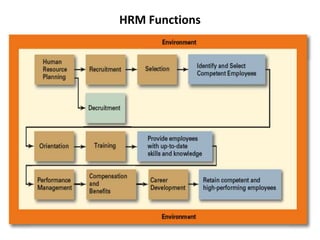
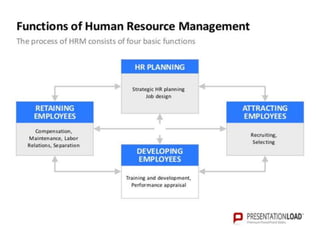
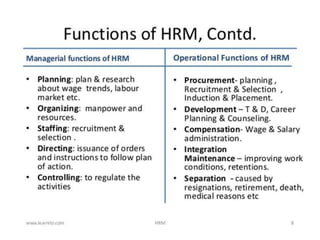
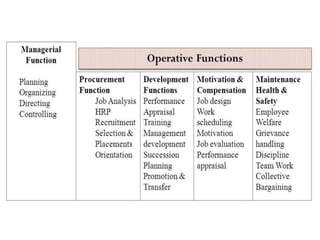
HRM Functions
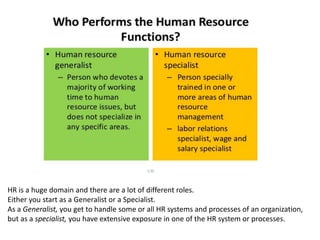
HR is a huge domain and there are a lot of different roles.
Either you start as a Generalist or a Specialist.
As a Generalist, you get to handle some or all HR systems and processes of an organization,
but as a specialist, you have extensive exposure in one of the HR system or processes.
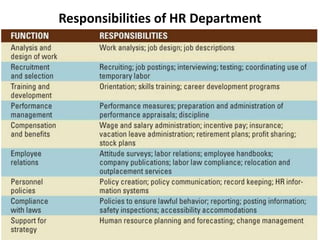
Responsibilities of HR Department
Foundations of Human Resources Management

Foundations of Human Resources Management

  • 1.
  • 2.
    Introduction • People, notthe building make a company successful. • People are the common element in every organization • Let us see what is meant by three terms:  Human: Homo-sapiens; Social Animal  Resource: Financial, Physical, informational and Human  Management: is the process of doing things efficiently and effectively with through other people. • Process consists of: Planning: establishing goals, and strategies to achieve them Organizing: determining what activities need to be completed to achieve these goals Leading: ensuring right people are right job with appropriate skills (staffing) and motivating them to high levels of productivity. Controlling: monitoring activities to ensure that goals are met
  • 3.
    Essence of HRM •‘EMPLOYEES ARE THE MOST IMPORTANT ASSET OF THE ORGANIZATION’ • The quality and effectiveness of the organization is determined by the quality of the people that are employed. • Success for most organizations depends on finding the employees with the skills to successfully perform the tasks required to attain the company’s strategic goals.
  • 4.
    What is HRM? •HRM is Human Resource management----it is the management of the people/humans/individuals in an organization • HRM is a managerial function that tries to match an organization’s needs to the skills and abilities of its employees. • In a layman language, the process of hiring and developing employees so that they become more valuable to the organization is human resource management
  • 5.
    Definition of HRM •Human Resource Management is activities, policies and practices to: – Obtain and develop employees, Utilize, evaluate and maintain employees to accomplish organizational goals. • HRM is the utilization of the individuals /humans/people: – to achieve organizational goals. • HRM is the design of formal systems in an organization to ensure : – Efficient and effective use human talent to accomplish organizational goals. • HRM can be defined as a process of – procuring, developing and maintaining competent human resources in the organisation – so that the goals of an organisation are achieved in an effective and efficient manner.
  • 6.
    • In short,HRM is an art of managing people at work in such a manner that they give their best to the organisation for achieving its set goals. • Effective HRM practices Organization’s /Company’s performance Affects
  • 7.
  • 8.
  • 9.
    Importance of HRM(additional) • As a necessary part of the organizing function of management – Selecting, training, and evaluating the work force • As an important strategic tool – HRM helps establish an organization’s sustainable competitive advantage. • Adds value to the firm – High performance work practices lead to both high individual and high organizational performance.
  • 10.
    Examples of High-PerformanceWork Practices • Self-managed teams • Decentralized decision making • Training programs to develop knowledge, skills, and abilities • Flexible job assignments • Open communication • Performance-based compensation • Staffing based on person–job and person–organization fit Example of High performance Work Practices  Self-managed teams  Decentralized decision making  Training programs to develop knowledge, skills, and abilities  Flexible job assignments  Open communication  Performance-based compensation  Staffing based on person–job and person–organization fit
  • 11.
    HRM Practices • JobAnalysis: analysis and design of jobs/work; HRM practices that support organization’s goals and strategies. • Human Resource planning (HRP): determining how many employees with specific skills, and knowledge are needed. • Recruiting: Attracting potential employees • Selection: choosing employees • Training and development: teaching employees how to perform their jobs and prepare them for future • Compensation and Benefits: Rewarding employees • Performance Management: Evaluating their performance • Employee retention: Creating positive work environment • Company’s Performance
  • 13.
  • 16.
    HR is ahuge domain and there are a lot of different roles. Either you start as a Generalist or a Specialist. As a Generalist, you get to handle some or all HR systems and processes of an organization, but as a specialist, you have extensive exposure in one of the HR system or processes.
  • 18.