
Fachhochschule Ludwigshafen am Rhein

Prof. Dr. Jutta Rump

Human Resource
Management
1
Contents

Fachhochschule Ludwigshafen am Rhein

Prof. Dr. Jutta Rump

Human Resource Management – an Overview
1. Definition
2. The Functional Areas of Human Resource Management
3. Protagonists of HRM
4. The Organization of Human Resource Management
4.1 Human Resource Management in Small Businesses
4.2 Human Resource Management in Medium-Sized Firms
4.3 Human Resource Management in Large Firms
4.4 Outsourcing
4.5 Shared Service Center
5. The Internal and External Environment of Human Resource
Management
6. Some Ins and Outs of HRM

2
Fachhochschule Ludwigshafen am Rhein

Job Analysis
1.
2.
3.
4.

Prof. Dr. Jutta Rump

Definition
Job Analysis Methods
Job Description
Job Specification

Human Resource Planning
1.
2.
3.
4.
5.
6.

Definition
The Human Resource Planning Process
Human Resource Forecasting Techniques
The Quantitative Comparison of Requirements and Availability
The Qualitative Comparison of Requirements and Availability
Qualification ProfilSome Ins and Outs of HRM

3
Fachhochschule Ludwigshafen am Rhein

Recruitment
1.
2.
3.
4.

Prof. Dr. Jutta Rump

Definition
Alternatives to Recruitment
Environment of Recruitment
The Recruitment Process
4.1 Recruitment Sources
4.2 Recruitment Methods
4.3 Internet Recruiting
4.4 Selection
4.4.1 Definition
4.4.2 The Selection Process

Downsizing
1. Definition
2. Reasons for Downsizing
4
Fachhochschule Ludwigshafen am Rhein

Compensation and Benefits
1.
2.
3.

4.

5.

6.

Prof. Dr. Jutta Rump

Definition
Components of a Total Compensation Program
Direct Financial Compensation
3.1 Equity in Direct Financial Compensation
3.2 Factors of Individual Direct Financial Compensation
3.3 Job Pricing
3.4 Executive Compensation
Indirect Financial Compensation
4.1 Measures of Indirect Financial Compensation
4.2 Profit Sharing
Nonfinancial Compensation
5.1 The Job as a Total Compensation Factor
5.2 The Job Environment as a Total Compensation Factor
Cafeteria Compensation

5
Fachhochschule Ludwigshafen am Rhein

Human Resource Development
1.
2.
3.
4.
5.

6.

Prof. Dr. Jutta Rump

Introduction
Definition of Human Resource Development
The Purpose of HRD
The Importance of Change Concerning HRD
Training and Development
5.1 Definition
5.2 The Training and Development Process
5.3 Special Subjects of Training and Development
5.3.1 Management Development
5.3.2 Orientation
5.3.3 Vocational Training
Career Planning and Career Development

6
Fachhochschule Ludwigshafen am Rhein

6.1
6.2
6.3
6.4
6.5
6.6
6.7
6.8
6.9

Definition
Career Security / Employability
Factors Influencing Career Planning
Career-Impacted Life Stages
Individual Career Planning
Organizational Career Planning
Career Paths
Career Development
Career Planning and Development Methods

Prof. Dr. Jutta Rump

7
Fachhochschule Ludwigshafen am Rhein

7.

Performance Appraisal
7.1 Definition
7.2 Uses of Performance Appraisal
7.3 The Performance Appraisal Process
7.4 Appraisal Criteria
7.5 Responsibility for Appraisal
7.6 Requirements
7.7 Performance Appraisal Methods
7.8 Problems in Performance Appraisal

Prof. Dr. Jutta Rump

8
Fachhochschule Ludwigshafen am Rhein

Prof. Dr. Jutta Rump

Human Resource
Management
- An Overview 9
Fachhochschule Ludwigshafen am Rhein

Prof. Dr. Jutta Rump

1. Definition
Human resource management deals with the availability of
human resources and the efficiency of the personnel
placement. There are several functional areas being
associated with effective human resource management:
-Job analysis
- Human resource planning
- Recruitment and selection
- Human resource development
- Compensation and benefits
- Downsizing
The main purpose of human resource management is to
create and to keep the balance between the firm‘s goals and
the interests of the employees.
10
Fachhochschule Ludwigshafen am Rhein

Prof. Dr. Jutta Rump

2. The Functional Areas of Human
Resource Management
Job analysis is the systematic process of determining the skills, duties
and knowledge required for performing jobs in an organization. It
impacts on human resource planning, recruitment, and human resource
development.
Human resource planning is the process of systematically reviewing
human resource requirements to ensure that the required numbers of
employees with the required skills are available when needed.
Recruitment is the process of attracting qualified individuals and
encouraging them to apply for work.
Compensation and benefits provide employees with rewards for their
contributions to meeting organizational goals.
Downsizing is a process of reducing the numbers of employees.
11
Fachhochschule Ludwigshafen am Rhein

Prof. Dr. Jutta Rump

Human resource development is a major HRM function that
consists not only training and development but also individual career
planning, career development and performance appraisal.
Training is designed to provide learners with knowledge and
skills needed for their present job.
Development involves learning that goes beyond today‘s job, it
has a more long-term focus.
Career planning is an ongoing process whereby an individual
sets career goals and identifies the means to achieve them.
Career development is a formal approach used by the
organization to ensure that people with proper qualifications and
experiences are available when needed.
Through performance appraisal, employees are evaluated to
determine how well they are performing their assigned tasks.
12
Fachhochschule Ludwigshafen am Rhein

Prof. Dr. Jutta Rump

3. Protagonists of HRM
There are several protagonists performing human resource
management tasks:
The human resource manager
The line manager
The top management
The workers‘ council (especially in Germany)

13
Fachhochschule Ludwigshafen am Rhein

Prof. Dr. Jutta Rump

The Human Resource Manager
Various classifications occur within the human resource profession.
Human resource executive: An executive is a top-level manager
who reports directly to the corporations‘s chief executive officer
(CEO) or to the head of a major division.
Human resource generalist: A generalist performs tasks in a variety
of human resource-related areas. The generalist is involved in
several or all human resource management functions.
Human resource specialist: A specialist is typically concerned with
only one of the functional areas of human resource management.

14
Fachhochschule Ludwigshafen am Rhein

Prof. Dr. Jutta Rump

4. The Organization of Human Resource
Management
The organization structure of human resource management
depends often on the company‘s size. As firms grow and become
more complex, the human resource functions also become more
complex.
The basic purpose of human resource management remains the
same, the difference is in the approach which is used to
accomplish its objectives.

15
Fachhochschule Ludwigshafen am Rhein

Prof. Dr. Jutta Rump

4.1 Human Resource Management in
Small Businesses
Small businesses seldom have a formal human resource unit and
HRM specialists. The top management and the line managers
handle human resource functions.
Some aspects of human resource functions may actually be more
significant in smaller firms than in larger ones. For example, a
staffing mistake might be harmful and may cause the business to
fail.
Manager /
Owner

Sales

Operations

Finance
16
Fachhochschule Ludwigshafen am Rhein

Prof. Dr. Jutta Rump

4.2 Human Resource Management in
Medium-Sized Firms
As a firm grows a separate staff function may be required to
coordinate human resource activities. In a medium-sized firm the
person chosen to fill this role is expected to handle most of the
human resource activities.

President

Sales Manager

Operations
Manager

Finance
Manager

Human
Resource
Manager

17
Fachhochschule Ludwigshafen am Rhein

Prof. Dr. Jutta Rump

4.3 Human Resource Management in Large
Firms
When the firms‘s human resource function becomes too complex
for one person, separate sections are often created and placed
under a human resource executive.
President

Vice President
Marketing /
Sales
Manager
HR
Planning

Vice President
Operations

Manager
Recruitment

Vice President
Finance

Manager
HRD

Vice President
Human
Resource
Manager
Compensation /
Benefits
18
Fachhochschule Ludwigshafen am Rhein

Prof. Dr. Jutta Rump

4.4 Outsourcing
Outsourcing is the process of transfering the responsibility for an
area of services and its objectives to an external provider. By
outsourcing certain projects, companies can save time and
resources and redirect their energy to more strategic issues.
Manager
Human
Resource

Executive
Recruiting
Outsourced

HR
Recruitment

HR
Development

Executive
Development
Outsourced
19
Fachhochschule Ludwigshafen am Rhein

Prof. Dr. Jutta Rump

4.5 Shared Service Center
A shared service center takes routine, transaction-based activities
dispersed throughout the organization and consolidates them in
one place.
For example, a company with 20 business units could consolidate
the routine HR tasks and perform them in one location.

20
Fachhochschule Ludwigshafen am Rhein

Prof. Dr. Jutta Rump

5. The Internal and External Environment
of Human Resource Management
Legal Considerations

Society

Firm‘s Mission
and Policies

Corporate
Culture

Informal Organization

Unions

Technology

Employees and their
Capabilities and
Attitudes

Human
Resource
Management

Management
Style

Labor Market

Economy

Other Units of the
Organization

Formal Organization

Competition

Customers

Shareholder
21
Fachhochschule Ludwigshafen am Rhein

Prof. Dr. Jutta Rump

6. Some Ins and Outs of HRM
Out:
In:
and a

Job titles and labels
Everyone is a businessperson, an owner of a business process
president of his / her job

Out:
In:

Chain of command
Self-management, proactivity, personal responsibility, initiative

Out:
In:

Stability, order, structure better be safe than sorry
Flux, disorder, risk, better be sorry than safe

Out:
the

Good citizenship, wait for someone to decide your fate, work in

In:
be

same organization for a long time
Make a difference, learn from mistakes, change the employers,
flexible

22
Fachhochschule Ludwigshafen am Rhein

Prof. Dr. Jutta Rump

Job Analysis
Fachhochschule Ludwigshafen am Rhein

Prof. Dr. Jutta Rump

1. Definition
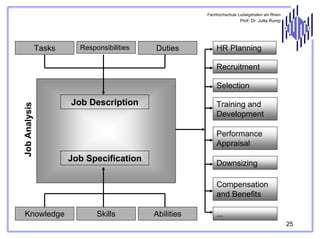
Job analysis is the systematic process of determining a job‘s duties
and responsibilities, its relation to other jobs, skills and knowledge
required and working conditions under which it is performed.
A job consists of a group of tasks which make sure that the organization
achieves its goals.
A position is the collection of tasks and responsibilities performed by
one person. There is a position for every person in an organization.
Job analysis is used to prepare job descriptions and job specifications.
The job description is a document that provides information regarding
the task, duties and responsibilities of the job.
The minimum acceptable qualifications that a person should possess in
order to perform are listed in the job specification.

24
Fachhochschule Ludwigshafen am Rhein

Prof. Dr. Jutta Rump

Tasks

Responsibilities

Duties

HR Planning
Recruitment

Job Analysis

Selection

Job Description

Training and
Development
Performance
Appraisal

Job Specification

Downsizing
Compensation
and Benefits

Knowledge

Skills

Abilities

...
25
Fachhochschule Ludwigshafen am Rhein

Prof. Dr. Jutta Rump

2. Job Analysis Methods
There are several methods of job analysis:
Questionaires
Observation
Interviews
Employee recording
Usually an analyst does not use one job analysis method exclusively.
A combination of methods is often more appropriate.
Regardless of the methods taken the analyst should learn as much as
possible about the job. It is necessary that the supervisor introduces the
analyst to the employees and explains the purpose of the job analysis.
Trust and confidence ist an essential requirement for the process of job
analysis.
26
Fachhochschule Ludwigshafen am Rhein

Prof. Dr. Jutta Rump

3. Job Description
The job description is a document that provides information
regarding the task, duties and responsibilities of the job. It has to
be relevant and accurate.
Components of the job description are
- major duties performed,
- percentage of time devoted to each duty,
- performance standards to be achieved,
- Working conditions and possible hazards,
- supervision and subordination,
- the machines and equipment used on the job.

27
Fachhochschule Ludwigshafen am Rhein

Prof. Dr. Jutta Rump

4. Job Specification
The job specification is a document containing the minimum
acceptable qualifications that a person should possess in order to
perform a particular job. Items are requirements concerning skills,
knowledge, abilities, experience ...
Criteria are for example
- knowledge of business
- customer orientation
- interpersonal skills / team player
- ability to influence others
- confidentiality
- planing, organizing and time management
- written and oral communication
...
28
Fachhochschule Ludwigshafen am Rhein

Prof. Dr. Jutta Rump

Human Resource
Planning
Fachhochschule Ludwigshafen am Rhein

Prof. Dr. Jutta Rump

1. Definition
Human resource planning is the process of systematically reviewing
human resoure requirements to ensure that the required numbers of
employees with the required skills are available when and where they are
needed.
Human resource planning includes four factors:
Quantity: How many employees do we need?
Quality: Which skills, knowledge and abilities do we need?
Space:

Where do we need the employees?

Time:

When do we need the employees? How long do we need
them?

30
Fachhochschule Ludwigshafen am Rhein

Prof. Dr. Jutta Rump

2. The Human Resource Planning
Process
Strategic Planning
Human Resource Planning
Forecasting Human
Resource
Requirements

Comparing
Requirements and
Availability

Forecasting
Human Resource
Availability

Demand = Supply

Surplus of workers

No Action

Restricted Hiring,
Reduced Hours,
Early Retirement,
Layoffs, Downsizing

Shortage of
workers
Recruitment
Selection
Fachhochschule Ludwigshafen am Rhein

Prof. Dr. Jutta Rump

A requirement forecast is an estimate of the numbers and kinds of
employees the organization will need at future dates in order to realize
its goals. Before human resource requirements can be projected, the
demand for the company‘s goods and services must be forecasted first.
Forecasting requirements provide managers with the means of
estimating how many and what types of employees will be required.
Availability forecast is an estimate of the numbers and kinds of
employees the organization will have got at future dates. The
availability forecast is a process of considering incomings and
outgoings during the planning period.

32
Fachhochschule Ludwigshafen am Rhein

Prof. Dr. Jutta Rump

3. Human Resource Forecasting
Techniques
Forecasting techniques include
zero-base forecasting (zero-base forecasting is a method for
estimating future employment needs using the organization‘s
current level of employment as the starting point. Vacant positions
are not automatically filled. The filling has to be justified.),
the bottom-up approach (the bottom-up approach is a method
beginning with the lowest organizational units. Each level forecasts
ist requirements),
the use of mathematical models,
simulations.

33
Fachhochschule Ludwigshafen am Rhein

Prof. Dr. Jutta Rump

4. Quantitative Comparison of
Requirments and Availability
Availability in t0
+ estimated incomings during the planning period
- estimated outgoings during the planning period
Availability in tx
- Requirments in tx
Balance
Positive balance: Downsizing
Negative balance: Recruitment and / or human resource development
34
Fachhochschule Ludwigshafen am Rhein

Prof. Dr. Jutta Rump

5. Qualitative Comparison of Requirements
and Availability
Available Qualifications

Required Skills, Knowledge and Abilities

• Today

• Today

• In Future

• In Future

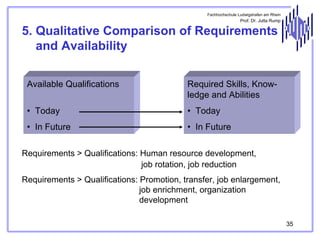
Requirements > Qualifications: Human resource development,
job rotation, job reduction
Requirements > Qualifications: Promotion, transfer, job enlargement,
job enrichment, organization
development
35
Fachhochschule Ludwigshafen am Rhein

Prof. Dr. Jutta Rump

6. Qualification Profil
The qualification profil is a document containing qualifications
which a person possesses.
In order to check the aptitude the job specification and the
qualification profil are compared.

What do we need

What do we have

What will we need

What will we have

36
Fachhochschule Ludwigshafen am Rhein

Prof. Dr. Jutta Rump

Recruitment
Fachhochschule Ludwigshafen am Rhein

Prof. Dr. Jutta Rump

1. Definition
Recruitment is the process of attracting individuals
- just in time,
- in sufficent numbers and
- with appropriate qualifications
and encouraging them to apply for jobs.
Identifying productive sources of applicants and using suitable
recruitments methods are essentials to maximize recruiting
effectiveness and efficiency.

38
Fachhochschule Ludwigshafen am Rhein

Prof. Dr. Jutta Rump

2. Alternatives to Recruitment
Even when human resource planning indicates a need for
additional employees, a company may decide against increasing
the size of its workforce.
Alternatives to recruitment include
-

outsourcing,
contingent workers,
employee leasing and
overtime.

39
Fachhochschule Ludwigshafen am Rhein

Prof. Dr. Jutta Rump

3. Environment of Recruitment

External environment
Labor Market Conditions
- Quality
- Quantity
Legal Considerations
Corporate Image

Internal environment
Human Resource Planning
Promotion Policies:
- Promotion from within
- or a policy of filling
positions from outside the
organization
The Firm‘s Knowledge of
Employees

40
Fachhochschule Ludwigshafen am Rhein

Prof. Dr. Jutta Rump

4. The Recruitment Process
Human Resource Planning

Alternatives to
Recruitment

Recruitment

Internal Sources

External Sources

Internal Methods

External Methods

Selection
Recruited Individuals
41
Fachhochschule Ludwigshafen am Rhein

Prof. Dr. Jutta Rump

4.1 Recruitment Sources
Internal Recruitment
Sources
Employees
Normally internal recruitment
takes priority over external
recruitment. Exceptions are:
- to fill entry-level jobs
- to acquire skills not
possessed
by current employees
- to obtain employees with
different backgrounds to
provide a diversity of ideas.

External Recruitment
sources
High Schools
Vocational Schools
Colleges and Universities
Competitors and Other
Firms
The Unemployed
Older Individuals
Self-employed Workers
Fachhochschule Ludwigshafen am Rhein

Prof. Dr. Jutta Rump

4.2 Recruitment Methods
External Recruitment Methods
Internal Recruitment
Methods

Advertising

Job Posting: Job posting is a
procedure for informing the
employees that a job opening
exists.

Executive Search Firms

Job Bidding: Job bidding is a
technique that permits
employees who believe that
they possess the required
qualifications to apply for a
posted job.

Private and Public
Employment Agencies
Job Fairs
Internships
Employee Referrals
Event Recruiting
Open Houses
Sign-on Bonuses
Fachhochschule Ludwigshafen am Rhein

Prof. Dr. Jutta Rump

4.3 Internet Recruiting
The requirements for effective Internet recruiting are
- to find Internet employment sites,
- to establish a budget,
- to develop an Internet Web site that is up-to-date and informative,
- to write effective online ads,
- to experiment with various advertising approaches,
- to monitor both traditional and Internet advertisement,
- to experiment with several Web sites and
- become a sleuth on the Internet.
In addition, do not neglect traditional recruiting methods.

44
Fachhochschule Ludwigshafen am Rhein

Prof. Dr. Jutta Rump

4.4 Selection
4.4.1 Definition
The purpose of the selection is to identify and employ the bestqualified individuals. Selection is the process of choosing from a
group of applicants the individual best suited for a particular position.
There are several factors influencing the selection:
-

Legal considerations
Labor market conditions
Type of organization (Private, governmental or not for profit)
Speed of decision making
Organizational hierarchy

45
Fachhochschule Ludwigshafen am Rhein

Prof. Dr. Jutta Rump

4.4.2 The Selection Process

Preliminary
Interview

Review of
Applications

Selection
Tests

Employment
Interviews

New
Employee

Physical
Examination

Selection
Decision

Reference
and
Background
Checks

46
Fachhochschule Ludwigshafen am Rhein

Prof. Dr. Jutta Rump

There are several
preliminary interviews:
- Telephone interview
- Computer interview
- Videotaped interview

Preliminary
Interview

Review of
Applications

Selection
Tests

Employment
Interviews

New
Employee

Physical
Examination

Selection
Decision

Reference
and
Background
Checks

47
Fachhochschule Ludwigshafen am Rhein

An application should
include

Prof. Dr. Jutta Rump

- name,
- address,
- education,
- work history,
- certificates and
- references.

Preliminary
Interview

Review of
Applications

Selection
Tests

Employment
Interviews

New
Employee

Physical
Examination

Selection
Decision

Reference
and
Background
Checks
48
Fachhochschule Ludwigshafen am Rhein

Prof. Dr. Jutta Rump

Employment tests include
cognitive aptitude tests,
psychomotor abilities tests,
job-knowledge tests, worksample tests, vocational
interest tests, personality tests
and drug and alcohol tests.

Preliminary
Interview

Review of
Applications

Selection
Tests

Employment
Interviews

New
Employee

Physical
Examination

Selection
Decision

Reference
and
Background
Checks
49
Fachhochschule Ludwigshafen am Rhein

The employment
interview is a goaloriented conversation
in which interviewer
and applicant
exchange
information.

Prof. Dr. Jutta Rump

Types of interviews
are:

There are several
methods of interviewing:

- unstructured
interviews,
- structured interviews,
- behavioral interviews

one-on-one interview
group interview
board interview
stress interview
assessment center

Preliminary
Interview

Review of
Applications

Selection
Tests

Employment
Interviews

New
Employee

Physical
Examination

Selection
Decision

Reference
and
Background
Checks
50
Fachhochschule Ludwigshafen am Rhein

Prof. Dr. Jutta Rump

Preliminary
Interview

Review of
Applications

Selection
Tests

Employment
Interviews

New
Employee

Physical
Examination

Selection
Decision

Reference
and
Background
Checks

Personal reference checks may provide
additional information about the applicant and
allow verification. An effective and
comprehensive background investigation
relates to the provious employment,
education, personal references, criminal
history, credit history ...
51
Fachhochschule Ludwigshafen am Rhein

Prof. Dr. Jutta Rump

Preliminary
Interview

Review of
Applications

Selection
Tests

Employment
Interviews

New
Employee

Physical
Examination

Selection
Decision

Reference
and
Background
Checks

The selection decision is when the final choice is made from among
those who are still in the race after the Interview information, reference
checks, background investigations are evaluated.
The individual with the best overall qualification may not be hired. The
person whose qualifications most closely conform to the requirements
should be selected.

52
Fachhochschule Ludwigshafen am Rhein

Prof. Dr. Jutta Rump

Preliminary
Interview

Review of
Applications

Selection
Tests

Employment
Interviews

New
Employee

Physical
Examination

Selection
Decision

Reference
and
Background
Checks

The physical examination must be
directly relevant to the job requirements.
The purpose of the physical examination
is to determine whether the applicant is
physically capable of performing the
tasks.

53
Fachhochschule Ludwigshafen am Rhein

Prof. Dr. Jutta Rump

Preliminary
Interview

Review of
Applications

Selection
Tests

Employment
Interviews

New
Employee

Physical
Examination

Selection
Decision

Reference
and
Background
Checks

The selection results
should be made
known to both the
successful and the
unsuccessful
candidates as soon
as possible.
54
Fachhochschule Ludwigshafen am Rhein

Prof. Dr. Jutta Rump

Downsizing

55
Fachhochschule Ludwigshafen am Rhein

Prof. Dr. Jutta Rump

1. Definition
Downsizing is the process of reducing the surplus of employees.
If a surplus of employees is projected by the human resource
planning, ways must be found to reduce the numbers of workers.
There are several ways of downsizing:
Restriced hiring
Reduced hours
Early retirement
Non-prolongation of limited employment contracts
Non-prolongation of leasing contracts
Outplacement
Layoffs
56
Fachhochschule Ludwigshafen am Rhein

Prof. Dr. Jutta Rump

Restriced hiring: When a firm implements a restricted hiring policy,
it reduces the workforce by not replacing employees who leave. New
workers are hired only when the overall performance may be
affected.
Reduced hours: Instead of working 40 hours a week, the
management decides to cut each employee‘s time to 30 or 20 hours.
This cutback does not normally apply to the management level.
Early retirement: Older employees (older than 58) have the
possibility to retire at the age of 58 without substantial financial
disadvantages.
Outplacement: The employer helps the employee to find a new job.
Layoffs: The employee is dismissed. He / she is no longer
employed. Normally layoffs base on a combination of seniority,
productivity and ability.
57
Fachhochschule Ludwigshafen am Rhein

Prof. Dr. Jutta Rump

2. Reasons for Downsizing
Management Faults
Reorganization
Reengineering
Rationalization and Optimalization
Technical Progress
Closing or Relocation
Merger
Change of Demands
Ecomonic Trends
...
58
Fachhochschule Ludwigshafen am Rhein

Prof. Dr. Jutta Rump

Compensation and
Benefits
Fachhochschule Ludwigshafen am Rhein

Prof. Dr. Jutta Rump

1. Definition
Compensation is the total of all rewards which employees get in return
for their services.
Direct financial compensation consists of the pay that a person
receives in the form of wages, salary, bonuses and commissions.
Indirect financial compensation (benefits) are all financial rewards that
are not included in direct compensation. These are for example insurance
and other programs for health, safety, security and general welfare.
Nonfinancial compensation consists of the satisfaction that a person
receives from the job itself or from the psychological and/or physical
environment in which the person works.

60
Fachhochschule Ludwigshafen am Rhein

Prof. Dr. Jutta Rump

2. Components of a Total Compensation
Program
Compensation

Financial

Nonfinancial

Direct

Indirect

The Job

Job Environment

-Wages
-Salaries
-Commissions
-Bonuses

-Unemployment
Insurance
-Health Benefits
-Pension Insurance Fund
-Retirement Plans
-Workers‘ Compensation
-Payment for Time Not
Worked
-Employee Services

-Skill Variety
-Task Identity
-Task
Significance
-Autonomy
-Feedback

-Sound Policies
-Competent
Employees
-Congenial Coworkers
-Appropriate
Status
Symbols
-Comfortable
Working
Conditions
-Workplace
Flexibility
61
Fachhochschule Ludwigshafen am Rhein

Prof. Dr. Jutta Rump

3. Direct Financial Compensation

62
Fachhochschule Ludwigshafen am Rhein

Prof. Dr. Jutta Rump

3.1 Equity in Direct Financial
Compensation
Equity – in the context of financial compensation – means fair pay treatment for employees. A fair days work for a fair days pay.
External equity exists when a firm‘s employees are paid comparable to
workers who perform similar job in other firms.
Internal equity exists when employees are paid according to the relative
value of their job within the same organization.
Team equity exists when more productive teams are rewarded more than
less productive teams.

63
Fachhochschule Ludwigshafen am Rhein

Prof. Dr. Jutta Rump

3.2 Factors of Individual Direct Financial
Compensation
The Organization

The Employee

Individual
Financial
Compensatio
n

The Labor Market

The Job

64
Fachhochschule Ludwigshafen am Rhein

Prof. Dr. Jutta Rump

Organizational factors that should be considered include
compensation policies, organizational politics and the ability
to pay. This contains the decision to be a pay leader, pay
follower or to strive for an average position in the labor
market.
The Organization

The Employee

Individual
Financial
Compensatio
n

The Labor Market

The Job
65
Fachhochschule Ludwigshafen am Rhein

Factors thatProf. Dr. Jutta Rump
should be
considered include

The Organization

The Employee

Individual
Financial
Compensatio
n

- unemployment rate
- wage and salary
survey,
- cost of living,
- labor unions,
- the economy and
- labor law /
employment
legislation.
The Labor Market

The Job
66
Fachhochschule Ludwigshafen am Rhein

The Organization

The Employee

Individual
Financial
Compensation

Prof. Dr. Jutta Rump

The Labor Market

The Job

The organization pays for the value it attaches to certain duties,
responsibilities and other job-related factors. Management
techniques utilized for determining a job‘s relative worth include
job analysis, job description and job evaluation.
67
Fachhochschule Ludwigshafen am Rhein

Prof. Dr. Jutta Rump

The factors related to the employee include performance-based pay
(merit pay, variable pay, skill-based pay, competency-based pay),
seniority, experience, membership in the organization, potential,
political influence...

The Organization

The Employee

Individual
Financial
Compensation

The Labor Market

The Job
68
Fachhochschule Ludwigshafen am Rhein

Prof. Dr. Jutta Rump

3.3 Job Pricing
Placing a monetary value on the worth of a job is called job pricing.
It takes place after the job has been evaluated and the relative value
of each job in the organization has been determined.
Firms often use pay grades and pay ranges in the job pricing process.

69
Fachhochschule Ludwigshafen am Rhein

Prof. Dr. Jutta Rump

3.4 Executive Compensation
In determining executive compensation, firms typically prefer to relate
salary growth for the highest-level managers to overall corporate
performance, including the firm‘s market value. For the next
management tier, they tend to integrate overall corporate performance
with market rates and internal considerations to come up with
appropriate pay. For lower-level managers, salaries are often
determined on the basis of market rates, internal pay relationship and
indivdiual performance. In general the higher the managerial position,
the greater the flexibility managers have in designing their jobs.
Executive compensation often has several elements:
- Base salary
- Short-term incentives or bonuses
- Long-term incentives and capital appreciation
- Perquisites (perks)
70
Fachhochschule Ludwigshafen am Rhein

Prof. Dr. Jutta Rump

4. Indirect Financial Compensation

71
Fachhochschule Ludwigshafen am Rhein

Prof. Dr. Jutta Rump

4.1 Measures of Indirect Financial
Compensation
Unemployment insurance: If employees lose their jobs, they receive
an unemployment compensation which depends on their last salaries /
wages and on the length of continuous employment.
Health benefits: Heath benefits include health care, dental care and
sometimes vision care.
Pension insurance fund: In Germany every employee has to pay a
percentage in statutory pension insurance fund. At the age of 65 he / she
gets the retirement benefits.
Retirement plans: The employee pays voluntarily a part of his income
in a retirement or savings fund. At the age of 60 or 65 he or she gets an
amount of retirement income which depends on the investment success.

72
Fachhochschule Ludwigshafen am Rhein

Prof. Dr. Jutta Rump

Disability insurance: The disability insurance protects employees
against loss of earnings resulting from total disability.
Workers‘ compensation: This benefit provides a degree of financial
protection for employees who incur expenses resulting from jobrelated accidents or illnesses.
Payment for time not worked: This includes rest periods, coffee
breaks, lunch periods, cleanup time, travel time, paid vacations, sick
pay, military duty, civic duties, bereavement time...
Employee services: Employee services are relocation benefits, child
care, educational assistance, food servies and financial services ( for
example loans)

73
Fachhochschule Ludwigshafen am Rhein

Prof. Dr. Jutta Rump

4.2 Profit Sharing
Profit sharing is a compensation plan that results in the distribution of a
predetermined percentage of the firm‘s profits to employees. Many
companies use this type of compensations plans to integrate the
employees‘ interests with those of the firm.
Gain sharing is a special form of profit sharing. Gain sharing plans are
designed to bind employees to the firm‘s performance by providing an
incentive payment based on the improved company performance.
Improved performance can take the form of increased productivity,
increased customer satisfaction, lower costs...

74
Fachhochschule Ludwigshafen am Rhein

Prof. Dr. Jutta Rump

5. Nonfinancial Compensation

75
Fachhochschule Ludwigshafen am Rhein

Prof. Dr. Jutta Rump

5.1 The Job as a Total Compensation
Factor
Some jobs can be so exciting, that the employee can hardly wait
to get to work each day. A person in this type of job would not
swap his or her employment with anyone in the world.
Most of us spend a large part of our lives not on the beach, but
working.When work is a drag, life may not be very pleasant.
In order to achieve motivation by the job, the job has to contain
five dimensions:
- Skill variety
- Task identity
- Task significance
- Autonomy
- Feedback
76
Fachhochschule Ludwigshafen am Rhein

Prof. Dr. Jutta Rump

5.2 The Job Environment as a Total
Compensation Factor
Employees can draw satisfaction not only from their work but also from
the job environment. The job environment includes
working atmosphere and congenial co-workers,
competent employees,
appropriate status symbols and
working conditions.

77
Fachhochschule Ludwigshafen am Rhein

Prof. Dr. Jutta Rump

Working conditions achieve satisfaction and motivation especially
when workplace flexibility exists. Workplace flexibility is a key factor
in attracting and retaining talented and qualified employees.
Programs of workplace flexibility include
flextime,
a compressed workweek,
job sharing,
telecommuting,
part-time work,
modified retirement.

78
Fachhochschule Ludwigshafen am Rhein

Prof. Dr. Jutta Rump

5.3 Cafeteria Compensation
Cafeteria compensation plans permit flexibility in allowing each
employee to determine the compensation package which best satisfies
his or her particular needs. The rationale behind the cafeteria plans is
that employees have individual needs and preferences.

79
Fachhochschule Ludwigshafen am Rhein

Prof. Dr. Jutta Rump

Human Resource
Development

80
Fachhochschule Ludwigshafen am Rhein

Prof. Dr. Jutta Rump

1. Introduction
In every market customers are demanding higher quality, lower costs,
and faster cycle times. To meet these requirements, firms must
continuously improve their overall performance. Rapide advances in
technology and improved processes have been important factors in
helping businesses. However, the most important competitive
advantage is the workforce and especially the competency,
knowledge and skills. The function / functional area dealing with
competency, knowledge and skills is Human Resource Management.

81
Fachhochschule Ludwigshafen am Rhein

2. Definition of Human Resource
Development (HRD)

Prof. Dr. Jutta Rump

Improved performance is the buttom-line purpose of HRD.
HRD is a major HRM function that consists not only training and
development but also individual career planning, career development and
performance appraisal.
Training is designed to provide learners with knowledge and skills
needed for their present job.
Development involves learning that goes beyond today‘s job, it has a
more long-term focus.
Career planning is an ongoing process whereby the individual sets
career goals and identifies the means to achieve them.
Career development is a formal approach used by the organization to
ensure that people with proper qualifications and experiences are
available when needed.
Through performance appraisal, employees are evaluated to
determine how well they are performing their assigned tasks.

82
Fachhochschule Ludwigshafen am Rhein

Prof. Dr. Jutta Rump

3. The Purpose of HRD
Availability of qualified employees
Development of knowledge, skills and experience
Promotion of prospective managers and talented young
employees
Improvement of leadership
Enhancement of motivation
Guarantee of employability
Decrease of fluctuation rate
Increase of flexibility
...
83
Fachhochschule Ludwigshafen am Rhein

Prof. Dr. Jutta Rump

4. The Importance of Change concerning
HRD
Another basic purpose of HRD is to anticipate change and to respond
proacticely to it.
The most prominent changes affecting HRD are the following:
Changes in organization structure caused by mergers, acquisitions,
rapid growth, downsizing, and outsourcing.
Changes in technology and the need for more highly skilled workers.
Changes in educational level of employees.
Changes in human resources, creating a diverse workforce consisting
of many groups.
Competitive pressures necessitating flexible courses and just-in-time
and just-what‘s-needed training.
Increased emphasis on learning organizations and human
performance management.

84
Fachhochschule Ludwigshafen am Rhein

Prof. Dr. Jutta Rump

5. Training and Development

85
Fachhochschule Ludwigshafen am Rhein

5.1 Definition

Prof. Dr. Jutta Rump

Training is designed to provide learners with knowledge and skills
needed for their present job.
Development involves learning that goes beyond today‘s job, it has
a more long-term focus. It prepares employees to keep pace with the
organization as it changes.
Training and development acitivities have the potential to align
employees of a company with its corporate strategies.

86
Fachhochschule Ludwigshafen am Rhein

Prof. Dr. Jutta Rump

5.2 The Training and Development Process
External Environment
Internal Environment
1. Determining
T&D Needs

5. Evaluating
T&D Programs
4. Implementing
T&D Programs

2. Establishing
Specific
Objectives
3. Selecting
T&D Methods

87
Fachhochschule Ludwigshafen am Rhein

Prof. Dr. Jutta Rump

Determining Training and Development
Needs
T&D needs may be determined by conducting analyses on several
levels. From overall organizational perspective, the firm‘s strategic
mission, goals, and corporate plans should be studied, along with the
results of human resource planning. The next level of analysis
focuses on the tasks that must be accomplished in order to achieve
the firms purposes. Job descriptions, performances appraisals and
interviews or surveys of supervisors and job incumbents are important
data sources for this analysis level. Finally, individual training needs
must be addressed. The relevant questions are “Who needs to be
trained?“ and “What kind of training is needed?“

88
Fachhochschule Ludwigshafen am Rhein

Prof. Dr. Jutta Rump

Establishing Training and Development
Objectives
T&D objectives are necessary. Without them, designing meaningful
T&D programs would not be possible.
T&D objectives are indepted to several standards. These standards
are
- handling,
- precision and
- measurability.
Besides T&D objectives have three dimensions:
- Content
- Direction and
- Time
89
Fachhochschule Ludwigshafen am Rhein

Prof. Dr. Jutta Rump

Selecting Training and Development
Methods
Training-on-the-Job

Training-off-the-Job

- Learning by Experience
(learning
job tasks by actually
performing)
- Job Rotation
- Job Enlargement
- Job Enrichment
- Computer-Based Training
- Web-Based Training
- Teamwork
- Substitution
- Coaching
- Mentoring
- Internship

- Business Games
- Case Study
- Videotapes
- In-Basket Training
- Role Playing
- Distance Learning and
Videoconferencing
- Classroom Programs
- Simulators
- Quality Circle
- Work Groups

90
Fachhochschule Ludwigshafen am Rhein

Prof. Dr. Jutta Rump

Implementing Training and Development
Programs
Implementing T&D programs is often difficult.
1.

Many managers are action oriented and feel that they are
too busy for T&D.

2.

Qualified trainers must be available.

3.

Training implies change which employees may resist.

4.

The content and the methods of T&D must relate to the work
requirements and to the career planning.

5.

Another difficulty in implementing T&D programs is record
keeping. Records inform how well he or she performs during
the training and on the job.

91
Fachhochschule Ludwigshafen am Rhein

Prof. Dr. Jutta Rump

Evaluation Training and Development
The credibility of T&D can be enhanced if the tangible benefits to the
organization can be shown. There are several approaches in order to
determine the valuable service and the value added.
- Participants opinions
- Extent of learning
- Behavioral change
- Accomplishment of T&D objectives
- Application at the workplace
- Feedback of immediate supervisors and collegues
- Benchmarking

92
Fachhochschule Ludwigshafen am Rhein

Prof. Dr. Jutta Rump

5.3 Special Subjects of Training
and Development
Management Development
Orientation
Vocational Training

93
Fachhochschule Ludwigshafen am Rhein

Prof. Dr. Jutta Rump

5.3.1 Management Development
Definition
Management development consists of all learning experiences
provided by an organization for the purpose of upgrading skills and
knowledge required in current and future managerial positions.
If critical knowledge and skills are provided by organizations in
develoment programs, the process will require personal commitment of
the individual manager. In fact, taking responsibility for one‘s own
development may be the most important aspect.

94
Fachhochschule Ludwigshafen am Rhein

Prof. Dr. Jutta Rump

The Adjustment of Management
Development
Management development can be offered in-house or outside the
company.
The most frequently mentioned
reasons for keeping management
training inside the company are
the following:

The most frequently mentioned
reasons to conduct management
training outside the company are
the following:

- Consideration of company
requirements and needs
- Lower costs
- Less time
- More control of content and
procedure

- An outside perspective
- New viewpoints
- Exposure to experts and research
- Broader vision

95
Fachhochschule Ludwigshafen am Rhein

Prof. Dr. Jutta Rump

Special Training Areas
Management development often deals with
- leadership
- diversity,
- customer service,
- conflict resolution,
- values,
- teamwork,
- empowerment,
- remedical training.

96
Fachhochschule Ludwigshafen am Rhein

Prof. Dr. Jutta Rump

5.3.2 Orientation
Definition
First impressions are the most lasting. Because of this, many
companies have orientation programs for new hires.
Orientation wants to inform new employees about the company
(products, benefits, policies, procedures, organizational structure,
corporate culture), the job and the work group. To perform effectively
und efficiently, they need information which allows them to do their
jobs and helps them to understand their co-workers behavior.
Orientation is effective in retaining and motivating personnel.

97
Fachhochschule Ludwigshafen am Rhein

Prof. Dr. Jutta Rump

Purposes of Orientation

Orientation acquaints employees with
- the employment situation (the job, department ...),
- company policies and rules,
- compensation and benefits,
- corporate culture.
Orientation influences
- the socialization,
- team membership,
- dealing with change.

98
Fachhochschule Ludwigshafen am Rhein

Prof. Dr. Jutta Rump

5.3.3 Vocational Training
Definition
Vocational training is the first systematical training of occupational
skills and competence. It is based on special laws.
In Germany firms and schools ( especially vocational training
schools) are responsible for the vocational training. This is called
the dual system of vocational training.
The firms are responsible for the practical training and the
vocational training schools impart comprehensive skills and
general knowledge.

99
Fachhochschule Ludwigshafen am Rhein

Prof. Dr. Jutta Rump

Advantages und Disadvantages of the
Dual System
Advantages
• Vocational Training is
close to reality
• Learning by doing
• Integration the
apprentices in production
operations

Disadvantages
• Risk of conflicts between
production objectives and
training goals
• No cooperations between
instructors and teachers
• Out-dated curricula and
antiquated training plans
(this refers especially to the
vocational schools)

100
Fachhochschule Ludwigshafen am Rhein

Prof. Dr. Jutta Rump

Implementing the Vocational Training
Methodical approach (job instruction, discussions, work in projects,
team work, junior firms, computer-based training, visits ...)
Time management (period of vocational training, reduction of the
apprenticeship, time sharing between firm and school ...)
Space management (apprentices‘ shop, employment in the
functional departments ...)

101
Fachhochschule Ludwigshafen am Rhein

Prof. Dr. Jutta Rump

The Holistic Vocational Training
Many firms aim at the holistic vocational training. The holistic vocational
training contains
- skills and knowledge (this is the traditional way of vocational training),
- methodical and social qualifications.
The employees should learn the capability to act. In this case they
become more flexible and are able to take over many different jobs.
The capability to act includes the following components:
- The employee knows what to do.
- He / she knows the work process.
- He / she knows the objectives which relate to the job.
- He / she knows the players and the relations / connections between
them.

102
Fachhochschule Ludwigshafen am Rhein

Prof. Dr. Jutta Rump

6. Career Planning and
Career Development

103
Fachhochschule Ludwigshafen am Rhein

Prof. Dr. Jutta Rump

6.1 Definition
A career is a general course that a person chooses to pursue
throughtout his or her working life.
Career planning is an ongoing process whereby an individual sets
career goals and identifies the means to achieve them. The major focus
of career planning should be on matching personal goals with
opportunities that are realistically available.
In organizational career planning, the organization identifies paths and
activities for indvidual employees as they develop. Organizational career
planning is necessary to help ensure that a firm improves its abilitiy to
perform by identifiying needed capabilities and the type of people needed
to perform in an ever-evolving business environment.
Career development is a formal approach used by the organization to
help people acquire the skills and experiences needed to perform current
and future jobs. Career development is important to maintain a motivated
and committed workforce.
104
Fachhochschule Ludwigshafen am Rhein

Prof. Dr. Jutta Rump

6.2 Career Security / Employability
For many employees career planning involves planning ways to
improve their career security as opposed to ensuring job security
within the organization. Fewer and fewer companies offer real job
security by protecting employees against job loss. Instead of job
security, employees strive for career security.
Career security is the development of marketable skills and expertise
that help ensure employment within a range of career.
Career security is different from job security in the way that job security
implies security in one job, often with one company. With career
security employees are offered opportunities to improve their skills in
an ever-changing work-environment. Under this so-called
employability doctrine, employees owe the company their
commitment while on board and the company owes ist workers the
opportunity to learn new skills.
105
Fachhochschule Ludwigshafen am Rhein

Prof. Dr. Jutta Rump

6.3 Factors Influencing Career Planning
There are several factors which infuence a person‘s view of a
career. Two major factors affect career planning:
Career-impacted life stages:
The main life stages of career cycle include growth,
exploration, establishment, maintenance and decline.
Career anchors:
The career anchors are managerial competence, functional
competence, security, creativity, autonomy and independence,
and technical competence.

106
Fachhochschule Ludwigshafen am Rhein

Prof. Dr. Jutta Rump

6.4 Career-Impacted Life Stages

Stage 1

Growth
Growth

From birth
to age 14

Stage 2

Stage 3

Exploration
Exploration

From 15 to 24

Developing a
Developing realistic understanding of
a selfabilities and
concept
talents

Stage 4

Establishment
Establishment

From 25 to 44
Finding a suitable
occupation;
engaging in
those activities
that help
establish a
career

MaintenMaintenance
ance

Between the age
of 45 and 64
Making an effort
to maintain and
to push the
career

Stage 5

Decline
Decline

Losing power
and responsibility;
preparing for
retirement

107
Fachhochschule Ludwigshafen am Rhein

Prof. Dr. Jutta Rump

6.5 Individual Career Planning
Through career planning, a person continuously evaluates his or her
abilities and interests, considers alternative career opportunities,
estblishes career goals, and plans practical development activities.
Individual career planning must begin with self-understanding or selfassessment. Then, the person is in a position to establish realistic goals
and to determine what to do to achieve these goals.
Self-assessment means learning about oneself. Some useful tools are
- a strength/weakness balance sheet and
- a likes and dislikes survey
Getting to know oneself is not an singular event. Self-assessment should
be viewed as a continuous process.

108
Fachhochschule Ludwigshafen am Rhein

Prof. Dr. Jutta Rump

6.6 Organizational Career Planning
In organizational career planning, the organization identifies paths
and activities for indvidual employees as they develop.
Management observes the employee‘s performence and compares it
with the job standards. Strength and weakness are noted, enabling
management to assist the employee in making a tentative career
decision. This tentative career decision is based on a number of
factors, including personal needs, abilities and aspirations, and the
organization‘s needs.
Although the primary responsibility for career planning rests with the
individual, organizational career planning must run closely parallel to
individual career planning if a firm is to retain its best and brightest
employees. Workers have to see that the company‘s organizational
career planning effort is directed toward furthering their specific
career objectives.
109
Fachhochschule Ludwigshafen am Rhein

Prof. Dr. Jutta Rump

6.7 Career Paths
A career path is a flexible line of movement through which an
employee may move during employment with a company.
There are several career paths:
Traditional career path
Network career path
Lateral career path
Dual career path
Adding value to the career / employability doctrine
Demotion

110
Fachhochschule Ludwigshafen am Rhein

Prof. Dr. Jutta Rump

6.8 Career Development
Career development is a formal approach taken by the organization to
ensure that people with proper qualifications and experiences are
available when needed.
Career development relates to skills, knowledge and experiences as
well as behavioral modifications that allow individuals to work better
and add values.
Career development benefits both: the organization and the employee.
The tools of career development are similar to those discripted in
chapter “Training and Development“
The employee‘s immediate supervisor is responsible for providing
support, advice and feedback.

111
Fachhochschule Ludwigshafen am Rhein

Prof. Dr. Jutta Rump

6.9 Career Planning and Development
Methods
There are numerous methods for career planning and development:
- Discussions with knowledgeable individuals
- Company materials for example job descriptions
- Performance appraisal
- Workshops
- Self-assessment and personal development plans
- Software packages and career planning web sites
- Inquiry of the corporate policies, objectives and strategies

112
Fachhochschule Ludwigshafen am Rhein

Prof. Dr. Jutta Rump

7. Performance Appraisal

113
Fachhochschule Ludwigshafen am Rhein

Prof. Dr. Jutta Rump

7.1 Definition
Performance appraisal is a system which reviews and evaluates an
individual‘s or teams‘s job performance. Besides an effective system
should evaluate accomplishments, should develop plans for the
individual and the team and should assess employee potential.
The primary goal of performance appraisal is to improve performance.

114
Fachhochschule Ludwigshafen am Rhein

Prof. Dr. Jutta Rump

7.2 Uses of Performance Appraisal
Performance appraisal data can be used in several human resource
functions. It is the information base for
- human resource planning,
- recruitment and selelection,
- training and development,
- career planning and development,
- compensation programs,
- internal employee relations.

115
Fachhochschule Ludwigshafen am Rhein

Prof. Dr. Jutta Rump

7.3 The Performance Appraisal Process

Stage 1
Stage 1

Identifying
specific
performance
appraisal
goals

Stage 2
Stage 2

Establishing
job expectations / job
analysis

Stage 3
Stage 3

Examining
work
performed

Stage 4
Stage 4

Appraising
performance

Stage 5
Stage 5

Discussing
appraisal
with the
employee

116
Fachhochschule Ludwigshafen am Rhein

Prof. Dr. Jutta Rump

7.4 Appraisal Criteria

In practice the most common appraisal critiera are
qualifications,
traits (attitude, appearance, initiative...),
behaviors (leadership style, teamwork, cooperation,
customer service orientation...),
task outcomes,
improvement potential.

117
Fachhochschule Ludwigshafen am Rhein

Prof. Dr. Jutta Rump

7.5 Responsibility for Appraisal
In many companies the human resource department is responsible
for developing and implementing performance appraisal programs.
It is essential that line managers play a key role from beginning to
end. They must directly participate in the program – as designer
and user.
There are severals possibilities in carrying responsibility for rating:
Evaluation of the employees by their supervisors
Evaluation of managers by subordinates
Peer evaluation
Self-appraisal
Evaluation by the customers
118
Fachhochschule Ludwigshafen am Rhein

Prof. Dr. Jutta Rump

7.6 Requirements
An effective performance appraisal requires the following factors:
Job-related criteria
Performance expectations
Standardization
Documentation
Trained appraisers
Continuous open communication
Due process

119
Fachhochschule Ludwigshafen am Rhein

Prof. Dr. Jutta Rump

7.7 Performance Appraisal Methods
There are several performance appraisal methods:
- Appraisal interview
- Rating scales
- Critical incidents method
- Behaviorally anchored rating scales
- Essay method
- Works standards method
- Ranking method
- Paired comparison
- Forced distribution method
- Assessment center
- The 360-degree feedback

120
Fachhochschule Ludwigshafen am Rhein

Prof. Dr. Jutta Rump

7.8 Problems in Performance Appraisal
The problems associated with performance appraisal include
-the lack of objectivity,
- halo error,
- leniency,
- strictness,
- central tendency,
- recent behavior bias,
- personal bias,
- manipulation of evaluation.

121

Skript human resource management

  • 1.
    Fachhochschule Ludwigshafen amRhein Prof. Dr. Jutta Rump Human Resource Management 1
  • 2.
    Contents Fachhochschule Ludwigshafen amRhein Prof. Dr. Jutta Rump Human Resource Management – an Overview 1. Definition 2. The Functional Areas of Human Resource Management 3. Protagonists of HRM 4. The Organization of Human Resource Management 4.1 Human Resource Management in Small Businesses 4.2 Human Resource Management in Medium-Sized Firms 4.3 Human Resource Management in Large Firms 4.4 Outsourcing 4.5 Shared Service Center 5. The Internal and External Environment of Human Resource Management 6. Some Ins and Outs of HRM 2
  • 3.
    Fachhochschule Ludwigshafen amRhein Job Analysis 1. 2. 3. 4. Prof. Dr. Jutta Rump Definition Job Analysis Methods Job Description Job Specification Human Resource Planning 1. 2. 3. 4. 5. 6. Definition The Human Resource Planning Process Human Resource Forecasting Techniques The Quantitative Comparison of Requirements and Availability The Qualitative Comparison of Requirements and Availability Qualification ProfilSome Ins and Outs of HRM 3
  • 4.
    Fachhochschule Ludwigshafen amRhein Recruitment 1. 2. 3. 4. Prof. Dr. Jutta Rump Definition Alternatives to Recruitment Environment of Recruitment The Recruitment Process 4.1 Recruitment Sources 4.2 Recruitment Methods 4.3 Internet Recruiting 4.4 Selection 4.4.1 Definition 4.4.2 The Selection Process Downsizing 1. Definition 2. Reasons for Downsizing 4
  • 5.
    Fachhochschule Ludwigshafen amRhein Compensation and Benefits 1. 2. 3. 4. 5. 6. Prof. Dr. Jutta Rump Definition Components of a Total Compensation Program Direct Financial Compensation 3.1 Equity in Direct Financial Compensation 3.2 Factors of Individual Direct Financial Compensation 3.3 Job Pricing 3.4 Executive Compensation Indirect Financial Compensation 4.1 Measures of Indirect Financial Compensation 4.2 Profit Sharing Nonfinancial Compensation 5.1 The Job as a Total Compensation Factor 5.2 The Job Environment as a Total Compensation Factor Cafeteria Compensation 5
  • 6.
    Fachhochschule Ludwigshafen amRhein Human Resource Development 1. 2. 3. 4. 5. 6. Prof. Dr. Jutta Rump Introduction Definition of Human Resource Development The Purpose of HRD The Importance of Change Concerning HRD Training and Development 5.1 Definition 5.2 The Training and Development Process 5.3 Special Subjects of Training and Development 5.3.1 Management Development 5.3.2 Orientation 5.3.3 Vocational Training Career Planning and Career Development 6
  • 7.
    Fachhochschule Ludwigshafen amRhein 6.1 6.2 6.3 6.4 6.5 6.6 6.7 6.8 6.9 Definition Career Security / Employability Factors Influencing Career Planning Career-Impacted Life Stages Individual Career Planning Organizational Career Planning Career Paths Career Development Career Planning and Development Methods Prof. Dr. Jutta Rump 7
  • 8.
    Fachhochschule Ludwigshafen amRhein 7. Performance Appraisal 7.1 Definition 7.2 Uses of Performance Appraisal 7.3 The Performance Appraisal Process 7.4 Appraisal Criteria 7.5 Responsibility for Appraisal 7.6 Requirements 7.7 Performance Appraisal Methods 7.8 Problems in Performance Appraisal Prof. Dr. Jutta Rump 8
  • 9.
    Fachhochschule Ludwigshafen amRhein Prof. Dr. Jutta Rump Human Resource Management - An Overview 9
  • 10.
    Fachhochschule Ludwigshafen amRhein Prof. Dr. Jutta Rump 1. Definition Human resource management deals with the availability of human resources and the efficiency of the personnel placement. There are several functional areas being associated with effective human resource management: -Job analysis - Human resource planning - Recruitment and selection - Human resource development - Compensation and benefits - Downsizing The main purpose of human resource management is to create and to keep the balance between the firm‘s goals and the interests of the employees. 10
  • 11.
    Fachhochschule Ludwigshafen amRhein Prof. Dr. Jutta Rump 2. The Functional Areas of Human Resource Management Job analysis is the systematic process of determining the skills, duties and knowledge required for performing jobs in an organization. It impacts on human resource planning, recruitment, and human resource development. Human resource planning is the process of systematically reviewing human resource requirements to ensure that the required numbers of employees with the required skills are available when needed. Recruitment is the process of attracting qualified individuals and encouraging them to apply for work. Compensation and benefits provide employees with rewards for their contributions to meeting organizational goals. Downsizing is a process of reducing the numbers of employees. 11
  • 12.
    Fachhochschule Ludwigshafen amRhein Prof. Dr. Jutta Rump Human resource development is a major HRM function that consists not only training and development but also individual career planning, career development and performance appraisal. Training is designed to provide learners with knowledge and skills needed for their present job. Development involves learning that goes beyond today‘s job, it has a more long-term focus. Career planning is an ongoing process whereby an individual sets career goals and identifies the means to achieve them. Career development is a formal approach used by the organization to ensure that people with proper qualifications and experiences are available when needed. Through performance appraisal, employees are evaluated to determine how well they are performing their assigned tasks. 12
  • 13.
    Fachhochschule Ludwigshafen amRhein Prof. Dr. Jutta Rump 3. Protagonists of HRM There are several protagonists performing human resource management tasks: The human resource manager The line manager The top management The workers‘ council (especially in Germany) 13
  • 14.
    Fachhochschule Ludwigshafen amRhein Prof. Dr. Jutta Rump The Human Resource Manager Various classifications occur within the human resource profession. Human resource executive: An executive is a top-level manager who reports directly to the corporations‘s chief executive officer (CEO) or to the head of a major division. Human resource generalist: A generalist performs tasks in a variety of human resource-related areas. The generalist is involved in several or all human resource management functions. Human resource specialist: A specialist is typically concerned with only one of the functional areas of human resource management. 14
  • 15.
    Fachhochschule Ludwigshafen amRhein Prof. Dr. Jutta Rump 4. The Organization of Human Resource Management The organization structure of human resource management depends often on the company‘s size. As firms grow and become more complex, the human resource functions also become more complex. The basic purpose of human resource management remains the same, the difference is in the approach which is used to accomplish its objectives. 15
  • 16.
    Fachhochschule Ludwigshafen amRhein Prof. Dr. Jutta Rump 4.1 Human Resource Management in Small Businesses Small businesses seldom have a formal human resource unit and HRM specialists. The top management and the line managers handle human resource functions. Some aspects of human resource functions may actually be more significant in smaller firms than in larger ones. For example, a staffing mistake might be harmful and may cause the business to fail. Manager / Owner Sales Operations Finance 16
  • 17.
    Fachhochschule Ludwigshafen amRhein Prof. Dr. Jutta Rump 4.2 Human Resource Management in Medium-Sized Firms As a firm grows a separate staff function may be required to coordinate human resource activities. In a medium-sized firm the person chosen to fill this role is expected to handle most of the human resource activities. President Sales Manager Operations Manager Finance Manager Human Resource Manager 17
  • 18.
    Fachhochschule Ludwigshafen amRhein Prof. Dr. Jutta Rump 4.3 Human Resource Management in Large Firms When the firms‘s human resource function becomes too complex for one person, separate sections are often created and placed under a human resource executive. President Vice President Marketing / Sales Manager HR Planning Vice President Operations Manager Recruitment Vice President Finance Manager HRD Vice President Human Resource Manager Compensation / Benefits 18
  • 19.
    Fachhochschule Ludwigshafen amRhein Prof. Dr. Jutta Rump 4.4 Outsourcing Outsourcing is the process of transfering the responsibility for an area of services and its objectives to an external provider. By outsourcing certain projects, companies can save time and resources and redirect their energy to more strategic issues. Manager Human Resource Executive Recruiting Outsourced HR Recruitment HR Development Executive Development Outsourced 19
  • 20.
    Fachhochschule Ludwigshafen amRhein Prof. Dr. Jutta Rump 4.5 Shared Service Center A shared service center takes routine, transaction-based activities dispersed throughout the organization and consolidates them in one place. For example, a company with 20 business units could consolidate the routine HR tasks and perform them in one location. 20
  • 21.
    Fachhochschule Ludwigshafen amRhein Prof. Dr. Jutta Rump 5. The Internal and External Environment of Human Resource Management Legal Considerations Society Firm‘s Mission and Policies Corporate Culture Informal Organization Unions Technology Employees and their Capabilities and Attitudes Human Resource Management Management Style Labor Market Economy Other Units of the Organization Formal Organization Competition Customers Shareholder 21
  • 22.
    Fachhochschule Ludwigshafen amRhein Prof. Dr. Jutta Rump 6. Some Ins and Outs of HRM Out: In: and a Job titles and labels Everyone is a businessperson, an owner of a business process president of his / her job Out: In: Chain of command Self-management, proactivity, personal responsibility, initiative Out: In: Stability, order, structure better be safe than sorry Flux, disorder, risk, better be sorry than safe Out: the Good citizenship, wait for someone to decide your fate, work in In: be same organization for a long time Make a difference, learn from mistakes, change the employers, flexible 22
  • 23.
    Fachhochschule Ludwigshafen amRhein Prof. Dr. Jutta Rump Job Analysis
  • 24.
    Fachhochschule Ludwigshafen amRhein Prof. Dr. Jutta Rump 1. Definition Job analysis is the systematic process of determining a job‘s duties and responsibilities, its relation to other jobs, skills and knowledge required and working conditions under which it is performed. A job consists of a group of tasks which make sure that the organization achieves its goals. A position is the collection of tasks and responsibilities performed by one person. There is a position for every person in an organization. Job analysis is used to prepare job descriptions and job specifications. The job description is a document that provides information regarding the task, duties and responsibilities of the job. The minimum acceptable qualifications that a person should possess in order to perform are listed in the job specification. 24
  • 25.
    Fachhochschule Ludwigshafen amRhein Prof. Dr. Jutta Rump Tasks Responsibilities Duties HR Planning Recruitment Job Analysis Selection Job Description Training and Development Performance Appraisal Job Specification Downsizing Compensation and Benefits Knowledge Skills Abilities ... 25
  • 26.
    Fachhochschule Ludwigshafen amRhein Prof. Dr. Jutta Rump 2. Job Analysis Methods There are several methods of job analysis: Questionaires Observation Interviews Employee recording Usually an analyst does not use one job analysis method exclusively. A combination of methods is often more appropriate. Regardless of the methods taken the analyst should learn as much as possible about the job. It is necessary that the supervisor introduces the analyst to the employees and explains the purpose of the job analysis. Trust and confidence ist an essential requirement for the process of job analysis. 26
  • 27.
    Fachhochschule Ludwigshafen amRhein Prof. Dr. Jutta Rump 3. Job Description The job description is a document that provides information regarding the task, duties and responsibilities of the job. It has to be relevant and accurate. Components of the job description are - major duties performed, - percentage of time devoted to each duty, - performance standards to be achieved, - Working conditions and possible hazards, - supervision and subordination, - the machines and equipment used on the job. 27
  • 28.
    Fachhochschule Ludwigshafen amRhein Prof. Dr. Jutta Rump 4. Job Specification The job specification is a document containing the minimum acceptable qualifications that a person should possess in order to perform a particular job. Items are requirements concerning skills, knowledge, abilities, experience ... Criteria are for example - knowledge of business - customer orientation - interpersonal skills / team player - ability to influence others - confidentiality - planing, organizing and time management - written and oral communication ... 28
  • 29.
    Fachhochschule Ludwigshafen amRhein Prof. Dr. Jutta Rump Human Resource Planning
  • 30.
    Fachhochschule Ludwigshafen amRhein Prof. Dr. Jutta Rump 1. Definition Human resource planning is the process of systematically reviewing human resoure requirements to ensure that the required numbers of employees with the required skills are available when and where they are needed. Human resource planning includes four factors: Quantity: How many employees do we need? Quality: Which skills, knowledge and abilities do we need? Space: Where do we need the employees? Time: When do we need the employees? How long do we need them? 30
  • 31.
    Fachhochschule Ludwigshafen amRhein Prof. Dr. Jutta Rump 2. The Human Resource Planning Process Strategic Planning Human Resource Planning Forecasting Human Resource Requirements Comparing Requirements and Availability Forecasting Human Resource Availability Demand = Supply Surplus of workers No Action Restricted Hiring, Reduced Hours, Early Retirement, Layoffs, Downsizing Shortage of workers Recruitment Selection
  • 32.
    Fachhochschule Ludwigshafen amRhein Prof. Dr. Jutta Rump A requirement forecast is an estimate of the numbers and kinds of employees the organization will need at future dates in order to realize its goals. Before human resource requirements can be projected, the demand for the company‘s goods and services must be forecasted first. Forecasting requirements provide managers with the means of estimating how many and what types of employees will be required. Availability forecast is an estimate of the numbers and kinds of employees the organization will have got at future dates. The availability forecast is a process of considering incomings and outgoings during the planning period. 32
  • 33.
    Fachhochschule Ludwigshafen amRhein Prof. Dr. Jutta Rump 3. Human Resource Forecasting Techniques Forecasting techniques include zero-base forecasting (zero-base forecasting is a method for estimating future employment needs using the organization‘s current level of employment as the starting point. Vacant positions are not automatically filled. The filling has to be justified.), the bottom-up approach (the bottom-up approach is a method beginning with the lowest organizational units. Each level forecasts ist requirements), the use of mathematical models, simulations. 33
  • 34.
    Fachhochschule Ludwigshafen amRhein Prof. Dr. Jutta Rump 4. Quantitative Comparison of Requirments and Availability Availability in t0 + estimated incomings during the planning period - estimated outgoings during the planning period Availability in tx - Requirments in tx Balance Positive balance: Downsizing Negative balance: Recruitment and / or human resource development 34
  • 35.
    Fachhochschule Ludwigshafen amRhein Prof. Dr. Jutta Rump 5. Qualitative Comparison of Requirements and Availability Available Qualifications Required Skills, Knowledge and Abilities • Today • Today • In Future • In Future Requirements > Qualifications: Human resource development, job rotation, job reduction Requirements > Qualifications: Promotion, transfer, job enlargement, job enrichment, organization development 35
  • 36.
    Fachhochschule Ludwigshafen amRhein Prof. Dr. Jutta Rump 6. Qualification Profil The qualification profil is a document containing qualifications which a person possesses. In order to check the aptitude the job specification and the qualification profil are compared. What do we need What do we have What will we need What will we have 36
  • 37.
    Fachhochschule Ludwigshafen amRhein Prof. Dr. Jutta Rump Recruitment
  • 38.
    Fachhochschule Ludwigshafen amRhein Prof. Dr. Jutta Rump 1. Definition Recruitment is the process of attracting individuals - just in time, - in sufficent numbers and - with appropriate qualifications and encouraging them to apply for jobs. Identifying productive sources of applicants and using suitable recruitments methods are essentials to maximize recruiting effectiveness and efficiency. 38
  • 39.
    Fachhochschule Ludwigshafen amRhein Prof. Dr. Jutta Rump 2. Alternatives to Recruitment Even when human resource planning indicates a need for additional employees, a company may decide against increasing the size of its workforce. Alternatives to recruitment include - outsourcing, contingent workers, employee leasing and overtime. 39
  • 40.
    Fachhochschule Ludwigshafen amRhein Prof. Dr. Jutta Rump 3. Environment of Recruitment External environment Labor Market Conditions - Quality - Quantity Legal Considerations Corporate Image Internal environment Human Resource Planning Promotion Policies: - Promotion from within - or a policy of filling positions from outside the organization The Firm‘s Knowledge of Employees 40
  • 41.
    Fachhochschule Ludwigshafen amRhein Prof. Dr. Jutta Rump 4. The Recruitment Process Human Resource Planning Alternatives to Recruitment Recruitment Internal Sources External Sources Internal Methods External Methods Selection Recruited Individuals 41
  • 42.
    Fachhochschule Ludwigshafen amRhein Prof. Dr. Jutta Rump 4.1 Recruitment Sources Internal Recruitment Sources Employees Normally internal recruitment takes priority over external recruitment. Exceptions are: - to fill entry-level jobs - to acquire skills not possessed by current employees - to obtain employees with different backgrounds to provide a diversity of ideas. External Recruitment sources High Schools Vocational Schools Colleges and Universities Competitors and Other Firms The Unemployed Older Individuals Self-employed Workers
  • 43.
    Fachhochschule Ludwigshafen amRhein Prof. Dr. Jutta Rump 4.2 Recruitment Methods External Recruitment Methods Internal Recruitment Methods Advertising Job Posting: Job posting is a procedure for informing the employees that a job opening exists. Executive Search Firms Job Bidding: Job bidding is a technique that permits employees who believe that they possess the required qualifications to apply for a posted job. Private and Public Employment Agencies Job Fairs Internships Employee Referrals Event Recruiting Open Houses Sign-on Bonuses
  • 44.
    Fachhochschule Ludwigshafen amRhein Prof. Dr. Jutta Rump 4.3 Internet Recruiting The requirements for effective Internet recruiting are - to find Internet employment sites, - to establish a budget, - to develop an Internet Web site that is up-to-date and informative, - to write effective online ads, - to experiment with various advertising approaches, - to monitor both traditional and Internet advertisement, - to experiment with several Web sites and - become a sleuth on the Internet. In addition, do not neglect traditional recruiting methods. 44
  • 45.
    Fachhochschule Ludwigshafen amRhein Prof. Dr. Jutta Rump 4.4 Selection 4.4.1 Definition The purpose of the selection is to identify and employ the bestqualified individuals. Selection is the process of choosing from a group of applicants the individual best suited for a particular position. There are several factors influencing the selection: - Legal considerations Labor market conditions Type of organization (Private, governmental or not for profit) Speed of decision making Organizational hierarchy 45
  • 46.
    Fachhochschule Ludwigshafen amRhein Prof. Dr. Jutta Rump 4.4.2 The Selection Process Preliminary Interview Review of Applications Selection Tests Employment Interviews New Employee Physical Examination Selection Decision Reference and Background Checks 46
  • 47.
    Fachhochschule Ludwigshafen amRhein Prof. Dr. Jutta Rump There are several preliminary interviews: - Telephone interview - Computer interview - Videotaped interview Preliminary Interview Review of Applications Selection Tests Employment Interviews New Employee Physical Examination Selection Decision Reference and Background Checks 47
  • 48.
    Fachhochschule Ludwigshafen amRhein An application should include Prof. Dr. Jutta Rump - name, - address, - education, - work history, - certificates and - references. Preliminary Interview Review of Applications Selection Tests Employment Interviews New Employee Physical Examination Selection Decision Reference and Background Checks 48
  • 49.
    Fachhochschule Ludwigshafen amRhein Prof. Dr. Jutta Rump Employment tests include cognitive aptitude tests, psychomotor abilities tests, job-knowledge tests, worksample tests, vocational interest tests, personality tests and drug and alcohol tests. Preliminary Interview Review of Applications Selection Tests Employment Interviews New Employee Physical Examination Selection Decision Reference and Background Checks 49
  • 50.
    Fachhochschule Ludwigshafen amRhein The employment interview is a goaloriented conversation in which interviewer and applicant exchange information. Prof. Dr. Jutta Rump Types of interviews are: There are several methods of interviewing: - unstructured interviews, - structured interviews, - behavioral interviews one-on-one interview group interview board interview stress interview assessment center Preliminary Interview Review of Applications Selection Tests Employment Interviews New Employee Physical Examination Selection Decision Reference and Background Checks 50
  • 51.
    Fachhochschule Ludwigshafen amRhein Prof. Dr. Jutta Rump Preliminary Interview Review of Applications Selection Tests Employment Interviews New Employee Physical Examination Selection Decision Reference and Background Checks Personal reference checks may provide additional information about the applicant and allow verification. An effective and comprehensive background investigation relates to the provious employment, education, personal references, criminal history, credit history ... 51
  • 52.
    Fachhochschule Ludwigshafen amRhein Prof. Dr. Jutta Rump Preliminary Interview Review of Applications Selection Tests Employment Interviews New Employee Physical Examination Selection Decision Reference and Background Checks The selection decision is when the final choice is made from among those who are still in the race after the Interview information, reference checks, background investigations are evaluated. The individual with the best overall qualification may not be hired. The person whose qualifications most closely conform to the requirements should be selected. 52
  • 53.
    Fachhochschule Ludwigshafen amRhein Prof. Dr. Jutta Rump Preliminary Interview Review of Applications Selection Tests Employment Interviews New Employee Physical Examination Selection Decision Reference and Background Checks The physical examination must be directly relevant to the job requirements. The purpose of the physical examination is to determine whether the applicant is physically capable of performing the tasks. 53
  • 54.
    Fachhochschule Ludwigshafen amRhein Prof. Dr. Jutta Rump Preliminary Interview Review of Applications Selection Tests Employment Interviews New Employee Physical Examination Selection Decision Reference and Background Checks The selection results should be made known to both the successful and the unsuccessful candidates as soon as possible. 54
  • 55.
    Fachhochschule Ludwigshafen amRhein Prof. Dr. Jutta Rump Downsizing 55
  • 56.
    Fachhochschule Ludwigshafen amRhein Prof. Dr. Jutta Rump 1. Definition Downsizing is the process of reducing the surplus of employees. If a surplus of employees is projected by the human resource planning, ways must be found to reduce the numbers of workers. There are several ways of downsizing: Restriced hiring Reduced hours Early retirement Non-prolongation of limited employment contracts Non-prolongation of leasing contracts Outplacement Layoffs 56
  • 57.
    Fachhochschule Ludwigshafen amRhein Prof. Dr. Jutta Rump Restriced hiring: When a firm implements a restricted hiring policy, it reduces the workforce by not replacing employees who leave. New workers are hired only when the overall performance may be affected. Reduced hours: Instead of working 40 hours a week, the management decides to cut each employee‘s time to 30 or 20 hours. This cutback does not normally apply to the management level. Early retirement: Older employees (older than 58) have the possibility to retire at the age of 58 without substantial financial disadvantages. Outplacement: The employer helps the employee to find a new job. Layoffs: The employee is dismissed. He / she is no longer employed. Normally layoffs base on a combination of seniority, productivity and ability. 57
  • 58.
    Fachhochschule Ludwigshafen amRhein Prof. Dr. Jutta Rump 2. Reasons for Downsizing Management Faults Reorganization Reengineering Rationalization and Optimalization Technical Progress Closing or Relocation Merger Change of Demands Ecomonic Trends ... 58
  • 59.
    Fachhochschule Ludwigshafen amRhein Prof. Dr. Jutta Rump Compensation and Benefits
  • 60.
    Fachhochschule Ludwigshafen amRhein Prof. Dr. Jutta Rump 1. Definition Compensation is the total of all rewards which employees get in return for their services. Direct financial compensation consists of the pay that a person receives in the form of wages, salary, bonuses and commissions. Indirect financial compensation (benefits) are all financial rewards that are not included in direct compensation. These are for example insurance and other programs for health, safety, security and general welfare. Nonfinancial compensation consists of the satisfaction that a person receives from the job itself or from the psychological and/or physical environment in which the person works. 60
  • 61.
    Fachhochschule Ludwigshafen amRhein Prof. Dr. Jutta Rump 2. Components of a Total Compensation Program Compensation Financial Nonfinancial Direct Indirect The Job Job Environment -Wages -Salaries -Commissions -Bonuses -Unemployment Insurance -Health Benefits -Pension Insurance Fund -Retirement Plans -Workers‘ Compensation -Payment for Time Not Worked -Employee Services -Skill Variety -Task Identity -Task Significance -Autonomy -Feedback -Sound Policies -Competent Employees -Congenial Coworkers -Appropriate Status Symbols -Comfortable Working Conditions -Workplace Flexibility 61
  • 62.
    Fachhochschule Ludwigshafen amRhein Prof. Dr. Jutta Rump 3. Direct Financial Compensation 62
  • 63.
    Fachhochschule Ludwigshafen amRhein Prof. Dr. Jutta Rump 3.1 Equity in Direct Financial Compensation Equity – in the context of financial compensation – means fair pay treatment for employees. A fair days work for a fair days pay. External equity exists when a firm‘s employees are paid comparable to workers who perform similar job in other firms. Internal equity exists when employees are paid according to the relative value of their job within the same organization. Team equity exists when more productive teams are rewarded more than less productive teams. 63
  • 64.
    Fachhochschule Ludwigshafen amRhein Prof. Dr. Jutta Rump 3.2 Factors of Individual Direct Financial Compensation The Organization The Employee Individual Financial Compensatio n The Labor Market The Job 64
  • 65.
    Fachhochschule Ludwigshafen amRhein Prof. Dr. Jutta Rump Organizational factors that should be considered include compensation policies, organizational politics and the ability to pay. This contains the decision to be a pay leader, pay follower or to strive for an average position in the labor market. The Organization The Employee Individual Financial Compensatio n The Labor Market The Job 65
  • 66.
    Fachhochschule Ludwigshafen amRhein Factors thatProf. Dr. Jutta Rump should be considered include The Organization The Employee Individual Financial Compensatio n - unemployment rate - wage and salary survey, - cost of living, - labor unions, - the economy and - labor law / employment legislation. The Labor Market The Job 66
  • 67.
    Fachhochschule Ludwigshafen amRhein The Organization The Employee Individual Financial Compensation Prof. Dr. Jutta Rump The Labor Market The Job The organization pays for the value it attaches to certain duties, responsibilities and other job-related factors. Management techniques utilized for determining a job‘s relative worth include job analysis, job description and job evaluation. 67
  • 68.
    Fachhochschule Ludwigshafen amRhein Prof. Dr. Jutta Rump The factors related to the employee include performance-based pay (merit pay, variable pay, skill-based pay, competency-based pay), seniority, experience, membership in the organization, potential, political influence... The Organization The Employee Individual Financial Compensation The Labor Market The Job 68
  • 69.
    Fachhochschule Ludwigshafen amRhein Prof. Dr. Jutta Rump 3.3 Job Pricing Placing a monetary value on the worth of a job is called job pricing. It takes place after the job has been evaluated and the relative value of each job in the organization has been determined. Firms often use pay grades and pay ranges in the job pricing process. 69
  • 70.
    Fachhochschule Ludwigshafen amRhein Prof. Dr. Jutta Rump 3.4 Executive Compensation In determining executive compensation, firms typically prefer to relate salary growth for the highest-level managers to overall corporate performance, including the firm‘s market value. For the next management tier, they tend to integrate overall corporate performance with market rates and internal considerations to come up with appropriate pay. For lower-level managers, salaries are often determined on the basis of market rates, internal pay relationship and indivdiual performance. In general the higher the managerial position, the greater the flexibility managers have in designing their jobs. Executive compensation often has several elements: - Base salary - Short-term incentives or bonuses - Long-term incentives and capital appreciation - Perquisites (perks) 70
  • 71.
    Fachhochschule Ludwigshafen amRhein Prof. Dr. Jutta Rump 4. Indirect Financial Compensation 71
  • 72.
    Fachhochschule Ludwigshafen amRhein Prof. Dr. Jutta Rump 4.1 Measures of Indirect Financial Compensation Unemployment insurance: If employees lose their jobs, they receive an unemployment compensation which depends on their last salaries / wages and on the length of continuous employment. Health benefits: Heath benefits include health care, dental care and sometimes vision care. Pension insurance fund: In Germany every employee has to pay a percentage in statutory pension insurance fund. At the age of 65 he / she gets the retirement benefits. Retirement plans: The employee pays voluntarily a part of his income in a retirement or savings fund. At the age of 60 or 65 he or she gets an amount of retirement income which depends on the investment success. 72
  • 73.
    Fachhochschule Ludwigshafen amRhein Prof. Dr. Jutta Rump Disability insurance: The disability insurance protects employees against loss of earnings resulting from total disability. Workers‘ compensation: This benefit provides a degree of financial protection for employees who incur expenses resulting from jobrelated accidents or illnesses. Payment for time not worked: This includes rest periods, coffee breaks, lunch periods, cleanup time, travel time, paid vacations, sick pay, military duty, civic duties, bereavement time... Employee services: Employee services are relocation benefits, child care, educational assistance, food servies and financial services ( for example loans) 73
  • 74.
    Fachhochschule Ludwigshafen amRhein Prof. Dr. Jutta Rump 4.2 Profit Sharing Profit sharing is a compensation plan that results in the distribution of a predetermined percentage of the firm‘s profits to employees. Many companies use this type of compensations plans to integrate the employees‘ interests with those of the firm. Gain sharing is a special form of profit sharing. Gain sharing plans are designed to bind employees to the firm‘s performance by providing an incentive payment based on the improved company performance. Improved performance can take the form of increased productivity, increased customer satisfaction, lower costs... 74
  • 75.
    Fachhochschule Ludwigshafen amRhein Prof. Dr. Jutta Rump 5. Nonfinancial Compensation 75
  • 76.
    Fachhochschule Ludwigshafen amRhein Prof. Dr. Jutta Rump 5.1 The Job as a Total Compensation Factor Some jobs can be so exciting, that the employee can hardly wait to get to work each day. A person in this type of job would not swap his or her employment with anyone in the world. Most of us spend a large part of our lives not on the beach, but working.When work is a drag, life may not be very pleasant. In order to achieve motivation by the job, the job has to contain five dimensions: - Skill variety - Task identity - Task significance - Autonomy - Feedback 76
  • 77.
    Fachhochschule Ludwigshafen amRhein Prof. Dr. Jutta Rump 5.2 The Job Environment as a Total Compensation Factor Employees can draw satisfaction not only from their work but also from the job environment. The job environment includes working atmosphere and congenial co-workers, competent employees, appropriate status symbols and working conditions. 77
  • 78.
    Fachhochschule Ludwigshafen amRhein Prof. Dr. Jutta Rump Working conditions achieve satisfaction and motivation especially when workplace flexibility exists. Workplace flexibility is a key factor in attracting and retaining talented and qualified employees. Programs of workplace flexibility include flextime, a compressed workweek, job sharing, telecommuting, part-time work, modified retirement. 78
  • 79.
    Fachhochschule Ludwigshafen amRhein Prof. Dr. Jutta Rump 5.3 Cafeteria Compensation Cafeteria compensation plans permit flexibility in allowing each employee to determine the compensation package which best satisfies his or her particular needs. The rationale behind the cafeteria plans is that employees have individual needs and preferences. 79
  • 80.
    Fachhochschule Ludwigshafen amRhein Prof. Dr. Jutta Rump Human Resource Development 80
  • 81.
    Fachhochschule Ludwigshafen amRhein Prof. Dr. Jutta Rump 1. Introduction In every market customers are demanding higher quality, lower costs, and faster cycle times. To meet these requirements, firms must continuously improve their overall performance. Rapide advances in technology and improved processes have been important factors in helping businesses. However, the most important competitive advantage is the workforce and especially the competency, knowledge and skills. The function / functional area dealing with competency, knowledge and skills is Human Resource Management. 81
  • 82.
    Fachhochschule Ludwigshafen amRhein 2. Definition of Human Resource Development (HRD) Prof. Dr. Jutta Rump Improved performance is the buttom-line purpose of HRD. HRD is a major HRM function that consists not only training and development but also individual career planning, career development and performance appraisal. Training is designed to provide learners with knowledge and skills needed for their present job. Development involves learning that goes beyond today‘s job, it has a more long-term focus. Career planning is an ongoing process whereby the individual sets career goals and identifies the means to achieve them. Career development is a formal approach used by the organization to ensure that people with proper qualifications and experiences are available when needed. Through performance appraisal, employees are evaluated to determine how well they are performing their assigned tasks. 82
  • 83.
    Fachhochschule Ludwigshafen amRhein Prof. Dr. Jutta Rump 3. The Purpose of HRD Availability of qualified employees Development of knowledge, skills and experience Promotion of prospective managers and talented young employees Improvement of leadership Enhancement of motivation Guarantee of employability Decrease of fluctuation rate Increase of flexibility ... 83
  • 84.
    Fachhochschule Ludwigshafen amRhein Prof. Dr. Jutta Rump 4. The Importance of Change concerning HRD Another basic purpose of HRD is to anticipate change and to respond proacticely to it. The most prominent changes affecting HRD are the following: Changes in organization structure caused by mergers, acquisitions, rapid growth, downsizing, and outsourcing. Changes in technology and the need for more highly skilled workers. Changes in educational level of employees. Changes in human resources, creating a diverse workforce consisting of many groups. Competitive pressures necessitating flexible courses and just-in-time and just-what‘s-needed training. Increased emphasis on learning organizations and human performance management. 84
  • 85.
    Fachhochschule Ludwigshafen amRhein Prof. Dr. Jutta Rump 5. Training and Development 85
  • 86.
    Fachhochschule Ludwigshafen amRhein 5.1 Definition Prof. Dr. Jutta Rump Training is designed to provide learners with knowledge and skills needed for their present job. Development involves learning that goes beyond today‘s job, it has a more long-term focus. It prepares employees to keep pace with the organization as it changes. Training and development acitivities have the potential to align employees of a company with its corporate strategies. 86
  • 87.
    Fachhochschule Ludwigshafen amRhein Prof. Dr. Jutta Rump 5.2 The Training and Development Process External Environment Internal Environment 1. Determining T&D Needs 5. Evaluating T&D Programs 4. Implementing T&D Programs 2. Establishing Specific Objectives 3. Selecting T&D Methods 87
  • 88.
    Fachhochschule Ludwigshafen amRhein Prof. Dr. Jutta Rump Determining Training and Development Needs T&D needs may be determined by conducting analyses on several levels. From overall organizational perspective, the firm‘s strategic mission, goals, and corporate plans should be studied, along with the results of human resource planning. The next level of analysis focuses on the tasks that must be accomplished in order to achieve the firms purposes. Job descriptions, performances appraisals and interviews or surveys of supervisors and job incumbents are important data sources for this analysis level. Finally, individual training needs must be addressed. The relevant questions are “Who needs to be trained?“ and “What kind of training is needed?“ 88
  • 89.
    Fachhochschule Ludwigshafen amRhein Prof. Dr. Jutta Rump Establishing Training and Development Objectives T&D objectives are necessary. Without them, designing meaningful T&D programs would not be possible. T&D objectives are indepted to several standards. These standards are - handling, - precision and - measurability. Besides T&D objectives have three dimensions: - Content - Direction and - Time 89
  • 90.
    Fachhochschule Ludwigshafen amRhein Prof. Dr. Jutta Rump Selecting Training and Development Methods Training-on-the-Job Training-off-the-Job - Learning by Experience (learning job tasks by actually performing) - Job Rotation - Job Enlargement - Job Enrichment - Computer-Based Training - Web-Based Training - Teamwork - Substitution - Coaching - Mentoring - Internship - Business Games - Case Study - Videotapes - In-Basket Training - Role Playing - Distance Learning and Videoconferencing - Classroom Programs - Simulators - Quality Circle - Work Groups 90
  • 91.
    Fachhochschule Ludwigshafen amRhein Prof. Dr. Jutta Rump Implementing Training and Development Programs Implementing T&D programs is often difficult. 1. Many managers are action oriented and feel that they are too busy for T&D. 2. Qualified trainers must be available. 3. Training implies change which employees may resist. 4. The content and the methods of T&D must relate to the work requirements and to the career planning. 5. Another difficulty in implementing T&D programs is record keeping. Records inform how well he or she performs during the training and on the job. 91
  • 92.
    Fachhochschule Ludwigshafen amRhein Prof. Dr. Jutta Rump Evaluation Training and Development The credibility of T&D can be enhanced if the tangible benefits to the organization can be shown. There are several approaches in order to determine the valuable service and the value added. - Participants opinions - Extent of learning - Behavioral change - Accomplishment of T&D objectives - Application at the workplace - Feedback of immediate supervisors and collegues - Benchmarking 92
  • 93.
    Fachhochschule Ludwigshafen amRhein Prof. Dr. Jutta Rump 5.3 Special Subjects of Training and Development Management Development Orientation Vocational Training 93
  • 94.
    Fachhochschule Ludwigshafen amRhein Prof. Dr. Jutta Rump 5.3.1 Management Development Definition Management development consists of all learning experiences provided by an organization for the purpose of upgrading skills and knowledge required in current and future managerial positions. If critical knowledge and skills are provided by organizations in develoment programs, the process will require personal commitment of the individual manager. In fact, taking responsibility for one‘s own development may be the most important aspect. 94
  • 95.
    Fachhochschule Ludwigshafen amRhein Prof. Dr. Jutta Rump The Adjustment of Management Development Management development can be offered in-house or outside the company. The most frequently mentioned reasons for keeping management training inside the company are the following: The most frequently mentioned reasons to conduct management training outside the company are the following: - Consideration of company requirements and needs - Lower costs - Less time - More control of content and procedure - An outside perspective - New viewpoints - Exposure to experts and research - Broader vision 95
  • 96.
    Fachhochschule Ludwigshafen amRhein Prof. Dr. Jutta Rump Special Training Areas Management development often deals with - leadership - diversity, - customer service, - conflict resolution, - values, - teamwork, - empowerment, - remedical training. 96
  • 97.
    Fachhochschule Ludwigshafen amRhein Prof. Dr. Jutta Rump 5.3.2 Orientation Definition First impressions are the most lasting. Because of this, many companies have orientation programs for new hires. Orientation wants to inform new employees about the company (products, benefits, policies, procedures, organizational structure, corporate culture), the job and the work group. To perform effectively und efficiently, they need information which allows them to do their jobs and helps them to understand their co-workers behavior. Orientation is effective in retaining and motivating personnel. 97
  • 98.
    Fachhochschule Ludwigshafen amRhein Prof. Dr. Jutta Rump Purposes of Orientation Orientation acquaints employees with - the employment situation (the job, department ...), - company policies and rules, - compensation and benefits, - corporate culture. Orientation influences - the socialization, - team membership, - dealing with change. 98
  • 99.
    Fachhochschule Ludwigshafen amRhein Prof. Dr. Jutta Rump 5.3.3 Vocational Training Definition Vocational training is the first systematical training of occupational skills and competence. It is based on special laws. In Germany firms and schools ( especially vocational training schools) are responsible for the vocational training. This is called the dual system of vocational training. The firms are responsible for the practical training and the vocational training schools impart comprehensive skills and general knowledge. 99
  • 100.
    Fachhochschule Ludwigshafen amRhein Prof. Dr. Jutta Rump Advantages und Disadvantages of the Dual System Advantages • Vocational Training is close to reality • Learning by doing • Integration the apprentices in production operations Disadvantages • Risk of conflicts between production objectives and training goals • No cooperations between instructors and teachers • Out-dated curricula and antiquated training plans (this refers especially to the vocational schools) 100
  • 101.
    Fachhochschule Ludwigshafen amRhein Prof. Dr. Jutta Rump Implementing the Vocational Training Methodical approach (job instruction, discussions, work in projects, team work, junior firms, computer-based training, visits ...) Time management (period of vocational training, reduction of the apprenticeship, time sharing between firm and school ...) Space management (apprentices‘ shop, employment in the functional departments ...) 101
  • 102.
    Fachhochschule Ludwigshafen amRhein Prof. Dr. Jutta Rump The Holistic Vocational Training Many firms aim at the holistic vocational training. The holistic vocational training contains - skills and knowledge (this is the traditional way of vocational training), - methodical and social qualifications. The employees should learn the capability to act. In this case they become more flexible and are able to take over many different jobs. The capability to act includes the following components: - The employee knows what to do. - He / she knows the work process. - He / she knows the objectives which relate to the job. - He / she knows the players and the relations / connections between them. 102
  • 103.
    Fachhochschule Ludwigshafen amRhein Prof. Dr. Jutta Rump 6. Career Planning and Career Development 103
  • 104.
    Fachhochschule Ludwigshafen amRhein Prof. Dr. Jutta Rump 6.1 Definition A career is a general course that a person chooses to pursue throughtout his or her working life. Career planning is an ongoing process whereby an individual sets career goals and identifies the means to achieve them. The major focus of career planning should be on matching personal goals with opportunities that are realistically available. In organizational career planning, the organization identifies paths and activities for indvidual employees as they develop. Organizational career planning is necessary to help ensure that a firm improves its abilitiy to perform by identifiying needed capabilities and the type of people needed to perform in an ever-evolving business environment. Career development is a formal approach used by the organization to help people acquire the skills and experiences needed to perform current and future jobs. Career development is important to maintain a motivated and committed workforce. 104
  • 105.
    Fachhochschule Ludwigshafen amRhein Prof. Dr. Jutta Rump 6.2 Career Security / Employability For many employees career planning involves planning ways to improve their career security as opposed to ensuring job security within the organization. Fewer and fewer companies offer real job security by protecting employees against job loss. Instead of job security, employees strive for career security. Career security is the development of marketable skills and expertise that help ensure employment within a range of career. Career security is different from job security in the way that job security implies security in one job, often with one company. With career security employees are offered opportunities to improve their skills in an ever-changing work-environment. Under this so-called employability doctrine, employees owe the company their commitment while on board and the company owes ist workers the opportunity to learn new skills. 105
  • 106.
    Fachhochschule Ludwigshafen amRhein Prof. Dr. Jutta Rump 6.3 Factors Influencing Career Planning There are several factors which infuence a person‘s view of a career. Two major factors affect career planning: Career-impacted life stages: The main life stages of career cycle include growth, exploration, establishment, maintenance and decline. Career anchors: The career anchors are managerial competence, functional competence, security, creativity, autonomy and independence, and technical competence. 106
  • 107.
    Fachhochschule Ludwigshafen amRhein Prof. Dr. Jutta Rump 6.4 Career-Impacted Life Stages Stage 1 Growth Growth From birth to age 14 Stage 2 Stage 3 Exploration Exploration From 15 to 24 Developing a Developing realistic understanding of a selfabilities and concept talents Stage 4 Establishment Establishment From 25 to 44 Finding a suitable occupation; engaging in those activities that help establish a career MaintenMaintenance ance Between the age of 45 and 64 Making an effort to maintain and to push the career Stage 5 Decline Decline Losing power and responsibility; preparing for retirement 107
  • 108.
    Fachhochschule Ludwigshafen amRhein Prof. Dr. Jutta Rump 6.5 Individual Career Planning Through career planning, a person continuously evaluates his or her abilities and interests, considers alternative career opportunities, estblishes career goals, and plans practical development activities. Individual career planning must begin with self-understanding or selfassessment. Then, the person is in a position to establish realistic goals and to determine what to do to achieve these goals. Self-assessment means learning about oneself. Some useful tools are - a strength/weakness balance sheet and - a likes and dislikes survey Getting to know oneself is not an singular event. Self-assessment should be viewed as a continuous process. 108
  • 109.
    Fachhochschule Ludwigshafen amRhein Prof. Dr. Jutta Rump 6.6 Organizational Career Planning In organizational career planning, the organization identifies paths and activities for indvidual employees as they develop. Management observes the employee‘s performence and compares it with the job standards. Strength and weakness are noted, enabling management to assist the employee in making a tentative career decision. This tentative career decision is based on a number of factors, including personal needs, abilities and aspirations, and the organization‘s needs. Although the primary responsibility for career planning rests with the individual, organizational career planning must run closely parallel to individual career planning if a firm is to retain its best and brightest employees. Workers have to see that the company‘s organizational career planning effort is directed toward furthering their specific career objectives. 109
  • 110.
    Fachhochschule Ludwigshafen amRhein Prof. Dr. Jutta Rump 6.7 Career Paths A career path is a flexible line of movement through which an employee may move during employment with a company. There are several career paths: Traditional career path Network career path Lateral career path Dual career path Adding value to the career / employability doctrine Demotion 110
  • 111.
    Fachhochschule Ludwigshafen amRhein Prof. Dr. Jutta Rump 6.8 Career Development Career development is a formal approach taken by the organization to ensure that people with proper qualifications and experiences are available when needed. Career development relates to skills, knowledge and experiences as well as behavioral modifications that allow individuals to work better and add values. Career development benefits both: the organization and the employee. The tools of career development are similar to those discripted in chapter “Training and Development“ The employee‘s immediate supervisor is responsible for providing support, advice and feedback. 111
  • 112.
    Fachhochschule Ludwigshafen amRhein Prof. Dr. Jutta Rump 6.9 Career Planning and Development Methods There are numerous methods for career planning and development: - Discussions with knowledgeable individuals - Company materials for example job descriptions - Performance appraisal - Workshops - Self-assessment and personal development plans - Software packages and career planning web sites - Inquiry of the corporate policies, objectives and strategies 112
  • 113.
    Fachhochschule Ludwigshafen amRhein Prof. Dr. Jutta Rump 7. Performance Appraisal 113
  • 114.
    Fachhochschule Ludwigshafen amRhein Prof. Dr. Jutta Rump 7.1 Definition Performance appraisal is a system which reviews and evaluates an individual‘s or teams‘s job performance. Besides an effective system should evaluate accomplishments, should develop plans for the individual and the team and should assess employee potential. The primary goal of performance appraisal is to improve performance. 114
  • 115.
    Fachhochschule Ludwigshafen amRhein Prof. Dr. Jutta Rump 7.2 Uses of Performance Appraisal Performance appraisal data can be used in several human resource functions. It is the information base for - human resource planning, - recruitment and selelection, - training and development, - career planning and development, - compensation programs, - internal employee relations. 115
  • 116.
    Fachhochschule Ludwigshafen amRhein Prof. Dr. Jutta Rump 7.3 The Performance Appraisal Process Stage 1 Stage 1 Identifying specific performance appraisal goals Stage 2 Stage 2 Establishing job expectations / job analysis Stage 3 Stage 3 Examining work performed Stage 4 Stage 4 Appraising performance Stage 5 Stage 5 Discussing appraisal with the employee 116
  • 117.
    Fachhochschule Ludwigshafen amRhein Prof. Dr. Jutta Rump 7.4 Appraisal Criteria In practice the most common appraisal critiera are qualifications, traits (attitude, appearance, initiative...), behaviors (leadership style, teamwork, cooperation, customer service orientation...), task outcomes, improvement potential. 117
  • 118.
    Fachhochschule Ludwigshafen amRhein Prof. Dr. Jutta Rump 7.5 Responsibility for Appraisal In many companies the human resource department is responsible for developing and implementing performance appraisal programs. It is essential that line managers play a key role from beginning to end. They must directly participate in the program – as designer and user. There are severals possibilities in carrying responsibility for rating: Evaluation of the employees by their supervisors Evaluation of managers by subordinates Peer evaluation Self-appraisal Evaluation by the customers 118
  • 119.
    Fachhochschule Ludwigshafen amRhein Prof. Dr. Jutta Rump 7.6 Requirements An effective performance appraisal requires the following factors: Job-related criteria Performance expectations Standardization Documentation Trained appraisers Continuous open communication Due process 119
  • 120.
    Fachhochschule Ludwigshafen amRhein Prof. Dr. Jutta Rump 7.7 Performance Appraisal Methods There are several performance appraisal methods: - Appraisal interview - Rating scales - Critical incidents method - Behaviorally anchored rating scales - Essay method - Works standards method - Ranking method - Paired comparison - Forced distribution method - Assessment center - The 360-degree feedback 120
  • 121.
    Fachhochschule Ludwigshafen amRhein Prof. Dr. Jutta Rump 7.8 Problems in Performance Appraisal The problems associated with performance appraisal include -the lack of objectivity, - halo error, - leniency, - strictness, - central tendency, - recent behavior bias, - personal bias, - manipulation of evaluation. 121