EVOLUTION OF HRM


           “There is no „magic‟ in the success of companies.
The secret of their success is simply the way that treat their employees”


                             Akio Morita
                       Founder, Sony Corporation
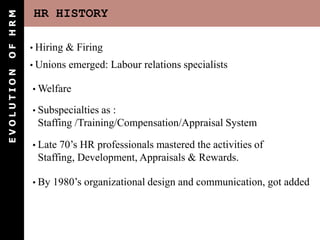
OF HRM      HR HISTORY

            • Hiring & Firing
            • Unions emerged: Labour relations specialists
EVOLUTION


            • Welfare

            • Subspecialties as :
             Staffing /Training/Compensation/Appraisal System

            • Late 70’s HR professionals mastered the activities of
             Staffing, Development, Appraisals & Rewards.

            • By 1980’s organizational design and communication, got added
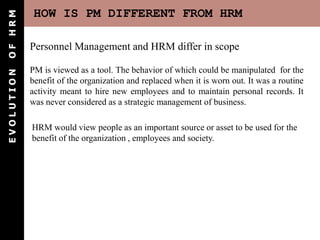
OF HRM       HOW IS PM DIFFERENT FROM HRM

            Personnel Management and HRM differ in scope

            PM is viewed as a tool. The behavior of which could be manipulated for the
EVOLUTION


            benefit of the organization and replaced when it is worn out. It was a routine
            activity meant to hire new employees and to maintain personal records. It
            was never considered as a strategic management of business.

            HRM would view people as an important source or asset to be used for the
            benefit of the organization , employees and society.
OF HRM
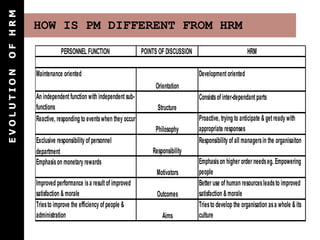
            HOW IS PM DIFFERENT FROM HRM

                        PERSONNEL FUNCTION                   POINTS OF DISCUSSION                          HRM
EVOLUTION


            Maintenance oriented                                                    Development oriented
                                                                  Orientation
            An independent function with independent sub-                           Consists of inter-dependant parts
            functions                                              Structure
            Reactive, responding to events when they occur                          Proactive, trying to anticipate & get ready with
                                                                  Philosophy        appropriate responses
            Exclusive responsibility of personnel                                   Responsibility of all managers in the organisaiton
            department                                           Responsibility
            Emphasis on monetary rewards                                            Emphasis on higher order needs eg. Empowering
                                                                   Motivators       people
            Improved performance is a result of improved                            Better use of human resources leads to improved
            satisfaction & morale                                  Outcomes         satisfaction & morale
            Tries to improve the efficiency of people &                             Tries to develop the organisation as a whole & its
            administration                                           Aims           culture
OF HRM      ESSENTIALS IN THE DEFINITION OF HRM

             It is people who staff the organization and manage organizations

             HRM involves application of management functions and principals.
EVOLUTION


             Functions and principals are applied to acquisitioning, developing
             , maintaining and remunerating employees

             Decisions on different aspects of employees must be consistent with
             other decisions on HR

             Decisions made must influence the effectiveness of the
              organization,    i.e. it should result in betterment of services to
              customers or productivity
OF HRM      DEFINITIONS OF HRM


            HRM is a series of integrated decisions that form the employment
            relationship; their quality contributes to the ability of the organization and
EVOLUTION


            the employees to achieve their objective.


            HRM is concerned with the people dimension in management. Since every
            organization is made up of people , acquiring their services, developing
            their skills , motivating them to higher levels of performance and ensuring
            that they continue to maintain their commitments to the organization are
            essential to achieving organizational objectives.
OF HRM
EVOLUTION    DEFINITIONS OF HRM


            HRM is management in planning, organizing, directing and controlling of the
            procurement, development, compensation, integration, maintenance and
            separation of human resources to the end that individual, organizational and
            social responsibilities are accomplished.
OF HRM      MANAGERIAL FUNCTIONS OF HRM


            Planning: Determination in advance of a personal program that will
            contribute to goals established for the enterprise
EVOLUTION


            Organising : This is required to carry out the plans. Designing the structure of
            relationships among jobs , personnel and physical factors.


            Directing : Before the action is started “direction “ is necessary; this may be
            in the form of “motivation “ “ actuation “ or “ command “.This is to get
            people to work willingly and effectively


            Controlling: Observation of action and its comparison with plans and
            correction of any deviation that may occur at any time.
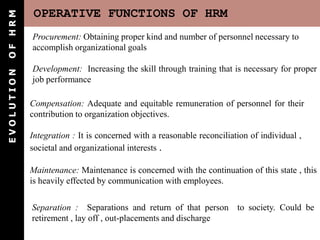
OF HRM       OPERATIVE FUNCTIONS OF HRM
            Procurement: Obtaining proper kind and number of personnel necessary to
            accomplish organizational goals

            Development: Increasing the skill through training that is necessary for proper
EVOLUTION


            job performance

            Compensation: Adequate and equitable remuneration of personnel for their
            contribution to organization objectives.

            Integration : It is concerned with a reasonable reconciliation of individual ,
            societal and organizational interests .

            Maintenance: Maintenance is concerned with the continuation of this state , this
            is heavily effected by communication with employees.

            Separation : Separations and return of that person to society. Could be
            retirement , lay off , out-placements and discharge
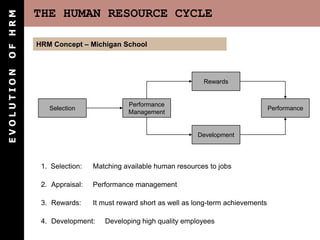
OF HRM      THE HUMAN RESOURCE CYCLE

            HRM Concept – Michigan School
EVOLUTION


                                                               Rewards


                                        Performance
               Selection                                                              Performance
                                        Management


                                                             Development


             1. Selection:   Matching available human resources to jobs

             2. Appraisal:   Performance management

             3. Rewards:     It must reward short as well as long-term achievements

             4. Development:    Developing high quality employees
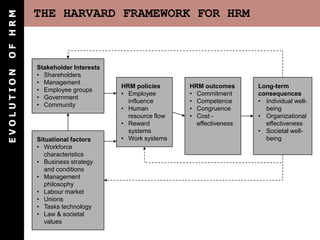
OF HRM      THE HARVARD FRAMEWORK FOR HRM


            Stakeholder Interests
EVOLUTION


            • Shareholders
            • Management
                                    HRM policies      HRM outcomes      Long-term
            • Employee groups
                                    • Employee        • Commitment      consequences
            • Government
                                      influence       • Competence      • Individual well-
            • Community
                                    • Human           • Congruence        being
                                      resource flow   • Cost -          • Organizational
                                    • Reward            effectiveness     effectiveness
                                      systems                           • Societal well-
            Situational factors     • Work systems                        being
            • Workforce
               characteristics
            • Business strategy
               and conditions
            • Management
               philosophy
            • Labour market
            • Unions
            • Tasks technology
            • Law & societal
               values
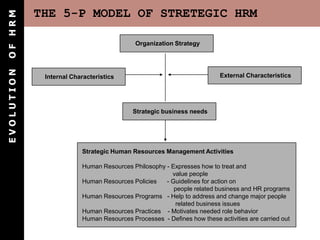
OF HRM      THE 5-P MODEL OF STRETEGIC HRM

                                           Organization Strategy
EVOLUTION


             Internal Characteristics                                   External Characteristics


                                          Strategic business needs


                         Strategic Human Resources Management Activities

                         Human Resources Philosophy - Expresses how to treat and
                                                      value people
                         Human Resources Policies   - Guidelines for action on
                                                       people related business and HR programs
                         Human Resources Programs - Help to address and change major people
                                                       related business issues
                         Human Resources Practices - Motivates needed role behavior
                         Human Resources Processes - Defines how these activities are carried out
OF HRM      HUMAN RESOURCE WHEELS
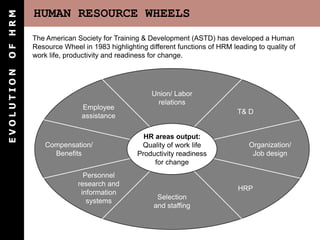
            The American Society for Training & Development (ASTD) has developed a Human
            Resource Wheel in 1983 highlighting different functions of HRM leading to quality of
            work life, productivity and readiness for change.
EVOLUTION


                                                  Union/ Labor
                                                   relations
                           Employee
                                                                             T& D
                           assistance

                                               HR areas output:
               Compensation/                  Quality of work life               Organization/
                 Benefits                    Productivity readiness               Job design
                                                  for change
                            Personnel
                          research and
                                                                             HRP
                           information
                                                   Selection
                             systems
                                                  and staffing
OF HRM      HUMAN RESOURCE WHEELS

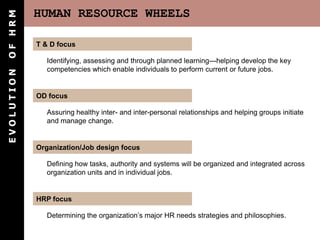
            T & D focus

              Identifying, assessing and through planned learning---helping develop the key
              competencies which enable individuals to perform current or future jobs.
EVOLUTION


            OD focus

              Assuring healthy inter- and inter-personal relationships and helping groups initiate
              and manage change.


            Organization/Job design focus

              Defining how tasks, authority and systems will be organized and integrated across
              organization units and in individual jobs.


            HRP focus

              Determining the organization‟s major HR needs strategies and philosophies.
OF HRM      HUMAN RESOURCE WHEELS

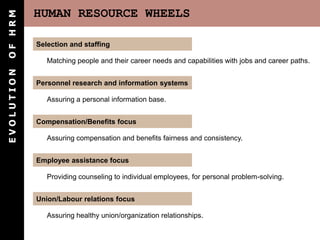
            Selection and staffing

               Matching people and their career needs and capabilities with jobs and career paths.
EVOLUTION


            Personnel research and information systems

               Assuring a personal information base.


            Compensation/Benefits focus

               Assuring compensation and benefits fairness and consistency.


            Employee assistance focus

               Providing counseling to individual employees, for personal problem-solving.


            Union/Labour relations focus

               Assuring healthy union/organization relationships.
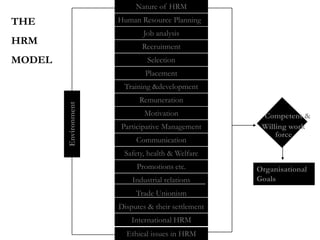
Nature of HRM
THE                   Human Resource Planning
                             Job analysis
HRM                          Recruitment
MODEL                          Selection
                              Placement
                       Training &development
                            Remuneration
        Environment


                              Motivation             Competent &
                      Participative Management       Willing work
                                                         force
                           Communication
                       Safety, health & Welfare
                           Promotions etc.          Organisational
                          Industrial relations      Goals
                           Trade Unionism
                      Disputes & their settlement
                          International HRM
                        Ethical issues in HRM
OF HRM      HUMAN RESOURCE FUNCTIONS
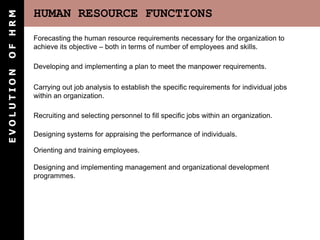
            Forecasting the human resource requirements necessary for the organization to
            achieve its objective – both in terms of number of employees and skills.

            Developing and implementing a plan to meet the manpower requirements.
EVOLUTION


            Carrying out job analysis to establish the specific requirements for individual jobs
            within an organization.

            Recruiting and selecting personnel to fill specific jobs within an organization.

            Designing systems for appraising the performance of individuals.

            Orienting and training employees.

            Designing and implementing management and organizational development
            programmes.
OF HRM      HUMAN RESOURCE FUNCTIONS

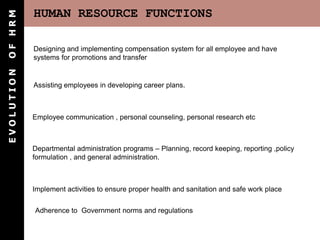
            Designing and implementing compensation system for all employee and have
            systems for promotions and transfer
EVOLUTION


            Assisting employees in developing career plans.


            Employee communication , personal counseling, personal research etc


            Departmental administration programs – Planning, record keeping, reporting ,policy
            formulation , and general administration.


            Implement activities to ensure proper health and sanitation and safe work place


            Adherence to Government norms and regulations
OF HRM      CHALLENGES FACED BY HRM


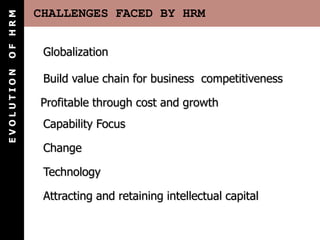
             Globalization
EVOLUTION


             Build value chain for business competitiveness

            Profitable through cost and growth
             Capability Focus

             Change

             Technology

             Attracting and retaining intellectual capital
OF HRM       CONCLUSION

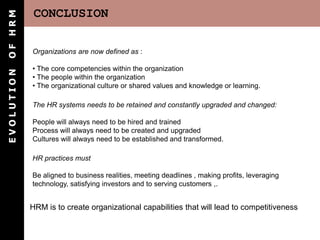
            Organizations are now defined as :

            • The core competencies within the organization
EVOLUTION


            • The people within the organization
            • The organizational culture or shared values and knowledge or learning.

            The HR systems needs to be retained and constantly upgraded and changed:

            People will always need to be hired and trained
            Process will always need to be created and upgraded
            Cultures will always need to be established and transformed.

            HR practices must

            Be aligned to business realities, meeting deadlines , making profits, leveraging
            technology, satisfying investors and to serving customers ,.


            HRM is to create organizational capabilities that will lead to competitiveness
Evolutionofhrm 090514031737-phpapp01

Evolutionofhrm 090514031737-phpapp01

  • 1.
    EVOLUTION OF HRM “There is no „magic‟ in the success of companies. The secret of their success is simply the way that treat their employees” Akio Morita Founder, Sony Corporation
  • 2.
    OF HRM HR HISTORY • Hiring & Firing • Unions emerged: Labour relations specialists EVOLUTION • Welfare • Subspecialties as : Staffing /Training/Compensation/Appraisal System • Late 70’s HR professionals mastered the activities of Staffing, Development, Appraisals & Rewards. • By 1980’s organizational design and communication, got added
  • 3.
    OF HRM HOW IS PM DIFFERENT FROM HRM Personnel Management and HRM differ in scope PM is viewed as a tool. The behavior of which could be manipulated for the EVOLUTION benefit of the organization and replaced when it is worn out. It was a routine activity meant to hire new employees and to maintain personal records. It was never considered as a strategic management of business. HRM would view people as an important source or asset to be used for the benefit of the organization , employees and society.
  • 4.
    OF HRM HOW IS PM DIFFERENT FROM HRM PERSONNEL FUNCTION POINTS OF DISCUSSION HRM EVOLUTION Maintenance oriented Development oriented Orientation An independent function with independent sub- Consists of inter-dependant parts functions Structure Reactive, responding to events when they occur Proactive, trying to anticipate & get ready with Philosophy appropriate responses Exclusive responsibility of personnel Responsibility of all managers in the organisaiton department Responsibility Emphasis on monetary rewards Emphasis on higher order needs eg. Empowering Motivators people Improved performance is a result of improved Better use of human resources leads to improved satisfaction & morale Outcomes satisfaction & morale Tries to improve the efficiency of people & Tries to develop the organisation as a whole & its administration Aims culture
  • 5.
    OF HRM ESSENTIALS IN THE DEFINITION OF HRM It is people who staff the organization and manage organizations HRM involves application of management functions and principals. EVOLUTION Functions and principals are applied to acquisitioning, developing , maintaining and remunerating employees Decisions on different aspects of employees must be consistent with other decisions on HR Decisions made must influence the effectiveness of the organization, i.e. it should result in betterment of services to customers or productivity
  • 6.
    OF HRM DEFINITIONS OF HRM HRM is a series of integrated decisions that form the employment relationship; their quality contributes to the ability of the organization and EVOLUTION the employees to achieve their objective. HRM is concerned with the people dimension in management. Since every organization is made up of people , acquiring their services, developing their skills , motivating them to higher levels of performance and ensuring that they continue to maintain their commitments to the organization are essential to achieving organizational objectives.
  • 7.
    OF HRM EVOLUTION DEFINITIONS OF HRM HRM is management in planning, organizing, directing and controlling of the procurement, development, compensation, integration, maintenance and separation of human resources to the end that individual, organizational and social responsibilities are accomplished.
  • 8.
    OF HRM MANAGERIAL FUNCTIONS OF HRM Planning: Determination in advance of a personal program that will contribute to goals established for the enterprise EVOLUTION Organising : This is required to carry out the plans. Designing the structure of relationships among jobs , personnel and physical factors. Directing : Before the action is started “direction “ is necessary; this may be in the form of “motivation “ “ actuation “ or “ command “.This is to get people to work willingly and effectively Controlling: Observation of action and its comparison with plans and correction of any deviation that may occur at any time.
  • 9.
    OF HRM OPERATIVE FUNCTIONS OF HRM Procurement: Obtaining proper kind and number of personnel necessary to accomplish organizational goals Development: Increasing the skill through training that is necessary for proper EVOLUTION job performance Compensation: Adequate and equitable remuneration of personnel for their contribution to organization objectives. Integration : It is concerned with a reasonable reconciliation of individual , societal and organizational interests . Maintenance: Maintenance is concerned with the continuation of this state , this is heavily effected by communication with employees. Separation : Separations and return of that person to society. Could be retirement , lay off , out-placements and discharge
  • 10.
    OF HRM THE HUMAN RESOURCE CYCLE HRM Concept – Michigan School EVOLUTION Rewards Performance Selection Performance Management Development 1. Selection: Matching available human resources to jobs 2. Appraisal: Performance management 3. Rewards: It must reward short as well as long-term achievements 4. Development: Developing high quality employees
  • 11.
    OF HRM THE HARVARD FRAMEWORK FOR HRM Stakeholder Interests EVOLUTION • Shareholders • Management HRM policies HRM outcomes Long-term • Employee groups • Employee • Commitment consequences • Government influence • Competence • Individual well- • Community • Human • Congruence being resource flow • Cost - • Organizational • Reward effectiveness effectiveness systems • Societal well- Situational factors • Work systems being • Workforce characteristics • Business strategy and conditions • Management philosophy • Labour market • Unions • Tasks technology • Law & societal values
  • 12.
    OF HRM THE 5-P MODEL OF STRETEGIC HRM Organization Strategy EVOLUTION Internal Characteristics External Characteristics Strategic business needs Strategic Human Resources Management Activities Human Resources Philosophy - Expresses how to treat and value people Human Resources Policies - Guidelines for action on people related business and HR programs Human Resources Programs - Help to address and change major people related business issues Human Resources Practices - Motivates needed role behavior Human Resources Processes - Defines how these activities are carried out
  • 13.
    OF HRM HUMAN RESOURCE WHEELS The American Society for Training & Development (ASTD) has developed a Human Resource Wheel in 1983 highlighting different functions of HRM leading to quality of work life, productivity and readiness for change. EVOLUTION Union/ Labor relations Employee T& D assistance HR areas output: Compensation/ Quality of work life Organization/ Benefits Productivity readiness Job design for change Personnel research and HRP information Selection systems and staffing
  • 14.
    OF HRM HUMAN RESOURCE WHEELS T & D focus Identifying, assessing and through planned learning---helping develop the key competencies which enable individuals to perform current or future jobs. EVOLUTION OD focus Assuring healthy inter- and inter-personal relationships and helping groups initiate and manage change. Organization/Job design focus Defining how tasks, authority and systems will be organized and integrated across organization units and in individual jobs. HRP focus Determining the organization‟s major HR needs strategies and philosophies.
  • 15.
    OF HRM HUMAN RESOURCE WHEELS Selection and staffing Matching people and their career needs and capabilities with jobs and career paths. EVOLUTION Personnel research and information systems Assuring a personal information base. Compensation/Benefits focus Assuring compensation and benefits fairness and consistency. Employee assistance focus Providing counseling to individual employees, for personal problem-solving. Union/Labour relations focus Assuring healthy union/organization relationships.
  • 16.
    Nature of HRM THE Human Resource Planning Job analysis HRM Recruitment MODEL Selection Placement Training &development Remuneration Environment Motivation Competent & Participative Management Willing work force Communication Safety, health & Welfare Promotions etc. Organisational Industrial relations Goals Trade Unionism Disputes & their settlement International HRM Ethical issues in HRM
  • 17.
    OF HRM HUMAN RESOURCE FUNCTIONS Forecasting the human resource requirements necessary for the organization to achieve its objective – both in terms of number of employees and skills. Developing and implementing a plan to meet the manpower requirements. EVOLUTION Carrying out job analysis to establish the specific requirements for individual jobs within an organization. Recruiting and selecting personnel to fill specific jobs within an organization. Designing systems for appraising the performance of individuals. Orienting and training employees. Designing and implementing management and organizational development programmes.
  • 18.
    OF HRM HUMAN RESOURCE FUNCTIONS Designing and implementing compensation system for all employee and have systems for promotions and transfer EVOLUTION Assisting employees in developing career plans. Employee communication , personal counseling, personal research etc Departmental administration programs – Planning, record keeping, reporting ,policy formulation , and general administration. Implement activities to ensure proper health and sanitation and safe work place Adherence to Government norms and regulations
  • 19.
    OF HRM CHALLENGES FACED BY HRM Globalization EVOLUTION Build value chain for business competitiveness Profitable through cost and growth Capability Focus Change Technology Attracting and retaining intellectual capital
  • 20.
    OF HRM CONCLUSION Organizations are now defined as : • The core competencies within the organization EVOLUTION • The people within the organization • The organizational culture or shared values and knowledge or learning. The HR systems needs to be retained and constantly upgraded and changed: People will always need to be hired and trained Process will always need to be created and upgraded Cultures will always need to be established and transformed. HR practices must Be aligned to business realities, meeting deadlines , making profits, leveraging technology, satisfying investors and to serving customers ,. HRM is to create organizational capabilities that will lead to competitiveness