Submitted To: Submitted By:
• Meaning of Human resource management
• Definition
• Objectives
• Functions
• importance
• Human:- refers to the skilled workforce in the
organization.
• Resource:- refer to limited availability or scarce.
• Management:- refer to maximize or proper utilization
and make best use of limited resource.
Altogether, the core purpose of HRM is to make efficient use of
existing human resource in the organization.
The best example at present situation is, construction
company has been facing serious shortage of skilled
workforce.
every organization desire to have skilled and competent
people to make their organization more effective than
their competitors.
You must treat your employees with respect and dignity
because in the most automated factory in the world, you
need the power of human mind. That is what brings in
innovation. If you want high quality mind to work for
you, then you must protect the respect and dignity.
• It is a process of bringing people and organization
together so that the goals of each are met.
• It is the art of procuring, developing and maintaining
competent workforce to achieve organizational goals
efficiently.
• It is that part of management process which is
concerned with the management of human resource
in an organization
• HR is a function in organizations designed to
maximize employee performance in service of their
employer’s strategic objectives.
• HR is primarily concerned with how people are
managed within organizations, focusing, policies and
systems.
• HRM is the process of recruitment, selection of
employees, providing proper orientation and
induction, providing proper training and the
developing skills, assessment of employee
(performance of appraisal), providing proper
Compensation and benefits, motivating, maintaining
proper relations with labor and with trade unions,
maintaining employees safety, welfare and health by
complying with labor laws of concern state or country.
According to Invancevich and Glueck, “ human management
is concerned with the most effective use of people to
achieve organizational and individual goals.
Or
Human resource management is the planning, organizing,
directing, and controlling of the procurement, development,
compensation, integration, maintenance, and separation of
human resources to the end that individual, organizational, and
social objectives are accomplished.
• Pervasive in nature:- HRM is present in all enterprises. It
spreads through all the levels of management.
• Action-oriented:- HRM focuses attention on action, rather on
record-keeping, written procedures or rules.
• People-oriented:- HRM is all about people at work, both as
individuals and groups. It tries to put people on assigned jobs in
order to produce good results.
• Development-oriented:- HRM intends to develop the full
potential of employees. The reward structure is tuned to the
needs of employees. Training is offered to sharpen and…
Improve their skills. Employees are rotated on various jobs so that
they can gain their experience and exposure.
Every attempt is made to use their talent fully in the service of
organizational goals.
• Integrating mechanism:- HRM tries to build and maintain
cordial relations between people working at various level in the
organization.
• Challenging function:- managing human resource is a
challenging job due to the dynamic and complex nature of
people. Therefore it is necessary not only to manage people but
administering a social system diplomatically.
• Continuous function:- HRM is not a one shoot deal. It
requires constant alertness and awareness.
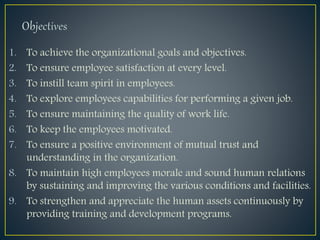
1. To achieve the organizational goals and objectives.
2. To ensure employee satisfaction at every level.
3. To instill team spirit in employees.
4. To explore employees capabilities for performing a given job.
5. To ensure maintaining the quality of work life.
6. To keep the employees motivated.
7. To ensure a positive environment of mutual trust and
understanding in the organization.
8. To maintain high employees morale and sound human relations
by sustaining and improving the various conditions and facilities.
9. To strengthen and appreciate the human assets continuously by
providing training and development programs.
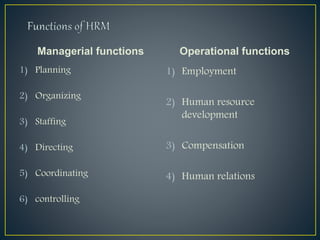
Managerial functions
1) Planning
2) Organizing
3) Staffing
4) Directing
5) Coordinating
6) controlling
Operational functions
1) Employment
2) Human resource
development
3) Compensation
4) Human relations
• Planning:- it is the process of thinking before doing. Planning is
a deciding stage that what is to be done exactly. Kit involves
planning of human resource’s requirement, recruitment, training,
etc. it also involves, forecasting of personal needs, set of programs,
procedure to achieve goal.
• Organizing:- it is the process of arranging people and other
resources to work together to accomplish a goal and it includes
identification and grouping of work activities.
• Staffing:- people could be the dynamic elements of management
so without proper sort of people things will remain immaterial. It
involves communication and counseling.
• Directing:- it means telling people to do a particular work and
ensures that they perform as per the directions. HRM is
responsible for motivating, developing communication network,
integrating disciplining and resolving grievances of workers and
employees quickly and satisfactorily.
• Coordinating:- organizational objectives will be achieved only
if group activities in the enterprise are coordinated effectively.
Coordination of personnel is required at all levels of management.
Personnel department coordinates the task of developing,
interpreting, and reviewing personnel policies and programmes
related to employees.
• Controlling:- HRM helps in maintaining proper discipline at
shop floor, regulating attendances, ,leaves, wages, etc. and train
and councils them on improving job performance and provides
safety and health awareness.
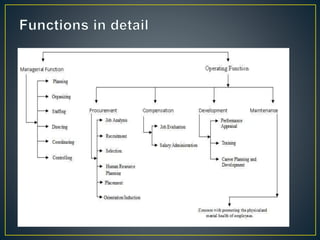
Procurement functions :- it concern with the right kind and right
number of people required to accomplishment the organizational
objectives. It consist of the following activities :
Job analysis :- job analysis identify the nature of job and what type
of people required to perform these job effectively. Job description
and job specification are prepared with the help of information
provided by job analysis.
Recruitment:- it is the process of identifying prospective
employees, stimulating, encouraging them to apply for a
particular job or jobs in the organization.
Selection:- it is the process of examining the applicants with regard
to their suitability for the given job and choosing the best from the
suitable candidates.
Human resource planning:- HRP is the process of estimating the
present and future manpower requirements of the organization.
Placement:- the selected candidates are assigned to a specific job
known as placement.
Orientation/induction:- it is the process of introducing new
employees to an existing employees in an organization in their
specific job and department.
Compensation functions:- provides appropriate remuneration to
employees for their contribution to achieve organizational objectives. It
consist of the following activities:
 Job evaluation;-
 Salary administration:- this function is to determine the salary structure
for various jobs in the organization.
Development functions:- it is the process of improving the knowledge,
skill and values of employees so that they can perform present and future
job more effectively. The activities are as such:-
 Performance appraisal:- it is a systematic evaluation of present potential
capabilities of personnel. It is a process of collecting, analyzing and
evaluating data relative to job behavior and results of individuals.
Training :- it is an organized procedure for improving the
knowledge and skills of the employees for doing a particular job
or for a definite purpose.
Carrier planning and development:- it involves the planning for
the carrier of employees and implementing these plans. It is only
possible through promotions and transfers.
Maintenance functions:- this function is concerned with promoting
the physical and mental health of employees by providing various
facility and social security.
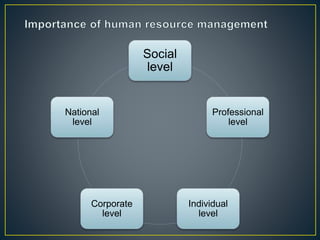
Social
level
Professional
level
Individual
level
Corporate
level
National
level
Social level: proper management of personnel enhances their
dignity by satisfying their social needs, this is done by:-
Making a balance between the jobs available and the job seekers,
according to the qualification and needs.
Making maximum utilization of the resource in an effective
manner and paying the employee a reasonable compensation in
proportion to the contribution made by him.
Eliminating waste or improper use of human resource, through
conservation of their normal energy and health.
By helping people to make their own decisions, that are in their
interests.
Professional level:- by providing healthy working environment, it
promotes teamwork in the employees. This is done by:-
Maintaining the dignity of the employees as a “human-being”.
Providing maximum opportunities for personnel development.
Providing healthy relationship between different workgroups so
that work is effectively performed.
Improving the employee’s working skills and capacity.
Correcting the errors of wrong postings and proper re-allocations
of work.
Individual level:- it can help the organization in accomplishing it
goals by:-
Creating right attitude among the employees through effective
motivation.
Utilizing effectively the available human resources.
Securing willing cooperation of the employees for achieving goals
of the enterprise and fulfilling their own social and other
psychological needs of recognition, love, affection, belongingness,
esteem and self-actualization.
Corporate level :- HRM is useful in helping business
organizations to attain it goals and objectives more efficiently and
effectively in the following ways :
HRM ensures that business organization has a team of dedicated,
competent employees.
HRM attracts as well as retains requisite talent through effective
HR planning, recruitment, selection, placement, orientation,
compensation, and promotion policies.
HRM develops requisite skills and correct attitude amongst the
employees through employee training, development, performance
appraisal, and other schemes.
National level:- HRM plays a very important role in the
development of nation in following ways:
Efficient exploration and utilization of natural, physical, and
financial resources of nation requires an efficient and committed
workforce.
The level of economic development of nation is dependent on the
skills, attitudes, and values of its human resource.
HRM helps to accelerate the process of economic growth.
HRM also helps in improving the standard of living and better
employment.
Human resource management basic intro.

Human resource management basic intro.

  • 1.
  • 2.
    • Meaning ofHuman resource management • Definition • Objectives • Functions • importance
  • 3.
    • Human:- refersto the skilled workforce in the organization. • Resource:- refer to limited availability or scarce. • Management:- refer to maximize or proper utilization and make best use of limited resource. Altogether, the core purpose of HRM is to make efficient use of existing human resource in the organization.
  • 4.
    The best exampleat present situation is, construction company has been facing serious shortage of skilled workforce. every organization desire to have skilled and competent people to make their organization more effective than their competitors. You must treat your employees with respect and dignity because in the most automated factory in the world, you need the power of human mind. That is what brings in innovation. If you want high quality mind to work for you, then you must protect the respect and dignity.
  • 5.
    • It isa process of bringing people and organization together so that the goals of each are met. • It is the art of procuring, developing and maintaining competent workforce to achieve organizational goals efficiently. • It is that part of management process which is concerned with the management of human resource in an organization
  • 6.
    • HR isa function in organizations designed to maximize employee performance in service of their employer’s strategic objectives. • HR is primarily concerned with how people are managed within organizations, focusing, policies and systems. • HRM is the process of recruitment, selection of employees, providing proper orientation and induction, providing proper training and the developing skills, assessment of employee (performance of appraisal), providing proper
  • 7.
    Compensation and benefits,motivating, maintaining proper relations with labor and with trade unions, maintaining employees safety, welfare and health by complying with labor laws of concern state or country.
  • 8.
    According to Invancevichand Glueck, “ human management is concerned with the most effective use of people to achieve organizational and individual goals. Or Human resource management is the planning, organizing, directing, and controlling of the procurement, development, compensation, integration, maintenance, and separation of human resources to the end that individual, organizational, and social objectives are accomplished.
  • 9.
    • Pervasive innature:- HRM is present in all enterprises. It spreads through all the levels of management. • Action-oriented:- HRM focuses attention on action, rather on record-keeping, written procedures or rules. • People-oriented:- HRM is all about people at work, both as individuals and groups. It tries to put people on assigned jobs in order to produce good results. • Development-oriented:- HRM intends to develop the full potential of employees. The reward structure is tuned to the needs of employees. Training is offered to sharpen and…
  • 10.
    Improve their skills.Employees are rotated on various jobs so that they can gain their experience and exposure. Every attempt is made to use their talent fully in the service of organizational goals. • Integrating mechanism:- HRM tries to build and maintain cordial relations between people working at various level in the organization. • Challenging function:- managing human resource is a challenging job due to the dynamic and complex nature of people. Therefore it is necessary not only to manage people but administering a social system diplomatically. • Continuous function:- HRM is not a one shoot deal. It requires constant alertness and awareness.
  • 11.
    1. To achievethe organizational goals and objectives. 2. To ensure employee satisfaction at every level. 3. To instill team spirit in employees. 4. To explore employees capabilities for performing a given job. 5. To ensure maintaining the quality of work life. 6. To keep the employees motivated. 7. To ensure a positive environment of mutual trust and understanding in the organization. 8. To maintain high employees morale and sound human relations by sustaining and improving the various conditions and facilities. 9. To strengthen and appreciate the human assets continuously by providing training and development programs.
  • 12.
    Managerial functions 1) Planning 2)Organizing 3) Staffing 4) Directing 5) Coordinating 6) controlling Operational functions 1) Employment 2) Human resource development 3) Compensation 4) Human relations
  • 14.
    • Planning:- itis the process of thinking before doing. Planning is a deciding stage that what is to be done exactly. Kit involves planning of human resource’s requirement, recruitment, training, etc. it also involves, forecasting of personal needs, set of programs, procedure to achieve goal. • Organizing:- it is the process of arranging people and other resources to work together to accomplish a goal and it includes identification and grouping of work activities. • Staffing:- people could be the dynamic elements of management so without proper sort of people things will remain immaterial. It involves communication and counseling.
  • 15.
    • Directing:- itmeans telling people to do a particular work and ensures that they perform as per the directions. HRM is responsible for motivating, developing communication network, integrating disciplining and resolving grievances of workers and employees quickly and satisfactorily. • Coordinating:- organizational objectives will be achieved only if group activities in the enterprise are coordinated effectively. Coordination of personnel is required at all levels of management. Personnel department coordinates the task of developing, interpreting, and reviewing personnel policies and programmes related to employees. • Controlling:- HRM helps in maintaining proper discipline at shop floor, regulating attendances, ,leaves, wages, etc. and train and councils them on improving job performance and provides safety and health awareness.
  • 16.
    Procurement functions :-it concern with the right kind and right number of people required to accomplishment the organizational objectives. It consist of the following activities : Job analysis :- job analysis identify the nature of job and what type of people required to perform these job effectively. Job description and job specification are prepared with the help of information provided by job analysis. Recruitment:- it is the process of identifying prospective employees, stimulating, encouraging them to apply for a particular job or jobs in the organization.
  • 17.
    Selection:- it isthe process of examining the applicants with regard to their suitability for the given job and choosing the best from the suitable candidates. Human resource planning:- HRP is the process of estimating the present and future manpower requirements of the organization. Placement:- the selected candidates are assigned to a specific job known as placement. Orientation/induction:- it is the process of introducing new employees to an existing employees in an organization in their specific job and department.
  • 18.
    Compensation functions:- providesappropriate remuneration to employees for their contribution to achieve organizational objectives. It consist of the following activities:  Job evaluation;-  Salary administration:- this function is to determine the salary structure for various jobs in the organization. Development functions:- it is the process of improving the knowledge, skill and values of employees so that they can perform present and future job more effectively. The activities are as such:-  Performance appraisal:- it is a systematic evaluation of present potential capabilities of personnel. It is a process of collecting, analyzing and evaluating data relative to job behavior and results of individuals.
  • 19.
    Training :- itis an organized procedure for improving the knowledge and skills of the employees for doing a particular job or for a definite purpose. Carrier planning and development:- it involves the planning for the carrier of employees and implementing these plans. It is only possible through promotions and transfers. Maintenance functions:- this function is concerned with promoting the physical and mental health of employees by providing various facility and social security.
  • 20.
  • 21.
    Social level: propermanagement of personnel enhances their dignity by satisfying their social needs, this is done by:- Making a balance between the jobs available and the job seekers, according to the qualification and needs. Making maximum utilization of the resource in an effective manner and paying the employee a reasonable compensation in proportion to the contribution made by him. Eliminating waste or improper use of human resource, through conservation of their normal energy and health. By helping people to make their own decisions, that are in their interests.
  • 22.
    Professional level:- byproviding healthy working environment, it promotes teamwork in the employees. This is done by:- Maintaining the dignity of the employees as a “human-being”. Providing maximum opportunities for personnel development. Providing healthy relationship between different workgroups so that work is effectively performed. Improving the employee’s working skills and capacity. Correcting the errors of wrong postings and proper re-allocations of work.
  • 23.
    Individual level:- itcan help the organization in accomplishing it goals by:- Creating right attitude among the employees through effective motivation. Utilizing effectively the available human resources. Securing willing cooperation of the employees for achieving goals of the enterprise and fulfilling their own social and other psychological needs of recognition, love, affection, belongingness, esteem and self-actualization.
  • 24.
    Corporate level :-HRM is useful in helping business organizations to attain it goals and objectives more efficiently and effectively in the following ways : HRM ensures that business organization has a team of dedicated, competent employees. HRM attracts as well as retains requisite talent through effective HR planning, recruitment, selection, placement, orientation, compensation, and promotion policies. HRM develops requisite skills and correct attitude amongst the employees through employee training, development, performance appraisal, and other schemes.
  • 25.
    National level:- HRMplays a very important role in the development of nation in following ways: Efficient exploration and utilization of natural, physical, and financial resources of nation requires an efficient and committed workforce. The level of economic development of nation is dependent on the skills, attitudes, and values of its human resource. HRM helps to accelerate the process of economic growth. HRM also helps in improving the standard of living and better employment.