Human Reproduction*
Biology 1408 Online Lab
Summer I 2018
* You might not want to do this assignment at a public
computer.
Human Reproduction Lab
● EXERCISE 1
○ Watch video “Life’s Greatest Miracle” (54 minutes)
○ Answer questions in worksheet as you watch
● EXERCISE 2
○ Read through birth control method presentation
○ Categorize the methods on the worksheet
● Post-Lab Quiz
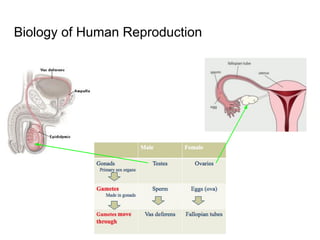
Biology of Human Reproduction
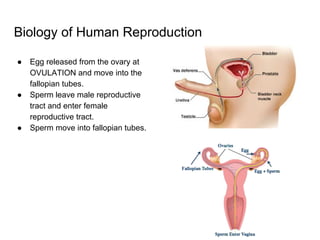
● Egg released from the ovary at
OVULATION and move into the
fallopian tubes.
● Sperm leave male reproductive
tract and enter female
reproductive tract.
● Sperm move into fallopian tubes.
Biology of Human Reproduction
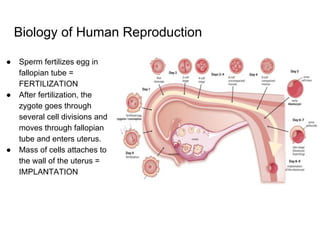
● Sperm fertilizes egg in
fallopian tube =
FERTILIZATION
● After fertilization, the
zygote goes through
several cell divisions and
moves through fallopian
tube and enters uterus.
● Mass of cells attaches to
the wall of the uterus =
IMPLANTATION
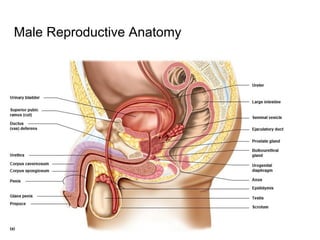
Male Reproductive Anatomy
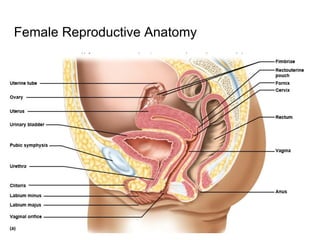
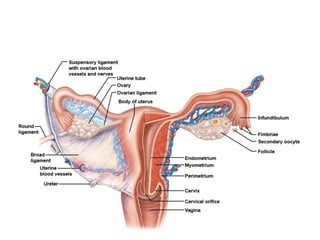
Female Reproductive Anatomy
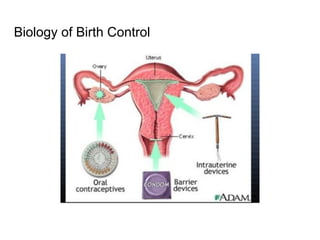
Biology of Birth Control
Birth Control - Abstinence
● Sperm NEVER meets egg
○ Gametes are produced but
don’t meet.
● Not guaranteed to prevent STDs.
○ How do you define sex?
● Exceptions
○ Parthenogenesis
○ In Vitro fertilization
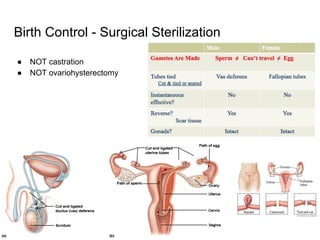
Birth Control - Surgical Sterilization
● NOT castration
● NOT ovariohysterectomy
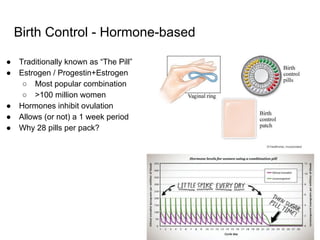
Birth Control - Hormone-based
● Traditionally known as “The Pill”
● Estrogen / Progestin+Estrogen
○ Most popular combination
○ >100 million women
● Hormones inhibit ovulation
● Allows (or not) a 1 week period
● Why 28 pills per pack?
Birth Control - Hormone-based
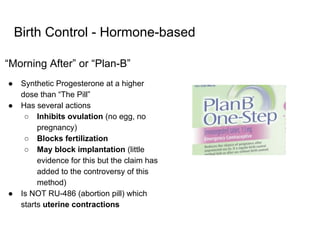
“Morning After” or “Plan-B”
● Synthetic Progesterone at a higher
dose than “The Pill”
● Has several actions
○ Inhibits ovulation (no egg, no
pregnancy)
○ Blocks fertilization
○ May block implantation (little
evidence for this but the claim has
added to the controversy of this
method)
● Is NOT RU-486 (abortion pill) which
starts uterine contractions
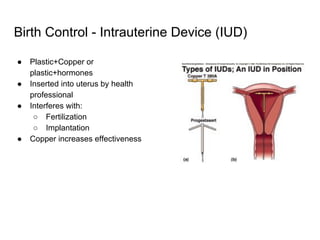
Birth Control - Intrauterine Device (IUD)
● Plastic+Copper or
plastic+hormones
● Inserted into uterus by health
professional
● Interferes with:
○ Fertilization
○ Implantation
● Copper increases effectiveness
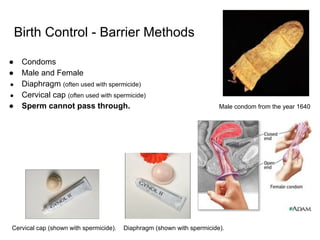
Birth Control - Barrier Methods
● Condoms
● Male and Female
● Diaphragm (often used with spermicide)
● Cervical cap (often used with spermicide)
● Sperm cannot pass through. Male condom from the year 1640
Cervical cap (shown with spermicide). Diaphragm (shown with spermicide).
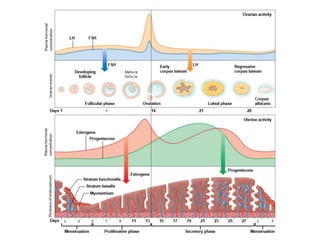
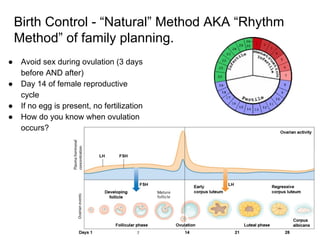
Birth Control - “Natural” Method AKA “Rhythm
Method” of family planning.
● Avoid sex during ovulation (3 days
before AND after)
● Day 14 of female reproductive
cycle
● If no egg is present, no fertilization
● How do you know when ovulation
occurs?
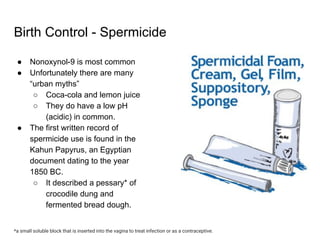
Birth Control - Spermicide
● Nonoxynol-9 is most common
● Unfortunately there are many
“urban myths”
○ Coca-cola and lemon juice
○ They do have a low pH
(acidic) in common.
● The first written record of
spermicide use is found in the
Kahun Papyrus, an Egyptian
document dating to the year
1850 BC.
○ It described a pessary* of
crocodile dung and
fermented bread dough.
*a small soluble block that is inserted into the vagina to treat infection or as a contraceptive.
● Complete worksheet
● Take Post-Lab Quiz

Human reproduction slides (BIOL1408)

  • 1.
    Human Reproduction* Biology 1408Online Lab Summer I 2018 * You might not want to do this assignment at a public computer.
  • 2.
    Human Reproduction Lab ●EXERCISE 1 ○ Watch video “Life’s Greatest Miracle” (54 minutes) ○ Answer questions in worksheet as you watch ● EXERCISE 2 ○ Read through birth control method presentation ○ Categorize the methods on the worksheet ● Post-Lab Quiz
  • 3.
    Biology of HumanReproduction
  • 4.
    Biology of HumanReproduction ● Egg released from the ovary at OVULATION and move into the fallopian tubes. ● Sperm leave male reproductive tract and enter female reproductive tract. ● Sperm move into fallopian tubes.
  • 5.
    Biology of HumanReproduction ● Sperm fertilizes egg in fallopian tube = FERTILIZATION ● After fertilization, the zygote goes through several cell divisions and moves through fallopian tube and enters uterus. ● Mass of cells attaches to the wall of the uterus = IMPLANTATION
  • 6.
  • 7.
  • 9.
  • 10.
    Birth Control -Abstinence ● Sperm NEVER meets egg ○ Gametes are produced but don’t meet. ● Not guaranteed to prevent STDs. ○ How do you define sex? ● Exceptions ○ Parthenogenesis ○ In Vitro fertilization
  • 11.
    Birth Control -Surgical Sterilization ● NOT castration ● NOT ovariohysterectomy
  • 12.
    Birth Control -Hormone-based ● Traditionally known as “The Pill” ● Estrogen / Progestin+Estrogen ○ Most popular combination ○ >100 million women ● Hormones inhibit ovulation ● Allows (or not) a 1 week period ● Why 28 pills per pack?
  • 14.
    Birth Control -Hormone-based “Morning After” or “Plan-B” ● Synthetic Progesterone at a higher dose than “The Pill” ● Has several actions ○ Inhibits ovulation (no egg, no pregnancy) ○ Blocks fertilization ○ May block implantation (little evidence for this but the claim has added to the controversy of this method) ● Is NOT RU-486 (abortion pill) which starts uterine contractions
  • 15.
    Birth Control -Intrauterine Device (IUD) ● Plastic+Copper or plastic+hormones ● Inserted into uterus by health professional ● Interferes with: ○ Fertilization ○ Implantation ● Copper increases effectiveness
  • 16.
    Birth Control -Barrier Methods ● Condoms ● Male and Female ● Diaphragm (often used with spermicide) ● Cervical cap (often used with spermicide) ● Sperm cannot pass through. Male condom from the year 1640 Cervical cap (shown with spermicide). Diaphragm (shown with spermicide).
  • 17.
    Birth Control -“Natural” Method AKA “Rhythm Method” of family planning. ● Avoid sex during ovulation (3 days before AND after) ● Day 14 of female reproductive cycle ● If no egg is present, no fertilization ● How do you know when ovulation occurs?
  • 19.
    Birth Control -Spermicide ● Nonoxynol-9 is most common ● Unfortunately there are many “urban myths” ○ Coca-cola and lemon juice ○ They do have a low pH (acidic) in common. ● The first written record of spermicide use is found in the Kahun Papyrus, an Egyptian document dating to the year 1850 BC. ○ It described a pessary* of crocodile dung and fermented bread dough. *a small soluble block that is inserted into the vagina to treat infection or as a contraceptive.
  • 20.
    ● Complete worksheet ●Take Post-Lab Quiz