METHODS OF POPULATION CONTROL
INTRODUCTION TO FAMILY PLANNING
METHODS
INTRODUCTION
• Demography- scientific study of human population
• Three observable human phenomena
i)changes in population size
ii)composition of the population
iii)Distribution of population
Deals with five demographic processes
i)Fertility
ii)Mortality
iii)Marriage
iv)Migration
v)Social
mobility
DEMOGRAPHIC CYCLE
• FIRST STAGE( High stationary) Eg; India in 1920
• SECOND STAGE( Early expanding) Eg; South asia and Africa
• THIRD STAGE( Late expanding) Eg; India, China, Singapore
• FOURTH STAGE( Lowstationary) Eg; Uk, Denmark, Sweeden
• FIFTH STAGE( Declining) Eg; East European Germany, Hungary
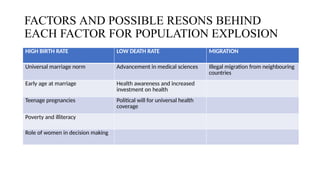
FACTORS AND POSSIBLE RESONS BEHIND
EACH FACTOR FOR POPULATION EXPLOSION
HIGH BIRTH RATE LOW DEATH RATE MIGRATION
Universal marriage norm Advancement in medical sciences Illegal migration from neighbouring
countries
Early age at marriage Health awareness and increased
investment on health
Teenage pregnancies Political will for universal health
coverage
Poverty and illiteracy
Role of women in decision making
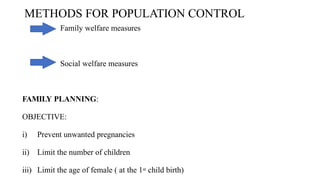
METHODS FOR POPULATION CONTROL
Family welfare measures
Social welfare measures
FAMILY PLANNING:
OBJECTIVE:
i) Prevent unwanted pregnancies
ii) Limit the number of children
iii) Limit the age of female ( at the 1st child birth)
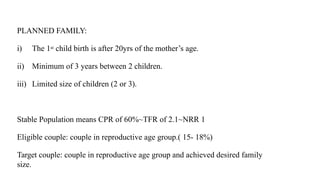
PLANNED FAMILY:
i) The 1st child birth is after 20yrs of the mother’s age.
ii) Minimum of 3 years between 2 children.
iii) Limited size of children (2 or 3).
Stable Population means CPR of 60%~TFR of 2.1~NRR 1
Eligible couple: couple in reproductive age group.( 15- 18%)
Target couple: couple in reproductive age group and achieved desired family
size.
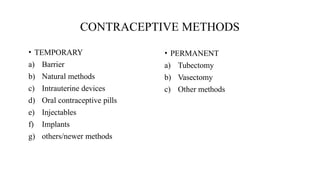
CONTRACEPTIVE METHODS
• TEMPORARY
a) Barrier
b) Natural methods
c) Intrauterine devices
d) Oral contraceptive pills
e) Injectables
f) Implants
g) others/newer methods
• PERMANENT
a) Tubectomy
b) Vasectomy
c) Other methods
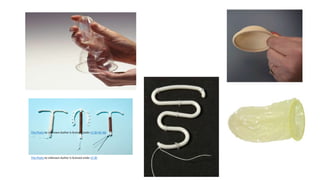
• BARRIER METHODS:
i) Condoms: Male condoms- latex, failure rate 2 or3 to 14/ HWY
Female condoms- polyurethane, prelubricated
with
silicone, two rings, failure rate 5 to 20/HWY
ii)Diaphragm: Vaginal barrier, dutch cap, used before intercouse and left for
six hours Chances of Toxic syndrome, 6-12 /HWY.
iii) Vaginal sponge: soaked in vinegar or olive oil, Today, 5× 2cms, nonoxynol-
9.
20- 40 /HWY.
. CHEMICAL METHOD:
iv) Foams
v) Creams,jellies and pastes
vi) Suppositories
This Photo by Unknown Author is licensed under CC BY
This Photo by Unknown Author is licensed under CC BY-NC-ND
• NATURAL METHODS:
i) Standard days method: fertile period from day 8 to 19 days. Regular cycle.
ii) Calendar rhythm method: short cycle minus 18 and long cycle minus 11. that is 8day
to 21 days of the cycle. 9/HWY
iii) Basal body temperature: 0.3 to 0.5 degree C as a result of progesterone. First day to
third day of rise of temperature.20/HWY
iv) Billing method/ cervical mucus secretion: fertile period usually 4 to 7 days prior to
ovulation. After three days after ovulation mucous become thick.
v) Lactational amenorrhoea method: During this period, prolactin inhibits ovulation.
INTRA UTERINE DEVICES(IUD)
• FIRST GENERATION: During 1965,Lippes loop ,Polyethylene,double S
shaped, fine
thread, four size A,B,C,D.
• SECOND GENERATION:During 1970, Earlier devices copper-7, copper T-200.
Newer devices Cu-T-220c, Cu-T-380 AorAg, Nova T, ML-Cu-375.
• THIRD GENERATION: i)Mirena( LGN-20) 7-8 yrs 20mcg
progesterone/day.Lowest failure rate 0.2 /HWY
ii)Progestasert(1yr) Natural Progesterone, loading
dose 38mg and 65mcg/day. Lowest expulsion rate.
MECHANISM OF ACTION OF
IUD
• Foreign body reaction in the uterus causing biochemical changes in the
endometrium and uterus fluid ,inhibits viability of gametes rather than
implantation.
• Alters the biochemical composition of cervical mucus inhibits the sperm
motility, capacitation and survival.
• Hormonal releasing devices increases the viscosity of cervical mucus thus inhibits
the sperm entering the cervix. High progesterone and low Oestrogen
unfavourable for implantation
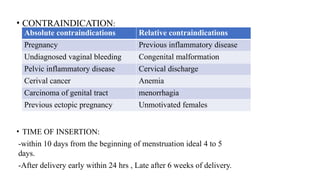
• CONTRAINDICATION:
• TIME OF INSERTION:
-within 10 days from the beginning of menstruation ideal 4 to 5
days.
-After delivery early within 24 hrs , Late after 6 weeks of delivery.
Absolute contraindications Relative contraindications
Pregnancy Previous inflammatory disease
Undiagnosed vaginal bleeding Congenital malformation
Pelvic inflammatory disease Cervical discharge
Cerival cancer Anemia
Carcinoma of genital tract menorrhagia
Previous ectopic pregnancy Unmotivated females
ADVERSE EFFECTS OF IUD
• Pain : MC cause of removal 15 to 40%.
• Bleeding : MC side effect. Removal 10 to 17 %.
• Ectopic pregnancy: due to delayed tubal motility cause by progesterone.
Rate 6.8%.
• Pelvic inflammatory disease.
• Perforation: Dangerous AD.
• Expulsion : MC cause is pain.
• Pregnancy with IUD insitu Mostly abort,
Continue-Thread not visible, sepsis.
Thread visible pull out.
ORAL CONTRACEPTIVE
HORMONAL :
i) combined hormonal contraceptive
ii) progesterone only contraceptive pill
iii) emergency contraceptive pill
iv) injectable hormonal pill
NON HORMONAL: Centchroman(chhaya)
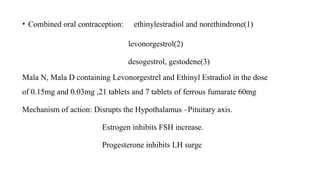
• Combined oral contraception: ethinylestradiol and norethindrone(1)
levonorgestrol(2)
desogestrol, gestodene(3)
Mala N, Mala D containing Levonorgestrel and Ethinyl Estradiol in the dose
of 0.15mg and 0.03mg ,21 tablets and 7 tablets of ferrous fumarate 60mg
Mechanism of action: Disrupts the Hypothalamus –Pituitary axis.
Estrogen inhibits FSH increase.
Progesterone inhibits LH surge
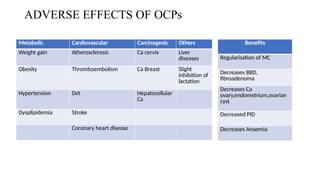
ADVERSE EFFECTS OF OCPs
Metabolic Cardiovascular Carcinogenic Others
Weight gain Atherosclerosis Ca cervix Liver
diseases
Obesity Thromboembolism Ca Breast Slight
inhibition of
lactation
Hypertension Dvt Hepatocellular
Ca
Dysplipidemia Stroke
Coronary heart disease
Benefits
Regularisation of MC
Decreases BBD,
fibroadenoma
Decreases Ca
ovary,endometrium,ovarian
cyst
Decreased PID
Decreases Anaemia
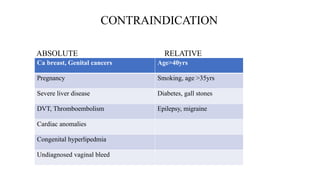
CONTRAINDICATION
ABSOLUTE RELATIVE
Ca breast, Genital cancers Age>40yrs
Pregnancy Smoking, age >35yrs
Severe liver disease Diabetes, gall stones
DVT, Thromboembolism Epilepsy, migraine
Cardiac anomalies
Congenital hyperlipedmia
Undiagnosed vaginal bleed
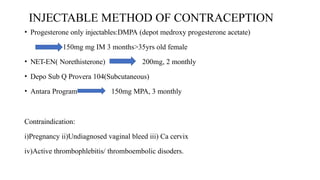
INJECTABLE METHOD OF CONTRACEPTION
• Progesterone only injectables:DMPA (depot medroxy progesterone acetate)
150mg mg IM 3 months>35yrs old female
• NET-EN( Norethisterone) 200mg, 2 monthly
• Depo Sub Q Provera 104(Subcutaneous)
• Antara Program 150mg MPA, 3 monthly
Contraindication:
i)Pregnancy ii)Undiagnosed vaginal bleed iii) Ca cervix
iv)Active thrombophlebitis/ thromboembolic disoders.
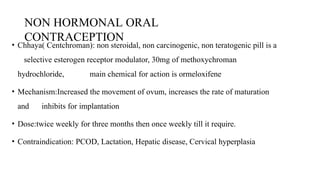
NON HORMONAL ORAL
CONTRACEPTION
• Chhaya( Centchroman): non steroidal, non carcinogenic, non teratogenic pill is a
selective esterogen receptor modulator, 30mg of methoxychroman
hydrochloride, main chemical for action is ormeloxifene
• Mechanism:Increased the movement of ovum, increases the rate of maturation
and inhibits for implantation
• Dose:twice weekly for three months then once weekly till it require.
• Contraindication: PCOD, Lactation, Hepatic disease, Cervical hyperplasia
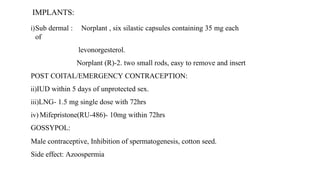
IMPLANTS:
i)Sub dermal : Norplant , six silastic capsules containing 35 mg each
of
levonorgesterol.
Norplant (R)-2. two small rods, easy to remove and insert
POST COITAL/EMERGENCY CONTRACEPTION:
ii)IUD within 5 days of unprotected sex.
iii)LNG- 1.5 mg single dose with 72hrs
iv) Mifepristone(RU-486)- 10mg within 72hrs
GOSSYPOL:
Male contraceptive, Inhibition of spermatogenesis, cotton seed.
Side effect: Azoospermia
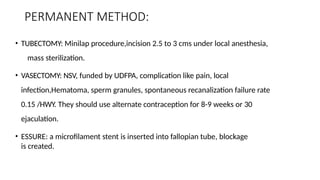
PERMANENT METHOD:
• TUBECTOMY: Minilap procedure,incision 2.5 to 3 cms under local anesthesia,
mass sterilization.
• VASECTOMY: NSV, funded by UDFPA, complication like pain, local
infection,Hematoma, sperm granules, spontaneous recanalization failure rate
0.15 /HWY. They should use alternate contraception for 8-9 weeks or 30
ejaculation.
• ESSURE: a microfilament stent is inserted into fallopian tube, blockage
is created.
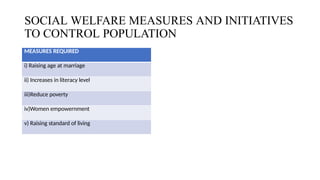
SOCIAL WELFARE MEASURES AND INITIATIVES
TO CONTROL POPULATION
MEASURES REQUIRED
i) Raising age at marriage
ii) Increases in literacy level
iii)Reduce poverty
iv)Women empowernment
v) Raising standard of living
THANK
YOU

methodsofpopulationcontrol-230417173501-2ce7e467.pptx

  • 1.
    METHODS OF POPULATIONCONTROL INTRODUCTION TO FAMILY PLANNING METHODS
  • 2.
    INTRODUCTION • Demography- scientificstudy of human population • Three observable human phenomena i)changes in population size ii)composition of the population iii)Distribution of population Deals with five demographic processes i)Fertility ii)Mortality iii)Marriage iv)Migration v)Social mobility
  • 3.
    DEMOGRAPHIC CYCLE • FIRSTSTAGE( High stationary) Eg; India in 1920 • SECOND STAGE( Early expanding) Eg; South asia and Africa • THIRD STAGE( Late expanding) Eg; India, China, Singapore • FOURTH STAGE( Lowstationary) Eg; Uk, Denmark, Sweeden • FIFTH STAGE( Declining) Eg; East European Germany, Hungary
  • 4.
    FACTORS AND POSSIBLERESONS BEHIND EACH FACTOR FOR POPULATION EXPLOSION HIGH BIRTH RATE LOW DEATH RATE MIGRATION Universal marriage norm Advancement in medical sciences Illegal migration from neighbouring countries Early age at marriage Health awareness and increased investment on health Teenage pregnancies Political will for universal health coverage Poverty and illiteracy Role of women in decision making
  • 5.
    METHODS FOR POPULATIONCONTROL Family welfare measures Social welfare measures FAMILY PLANNING: OBJECTIVE: i) Prevent unwanted pregnancies ii) Limit the number of children iii) Limit the age of female ( at the 1st child birth)
  • 6.
    PLANNED FAMILY: i) The1st child birth is after 20yrs of the mother’s age. ii) Minimum of 3 years between 2 children. iii) Limited size of children (2 or 3). Stable Population means CPR of 60%~TFR of 2.1~NRR 1 Eligible couple: couple in reproductive age group.( 15- 18%) Target couple: couple in reproductive age group and achieved desired family size.
  • 7.
    CONTRACEPTIVE METHODS • TEMPORARY a)Barrier b) Natural methods c) Intrauterine devices d) Oral contraceptive pills e) Injectables f) Implants g) others/newer methods • PERMANENT a) Tubectomy b) Vasectomy c) Other methods
  • 8.
    • BARRIER METHODS: i)Condoms: Male condoms- latex, failure rate 2 or3 to 14/ HWY Female condoms- polyurethane, prelubricated with silicone, two rings, failure rate 5 to 20/HWY ii)Diaphragm: Vaginal barrier, dutch cap, used before intercouse and left for six hours Chances of Toxic syndrome, 6-12 /HWY. iii) Vaginal sponge: soaked in vinegar or olive oil, Today, 5× 2cms, nonoxynol- 9. 20- 40 /HWY. . CHEMICAL METHOD: iv) Foams v) Creams,jellies and pastes vi) Suppositories
  • 9.
    This Photo byUnknown Author is licensed under CC BY This Photo by Unknown Author is licensed under CC BY-NC-ND
  • 10.
    • NATURAL METHODS: i)Standard days method: fertile period from day 8 to 19 days. Regular cycle. ii) Calendar rhythm method: short cycle minus 18 and long cycle minus 11. that is 8day to 21 days of the cycle. 9/HWY iii) Basal body temperature: 0.3 to 0.5 degree C as a result of progesterone. First day to third day of rise of temperature.20/HWY iv) Billing method/ cervical mucus secretion: fertile period usually 4 to 7 days prior to ovulation. After three days after ovulation mucous become thick. v) Lactational amenorrhoea method: During this period, prolactin inhibits ovulation.
  • 11.
    INTRA UTERINE DEVICES(IUD) •FIRST GENERATION: During 1965,Lippes loop ,Polyethylene,double S shaped, fine thread, four size A,B,C,D. • SECOND GENERATION:During 1970, Earlier devices copper-7, copper T-200. Newer devices Cu-T-220c, Cu-T-380 AorAg, Nova T, ML-Cu-375. • THIRD GENERATION: i)Mirena( LGN-20) 7-8 yrs 20mcg progesterone/day.Lowest failure rate 0.2 /HWY ii)Progestasert(1yr) Natural Progesterone, loading dose 38mg and 65mcg/day. Lowest expulsion rate.
  • 12.
    MECHANISM OF ACTIONOF IUD • Foreign body reaction in the uterus causing biochemical changes in the endometrium and uterus fluid ,inhibits viability of gametes rather than implantation. • Alters the biochemical composition of cervical mucus inhibits the sperm motility, capacitation and survival. • Hormonal releasing devices increases the viscosity of cervical mucus thus inhibits the sperm entering the cervix. High progesterone and low Oestrogen unfavourable for implantation
  • 13.
    • CONTRAINDICATION: • TIMEOF INSERTION: -within 10 days from the beginning of menstruation ideal 4 to 5 days. -After delivery early within 24 hrs , Late after 6 weeks of delivery. Absolute contraindications Relative contraindications Pregnancy Previous inflammatory disease Undiagnosed vaginal bleeding Congenital malformation Pelvic inflammatory disease Cervical discharge Cerival cancer Anemia Carcinoma of genital tract menorrhagia Previous ectopic pregnancy Unmotivated females
  • 14.
    ADVERSE EFFECTS OFIUD • Pain : MC cause of removal 15 to 40%. • Bleeding : MC side effect. Removal 10 to 17 %. • Ectopic pregnancy: due to delayed tubal motility cause by progesterone. Rate 6.8%. • Pelvic inflammatory disease. • Perforation: Dangerous AD. • Expulsion : MC cause is pain. • Pregnancy with IUD insitu Mostly abort, Continue-Thread not visible, sepsis. Thread visible pull out.
  • 15.
    ORAL CONTRACEPTIVE HORMONAL : i)combined hormonal contraceptive ii) progesterone only contraceptive pill iii) emergency contraceptive pill iv) injectable hormonal pill NON HORMONAL: Centchroman(chhaya)
  • 16.
    • Combined oralcontraception: ethinylestradiol and norethindrone(1) levonorgestrol(2) desogestrol, gestodene(3) Mala N, Mala D containing Levonorgestrel and Ethinyl Estradiol in the dose of 0.15mg and 0.03mg ,21 tablets and 7 tablets of ferrous fumarate 60mg Mechanism of action: Disrupts the Hypothalamus –Pituitary axis. Estrogen inhibits FSH increase. Progesterone inhibits LH surge
  • 17.
    ADVERSE EFFECTS OFOCPs Metabolic Cardiovascular Carcinogenic Others Weight gain Atherosclerosis Ca cervix Liver diseases Obesity Thromboembolism Ca Breast Slight inhibition of lactation Hypertension Dvt Hepatocellular Ca Dysplipidemia Stroke Coronary heart disease Benefits Regularisation of MC Decreases BBD, fibroadenoma Decreases Ca ovary,endometrium,ovarian cyst Decreased PID Decreases Anaemia
  • 18.
    CONTRAINDICATION ABSOLUTE RELATIVE Ca breast,Genital cancers Age>40yrs Pregnancy Smoking, age >35yrs Severe liver disease Diabetes, gall stones DVT, Thromboembolism Epilepsy, migraine Cardiac anomalies Congenital hyperlipedmia Undiagnosed vaginal bleed
  • 19.
    INJECTABLE METHOD OFCONTRACEPTION • Progesterone only injectables:DMPA (depot medroxy progesterone acetate) 150mg mg IM 3 months>35yrs old female • NET-EN( Norethisterone) 200mg, 2 monthly • Depo Sub Q Provera 104(Subcutaneous) • Antara Program 150mg MPA, 3 monthly Contraindication: i)Pregnancy ii)Undiagnosed vaginal bleed iii) Ca cervix iv)Active thrombophlebitis/ thromboembolic disoders.
  • 20.
    NON HORMONAL ORAL CONTRACEPTION •Chhaya( Centchroman): non steroidal, non carcinogenic, non teratogenic pill is a selective esterogen receptor modulator, 30mg of methoxychroman hydrochloride, main chemical for action is ormeloxifene • Mechanism:Increased the movement of ovum, increases the rate of maturation and inhibits for implantation • Dose:twice weekly for three months then once weekly till it require. • Contraindication: PCOD, Lactation, Hepatic disease, Cervical hyperplasia
  • 21.
    IMPLANTS: i)Sub dermal :Norplant , six silastic capsules containing 35 mg each of levonorgesterol. Norplant (R)-2. two small rods, easy to remove and insert POST COITAL/EMERGENCY CONTRACEPTION: ii)IUD within 5 days of unprotected sex. iii)LNG- 1.5 mg single dose with 72hrs iv) Mifepristone(RU-486)- 10mg within 72hrs GOSSYPOL: Male contraceptive, Inhibition of spermatogenesis, cotton seed. Side effect: Azoospermia
  • 22.
    PERMANENT METHOD: • TUBECTOMY:Minilap procedure,incision 2.5 to 3 cms under local anesthesia, mass sterilization. • VASECTOMY: NSV, funded by UDFPA, complication like pain, local infection,Hematoma, sperm granules, spontaneous recanalization failure rate 0.15 /HWY. They should use alternate contraception for 8-9 weeks or 30 ejaculation. • ESSURE: a microfilament stent is inserted into fallopian tube, blockage is created.
  • 23.
    SOCIAL WELFARE MEASURESAND INITIATIVES TO CONTROL POPULATION MEASURES REQUIRED i) Raising age at marriage ii) Increases in literacy level iii)Reduce poverty iv)Women empowernment v) Raising standard of living
  • 24.