2
1. Introduction
2. Fact or Fiction?
3. Prenatal Development
4. Birth
5. Problems and Solutions
6. The New Family
7. Closing Thoughts
Introduction
3
Video:
The Prenatal Period: Conception to Birth
4
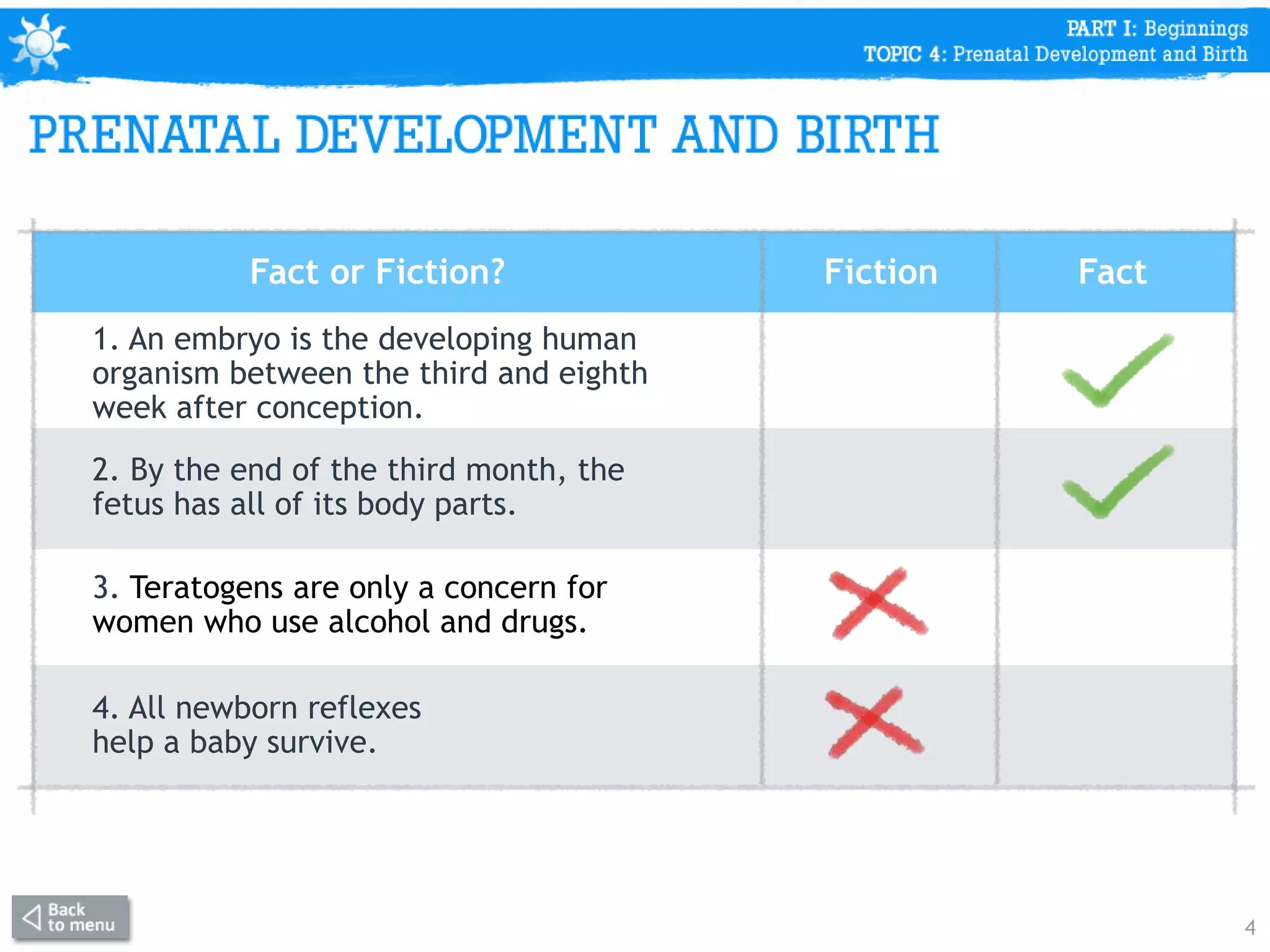
Fact or Fiction? Fiction Fact
1. An embryo is the developing human
organism between the third and eighth
week after conception.
2. By the end of the third month, the
fetus has all of its body parts.
3. Teratogens are only a concern for
women who use alcohol and drugs.
4. All newborn reflexes
help a baby survive.
Beginning of
pregnancy
Pregnancy begins at conception, which is also the
starting point of gestational age. However, the
organism does not become an embryo until about
two weeks later, and pregnancy does not affect the
woman (and cannot be confirmed by blood or urine
testing) until implantation.
Length of
pregnancy
Full-term pregnancies last 266 days, or 38
weeks, or 9 months.
Trimesters
Instead of germinal period, embryonic period,
and fetal period, some writers divide pregnancy
into three-month periods called trimesters.
Due date
Although doctors assign a specific due date (based
on the woman’s LMP), only 5% of babies are born on
that exact date.
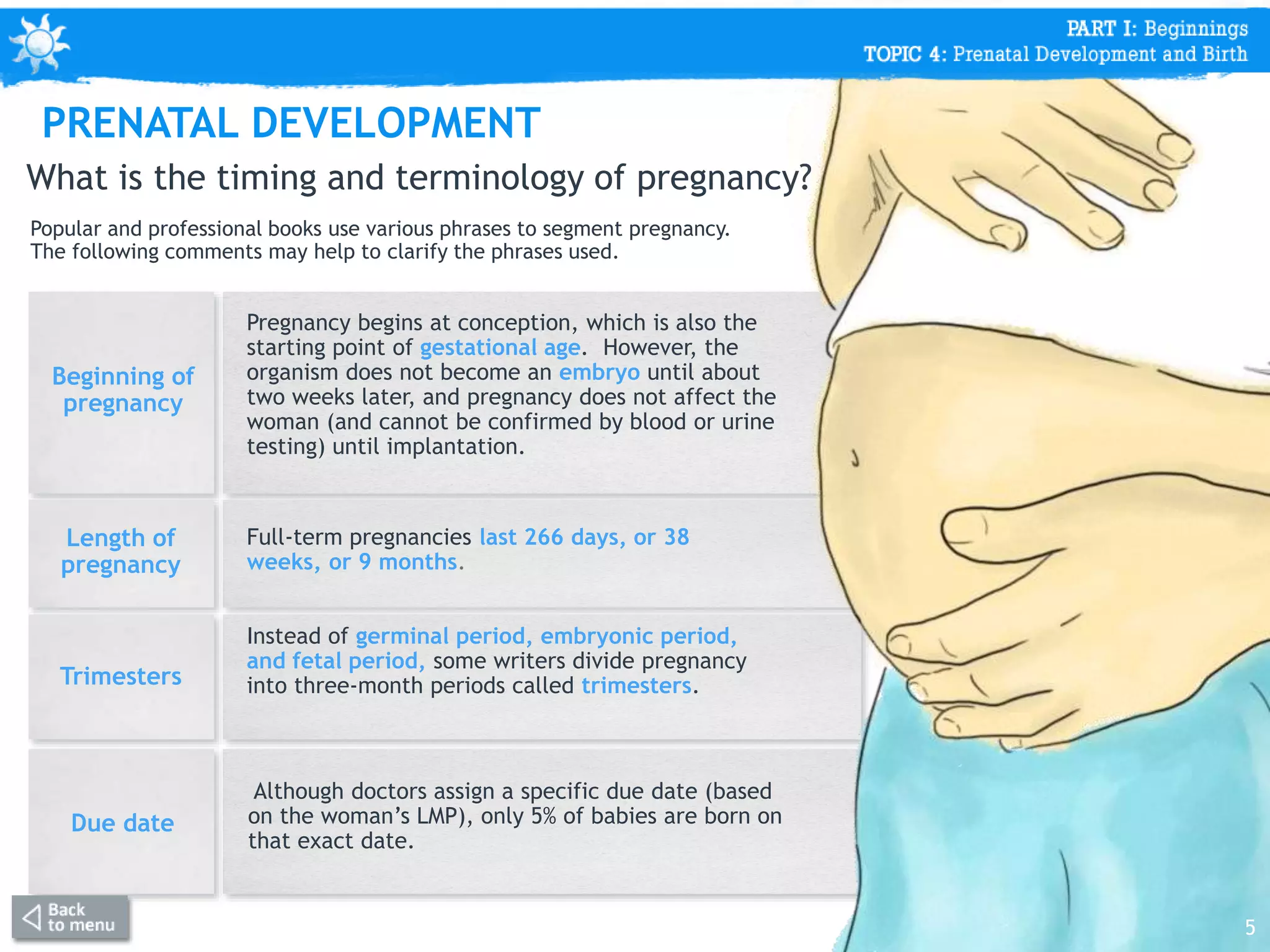
What is the timing and terminology of pregnancy?
Popular and professional books use various phrases to segment pregnancy.
The following comments may help to clarify the phrases used.
5
PRENATAL DEVELOPMENT
How does implantation occur?
The First 14 Days
implantation: The process beginning about 10
days after conception, in which the developing
organism nestles in, and attaches to the
placenta that lines the uterus.
The Most Dangerous Journey
Two-celled stage
Zygote
(single cell)
Fallopian
tube
Ovary
Ovum
Ova
Sperm
Implantation
Conception
6
PRENATAL DEVELOPMENT
What percentage of zygotes make it through each prenatal period?
The Germinal Period
The Embryonic Period
The Fetal Period
Birth
At least 60 percent of all developing organisms fail to grow or implant properly
and thus do not survive the germinal period. Most of these organisms are grossly
abnormal.
About 20 percent of all embryos are aborted spontaneously*, most often because
of chromosomal abnormalities.
About 5 percent of all fetuses are aborted spontaneously before viability at 22
weeks or are stillborn, defined as born dead after 22 weeks.
About 31 percent of all zygotes grow and survive to become living newborn
babies.
*Spontaneous abortions are also called miscarriages.
This table does not include induced abortions.
Sources: Bentley & Mascie-Taylor, 2000; K.L. Moore & Persaud, 2003.
Making it to Birth
7
PRENATAL DEVELOPMENT
Brain
Facial
Features
External
sex organs
Intestines
Arms, hands
and fingers
As nerves and muscles form links to the brain,
the embryo now moves spontaneously, as the
brain begins to move muscles.
Eyes and eyelids are developed. Eyes will continue
to migrate to the front of the head, where they
will eventually rest. Eyelids begin to grow
together and are only half closed. External,
middle, and inner ears are now fully formed.
External ears will continue to migrate to the side
of the head, where they will eventually rest.
Urogenital membranes have developed into either
male or female organs, and ovaries or testicles
are visible. Clitoris or penis begins to form, but
distinguishing the embryo’s sex is difficult.
The intestines begin to move from
the umbilical cord to the embryo’s
body cavity.
Arms are well formed, longer, and can
bend at elbows and move forward.
Fingers elongate and digits are fully
separated. Each finger has three digits,
and the thumb has two digits.
Overall
appearance
The head is still disproportionately large but is
erect and appears rounded. The neck is well
defined. The tail will disappear by the end of this
week. Cartilage begins to turn into bone. The
ectoderm layer is replaced by the beginnings of
skin. The body becomes evenly rounded, due to
the growth in the abdomen.
Brain
Facial
Features
External sex
organs Overall
appearance
Arms, hands
and fingersIntestines
8
What happens during the embryonic period of prenatal development?
From the Third through the Eighth Week
PRENATAL DEVELOPMENT
9
From the Third Through the Eighth Week
Video:
The Prenatal Period: Brain Development
PRENATAL DEVELOPMENT
fetus: A developing human organism from the start of
the ninth week after conception until birth.
10
What happens during the fetal period of prenatal development?
9 12 16 20 24 28 32 36 38
From the Ninth Week until Birth
9 weeks through 38 weeks
PRENATAL DEVELOPMENT
Brain
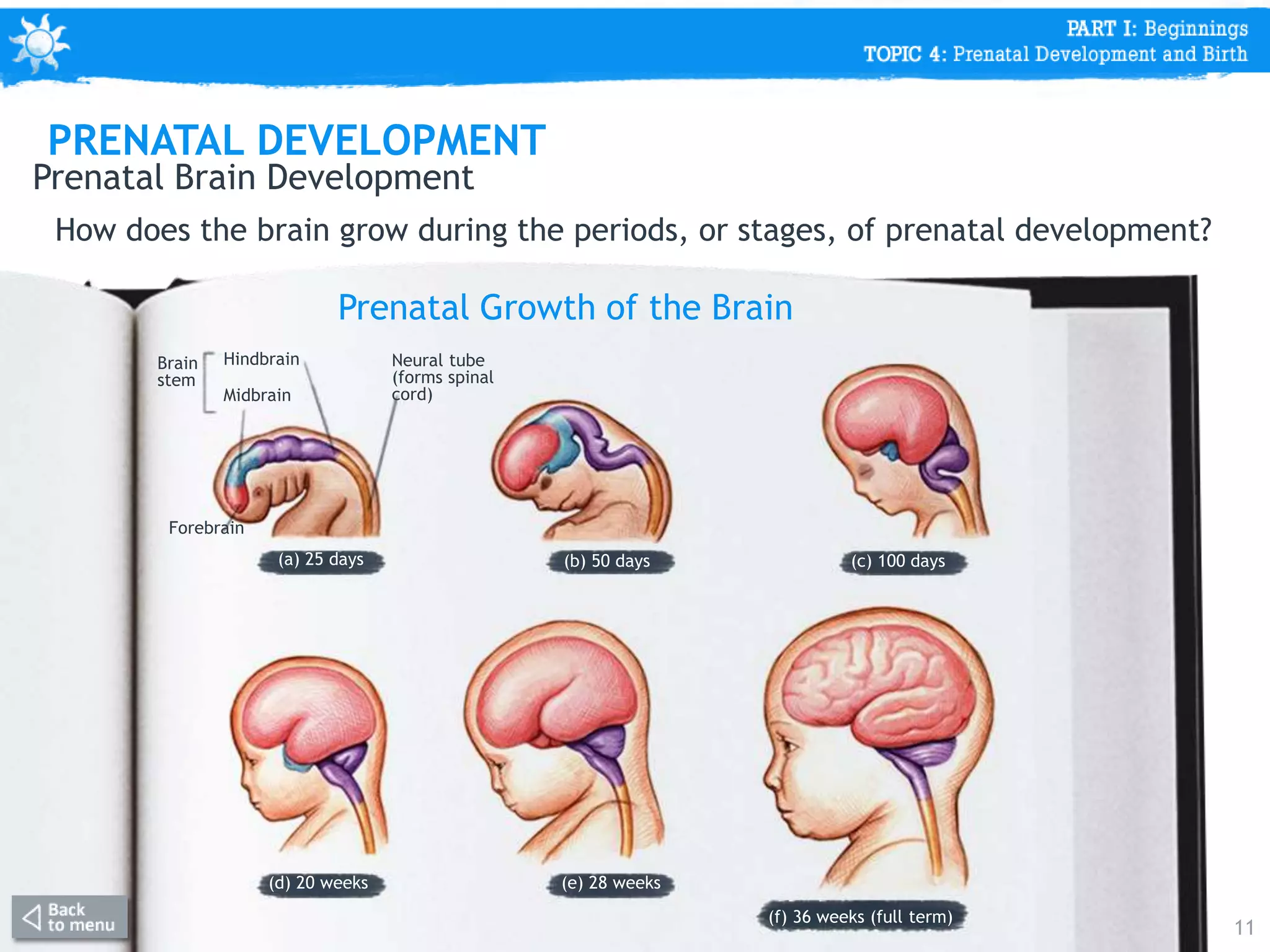
stem
Hindbrain Neural tube
(forms spinal
cord)
Forebrain
(a) 25 days
Midbrain
Prenatal Growth of the Brain
How does the brain grow during the periods, or stages, of prenatal development?
11
Prenatal Brain Development
(b) 50 days (c) 100 days
(d) 20 weeks (e) 28 weeks
(f) 36 weeks (full term)
PRENATAL DEVELOPMENT
From the Ninth Week until Birth
12
Video:
The Prenatal Period: Conception to Birth
PRENATAL DEVELOPMENT
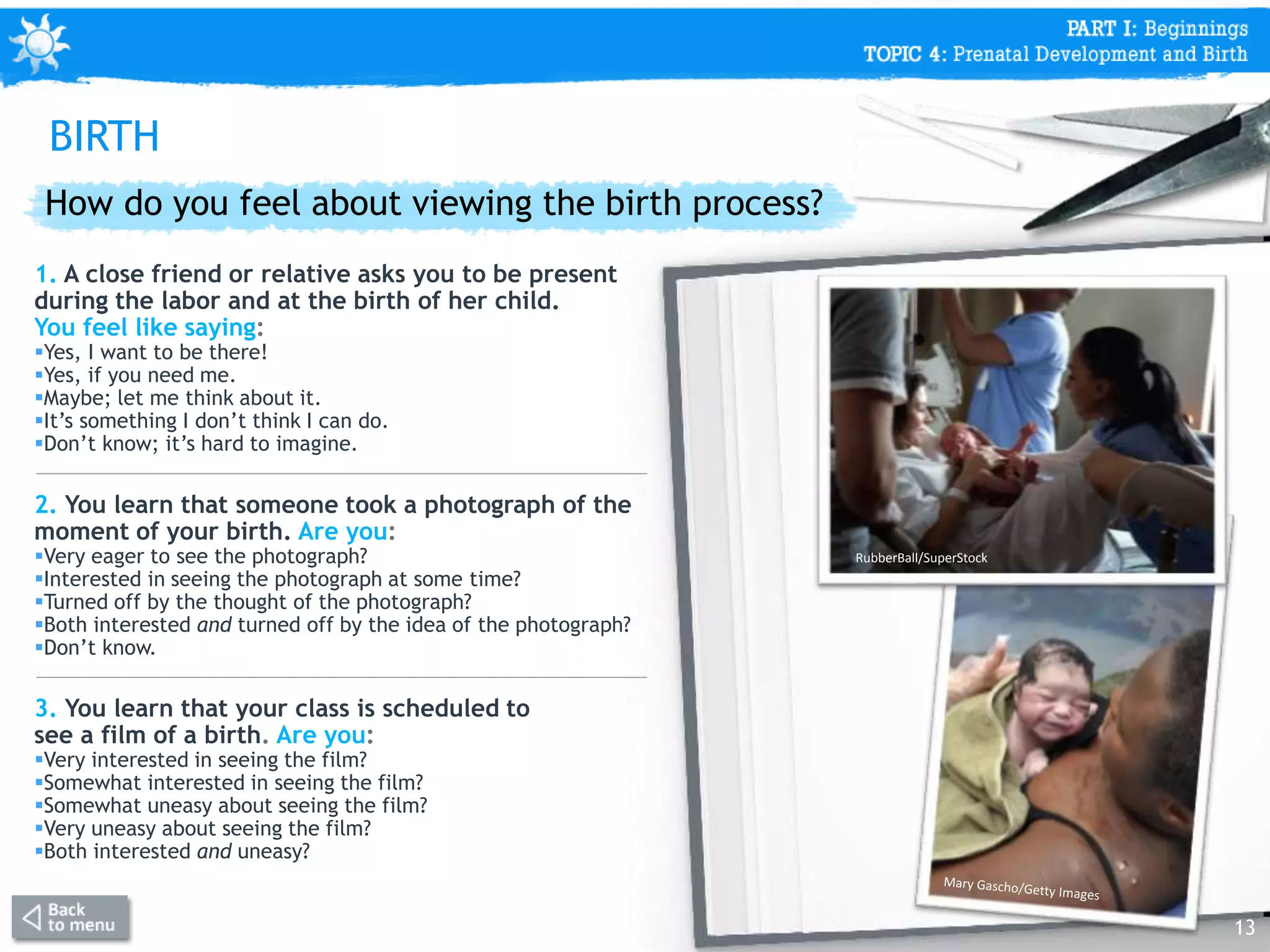
How do you feel about viewing the birth process?
1. A close friend or relative asks you to be present
during the labor and at the birth of her child.
You feel like saying:
Yes, I want to be there!
Yes, if you need me.
Maybe; let me think about it.
It’s something I don’t think I can do.
Don’t know; it’s hard to imagine.
2. You learn that someone took a photograph of the
moment of your birth. Are you:
Very eager to see the photograph?
Interested in seeing the photograph at some time?
Turned off by the thought of the photograph?
Both interested and turned off by the idea of the photograph?
Don’t know.
3. You learn that your class is scheduled to
see a film of a birth. Are you:
Very interested in seeing the film?
Somewhat interested in seeing the film?
Somewhat uneasy about seeing the film?
Very uneasy about seeing the film?
Both interested and uneasy?
13
RubberBall/SuperStock
BIRTH
14
Video:
Birth
BIRTH
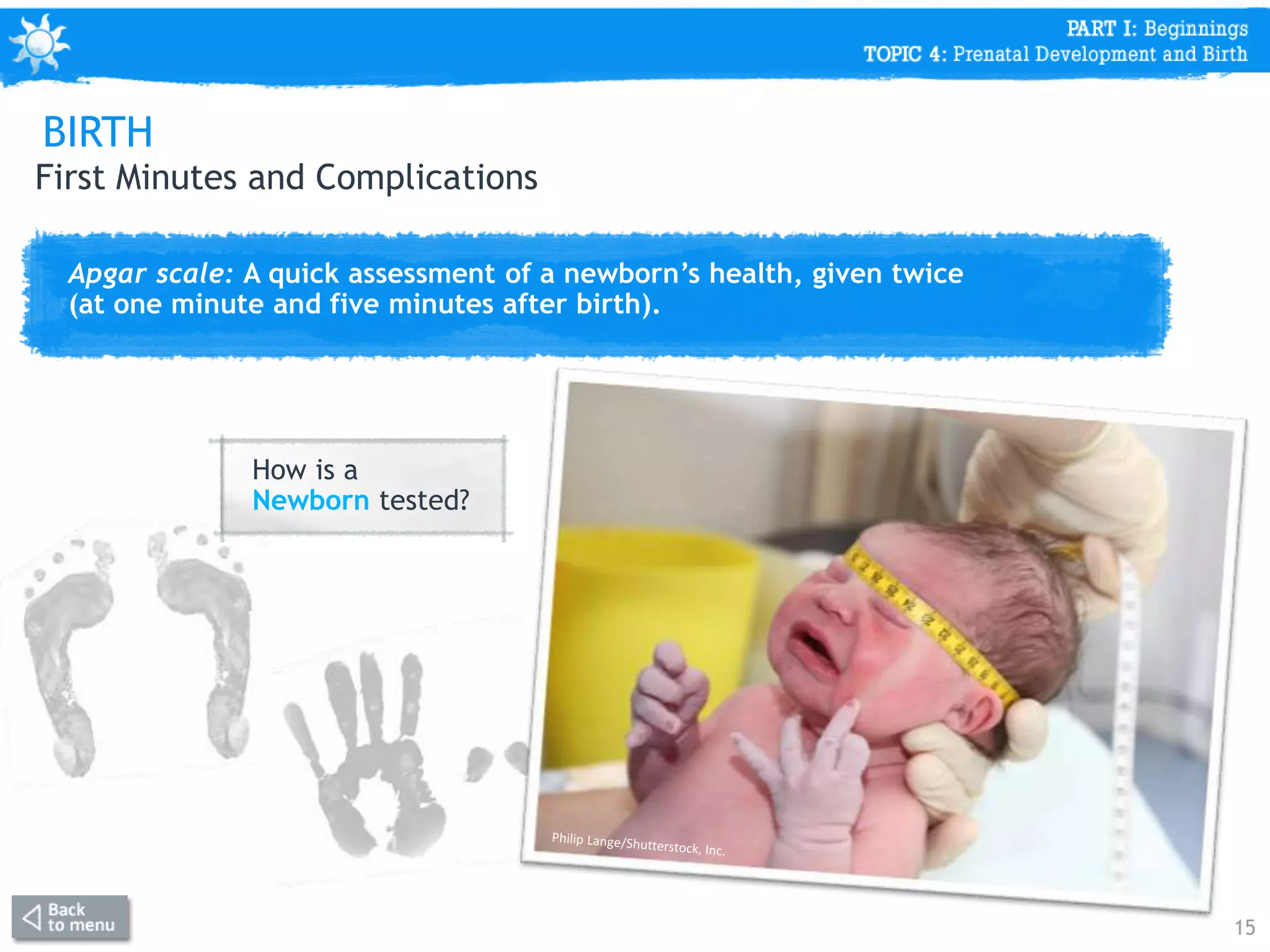
Apgar scale: A quick assessment of a newborn’s health, given twice
(at one minute and five minutes after birth).
How is a
Newborn tested?
15
First Minutes and Complications
BIRTH
What are the risks at different stages of development?
Birth Defects from Teratogens: Time of Exposure and Effect on Major Organs
Germinal Period Main Embryonic Period (in weeks) Fetal Period (in weeks)
Central nervous
system
Heart
Arms
Legs
Lips
Ears
Eyes
Teeth
Palate
Sex organs
Teratogens often
prevent implantation
Common site(s)
of action of
teratogens
Highly critical
period
Less critical
period
Neural-tube defects Mental retardation Learning disabilities
Cleft lip
Low-set malformed ears and deafness
Cataract, glaucoma
Enamel staining
Cleft palate
Masculinization of
female genitalia
Major congenital anomalies Functional defects and minor anomalies
1 2 3 4 5 6 7 8 9 16 32 38
Source: Adapted from K.L. Moore & Persaud. 2003 16
PROBLEMS AND SOLUTIONS
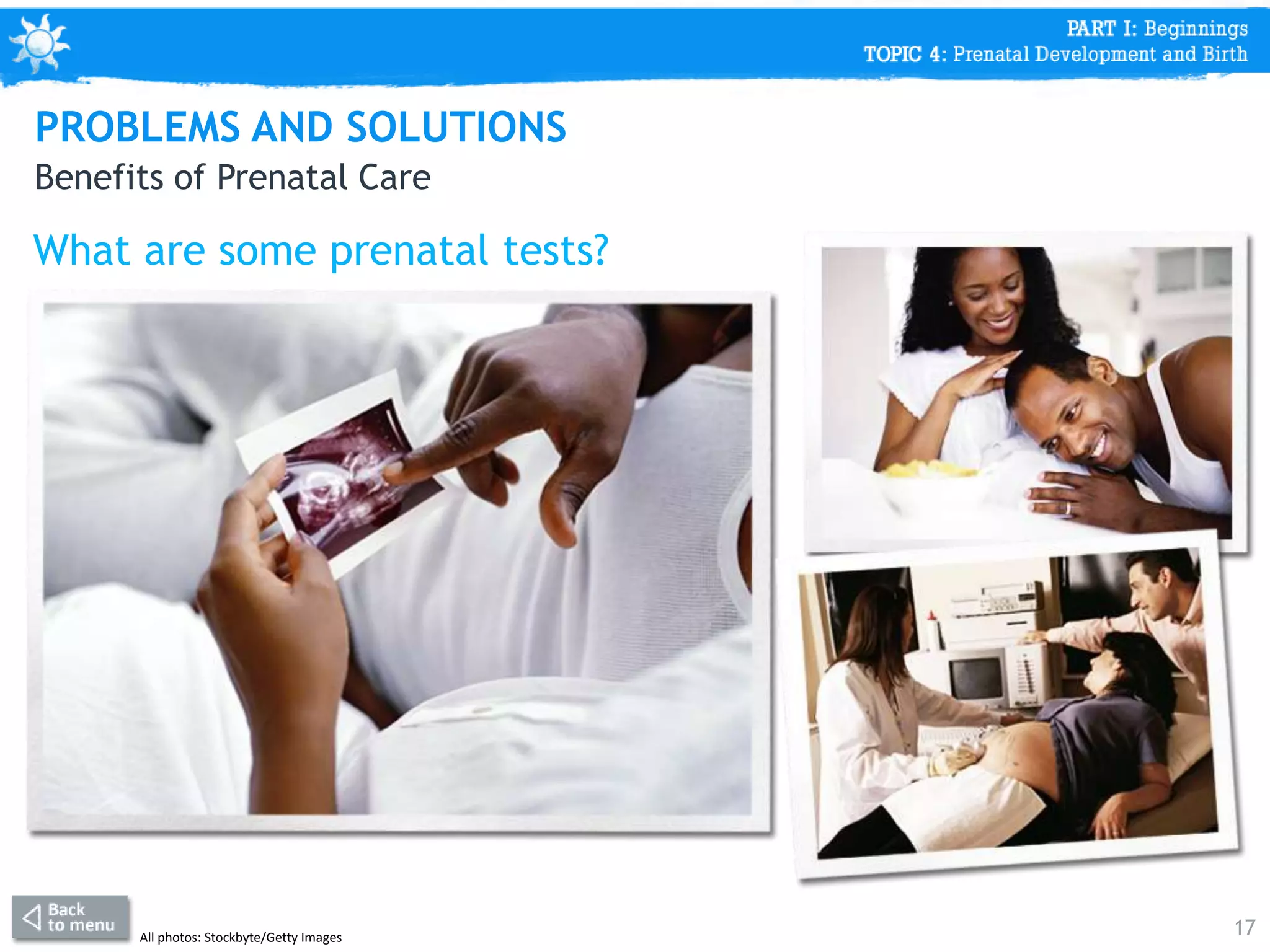
What are some prenatal tests?
17
Benefits of Prenatal Care
All photos: Stockbyte/Getty Images
PROBLEMS AND SOLUTIONS
Benefits of Prenatal Care
18
Video:
The Prenatal Period: Ultrasound
PROBLEMS AND SOLUTIONS
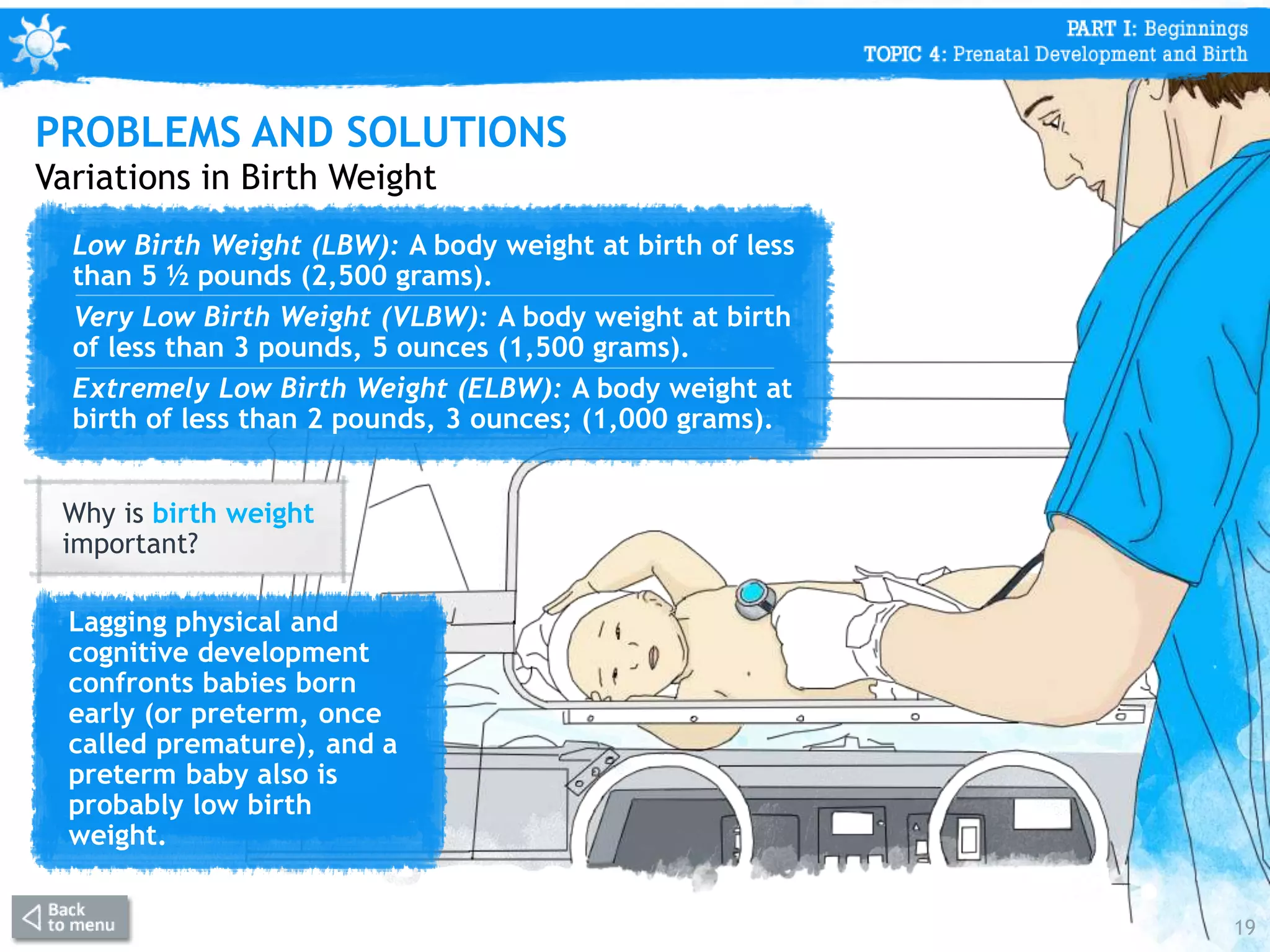
Low Birth Weight (LBW): A body weight at birth of less
than 5 ½ pounds (2,500 grams).
Very Low Birth Weight (VLBW): A body weight at birth
of less than 3 pounds, 5 ounces (1,500 grams).
Extremely Low Birth Weight (ELBW): A body weight at
birth of less than 2 pounds, 3 ounces; (1,000 grams).
Why is birth weight
important?
19
Variations in Birth Weight
Lagging physical and
cognitive development
confronts babies born
early (or preterm, once
called premature), and a
preterm baby also is
probably low birth
weight.
PROBLEMS AND SOLUTIONS
20
Variations in Birth Weight
Video:
Low Birthweight in India
PROBLEMS AND SOLUTIONS
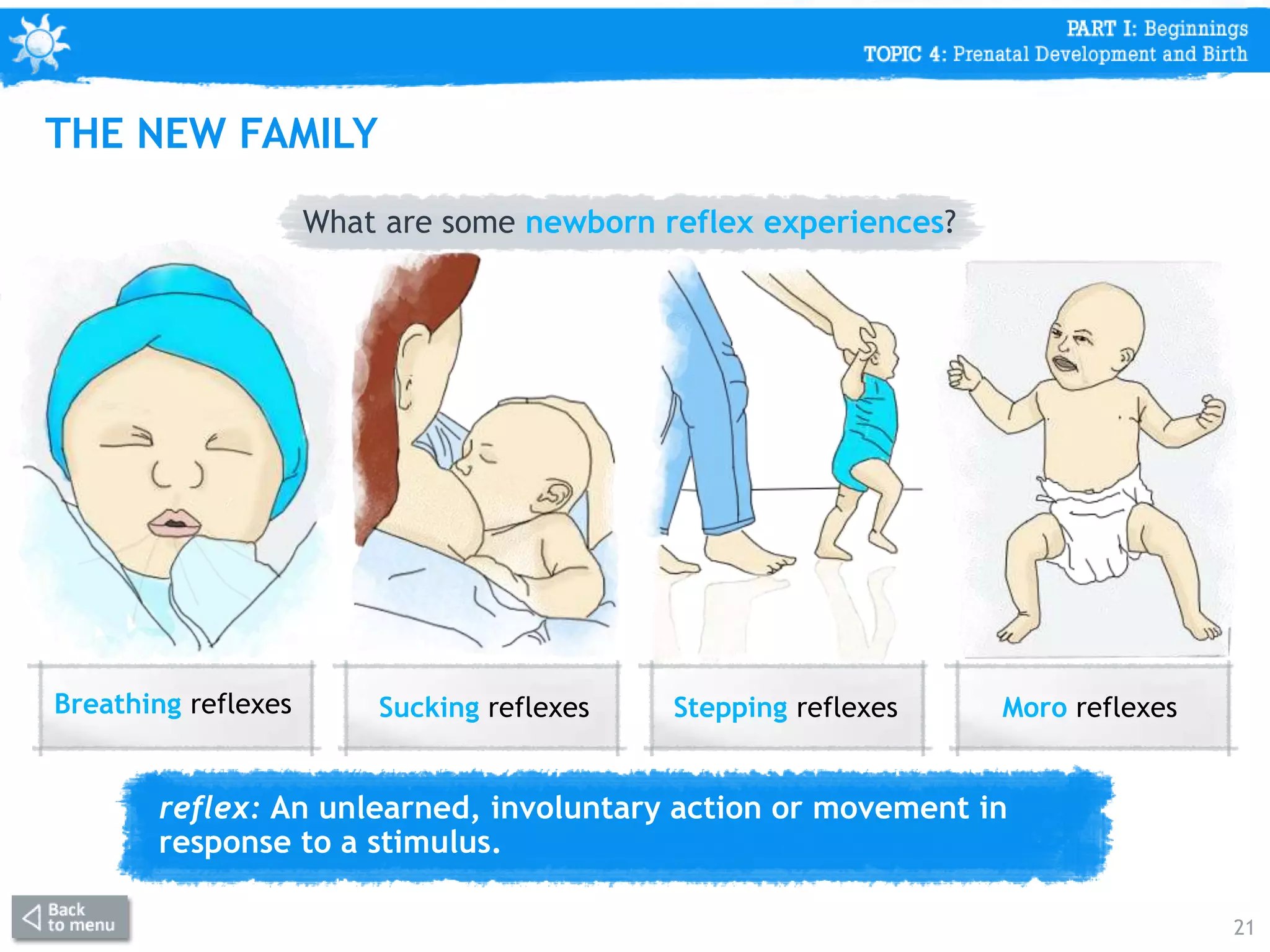
reflex: An unlearned, involuntary action or movement in
response to a stimulus.
What are some newborn reflex experiences?
21
Breathing reflexes Sucking reflexes Stepping reflexes Moro reflexes
THE NEW FAMILY
22
Reflexes
Video:
Newborn Reflexes
THE NEW FAMILY
What is a father’s role?
23
Social Support
couvade: Symptoms of pregnancy and birth experienced by fathers.
Allphotos:Stockbyte/GettyImages
THE NEW FAMILY
24
Social Support
Video:
The Experience of Pregnancy:
The First Trimester
THE NEW FAMILY
From what you discovered about prenatal development in these slides, what
examples can you cite to support the statement, “The most dramatic and
extensive transformation of the entire life span occurs before birth?”
Closing Thoughts
25
Allphotos:Stockbyte/GettyImages,exceptfor
lowermiddle,whichisRubberBall/SuperStock
Review lecture 4   chapter 4

Review lecture 4 chapter 4

  • 2.
    2 1. Introduction 2. Factor Fiction? 3. Prenatal Development 4. Birth 5. Problems and Solutions 6. The New Family 7. Closing Thoughts
  • 3.
  • 4.
    4 Fact or Fiction?Fiction Fact 1. An embryo is the developing human organism between the third and eighth week after conception. 2. By the end of the third month, the fetus has all of its body parts. 3. Teratogens are only a concern for women who use alcohol and drugs. 4. All newborn reflexes help a baby survive.
  • 5.
    Beginning of pregnancy Pregnancy beginsat conception, which is also the starting point of gestational age. However, the organism does not become an embryo until about two weeks later, and pregnancy does not affect the woman (and cannot be confirmed by blood or urine testing) until implantation. Length of pregnancy Full-term pregnancies last 266 days, or 38 weeks, or 9 months. Trimesters Instead of germinal period, embryonic period, and fetal period, some writers divide pregnancy into three-month periods called trimesters. Due date Although doctors assign a specific due date (based on the woman’s LMP), only 5% of babies are born on that exact date. What is the timing and terminology of pregnancy? Popular and professional books use various phrases to segment pregnancy. The following comments may help to clarify the phrases used. 5 PRENATAL DEVELOPMENT
  • 6.
    How does implantationoccur? The First 14 Days implantation: The process beginning about 10 days after conception, in which the developing organism nestles in, and attaches to the placenta that lines the uterus. The Most Dangerous Journey Two-celled stage Zygote (single cell) Fallopian tube Ovary Ovum Ova Sperm Implantation Conception 6 PRENATAL DEVELOPMENT
  • 7.
    What percentage ofzygotes make it through each prenatal period? The Germinal Period The Embryonic Period The Fetal Period Birth At least 60 percent of all developing organisms fail to grow or implant properly and thus do not survive the germinal period. Most of these organisms are grossly abnormal. About 20 percent of all embryos are aborted spontaneously*, most often because of chromosomal abnormalities. About 5 percent of all fetuses are aborted spontaneously before viability at 22 weeks or are stillborn, defined as born dead after 22 weeks. About 31 percent of all zygotes grow and survive to become living newborn babies. *Spontaneous abortions are also called miscarriages. This table does not include induced abortions. Sources: Bentley & Mascie-Taylor, 2000; K.L. Moore & Persaud, 2003. Making it to Birth 7 PRENATAL DEVELOPMENT
  • 8.
    Brain Facial Features External sex organs Intestines Arms, hands andfingers As nerves and muscles form links to the brain, the embryo now moves spontaneously, as the brain begins to move muscles. Eyes and eyelids are developed. Eyes will continue to migrate to the front of the head, where they will eventually rest. Eyelids begin to grow together and are only half closed. External, middle, and inner ears are now fully formed. External ears will continue to migrate to the side of the head, where they will eventually rest. Urogenital membranes have developed into either male or female organs, and ovaries or testicles are visible. Clitoris or penis begins to form, but distinguishing the embryo’s sex is difficult. The intestines begin to move from the umbilical cord to the embryo’s body cavity. Arms are well formed, longer, and can bend at elbows and move forward. Fingers elongate and digits are fully separated. Each finger has three digits, and the thumb has two digits. Overall appearance The head is still disproportionately large but is erect and appears rounded. The neck is well defined. The tail will disappear by the end of this week. Cartilage begins to turn into bone. The ectoderm layer is replaced by the beginnings of skin. The body becomes evenly rounded, due to the growth in the abdomen. Brain Facial Features External sex organs Overall appearance Arms, hands and fingersIntestines 8 What happens during the embryonic period of prenatal development? From the Third through the Eighth Week PRENATAL DEVELOPMENT
  • 9.
    9 From the ThirdThrough the Eighth Week Video: The Prenatal Period: Brain Development PRENATAL DEVELOPMENT
  • 10.
    fetus: A developinghuman organism from the start of the ninth week after conception until birth. 10 What happens during the fetal period of prenatal development? 9 12 16 20 24 28 32 36 38 From the Ninth Week until Birth 9 weeks through 38 weeks PRENATAL DEVELOPMENT
  • 11.
    Brain stem Hindbrain Neural tube (formsspinal cord) Forebrain (a) 25 days Midbrain Prenatal Growth of the Brain How does the brain grow during the periods, or stages, of prenatal development? 11 Prenatal Brain Development (b) 50 days (c) 100 days (d) 20 weeks (e) 28 weeks (f) 36 weeks (full term) PRENATAL DEVELOPMENT
  • 12.
    From the NinthWeek until Birth 12 Video: The Prenatal Period: Conception to Birth PRENATAL DEVELOPMENT
  • 13.
    How do youfeel about viewing the birth process? 1. A close friend or relative asks you to be present during the labor and at the birth of her child. You feel like saying: Yes, I want to be there! Yes, if you need me. Maybe; let me think about it. It’s something I don’t think I can do. Don’t know; it’s hard to imagine. 2. You learn that someone took a photograph of the moment of your birth. Are you: Very eager to see the photograph? Interested in seeing the photograph at some time? Turned off by the thought of the photograph? Both interested and turned off by the idea of the photograph? Don’t know. 3. You learn that your class is scheduled to see a film of a birth. Are you: Very interested in seeing the film? Somewhat interested in seeing the film? Somewhat uneasy about seeing the film? Very uneasy about seeing the film? Both interested and uneasy? 13 RubberBall/SuperStock BIRTH
  • 14.
  • 15.
    Apgar scale: Aquick assessment of a newborn’s health, given twice (at one minute and five minutes after birth). How is a Newborn tested? 15 First Minutes and Complications BIRTH
  • 16.
    What are therisks at different stages of development? Birth Defects from Teratogens: Time of Exposure and Effect on Major Organs Germinal Period Main Embryonic Period (in weeks) Fetal Period (in weeks) Central nervous system Heart Arms Legs Lips Ears Eyes Teeth Palate Sex organs Teratogens often prevent implantation Common site(s) of action of teratogens Highly critical period Less critical period Neural-tube defects Mental retardation Learning disabilities Cleft lip Low-set malformed ears and deafness Cataract, glaucoma Enamel staining Cleft palate Masculinization of female genitalia Major congenital anomalies Functional defects and minor anomalies 1 2 3 4 5 6 7 8 9 16 32 38 Source: Adapted from K.L. Moore & Persaud. 2003 16 PROBLEMS AND SOLUTIONS
  • 17.
    What are someprenatal tests? 17 Benefits of Prenatal Care All photos: Stockbyte/Getty Images PROBLEMS AND SOLUTIONS
  • 18.
    Benefits of PrenatalCare 18 Video: The Prenatal Period: Ultrasound PROBLEMS AND SOLUTIONS
  • 19.
    Low Birth Weight(LBW): A body weight at birth of less than 5 ½ pounds (2,500 grams). Very Low Birth Weight (VLBW): A body weight at birth of less than 3 pounds, 5 ounces (1,500 grams). Extremely Low Birth Weight (ELBW): A body weight at birth of less than 2 pounds, 3 ounces; (1,000 grams). Why is birth weight important? 19 Variations in Birth Weight Lagging physical and cognitive development confronts babies born early (or preterm, once called premature), and a preterm baby also is probably low birth weight. PROBLEMS AND SOLUTIONS
  • 20.
    20 Variations in BirthWeight Video: Low Birthweight in India PROBLEMS AND SOLUTIONS
  • 21.
    reflex: An unlearned,involuntary action or movement in response to a stimulus. What are some newborn reflex experiences? 21 Breathing reflexes Sucking reflexes Stepping reflexes Moro reflexes THE NEW FAMILY
  • 22.
  • 23.
    What is afather’s role? 23 Social Support couvade: Symptoms of pregnancy and birth experienced by fathers. Allphotos:Stockbyte/GettyImages THE NEW FAMILY
  • 24.
    24 Social Support Video: The Experienceof Pregnancy: The First Trimester THE NEW FAMILY
  • 25.
    From what youdiscovered about prenatal development in these slides, what examples can you cite to support the statement, “The most dramatic and extensive transformation of the entire life span occurs before birth?” Closing Thoughts 25 Allphotos:Stockbyte/GettyImages,exceptfor lowermiddle,whichisRubberBall/SuperStock