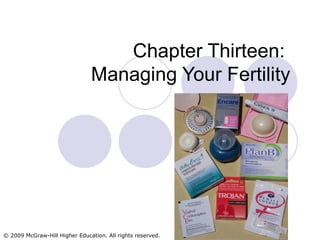
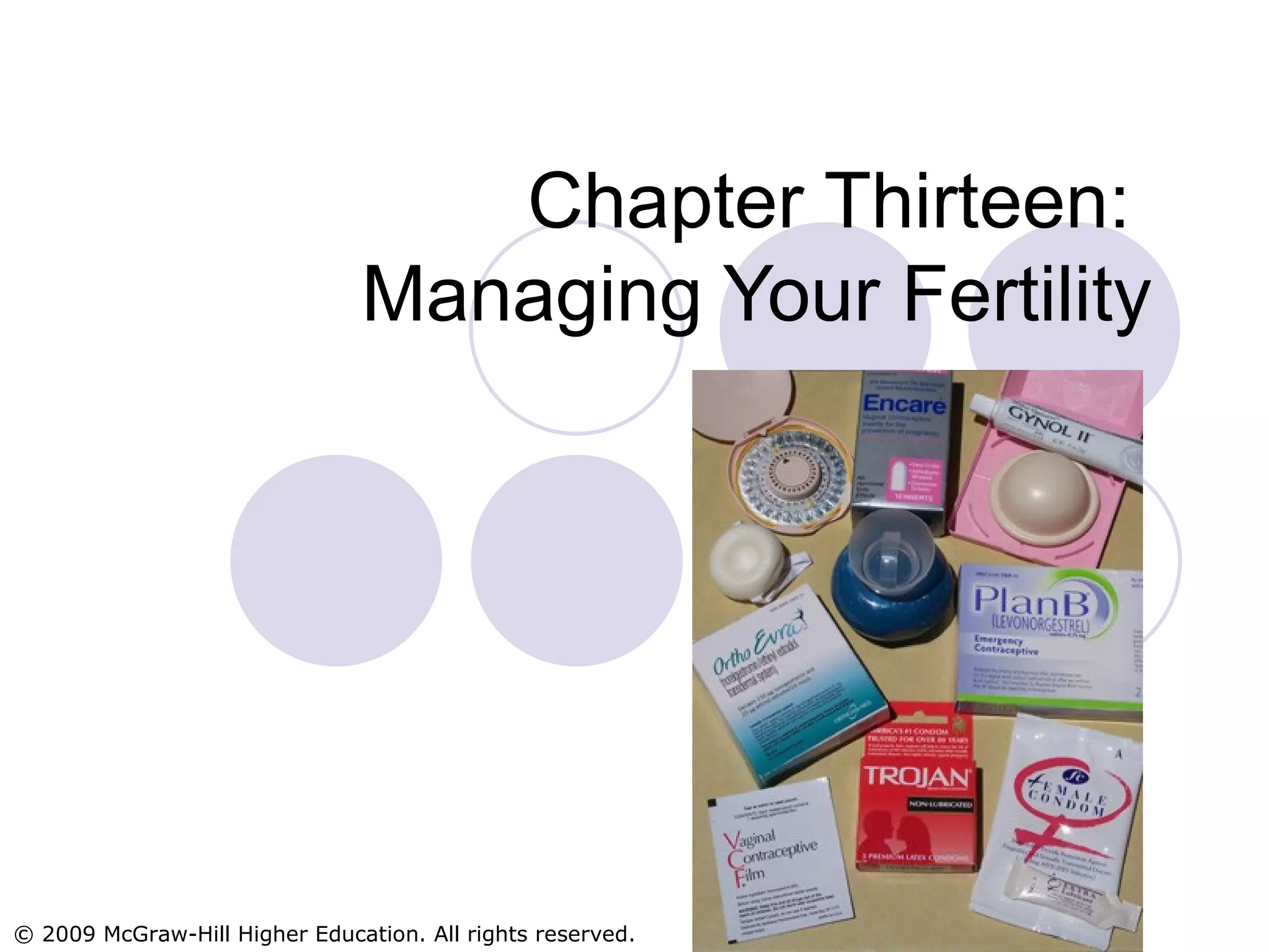
Chapter Thirteen:  Managing Your Fertility
Birth Control vs. Contraception Birth control refers to all procedures and methods that can prevent the birth of a child Contraception refers to procedures used to prevent fertilization
Theoretical Effectiveness vs. Use Effectiveness Theoretical effectiveness:   Measure of a contraceptive method’s ability to prevent a pregnancy when the method is used  precisely as directed during every act of intercourse Use effectiveness:   Measure of a contraceptive method’s ability to prevent a pregnancy when   used by the general public
Selecting Your Contraceptive Method Safety Effectiveness Reliability Reversibility Affordability Ease of use Interference with sexual expression Considerations when choosing contraception
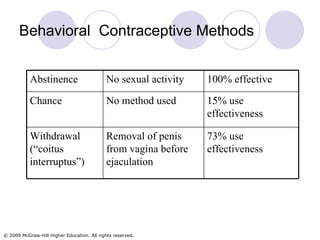
Behavioral  Contraceptive Methods 73% use effectiveness Removal of penis from vagina before ejaculation Withdrawal (“coitus interruptus”) 15% use effectiveness No method used Chance 100% effective No sexual activity Abstinence
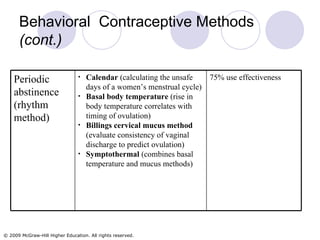
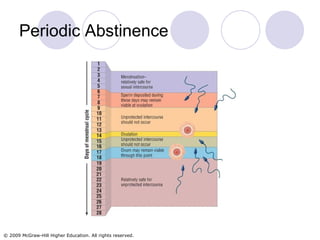
Behavioral  Contraceptive Methods  (cont.) 75% use effectiveness Calendar  (calculating the unsafe days of a women’s menstrual cycle) Basal body temperature  (rise in body temperature correlates with timing of ovulation) Billings cervical mucus method  (evaluate consistency of vaginal discharge to predict ovulation) Symptothermal  (combines basal temperature and mucus methods) Periodic abstinence (rhythm method)
Periodic Abstinence
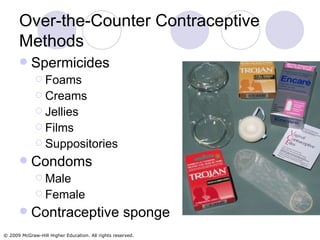
Over-the-Counter Contraceptive Methods Spermicides Foams Creams Jellies Films Suppositories Condoms Male Female Contraceptive sponge
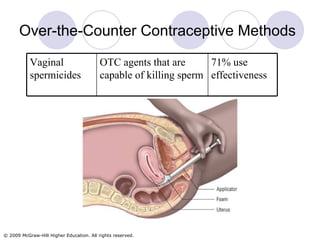
Over-the-Counter Contraceptive Methods 71% use effectiveness OTC agents that are capable of killing sperm Vaginal spermicides
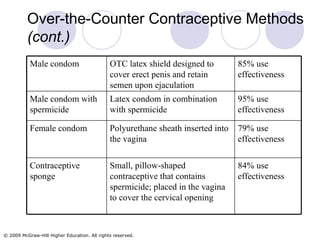
Over-the-Counter Contraceptive Methods  (cont.) 84% use effectiveness Small, pillow-shaped contraceptive that contains spermicide; placed in the vagina to cover the cervical opening Contraceptive sponge 79% use effectiveness Polyurethane sheath inserted into the vagina Female condom 95% use  effectiveness Latex condom in combination with spermicide Male condom with spermicide  85% use effectiveness OTC latex shield designed to cover erect penis and retain semen upon ejaculation Male condom
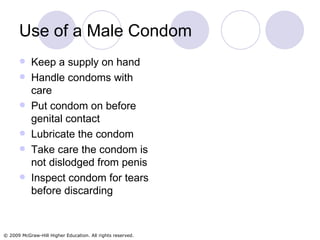
Use of a Male Condom Keep a supply on hand Handle condoms with care Put condom on before genital contact Lubricate the condom Take care the condom is not dislodged from penis Inspect condom for tears before discarding
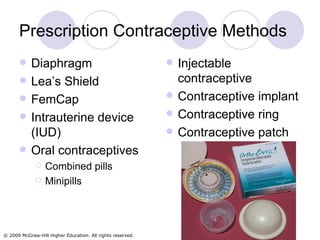
Prescription Contraceptive Methods Diaphragm Lea’s Shield FemCap Intrauterine device (IUD)  Oral contraceptives Combined pills Minipills Injectable contraceptive Contraceptive implant Contraceptive ring Contraceptive patch
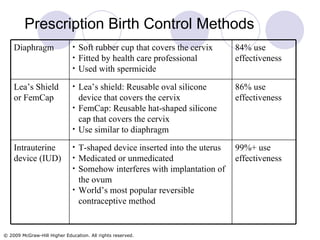
Prescription Birth Control Methods 99%+ use effectiveness T-shaped device inserted into the uterus Medicated or unmedicated Somehow interferes with implantation of the ovum World’s most popular reversible contraceptive method Intrauterine device (IUD) 86% use effectiveness Lea’s shield: Reusable oval silicone device that covers the cervix FemCap: Reusable hat-shaped silicone cap that covers the cervix Use similar to diaphragm Lea’s Shield or FemCap 84% use effectiveness Soft rubber cup that covers the cervix Fitted by health care professional Used with spermicide Diaphragm
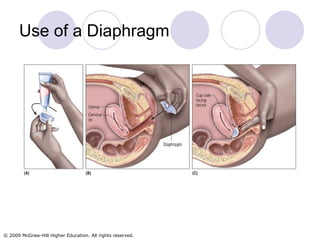
Use of a Diaphragm
Prescription Birth Control Methods (cont.) Blood clots, stroke, hypertension, heart attack Potential risks Tenderness in breasts Nausea Headaches Spotting Weight gain Sex drive fluctuation Frequent vaginal infections Mild depression Side effects Daily pills Estrogen works by reducing ovum development Progesterone reduces ovulation and thickens cervical mucus 92% use effectiveness Oral contraceptive pills
 
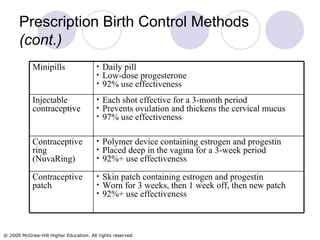
Prescription Birth Control Methods (cont.) Skin patch containing estrogen and progestin Worn for 3 weeks, then 1 week off, then new patch 92%+ use effectiveness Contraceptive patch Polymer device containing estrogen and progestin Placed deep in the vagina for a 3-week period  92%+ use effectiveness Contraceptive ring  (NuvaRing) Each shot effective for a 3-month period  Prevents ovulation and thickens the cervical mucus 97% use effectiveness Injectable contraceptive Daily pill Low-dose progesterone 92% use effectiveness Minipills
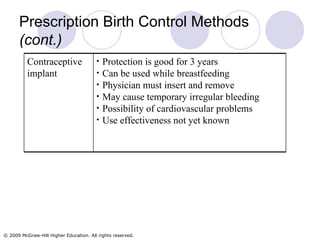
Prescription Birth Control Methods (cont.)   Protection is good for 3 years Can be used while breastfeeding  Physician must insert and remove May cause temporary irregular bleeding Possibility of cardiovascular problems Use effectiveness not yet known Contraceptive implant
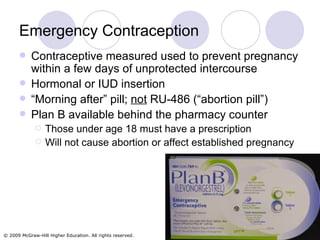
Emergency Contraception Contraceptive measured used to prevent pregnancy within a few days of unprotected intercourse Hormonal or IUD insertion  “ Morning after” pill;  not  RU-486 (“abortion pill”) Plan B available behind the pharmacy counter Those under age 18 must have a prescription Will not cause abortion or affect established pregnancy
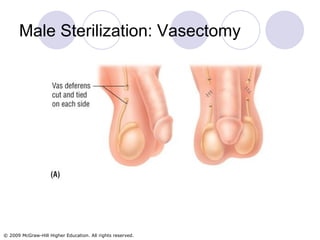
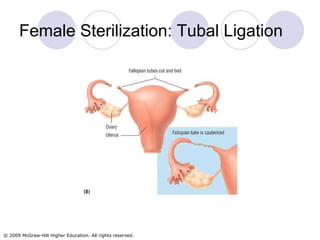
Sterilization Sterilization = Generally permanent birth control techniques that surgically disrupt the normal passage of ova or sperm Vasectomy: Removal of a section of the vas deferens Tubal ligation: Fallopian tubes are cut and the ends tied back
Male Sterilization: Vasectomy
Female Sterilization: Tubal Ligation
Abortion: Termination of a Pregnancy First Trimester Procedures Manual vacuum aspiration  Procedure performed by dilating the cervix and removing uterine contents Dilation and suction curettage (D&C) Procedure in which the cervical canal is dilated to allow the uterine wall to be scraped Medication abortion RU-486 (mifepristone) blocks the action of progesterone and causes the lining of the uterus to break down
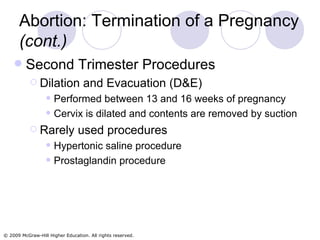
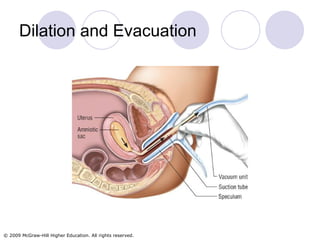
Abortion: Termination of a Pregnancy  (cont.) Second Trimester Procedures Dilation and Evacuation (D&E) Performed between 13 and 16 weeks of pregnancy Cervix is dilated and contents are removed by suction Rarely used procedures Hypertonic saline procedure Prostaglandin procedure
Dilation and Evacuation
Abortion: Termination of a Pregnancy  (cont.)   Partial-birth abortion Federal ban Third-trimester abortion procedures Hysterotomy Hysterectomy
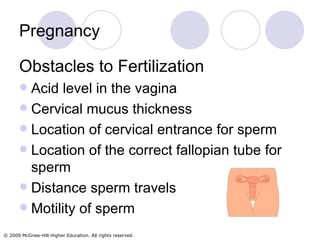
Pregnancy  Obstacles to Fertilization Acid level in the vagina Cervical mucus thickness Location of cervical entrance for sperm Location of the correct fallopian tube for sperm Distance sperm travels Motility of sperm
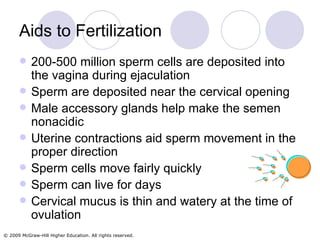
Aids to Fertilization 200-500 million sperm cells are deposited into the vagina during ejaculation Sperm are deposited near the cervical opening Male accessory glands help make the semen nonacidic Uterine contractions aid sperm movement in the proper direction Sperm cells move fairly quickly Sperm can live for days Cervical mucus is thin and watery at the time of ovulation
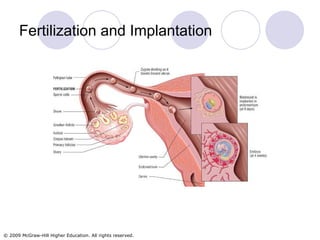
Fertilization and Implantation
Signs of Pregnancy (Presumptive) Missed menstrual period after sexual intercourse the previous month Morning sickness Increase in size and tenderness of breasts Darkening of the areolar tissue around the nipples
Signs of Pregnancy (Probable) Increased frequency of urination Increased in the size of the abdomen Cervix becomes softer by the sixth week Positive pregnancy test
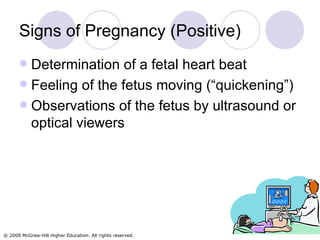
Signs of Pregnancy (Positive) Determination of a fetal heart beat Feeling of the fetus moving (“quickening”) Observations of the fetus by ultrasound or optical viewers
Agents that Can Damage a Fetus Rubella/herpes viruses Tobacco smoke Alcohol Certain OTC drugs Radiation Accutane (acne drug)
Intrauterine Development Three trimesters (13 weeks each) First trimester Zygote Blastocyst Embryo Fetus (after 8 weeks) Second trimester: Organs develop, fetal heartbeat and bone structure evident, prominent weight gain in the mother Third trimester: Fetus increases weight from 2-3 pounds; absorption of major nutrients allowing increased growth and weight
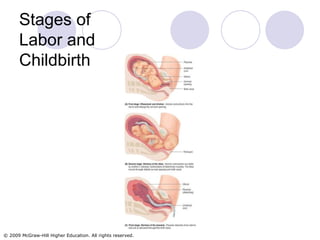
Three Stages of Labor Effacement/dilation of the cervix:  Uterine contractions thin the cervix and enlarge the cervical opening Cervix opens to 10 cm during this stage Delivery of the fetus: Uterine contractions are aided by mother’s voluntary contractions of abdominal muscles Fetus moves through the birth canal Delivery of the placenta:  Placenta detaches from uterine wall
Stages of Labor and Childbirth
Cesarean Deliveries  (C-section) Fetus is removed from the uterus through the abdominal wall  Possibly due to one or more of the following factors: Fetus is improperly positioned Mother’s pelvis is too small Fetus is especially large Fetus shows signs of distress Umbilical cord is compressed Placenta is being delivered before the fetus Mother’s health is at risk
Causes of Infertility Low sperm count Poor sperm motility Sperm abnormalities Lack of ovulation Obstruction of fallopian tubes
Enhancing Fertility Cold packs on the scrotum (men) Boxer shorts vs. briefs (men) Increase intercourse frequency
Treatments for Infertility Artificial insemination Surgical procedures  Fertility drugs Assisted reproductive technology In vitro fertilization Gamete intrafallopian transfer Zygote intrafallopian transfer Intracytoplasmic sperm injection
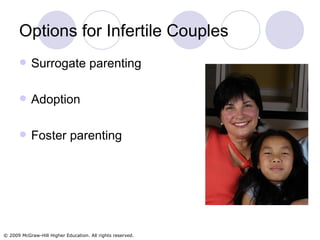
Options for Infertile Couples Surrogate parenting  Adoption Foster parenting
Cloning Techniques Procedures involve the following: Surgical removal of an egg from female donor Nucleus of the egg is removed Cell is taken from a cloning subject (male/female) Through an electrical jolt, the cell is fused with the  enucleated egg , creating a clonal zygote Embryo is implanted in the womb of a surrogate mother After nine months, a genetically matched reproduction is born
Cloning Reproductive cloning Not yet accomplished Banned in selected countries and states Therapeutic cloning Can be used to create stem cells
Chapter Thirteen:  Managing Your Fertility

Managing Your Fertility

  • 1.
    Chapter Thirteen: Managing Your Fertility
  • 2.
    Birth Control vs.Contraception Birth control refers to all procedures and methods that can prevent the birth of a child Contraception refers to procedures used to prevent fertilization
  • 3.
    Theoretical Effectiveness vs.Use Effectiveness Theoretical effectiveness: Measure of a contraceptive method’s ability to prevent a pregnancy when the method is used precisely as directed during every act of intercourse Use effectiveness: Measure of a contraceptive method’s ability to prevent a pregnancy when used by the general public
  • 4.
    Selecting Your ContraceptiveMethod Safety Effectiveness Reliability Reversibility Affordability Ease of use Interference with sexual expression Considerations when choosing contraception
  • 5.
    Behavioral ContraceptiveMethods 73% use effectiveness Removal of penis from vagina before ejaculation Withdrawal (“coitus interruptus”) 15% use effectiveness No method used Chance 100% effective No sexual activity Abstinence
  • 6.
    Behavioral ContraceptiveMethods (cont.) 75% use effectiveness Calendar (calculating the unsafe days of a women’s menstrual cycle) Basal body temperature (rise in body temperature correlates with timing of ovulation) Billings cervical mucus method (evaluate consistency of vaginal discharge to predict ovulation) Symptothermal (combines basal temperature and mucus methods) Periodic abstinence (rhythm method)
  • 7.
  • 8.
    Over-the-Counter Contraceptive MethodsSpermicides Foams Creams Jellies Films Suppositories Condoms Male Female Contraceptive sponge
  • 9.
    Over-the-Counter Contraceptive Methods71% use effectiveness OTC agents that are capable of killing sperm Vaginal spermicides
  • 10.
    Over-the-Counter Contraceptive Methods (cont.) 84% use effectiveness Small, pillow-shaped contraceptive that contains spermicide; placed in the vagina to cover the cervical opening Contraceptive sponge 79% use effectiveness Polyurethane sheath inserted into the vagina Female condom 95% use effectiveness Latex condom in combination with spermicide Male condom with spermicide 85% use effectiveness OTC latex shield designed to cover erect penis and retain semen upon ejaculation Male condom
  • 11.
    Use of aMale Condom Keep a supply on hand Handle condoms with care Put condom on before genital contact Lubricate the condom Take care the condom is not dislodged from penis Inspect condom for tears before discarding
  • 12.
    Prescription Contraceptive MethodsDiaphragm Lea’s Shield FemCap Intrauterine device (IUD) Oral contraceptives Combined pills Minipills Injectable contraceptive Contraceptive implant Contraceptive ring Contraceptive patch
  • 13.
    Prescription Birth ControlMethods 99%+ use effectiveness T-shaped device inserted into the uterus Medicated or unmedicated Somehow interferes with implantation of the ovum World’s most popular reversible contraceptive method Intrauterine device (IUD) 86% use effectiveness Lea’s shield: Reusable oval silicone device that covers the cervix FemCap: Reusable hat-shaped silicone cap that covers the cervix Use similar to diaphragm Lea’s Shield or FemCap 84% use effectiveness Soft rubber cup that covers the cervix Fitted by health care professional Used with spermicide Diaphragm
  • 14.
    Use of aDiaphragm
  • 15.
    Prescription Birth ControlMethods (cont.) Blood clots, stroke, hypertension, heart attack Potential risks Tenderness in breasts Nausea Headaches Spotting Weight gain Sex drive fluctuation Frequent vaginal infections Mild depression Side effects Daily pills Estrogen works by reducing ovum development Progesterone reduces ovulation and thickens cervical mucus 92% use effectiveness Oral contraceptive pills
  • 16.
  • 17.
    Prescription Birth ControlMethods (cont.) Skin patch containing estrogen and progestin Worn for 3 weeks, then 1 week off, then new patch 92%+ use effectiveness Contraceptive patch Polymer device containing estrogen and progestin Placed deep in the vagina for a 3-week period 92%+ use effectiveness Contraceptive ring (NuvaRing) Each shot effective for a 3-month period Prevents ovulation and thickens the cervical mucus 97% use effectiveness Injectable contraceptive Daily pill Low-dose progesterone 92% use effectiveness Minipills
  • 18.
    Prescription Birth ControlMethods (cont.) Protection is good for 3 years Can be used while breastfeeding Physician must insert and remove May cause temporary irregular bleeding Possibility of cardiovascular problems Use effectiveness not yet known Contraceptive implant
  • 19.
    Emergency Contraception Contraceptivemeasured used to prevent pregnancy within a few days of unprotected intercourse Hormonal or IUD insertion “ Morning after” pill; not RU-486 (“abortion pill”) Plan B available behind the pharmacy counter Those under age 18 must have a prescription Will not cause abortion or affect established pregnancy
  • 20.
    Sterilization Sterilization =Generally permanent birth control techniques that surgically disrupt the normal passage of ova or sperm Vasectomy: Removal of a section of the vas deferens Tubal ligation: Fallopian tubes are cut and the ends tied back
  • 21.
  • 22.
  • 23.
    Abortion: Termination ofa Pregnancy First Trimester Procedures Manual vacuum aspiration Procedure performed by dilating the cervix and removing uterine contents Dilation and suction curettage (D&C) Procedure in which the cervical canal is dilated to allow the uterine wall to be scraped Medication abortion RU-486 (mifepristone) blocks the action of progesterone and causes the lining of the uterus to break down
  • 24.
    Abortion: Termination ofa Pregnancy (cont.) Second Trimester Procedures Dilation and Evacuation (D&E) Performed between 13 and 16 weeks of pregnancy Cervix is dilated and contents are removed by suction Rarely used procedures Hypertonic saline procedure Prostaglandin procedure
  • 25.
  • 26.
    Abortion: Termination ofa Pregnancy (cont.) Partial-birth abortion Federal ban Third-trimester abortion procedures Hysterotomy Hysterectomy
  • 27.
    Pregnancy Obstaclesto Fertilization Acid level in the vagina Cervical mucus thickness Location of cervical entrance for sperm Location of the correct fallopian tube for sperm Distance sperm travels Motility of sperm
  • 28.
    Aids to Fertilization200-500 million sperm cells are deposited into the vagina during ejaculation Sperm are deposited near the cervical opening Male accessory glands help make the semen nonacidic Uterine contractions aid sperm movement in the proper direction Sperm cells move fairly quickly Sperm can live for days Cervical mucus is thin and watery at the time of ovulation
  • 29.
  • 30.
    Signs of Pregnancy(Presumptive) Missed menstrual period after sexual intercourse the previous month Morning sickness Increase in size and tenderness of breasts Darkening of the areolar tissue around the nipples
  • 31.
    Signs of Pregnancy(Probable) Increased frequency of urination Increased in the size of the abdomen Cervix becomes softer by the sixth week Positive pregnancy test
  • 32.
    Signs of Pregnancy(Positive) Determination of a fetal heart beat Feeling of the fetus moving (“quickening”) Observations of the fetus by ultrasound or optical viewers
  • 33.
    Agents that CanDamage a Fetus Rubella/herpes viruses Tobacco smoke Alcohol Certain OTC drugs Radiation Accutane (acne drug)
  • 34.
    Intrauterine Development Threetrimesters (13 weeks each) First trimester Zygote Blastocyst Embryo Fetus (after 8 weeks) Second trimester: Organs develop, fetal heartbeat and bone structure evident, prominent weight gain in the mother Third trimester: Fetus increases weight from 2-3 pounds; absorption of major nutrients allowing increased growth and weight
  • 35.
    Three Stages ofLabor Effacement/dilation of the cervix: Uterine contractions thin the cervix and enlarge the cervical opening Cervix opens to 10 cm during this stage Delivery of the fetus: Uterine contractions are aided by mother’s voluntary contractions of abdominal muscles Fetus moves through the birth canal Delivery of the placenta: Placenta detaches from uterine wall
  • 36.
    Stages of Laborand Childbirth
  • 37.
    Cesarean Deliveries (C-section) Fetus is removed from the uterus through the abdominal wall Possibly due to one or more of the following factors: Fetus is improperly positioned Mother’s pelvis is too small Fetus is especially large Fetus shows signs of distress Umbilical cord is compressed Placenta is being delivered before the fetus Mother’s health is at risk
  • 38.
    Causes of InfertilityLow sperm count Poor sperm motility Sperm abnormalities Lack of ovulation Obstruction of fallopian tubes
  • 39.
    Enhancing Fertility Coldpacks on the scrotum (men) Boxer shorts vs. briefs (men) Increase intercourse frequency
  • 40.
    Treatments for InfertilityArtificial insemination Surgical procedures Fertility drugs Assisted reproductive technology In vitro fertilization Gamete intrafallopian transfer Zygote intrafallopian transfer Intracytoplasmic sperm injection
  • 41.
    Options for InfertileCouples Surrogate parenting Adoption Foster parenting
  • 42.
    Cloning Techniques Proceduresinvolve the following: Surgical removal of an egg from female donor Nucleus of the egg is removed Cell is taken from a cloning subject (male/female) Through an electrical jolt, the cell is fused with the enucleated egg , creating a clonal zygote Embryo is implanted in the womb of a surrogate mother After nine months, a genetically matched reproduction is born
  • 43.
    Cloning Reproductive cloningNot yet accomplished Banned in selected countries and states Therapeutic cloning Can be used to create stem cells
  • 44.
    Chapter Thirteen: Managing Your Fertility

Editor's Notes

  • #2 Image source: The McGraw-Hill Companies, Inc./Kirstan Price, photographer