Muscle Adaptation to Exercise
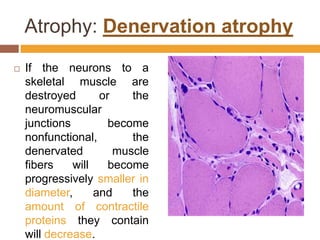
Atrophy: Denervation atrophyIf the neurons to a skeletal muscle are destroyed or the neuromuscular junctions become nonfunctional, the denervated muscle fibers will become progressively smaller in diameter, and the amount of contractile proteins they contain will decrease.
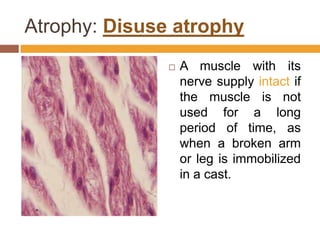
Atrophy: Disuse atrophyA muscle with its nerve supply intact if the muscle is not used for a long period of time, as when a broken arm or leg is immobilized in a cast.
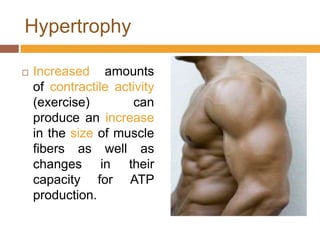
HypertrophyIncreased amounts of contractile activity (exercise) can produce an increase in the size of muscle fibers as well as changes in their capacity for ATP production.
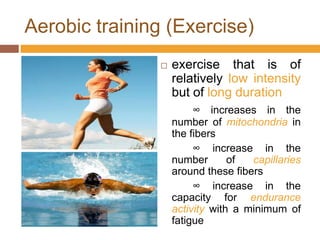
Aerobic training (Exercise)exercise that is of relatively low intensity but of long duration∞ increases in the number ofmitochondria in the fibers∞ increase in the number of capillaries around these fibers	∞ increase in the capacity for endurance activity with a minimum of fatigue
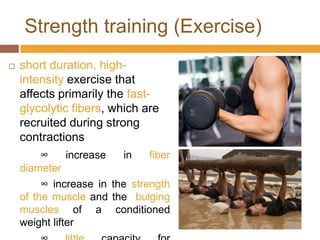
Strength training (Exercise)short duration, high-intensity exercise that affects primarily the fast-glycolytic fibers, which are recruited during strong contractions ∞ increase in fiber diameter	∞ increase in the strength of the muscle and the  bulging muscles of a conditioned weight lifter∞ little capacity for endurance
Exerciseproduces little change in the types of myosinenzymes formed by the fibers and thus little change in the proportions of fast and slow fibers in a muscledoes change the rates at which metabolicenzymes are synthesized, leading to changes in the proportion of oxidative and glycolytic fibers within a muscle
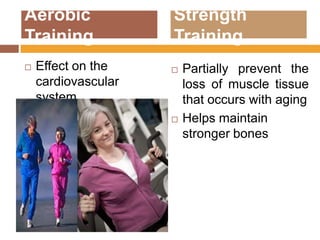
Aerobic TrainingStrength Training Effect on the cardiovascular system Partially prevent the loss of muscle tissue that occurs with agingHelps maintain stronger bones
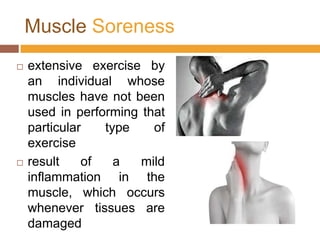
MuscleSorenessextensive exercise by an individual whose muscles have not been used in performing that particular type of exerciseresult of a mild inflammation in the muscle, which occurs whenever tissues are damaged
Lever Action of Muscles and Bones
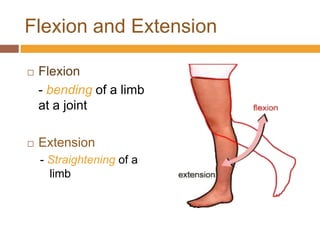
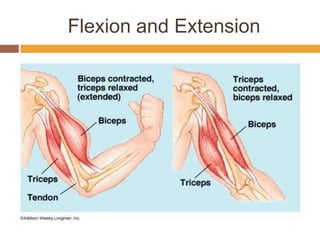
Flexion and ExtensionFlexion - bending of a limb at a jointExtension- Straightening of a limb
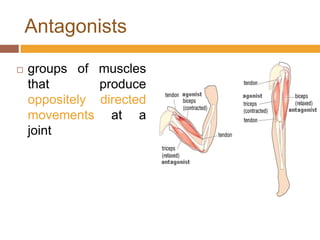
Antagonistsgroups of muscles that produce oppositelydirected movements at a joint
Flexion and Extension
Skeletal-Muscle Disease
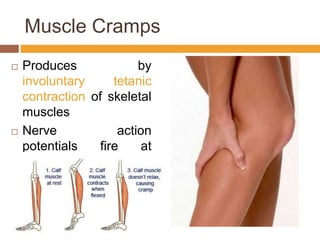
Muscle CrampsProduces by involuntary tetanic contraction of skeletal musclesNerve action potentials fire at abnormally high rates
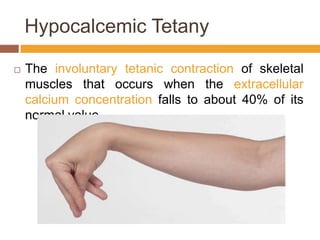
HypocalcemicTetanyThe involuntary tetanic contraction of skeletal muscles that occurs when the extracellular calcium concentration falls to about 40% of its normal value.
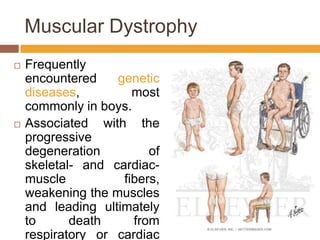
Muscular DystrophyFrequently encountered genetic diseases, most commonly in boys.Associated with the progressive degeneration of skeletal- and cardiac-muscle fibers, weakening the muscles and leading ultimately to death from respiratory or cardiac failure.
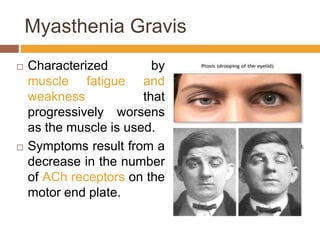
Myasthenia GravisCharacterized by muscle fatigue and weakness that progressively worsens as the muscle is used. Symptoms result from a decrease in the number of ACh receptors on the motor end plate.
END

part7b3

  • 1.
  • 2.
    Atrophy: Denervation atrophyIfthe neurons to a skeletal muscle are destroyed or the neuromuscular junctions become nonfunctional, the denervated muscle fibers will become progressively smaller in diameter, and the amount of contractile proteins they contain will decrease.
  • 3.
    Atrophy: Disuse atrophyAmuscle with its nerve supply intact if the muscle is not used for a long period of time, as when a broken arm or leg is immobilized in a cast.
  • 4.
    HypertrophyIncreased amounts ofcontractile activity (exercise) can produce an increase in the size of muscle fibers as well as changes in their capacity for ATP production.
  • 5.
    Aerobic training (Exercise)exercisethat is of relatively low intensity but of long duration∞ increases in the number ofmitochondria in the fibers∞ increase in the number of capillaries around these fibers ∞ increase in the capacity for endurance activity with a minimum of fatigue
  • 6.
    Strength training (Exercise)shortduration, high-intensity exercise that affects primarily the fast-glycolytic fibers, which are recruited during strong contractions ∞ increase in fiber diameter ∞ increase in the strength of the muscle and the bulging muscles of a conditioned weight lifter∞ little capacity for endurance
  • 7.
    Exerciseproduces little changein the types of myosinenzymes formed by the fibers and thus little change in the proportions of fast and slow fibers in a muscledoes change the rates at which metabolicenzymes are synthesized, leading to changes in the proportion of oxidative and glycolytic fibers within a muscle
  • 8.
    Aerobic TrainingStrength TrainingEffect on the cardiovascular system Partially prevent the loss of muscle tissue that occurs with agingHelps maintain stronger bones
  • 9.
    MuscleSorenessextensive exercise byan individual whose muscles have not been used in performing that particular type of exerciseresult of a mild inflammation in the muscle, which occurs whenever tissues are damaged
  • 10.
    Lever Action ofMuscles and Bones
  • 11.
    Flexion and ExtensionFlexion- bending of a limb at a jointExtension- Straightening of a limb
  • 12.
    Antagonistsgroups of musclesthat produce oppositelydirected movements at a joint
  • 13.
  • 14.
  • 15.
    Muscle CrampsProduces byinvoluntary tetanic contraction of skeletal musclesNerve action potentials fire at abnormally high rates
  • 16.
    HypocalcemicTetanyThe involuntary tetaniccontraction of skeletal muscles that occurs when the extracellular calcium concentration falls to about 40% of its normal value.
  • 17.
    Muscular DystrophyFrequently encounteredgenetic diseases, most commonly in boys.Associated with the progressive degeneration of skeletal- and cardiac-muscle fibers, weakening the muscles and leading ultimately to death from respiratory or cardiac failure.
  • 18.
    Myasthenia GravisCharacterized bymuscle fatigue and weakness that progressively worsens as the muscle is used. Symptoms result from a decrease in the number of ACh receptors on the motor end plate.
  • 19.