Migration in Birds
Patel Dhenuka
Environment Science
Roll Nub-308
OUTLINES
•
•
•
•
•
•
Definition of Bird Migration
Migration Facts
Migration flyways
Why Do Birds Migrate?
Types of Bird Migration
Disadvantage of Bird Migration
•
•
The word “migration” has come from the
Latin word migrar which means going from
one place to another.
According to L.Thomson(1926),bird
migration may be described as “changes of
habitat periodically recurring and alternating
in direction, which tend to secure optimum
environment conditions at all times”.
Definition of Bird Migration



At least 4,000 species of bird are regular migrants,
which is about 40%of the total number of birds in
the world.
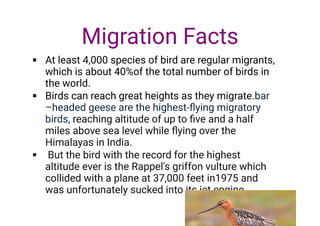
Birds can reach great heights as they migrate.bar
–headed geese are the highest-flying migratory
birds, reaching altitude of up to five and a half
miles above sea level while flying over the
Himalayas in India.
But the bird with the record for the highest
altitude ever is the Rappel's griffon vulture which
collided with a plane at 37,000 feet in1975 and
was unfortunately sucked into its jet engine.
Migration Facts
•
•
•
The Arctic tern has the longest migration of any bird in
the world. These black –capped ,red-billed birds can fly
more than 49,700 miles in a year, making a round trip
between their breeding grounds in the Arctic and the
Antarctic, where they spend their winters.
The lucky bird gets to see two summers a year ! And over
its lifespan of more than 30 years, the flights can add up
the equivalent of three trips to the moon and back.
Speaking of long distance, the northern wheatear travels
up to 9,000 miles each way between the Arctic and Africa,
giving it one of the largest ranges of any songbird. What
makes this an amazing feat is the tiny bird weighs less
than an ounce ,on average.
•
•
•
The award for fastest bird goes to the great
snipe: It flies around 4,200miles at speeds of up
to 60mph.
The bar-tailed godwit can fly for nearly 7000
miles without stopping, making it the bird with
the longest recorded non-stop flight.
Even birds that don’t fly migrate. emus, the
large Australian birds, often travel for miles on
foot to find food, and many populations of
penguins migrate by swimming.
•
•
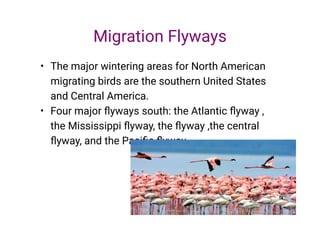
The major wintering areas for North American
migrating birds are the southern United States
and Central America.
Four major flyways south: the Atlantic flyway ,
the Mississippi flyway, the flyway ,the central
flyway, and the Pacific flyway
Migration Flyways
Why Do Birds Migrate ?
•
•
•
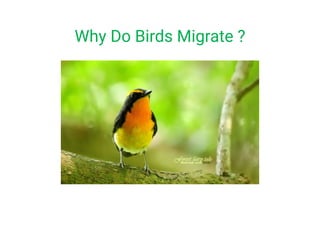
The reasons are complex and not fully understood. But a
simple explanation is food and a safe place to breed.
Birds which breed in the summer in the extreme north
such as the summer in the Arctic benefit from an
abundance of food as plants and insect life flourish in
the long daylight hours; and because few large
permanent predators can survive the harsh winter.
Many birds that breed in the Arctic simply lay their eggs
on the ground. Being able to fly, they can avoid the harsh
winter conditions, and be the first to arrive to enjoy the
summer benefits.
Why Do Birds Migrate ?




Behavior is inherited.
however, birds will not migrate in the absence of
certain physiological environment cues.
In the late summer, the decrease in sunlight
stimulates a migrating bird’s pituitary gland to
produce the hormone prolactin and its adrenal
gland to produce the hormone corticosterone.
These hormones, in turn, cause the birds to
accumulate large amounts of fat just under the
skin, providing them will enough energy for the long
migratory flights.
Why Do Birds Migrate ?
Types Of Bird Migration
Migration may be :
1.Latitudinal
2.Longitudinal
3.Altitudinal or Vertical
4.Partial
5.Total
6.Vagrant or Irregular
7.Seasonal
8.Diurnal
9.Nocturnal
Latitudinal migration




The latitudinal migration usually means the means the
movement from north to south and vice versa.
Cuckoo breeds in India and spends the summer at
south-east Africa and thus covers a distance of about
7250km.
Some tropical birds migrate during rainy season to the
outer tropics to breed and return to the central tropics
in dry season.
Puffinus (great shearwater) breeds on small islands
and migrates as far as Greenland in may and returns
few months.
Latitudinal migration
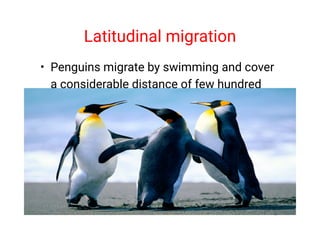
• Penguins migrate by swimming and cover
a considerable distance of few hundred
miles.
Longitudinal migration
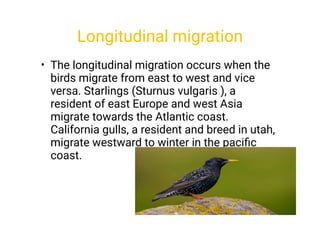
• The longitudinal migration occurs when the
birds migrate from east to west and vice
versa. Starlings (Sturnus vulgaris ), a
resident of east Europe and west Asia
migrate towards the Atlantic coast.
California gulls, a resident and breed in utah,
migrate westward to winter in the pacific
coast.
Altitude migration
•
•
•
The altitude migration occurs in mountainous
regions.
Many birds in habitating the mountain peaks
migrate to low lands during winters.
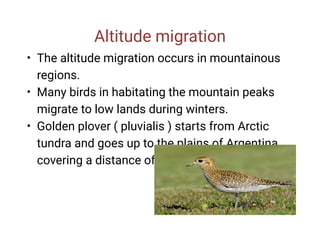
Golden plover ( pluvialis ) starts from Arctic
tundra and goes up to the plains of Argentina
covering a distance of 11,250 km
Partial Migration
•
•
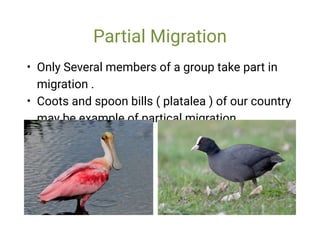
Only Several members of a group take part in
migration .
Coots and spoon bills ( platalea ) of our country
may be example of partical migration.
Total migration
• When all the members of a species take part in
the migration, it is called total migration.
Vagrant or irregular migration
•
•
When Some of the birds disperse to a short or
long distance for safety and food, it is called
vagrant or irregular migration.
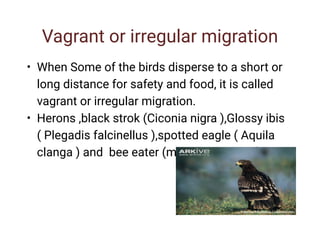
Herons ,black strok (Ciconia nigra ),Glossy ibis
( Plegadis falcinellus ),spotted eagle ( Aquila
clanga ) and bee eater (merops apiaster ).
Daily migration
•
•
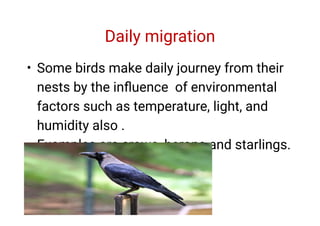
Some birds make daily journey from their
nests by the influence of environmental
factors such as temperature, light, and
humidity also .
Examples are crows, herons and starlings.
Seasonal migration
•
•
•
•
Some birds migrates at different seasons of
the year for food or breeding , called seasonal
migration. e.g., cuckoos, swifts, swallows etc.
They migrate from the south to the north
during summer. These birds are called summer
visitors.
Again there are some birds like snow bunting,
red wing, shore lark, grey plover etc.
Which migrate from north to south during
winter. They are called winter visitors.
Nocturnal and Diurnal Flight
1.
•
•
Diurnal migration
Many larger birds like crows, robins, swallows,
hawks, jays, blue birds, pelicans, cranes, geese,
etc.
Migrate during daytime for food .
Nocturnal migration
•
•
•
Some small-sized birds of passerine
groups like sparrows, warblers, etc .
Migrate in darkness, called nocturnal
birds.
The darkness of the night gives them
protection from their enemies.
Disadvantage of bird migration
1.
2.
3.
4.
Many youngs are not, able to reach the
destination because they die during the course
of the continuous and tiresome journey.
Sudden changes in the climate such as storms
and hurricanes, strong current of wind, fog are
the causes for death of migratory birds.
Sometimes man-made high tours and light
houses cause the death of migratory birds.
Man themselves are responsible for the death of
the migrants. They shoot at these poor birds just
for their own leisure and amusement.
Reference
•
•
•
The book of indian birds by salim ali
Migration in birds www.iaszoology.com
Obligate and facultive migration in birds
https://link.springer.com
THANK YOU

MIGRATION IN BRIDS

  • 1.
    Migration in Birds PatelDhenuka Environment Science Roll Nub-308
  • 2.
    OUTLINES • • • • • • Definition of BirdMigration Migration Facts Migration flyways Why Do Birds Migrate? Types of Bird Migration Disadvantage of Bird Migration
  • 3.
    • • The word “migration”has come from the Latin word migrar which means going from one place to another. According to L.Thomson(1926),bird migration may be described as “changes of habitat periodically recurring and alternating in direction, which tend to secure optimum environment conditions at all times”. Definition of Bird Migration
  • 4.
       At least 4,000species of bird are regular migrants, which is about 40%of the total number of birds in the world. Birds can reach great heights as they migrate.bar –headed geese are the highest-flying migratory birds, reaching altitude of up to five and a half miles above sea level while flying over the Himalayas in India. But the bird with the record for the highest altitude ever is the Rappel's griffon vulture which collided with a plane at 37,000 feet in1975 and was unfortunately sucked into its jet engine. Migration Facts
  • 5.
    • • • The Arctic ternhas the longest migration of any bird in the world. These black –capped ,red-billed birds can fly more than 49,700 miles in a year, making a round trip between their breeding grounds in the Arctic and the Antarctic, where they spend their winters. The lucky bird gets to see two summers a year ! And over its lifespan of more than 30 years, the flights can add up the equivalent of three trips to the moon and back. Speaking of long distance, the northern wheatear travels up to 9,000 miles each way between the Arctic and Africa, giving it one of the largest ranges of any songbird. What makes this an amazing feat is the tiny bird weighs less than an ounce ,on average.
  • 6.
    • • • The award forfastest bird goes to the great snipe: It flies around 4,200miles at speeds of up to 60mph. The bar-tailed godwit can fly for nearly 7000 miles without stopping, making it the bird with the longest recorded non-stop flight. Even birds that don’t fly migrate. emus, the large Australian birds, often travel for miles on foot to find food, and many populations of penguins migrate by swimming.
  • 7.
    • • The major winteringareas for North American migrating birds are the southern United States and Central America. Four major flyways south: the Atlantic flyway , the Mississippi flyway, the flyway ,the central flyway, and the Pacific flyway Migration Flyways
  • 8.
    Why Do BirdsMigrate ?
  • 9.
    • • • The reasons arecomplex and not fully understood. But a simple explanation is food and a safe place to breed. Birds which breed in the summer in the extreme north such as the summer in the Arctic benefit from an abundance of food as plants and insect life flourish in the long daylight hours; and because few large permanent predators can survive the harsh winter. Many birds that breed in the Arctic simply lay their eggs on the ground. Being able to fly, they can avoid the harsh winter conditions, and be the first to arrive to enjoy the summer benefits. Why Do Birds Migrate ?
  • 10.
        Behavior is inherited. however,birds will not migrate in the absence of certain physiological environment cues. In the late summer, the decrease in sunlight stimulates a migrating bird’s pituitary gland to produce the hormone prolactin and its adrenal gland to produce the hormone corticosterone. These hormones, in turn, cause the birds to accumulate large amounts of fat just under the skin, providing them will enough energy for the long migratory flights. Why Do Birds Migrate ?
  • 11.
    Types Of BirdMigration Migration may be : 1.Latitudinal 2.Longitudinal 3.Altitudinal or Vertical 4.Partial 5.Total 6.Vagrant or Irregular 7.Seasonal 8.Diurnal 9.Nocturnal
  • 12.
    Latitudinal migration     The latitudinalmigration usually means the means the movement from north to south and vice versa. Cuckoo breeds in India and spends the summer at south-east Africa and thus covers a distance of about 7250km. Some tropical birds migrate during rainy season to the outer tropics to breed and return to the central tropics in dry season. Puffinus (great shearwater) breeds on small islands and migrates as far as Greenland in may and returns few months.
  • 13.
    Latitudinal migration • Penguinsmigrate by swimming and cover a considerable distance of few hundred miles.
  • 14.
    Longitudinal migration • Thelongitudinal migration occurs when the birds migrate from east to west and vice versa. Starlings (Sturnus vulgaris ), a resident of east Europe and west Asia migrate towards the Atlantic coast. California gulls, a resident and breed in utah, migrate westward to winter in the pacific coast.
  • 15.
    Altitude migration • • • The altitudemigration occurs in mountainous regions. Many birds in habitating the mountain peaks migrate to low lands during winters. Golden plover ( pluvialis ) starts from Arctic tundra and goes up to the plains of Argentina covering a distance of 11,250 km
  • 16.
    Partial Migration • • Only Severalmembers of a group take part in migration . Coots and spoon bills ( platalea ) of our country may be example of partical migration.
  • 17.
    Total migration • Whenall the members of a species take part in the migration, it is called total migration.
  • 18.
    Vagrant or irregularmigration • • When Some of the birds disperse to a short or long distance for safety and food, it is called vagrant or irregular migration. Herons ,black strok (Ciconia nigra ),Glossy ibis ( Plegadis falcinellus ),spotted eagle ( Aquila clanga ) and bee eater (merops apiaster ).
  • 19.
    Daily migration • • Some birdsmake daily journey from their nests by the influence of environmental factors such as temperature, light, and humidity also . Examples are crows, herons and starlings.
  • 20.
    Seasonal migration • • • • Some birdsmigrates at different seasons of the year for food or breeding , called seasonal migration. e.g., cuckoos, swifts, swallows etc. They migrate from the south to the north during summer. These birds are called summer visitors. Again there are some birds like snow bunting, red wing, shore lark, grey plover etc. Which migrate from north to south during winter. They are called winter visitors.
  • 21.
    Nocturnal and DiurnalFlight 1. • • Diurnal migration Many larger birds like crows, robins, swallows, hawks, jays, blue birds, pelicans, cranes, geese, etc. Migrate during daytime for food .
  • 22.
    Nocturnal migration • • • Some small-sizedbirds of passerine groups like sparrows, warblers, etc . Migrate in darkness, called nocturnal birds. The darkness of the night gives them protection from their enemies.
  • 23.
    Disadvantage of birdmigration 1. 2. 3. 4. Many youngs are not, able to reach the destination because they die during the course of the continuous and tiresome journey. Sudden changes in the climate such as storms and hurricanes, strong current of wind, fog are the causes for death of migratory birds. Sometimes man-made high tours and light houses cause the death of migratory birds. Man themselves are responsible for the death of the migrants. They shoot at these poor birds just for their own leisure and amusement.
  • 24.
    Reference • • • The book ofindian birds by salim ali Migration in birds www.iaszoology.com Obligate and facultive migration in birds https://link.springer.com
  • 25.