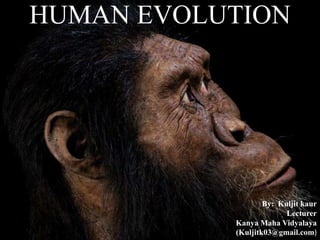
HUMAN EVOLUTION
By: Kuljit kaur
Lecturer
Kanya Maha Vidyalaya
(Kuljitk03@gmail.com)
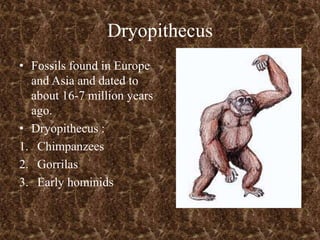
Dryopithecus
• Fossils found in Europe
and Asia and dated to
about 16-7 million years
ago.
• Dryopithecus :
1. Chimpanzees
2. Gorrilas
3. Early hominids
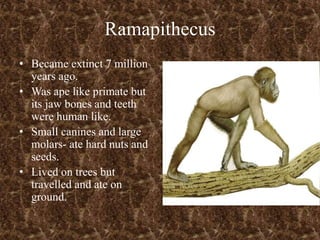
Ramapithecus
• Became extinct 7 million
years ago.
• Was ape like primate but
its jaw bones and teeth
were human like.
• Small canines and large
molars- ate hard nuts and
seeds.
• Lived on trees but
travelled and ate on
ground.
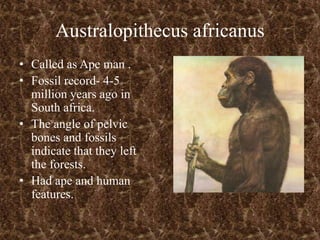
Australopithecus africanus
• Called as Ape man .
• Fossil record- 4-5
million years ago in
South africa.
• The angle of pelvic
bones and fossils
indicate that they left
the forests.
• Had ape and human
features.
• Bipedal locomotion
• Omnivorous
• Erect or semi erect posture
• Lived in cages
• Used pebbels and bones as tools
• Protuding face and lack of chin
• Low brain capacity (350-450cm3)
• Teeth and jaws larger than modern man.
Homo habilis
• Lived in Africa 2
million years ago.
• More man like
• Led community life
• Cared for young ones
• Used tools of chipped
stones
• Brain capacity – 750
cm3
Homo erectus
• The erect man
• 1.7 million years ago
• Co existed for a time with H.habilis
as well as Homo sapiens
• Fossil evidence of cooperation,
social organization,use of more
elaborate tools and use of fire
• Erect posture
• Protruding jaw, protruding brow
ridges and larger teeth
• Brain capacity- 800-1200 cm3
• Made tools out of bones and stones
• Lived in families
Homo sapiens neanderthalensis
• The neanderthal man
• Found in Neander valley
• 100,000-40,000 years ago
• Stronger than modern man
• Strong shoulders, arms, pwerful
hands
• Cranial capacity- 1300-1600 cm3
• Flat cranium, heavy brow ridges,
strong mandibles
• Made tools, skilled hunters,used
animal hides as clothes
• Lived with families and burned the
dead
Homo sapiens fossilis
• Less hairy body
• Cranial capacity- 1650 cm3
• Large skull
• Strong jaws
• Broad flat face
• Narrow elevated nose
• Prominent chin
• Used sophisticated tools
Homo sapiens sapiens
• Appeared 25,000 years
ago
• Superior brain power
but inferior body power
• Intelligence covered for
feeble sight and powers
of hearing and smell
Human evolution

Human evolution

  • 1.
    HUMAN EVOLUTION By: Kuljitkaur Lecturer Kanya Maha Vidyalaya (Kuljitk03@gmail.com)
  • 2.
    Dryopithecus • Fossils foundin Europe and Asia and dated to about 16-7 million years ago. • Dryopithecus : 1. Chimpanzees 2. Gorrilas 3. Early hominids
  • 3.
    Ramapithecus • Became extinct7 million years ago. • Was ape like primate but its jaw bones and teeth were human like. • Small canines and large molars- ate hard nuts and seeds. • Lived on trees but travelled and ate on ground.
  • 4.
    Australopithecus africanus • Calledas Ape man . • Fossil record- 4-5 million years ago in South africa. • The angle of pelvic bones and fossils indicate that they left the forests. • Had ape and human features.
  • 5.
    • Bipedal locomotion •Omnivorous • Erect or semi erect posture • Lived in cages • Used pebbels and bones as tools • Protuding face and lack of chin • Low brain capacity (350-450cm3) • Teeth and jaws larger than modern man.
  • 6.
    Homo habilis • Livedin Africa 2 million years ago. • More man like • Led community life • Cared for young ones • Used tools of chipped stones • Brain capacity – 750 cm3
  • 7.
    Homo erectus • Theerect man • 1.7 million years ago • Co existed for a time with H.habilis as well as Homo sapiens • Fossil evidence of cooperation, social organization,use of more elaborate tools and use of fire • Erect posture • Protruding jaw, protruding brow ridges and larger teeth • Brain capacity- 800-1200 cm3 • Made tools out of bones and stones • Lived in families
  • 8.
    Homo sapiens neanderthalensis •The neanderthal man • Found in Neander valley • 100,000-40,000 years ago • Stronger than modern man • Strong shoulders, arms, pwerful hands • Cranial capacity- 1300-1600 cm3 • Flat cranium, heavy brow ridges, strong mandibles • Made tools, skilled hunters,used animal hides as clothes • Lived with families and burned the dead
  • 9.
    Homo sapiens fossilis •Less hairy body • Cranial capacity- 1650 cm3 • Large skull • Strong jaws • Broad flat face • Narrow elevated nose • Prominent chin • Used sophisticated tools
  • 10.
    Homo sapiens sapiens •Appeared 25,000 years ago • Superior brain power but inferior body power • Intelligence covered for feeble sight and powers of hearing and smell