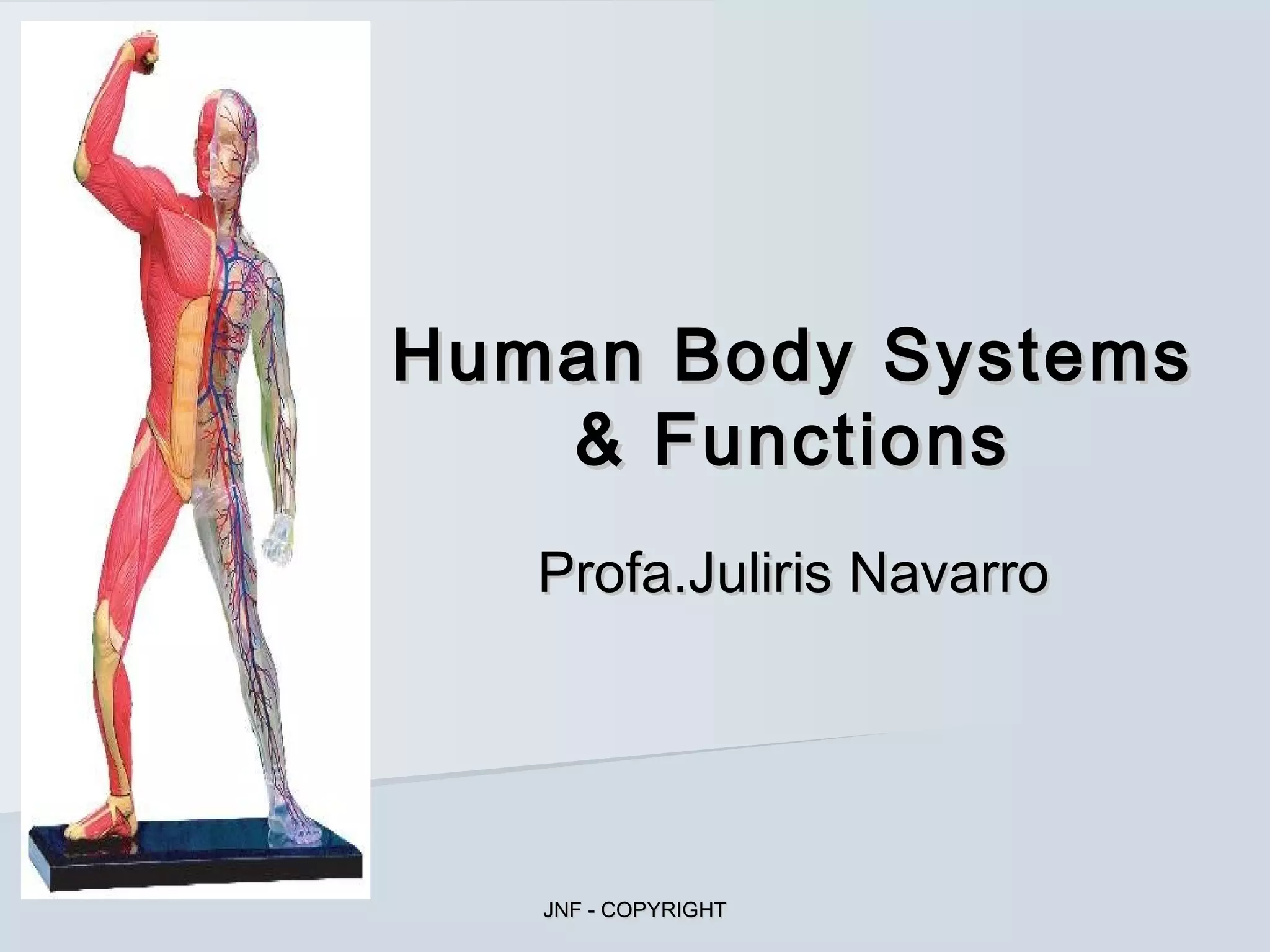
Human Body Systems
   & Functions
   Profa.Juliris Navarro


   JNF - COPYRIGHT
Integumentary System
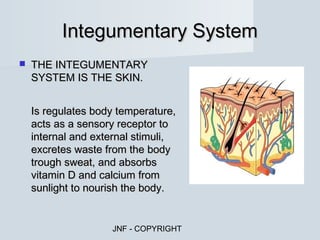
   THE INTEGUMENTARY
    SYSTEM IS THE SKIN.


    Is regulates body temperature,
    acts as a sensory receptor to
    internal and external stimuli,
    excretes waste from the body
    trough sweat, and absorbs
    vitamin D and calcium from
    sunlight to nourish the body.


                    JNF - COPYRIGHT
CARDIOVASCULAR SYSTEM
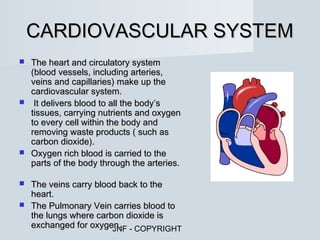
 The heart and circulatory system
  (blood vessels, including arteries,
  veins and capillaries) make up the
  cardiovascular system.
 It delivers blood to all the body’s
  tissues, carrying nutrients and oxygen
  to every cell within the body and
  removing waste products ( such as
  carbon dioxide).
 Oxygen rich blood is carried to the
  parts of the body through the arteries.

 The veins carry blood back to the
  heart.
 The Pulmonary Vein carries blood to
  the lungs where carbon dioxide is
  exchanged for oxygen. - COPYRIGHT
                      JNF
CIRCULATORY SYSTEM
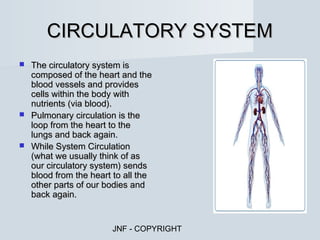
 The circulatory system is
  composed of the heart and the
  blood vessels and provides
  cells within the body with
  nutrients (via blood).
 Pulmonary circulation is the
  loop from the heart to the
  lungs and back again.
 While System Circulation
  (what we usually think of as
  our circulatory system) sends
  blood from the heart to all the
  other parts of our bodies and
  back again.


                       JNF - COPYRIGHT
LYMPHATIC SYSTEM
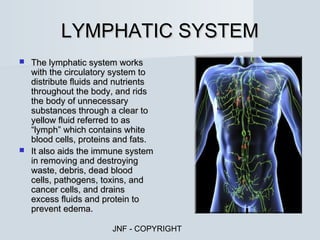
 The lymphatic system works
  with the circulatory system to
  distribute fluids and nutrients
  throughout the body, and rids
  the body of unnecessary
  substances through a clear to
  yellow fluid referred to as
  “lymph” which contains white
  blood cells, proteins and fats.
 It also aids the immune system
  in removing and destroying
  waste, debris, dead blood
  cells, pathogens, toxins, and
  cancer cells, and drains
  excess fluids and protein to
  prevent edema.

                      JNF - COPYRIGHT
LYMPHATIC NODES
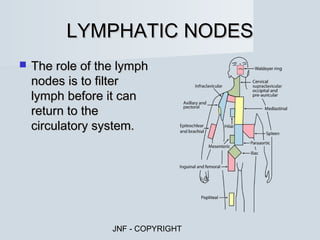
   The role of the lymph
    nodes is to filter
    lymph before it can
    return to the
    circulatory system.


                  JNF - COPYRIGHT
URINARY SYSTEM
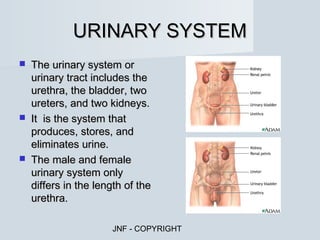
   The urinary system or
    urinary tract includes the
    urethra, the bladder, two
    ureters, and two kidneys.
   It is the system that
    produces, stores, and
    eliminates urine.
   The male and female
    urinary system only
    differs in the length of the
    urethra.

                      JNF - COPYRIGHT
ENDOCRINE SYSTEM
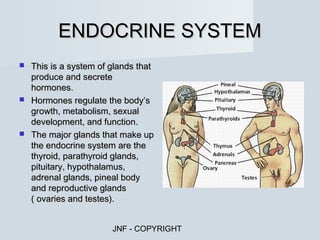
 This is a system of glands that
  produce and secrete
  hormones.
 Hormones regulate the body’s
  growth, metabolism, sexual
  development, and function.
 The major glands that make up
  the endocrine system are the
  thyroid, parathyroid glands,
  pituitary, hypothalamus,
  adrenal glands, pineal body
  and reproductive glands
  ( ovaries and testes).


                      JNF - COPYRIGHT
NERVOUS SYSTEM
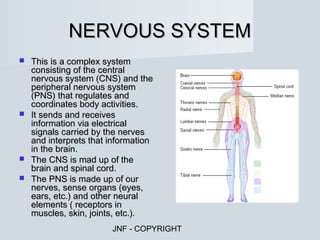
 This is a complex system
  consisting of the central
  nervous system (CNS) and the
  peripheral nervous system
  (PNS) that regulates and
  coordinates body activities.
 It sends and receives
  information via electrical
  signals carried by the nerves
  and interprets that information
  in the brain.
 The CNS is mad up of the
  brain and spinal cord.
 The PNS is made up of our
  nerves, sense organs (eyes,
  ears, etc.) and other neural
  elements ( receptors in
  muscles, skin, joints, etc.).
                      JNF - COPYRIGHT
REPRODUCTIVE SYSTEM
 This is the system by which
  both male and female humans
  reproduce.
 It is sometimes called the
  genital system as it is made up
  of the organs in the pelvic
  region that contribute toward
  the reproductive process.
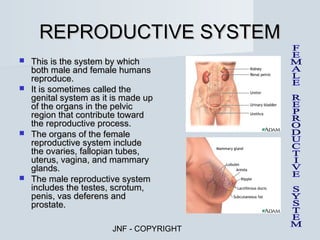
 The organs of the female
  reproductive system include
  the ovaries, fallopian tubes,
  uterus, vagina, and mammary
  glands.
 The male reproductive system
  includes the testes, scrotum,
  penis, vas deferens and
  prostate.

                      JNF - COPYRIGHT
REPRODUCTIVE SYSTEM
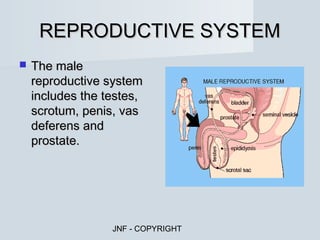
   The male
    reproductive system
    includes the testes,
    scrotum, penis, vas
    deferens and
    prostate.


                  JNF - COPYRIGHT
DIGESTIVE SYSTEM
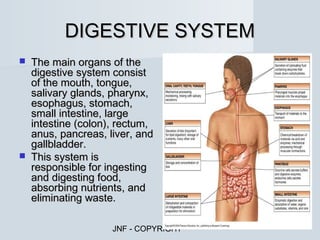
   The main organs of the
    digestive system consist
    of the mouth, tongue,
    salivary glands, pharynx,
    esophagus, stomach,
    small intestine, large
    intestine (colon), rectum,
    anus, pancreas, liver, and
    gallbladder.
   This system is
    responsible for ingesting
    and digesting food,
    absorbing nutrients, and
    eliminating waste.

                     JNF - COPYRIGHT
RESPIRATORY SYSTEM
 This system is responsible for
  delivering oxygenated blood to
  al parts of the body.
 Through breathing, the body
  inhales oxygen and exhales
  carbon dioxide, warms and
  moisturizes the air, and filters
  debris.
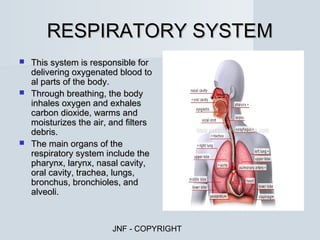
 The main organs of the
  respiratory system include the
  pharynx, larynx, nasal cavity,
  oral cavity, trachea, lungs,
  bronchus, bronchioles, and
  alveoli.


                       JNF - COPYRIGHT
MUSCULOSKELETAL
              SYSTEM
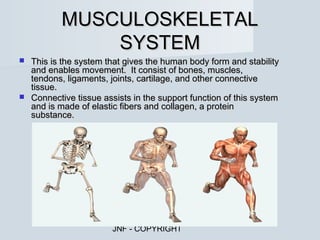
 This is the system that gives the human body form and stability
  and enables movement. It consist of bones, muscles,
  tendons, ligaments, joints, cartilage, and other connective
  tissue.
 Connective tissue assists in the support function of this system
  and is made of elastic fibers and collagen, a protein
  substance.


                       JNF - COPYRIGHT
SPINE ( Vertebral Column)
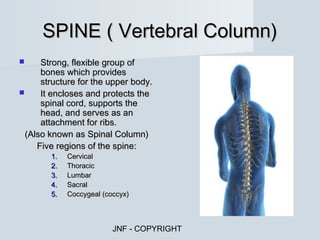
     Strong, flexible group of
      bones which provides
      structure for the upper body.
     It encloses and protects the
      spinal cord, supports the
      head, and serves as an
      attachment for ribs.
  (Also known as Spinal Column)
     Five regions of the spine:
        1.   Cervical
        2.   Thoracic
        3.   Lumbar
        4.   Sacral
        5.   Coccygeal (coccyx)


                          JNF - COPYRIGHT
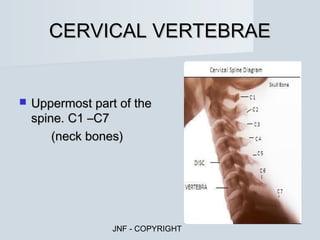
CERVICAL VERTEBRAE


   Uppermost part of the
    spine. C1 –C7
        (neck bones)


                  JNF - COPYRIGHT
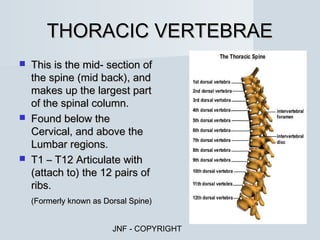
THORACIC VERTEBRAE
   This is the mid- section of
    the spine (mid back), and
    makes up the largest part
    of the spinal column.
   Found below the
    Cervical, and above the
    Lumbar regions.
   T1 – T12 Articulate with
    (attach to) the 12 pairs of
    ribs.
    (Formerly known as Dorsal Spine)


                         JNF - COPYRIGHT
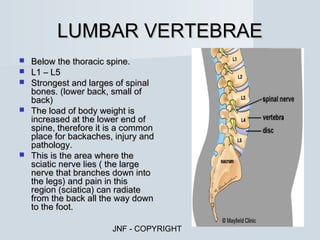
LUMBAR VERTEBRAE
   Below the thoracic spine.
   L1 – L5
   Strongest and larges of spinal
    bones. (lower back, small of
    back)
   The load of body weight is
    increased at the lower end of
    spine, therefore it is a common
    place for backaches, injury and
    pathology.
   This is the area where the
    sciatic nerve lies ( the large
    nerve that branches down into
    the legs) and pain in this
    region (sciatica) can radiate
    from the back all the way down
    to the foot.

                        JNF - COPYRIGHT
REFERENCES

   MOSBY’S DICTIONARY of Medicine, Nursing & Health
    Professions 9th Edition

   http://www.google.com/imghp?hl=en&tab=ii


                   JNF - COPYRIGHT

Human body systems & functions

  • 1.
    Human Body Systems & Functions Profa.Juliris Navarro JNF - COPYRIGHT
  • 2.
    Integumentary System  THE INTEGUMENTARY SYSTEM IS THE SKIN. Is regulates body temperature, acts as a sensory receptor to internal and external stimuli, excretes waste from the body trough sweat, and absorbs vitamin D and calcium from sunlight to nourish the body. JNF - COPYRIGHT
  • 3.
    CARDIOVASCULAR SYSTEM  Theheart and circulatory system (blood vessels, including arteries, veins and capillaries) make up the cardiovascular system.  It delivers blood to all the body’s tissues, carrying nutrients and oxygen to every cell within the body and removing waste products ( such as carbon dioxide).  Oxygen rich blood is carried to the parts of the body through the arteries.  The veins carry blood back to the heart.  The Pulmonary Vein carries blood to the lungs where carbon dioxide is exchanged for oxygen. - COPYRIGHT JNF
  • 4.
    CIRCULATORY SYSTEM  Thecirculatory system is composed of the heart and the blood vessels and provides cells within the body with nutrients (via blood).  Pulmonary circulation is the loop from the heart to the lungs and back again.  While System Circulation (what we usually think of as our circulatory system) sends blood from the heart to all the other parts of our bodies and back again. JNF - COPYRIGHT
  • 5.
    LYMPHATIC SYSTEM  Thelymphatic system works with the circulatory system to distribute fluids and nutrients throughout the body, and rids the body of unnecessary substances through a clear to yellow fluid referred to as “lymph” which contains white blood cells, proteins and fats.  It also aids the immune system in removing and destroying waste, debris, dead blood cells, pathogens, toxins, and cancer cells, and drains excess fluids and protein to prevent edema. JNF - COPYRIGHT
  • 6.
    LYMPHATIC NODES  The role of the lymph nodes is to filter lymph before it can return to the circulatory system. JNF - COPYRIGHT
  • 7.
    URINARY SYSTEM  The urinary system or urinary tract includes the urethra, the bladder, two ureters, and two kidneys.  It is the system that produces, stores, and eliminates urine.  The male and female urinary system only differs in the length of the urethra. JNF - COPYRIGHT
  • 8.
    ENDOCRINE SYSTEM  Thisis a system of glands that produce and secrete hormones.  Hormones regulate the body’s growth, metabolism, sexual development, and function.  The major glands that make up the endocrine system are the thyroid, parathyroid glands, pituitary, hypothalamus, adrenal glands, pineal body and reproductive glands ( ovaries and testes). JNF - COPYRIGHT
  • 9.
    NERVOUS SYSTEM  Thisis a complex system consisting of the central nervous system (CNS) and the peripheral nervous system (PNS) that regulates and coordinates body activities.  It sends and receives information via electrical signals carried by the nerves and interprets that information in the brain.  The CNS is mad up of the brain and spinal cord.  The PNS is made up of our nerves, sense organs (eyes, ears, etc.) and other neural elements ( receptors in muscles, skin, joints, etc.). JNF - COPYRIGHT
  • 10.
    REPRODUCTIVE SYSTEM  Thisis the system by which both male and female humans reproduce.  It is sometimes called the genital system as it is made up of the organs in the pelvic region that contribute toward the reproductive process.  The organs of the female reproductive system include the ovaries, fallopian tubes, uterus, vagina, and mammary glands.  The male reproductive system includes the testes, scrotum, penis, vas deferens and prostate. JNF - COPYRIGHT
  • 11.
    REPRODUCTIVE SYSTEM  The male reproductive system includes the testes, scrotum, penis, vas deferens and prostate. JNF - COPYRIGHT
  • 12.
    DIGESTIVE SYSTEM  The main organs of the digestive system consist of the mouth, tongue, salivary glands, pharynx, esophagus, stomach, small intestine, large intestine (colon), rectum, anus, pancreas, liver, and gallbladder.  This system is responsible for ingesting and digesting food, absorbing nutrients, and eliminating waste. JNF - COPYRIGHT
  • 13.
    RESPIRATORY SYSTEM  Thissystem is responsible for delivering oxygenated blood to al parts of the body.  Through breathing, the body inhales oxygen and exhales carbon dioxide, warms and moisturizes the air, and filters debris.  The main organs of the respiratory system include the pharynx, larynx, nasal cavity, oral cavity, trachea, lungs, bronchus, bronchioles, and alveoli. JNF - COPYRIGHT
  • 14.
    MUSCULOSKELETAL SYSTEM  This is the system that gives the human body form and stability and enables movement. It consist of bones, muscles, tendons, ligaments, joints, cartilage, and other connective tissue.  Connective tissue assists in the support function of this system and is made of elastic fibers and collagen, a protein substance. JNF - COPYRIGHT
  • 15.
    SPINE ( VertebralColumn)  Strong, flexible group of bones which provides structure for the upper body.  It encloses and protects the spinal cord, supports the head, and serves as an attachment for ribs. (Also known as Spinal Column) Five regions of the spine: 1. Cervical 2. Thoracic 3. Lumbar 4. Sacral 5. Coccygeal (coccyx) JNF - COPYRIGHT
  • 16.
    CERVICAL VERTEBRAE  Uppermost part of the spine. C1 –C7 (neck bones) JNF - COPYRIGHT
  • 17.
    THORACIC VERTEBRAE  This is the mid- section of the spine (mid back), and makes up the largest part of the spinal column.  Found below the Cervical, and above the Lumbar regions.  T1 – T12 Articulate with (attach to) the 12 pairs of ribs. (Formerly known as Dorsal Spine) JNF - COPYRIGHT
  • 18.
    LUMBAR VERTEBRAE  Below the thoracic spine.  L1 – L5  Strongest and larges of spinal bones. (lower back, small of back)  The load of body weight is increased at the lower end of spine, therefore it is a common place for backaches, injury and pathology.  This is the area where the sciatic nerve lies ( the large nerve that branches down into the legs) and pain in this region (sciatica) can radiate from the back all the way down to the foot. JNF - COPYRIGHT
  • 19.
    REFERENCES  MOSBY’S DICTIONARY of Medicine, Nursing & Health Professions 9th Edition  http://www.google.com/imghp?hl=en&tab=ii JNF - COPYRIGHT