Introduction
• A working knowledge of human anatomy requires an understanding of
  the body’s structures and how these structures operate in various
  systems.
• With knowledge of the important anatomical, directional, and regional
  terms associated with the structures of the body, people often find that
  most tissues are named quite descriptively, as seen on the following slide.
Anatomical Position
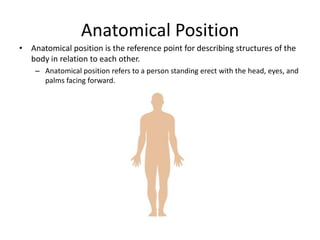
• Anatomical position is the reference point for describing structures of the
  body in relation to each other.
    – Anatomical position refers to a person standing erect with the head, eyes, and
      palms facing forward.
Anatomical, Directional, and Regional Terms
Anatomical Terminology
• Knowing the meaning of
  common root words will
  help in understanding the
  bodily structures and
  related terminology.
Structural Levels of the Body
• There are four structural levels of the body:
  cells, tissues, organs, and systems.
  – Cells are the most basic structure and combine to
    form tissue.
  – Two or more tissues make up an organ.
  – Organs that function together make up a system.
  – The fitness professional must understand the
    cardiovascular, respiratory, digestive, skeletal,
    nervous, muscular, and endocrine systems.
Structural Levels of the Body
Cardiovascular System
• The cardiovascular system, also called the
  circulatory system, is composed of the
  heart, blood vessels, and blood.
• Blood is the fluid component that transports
  necessary substances throughout the body.
  – Blood is transported via blood vessels: arteries,
              veins, and capillaries.
The Heart
• Blood travels continuously through the heart into
  the arteries, then to the capillaries and into the
  veins, and then back to the heart.
• The heart, which is about the size of an adult
  fist, pumps blood throughout the body.
  – It is divided into four chambers: right atrium, right
    ventricle, left atrium, and left ventricle.
  – The atria are the receiving chambers and the
    ventricles are the propulsion chambers. Valves are
    necessary to prevent backflow between the atria and
    ventricles, and between the ventricles and the
    pulmonary arteries and aorta.
Respiratory System
•   The functions of the respiratory system include:
     –   Replacing oxygen and removing carbon dioxide from the blood
     –   Vocalization
     –   Regulation of the acid-base
         balance during exercise
•   Components of the respiratory
    system include the nose,
    nasal cavity, pharynx, larynx,
    trachea, bronchi, and lungs.
     –   They form a passage that
         filters air and transports it
         to the lungs.
     –   Gas exchange occurs in
         the lungs in the alveoli.
Digestive System
•   The digestive system is activated as soon as a substance enters the mouth, and is responsible
    for moving the food along the digestive tract, preparing it for digestion, chemically digesting
    it, absorbing the food, and eliminating the waste products.
•   After entering the cells, the digested food molecules may be reassembled into proteins,
    carbohydrates, and fats, or may be used in the production of energy to support body activity.
•   This diagram shows key organs of the digestive system.
Skeletal System
• The human skeleton performs the following functions:
    –   Supports soft tissues and provides attachment sites for muscles
    –   Movement at joints when muscles are contracted
    –   Protects organs (e.g., skull encases the brain)
    –   Stores calcium, phosphorus, fat, sodium, potassium, and other minerals
    –   Production of blood cells
• The skeletal system is divided into two parts:
    – The axial skeleton
    – The appendicular skeleton
• An illustration of the skeletal system is presented on the following slide.
Skeletal System Illustration
Nervous System
•   The nervous system connects the muscles to the brain and spinal cord through a
    network of nerve circuits that direct the ebb and flow of muscular energy.
     – Structurally, it is divided into the central nervous system (CNS) and peripheral nervous
       system (PNS).
          • The CNS consists of the brain and spinal cords, while the PNS consists of all the nerve structures
            outside the brain and spinal cord.
•   Nerves are made up of multiple nerve cells
    called neurons.
•   Sensory nerves carry impulses to the
    CNS, while motor nerves carry impulses
    from the CNS to the PNS.
Proprioception
• Proprioception is the sense of knowing where
  the body is in relation to its various segments
  and the external environment.
  – Receptors in the skin, in and around the joints and
    muscles, and in the inner ear transmit the
    information.
Muscular System
The muscular system is responsible for:
-Producing body movements
-Stabilizing body positions
-Regulating organ volumes
-Movement of substances within the body
    blood, lymph, urine, air, food and
    fluids, sperm
-Producing heat
    involuntary contractions of skeletal
    muscle (shivering)
The Endocrine System
•   The endocrine system, which is made up of various glands throughout the body, is
    responsible for regulating bodily activities through the production of hormones.
•   The principal glands are:
Summary
•   To design safe and effective programs and group fitness classes, fitness
    professionals must have working knowledge of human anatomy.
•   Understanding the terminology and major systems will provide a foundation for
    successfully working with clients or class participants to achieve health and fitness
    goals.

Week 1 antomy

  • 1.
    Introduction • A workingknowledge of human anatomy requires an understanding of the body’s structures and how these structures operate in various systems. • With knowledge of the important anatomical, directional, and regional terms associated with the structures of the body, people often find that most tissues are named quite descriptively, as seen on the following slide.
  • 2.
    Anatomical Position • Anatomicalposition is the reference point for describing structures of the body in relation to each other. – Anatomical position refers to a person standing erect with the head, eyes, and palms facing forward.
  • 3.
  • 4.
    Anatomical Terminology • Knowingthe meaning of common root words will help in understanding the bodily structures and related terminology.
  • 5.
    Structural Levels ofthe Body • There are four structural levels of the body: cells, tissues, organs, and systems. – Cells are the most basic structure and combine to form tissue. – Two or more tissues make up an organ. – Organs that function together make up a system. – The fitness professional must understand the cardiovascular, respiratory, digestive, skeletal, nervous, muscular, and endocrine systems.
  • 6.
  • 7.
    Cardiovascular System • Thecardiovascular system, also called the circulatory system, is composed of the heart, blood vessels, and blood. • Blood is the fluid component that transports necessary substances throughout the body. – Blood is transported via blood vessels: arteries, veins, and capillaries.
  • 8.
    The Heart • Bloodtravels continuously through the heart into the arteries, then to the capillaries and into the veins, and then back to the heart. • The heart, which is about the size of an adult fist, pumps blood throughout the body. – It is divided into four chambers: right atrium, right ventricle, left atrium, and left ventricle. – The atria are the receiving chambers and the ventricles are the propulsion chambers. Valves are necessary to prevent backflow between the atria and ventricles, and between the ventricles and the pulmonary arteries and aorta.
  • 9.
    Respiratory System • The functions of the respiratory system include: – Replacing oxygen and removing carbon dioxide from the blood – Vocalization – Regulation of the acid-base balance during exercise • Components of the respiratory system include the nose, nasal cavity, pharynx, larynx, trachea, bronchi, and lungs. – They form a passage that filters air and transports it to the lungs. – Gas exchange occurs in the lungs in the alveoli.
  • 10.
    Digestive System • The digestive system is activated as soon as a substance enters the mouth, and is responsible for moving the food along the digestive tract, preparing it for digestion, chemically digesting it, absorbing the food, and eliminating the waste products. • After entering the cells, the digested food molecules may be reassembled into proteins, carbohydrates, and fats, or may be used in the production of energy to support body activity. • This diagram shows key organs of the digestive system.
  • 11.
    Skeletal System • Thehuman skeleton performs the following functions: – Supports soft tissues and provides attachment sites for muscles – Movement at joints when muscles are contracted – Protects organs (e.g., skull encases the brain) – Stores calcium, phosphorus, fat, sodium, potassium, and other minerals – Production of blood cells • The skeletal system is divided into two parts: – The axial skeleton – The appendicular skeleton • An illustration of the skeletal system is presented on the following slide.
  • 12.
  • 13.
    Nervous System • The nervous system connects the muscles to the brain and spinal cord through a network of nerve circuits that direct the ebb and flow of muscular energy. – Structurally, it is divided into the central nervous system (CNS) and peripheral nervous system (PNS). • The CNS consists of the brain and spinal cords, while the PNS consists of all the nerve structures outside the brain and spinal cord. • Nerves are made up of multiple nerve cells called neurons. • Sensory nerves carry impulses to the CNS, while motor nerves carry impulses from the CNS to the PNS.
  • 14.
    Proprioception • Proprioception isthe sense of knowing where the body is in relation to its various segments and the external environment. – Receptors in the skin, in and around the joints and muscles, and in the inner ear transmit the information.
  • 15.
    Muscular System The muscularsystem is responsible for: -Producing body movements -Stabilizing body positions -Regulating organ volumes -Movement of substances within the body blood, lymph, urine, air, food and fluids, sperm -Producing heat involuntary contractions of skeletal muscle (shivering)
  • 16.
    The Endocrine System • The endocrine system, which is made up of various glands throughout the body, is responsible for regulating bodily activities through the production of hormones. • The principal glands are:
  • 17.
    Summary • To design safe and effective programs and group fitness classes, fitness professionals must have working knowledge of human anatomy. • Understanding the terminology and major systems will provide a foundation for successfully working with clients or class participants to achieve health and fitness goals.