Com S 229 Spring 2007 Dr. Markus Lumpe
1
Study Project: Data Compression
In 1952 David A. Huffman published the paper “A Method for the Construction of
Minimum-Redundancy Codes” in which he defined a greedy algorithm that constructs an
optimal prefix code called a Huffman code.
The algorithm begins with a set C of pairs (c,f), called HuffmanLeaf, where c is a
character of an underlying alphabet (e.g., ASCII or data type byte) and f denotes the
number of occurrences of c in a given source file. The set C is a partial order ≤ over
pairs. Thus, if (‘t’,2),(‘d’,3) ∈ C (i.e, (‘t’,2), (‘d’,3) are elements of C),
then we have that pair (‘t’,2) ≤ (‘d’,3). Huffman’s algorithm uses the frequency
f to identify the two least-frequent objects in C and merges them. The result of the
merger is a new object (i.e., HuffmanNode) whose frequency is the sum of the
frequency of the two objects being merged. In total, the algorithm performs a sequence
of |C| - 1 “merging” operations to create a Huffman tree.
How does it work?
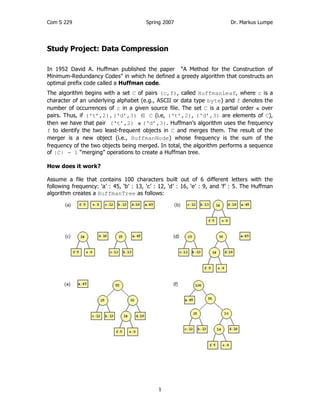
Assume a file that contains 100 characters built out of 6 different letters with the
following frequency: ‘a’ : 45, ‘b’ : 13, ‘c’ : 12, ‘d’ : 16, ‘e’ : 9, and ‘f’ : 5. The Huffman
algorithm creates a HuffmanTree as follows:
Com S 229 Spring 2007 Dr. Markus Lumpe
2
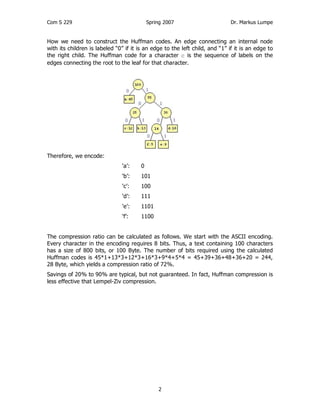
How we need to construct the Huffman codes. An edge connecting an internal node
with its children is labeled “0” if it is an edge to the left child, and “1” if it is an edge to
the right child. The Huffman code for a character c is the sequence of labels on the
edges connecting the root to the leaf for that character.
Therefore, we encode:
‘a’: 0
‘b’: 101
‘c’: 100
‘d’: 111
‘e’: 1101
‘f’: 1100
The compression ratio can be calculated as follows. We start with the ASCII encoding.
Every character in the encoding requires 8 bits. Thus, a text containing 100 characters
has a size of 800 bits, or 100 Byte. The number of bits required using the calculated
Huffman codes is 45*1+13*3+12*3+16*3+9*4+5*4 = 45+39+36+48+36+20 = 244,
28 Byte, which yields a compression ratio of 72%.
Savings of 20% to 90% are typical, but not guaranteed. In fact, Huffman compression is
less effective that Lempel-Ziv compression.
Com S 229 Spring 2007 Dr. Markus Lumpe
3
Compression: Design idea
Huffman codes are constructed in two phases: (i) an analysis phase in which the whole
source file is read to construct a map<unsigned char, long> of pairs
(Character, Frequency), and (ii) a coding phase in which a Huffman tree is
constructed to determine the Huffman codes.
In order to implement Huffman compression you need to solve the following sub-
problems:
1. Frequency collection, build the set C:
Start with an empty map<unsigned char, long> frequencies. You need
to process the whole input file, read all characters, and count their occurrences,
that is, frequencies[c]++. Start with an empty map<unsigned char,
long>.
2. Huffman tree construction:
Construct a Huffman tree according to the Huffman algorithm. The best data
type for this purpose is set<T>, where T is the base type of the set. T should be
a super type (or interface) for Huffman leaves and Huffman nodes. Also, to use
the set, you need to define a proper < operator for Huffman leaves and nodes.
3. Huffman code assignment:
Annotate the edges of the Huffman tree with 0 or 1. That is, define a scheme to
assign every leaf-node its corresponding Huffman code.
4. Huffman character/code mapping:
Build a map<unsigned byte, HuffmanCode> that contains mappings from
characters to HuffmanCode’s. HuffmanCode is the data type you chose to
represent Huffman codes. You need to traverse the Huffman tree and visit all
leafs. Use object-oriented techniques to solve this problem.
Assume as source files plain binary files. That is, a character is represented as a
unsigned char. Huffman codes have flexible length. To facilitate their representation
it might be usefule, but not required, to use the data type string. For example, the
character ‘e’ is represented as 0x65 of type unsigned char and its corresponding
Huffman code as “1101” of type string.
Your solution will require several different classes. For example, you will need at least, a
class for the analysis phase, the class HuffmanLeaf to represent leaves, the class
HuffmanNode to represent nodes, and the class HuffmanTree to represent Huffman
trees.
To test your application you can use the file “sample.txt”, which contains the text from
problem set 2. This file is 1996 Bytes long and contains 53 different characters. The
expected compression ratio is 41.27%, that is, we can represent 15968 Bits (1996
Bytes) of fixed-size code by at most 9384 Bits (or 1173 Bytes) of variable-size prefix
codes.
Com S 229 Spring 2007 Dr. Markus Lumpe
4
Week 1
Study the Huffman algorithm. Search the Internet for additional information. Develop a
basic class structure. Familiarize yourself with the container types map and set. Start
with simple tests. Prepare a catalogue of questions that need to be discussed in class.
Week 2
Implement the frequency analysis and the construction of the Huffman tree.
Week 3
Implement the compression.
Week 4
Implement the decompression.
Week 5
Code cleanup.
Deliverable
An operational compression/decompression C++ console application.
We will discuss ideas, problems, and possible solutions in class.
Lab sessions: 03/20, 03/22, and 03/27
Final submission deadline: Thursday, April 19, 2004, 4:10 p.m.

Huffman

  • 1.
    Com S 229Spring 2007 Dr. Markus Lumpe 1 Study Project: Data Compression In 1952 David A. Huffman published the paper “A Method for the Construction of Minimum-Redundancy Codes” in which he defined a greedy algorithm that constructs an optimal prefix code called a Huffman code. The algorithm begins with a set C of pairs (c,f), called HuffmanLeaf, where c is a character of an underlying alphabet (e.g., ASCII or data type byte) and f denotes the number of occurrences of c in a given source file. The set C is a partial order ≤ over pairs. Thus, if (‘t’,2),(‘d’,3) ∈ C (i.e, (‘t’,2), (‘d’,3) are elements of C), then we have that pair (‘t’,2) ≤ (‘d’,3). Huffman’s algorithm uses the frequency f to identify the two least-frequent objects in C and merges them. The result of the merger is a new object (i.e., HuffmanNode) whose frequency is the sum of the frequency of the two objects being merged. In total, the algorithm performs a sequence of |C| - 1 “merging” operations to create a Huffman tree. How does it work? Assume a file that contains 100 characters built out of 6 different letters with the following frequency: ‘a’ : 45, ‘b’ : 13, ‘c’ : 12, ‘d’ : 16, ‘e’ : 9, and ‘f’ : 5. The Huffman algorithm creates a HuffmanTree as follows:
  • 2.
    Com S 229Spring 2007 Dr. Markus Lumpe 2 How we need to construct the Huffman codes. An edge connecting an internal node with its children is labeled “0” if it is an edge to the left child, and “1” if it is an edge to the right child. The Huffman code for a character c is the sequence of labels on the edges connecting the root to the leaf for that character. Therefore, we encode: ‘a’: 0 ‘b’: 101 ‘c’: 100 ‘d’: 111 ‘e’: 1101 ‘f’: 1100 The compression ratio can be calculated as follows. We start with the ASCII encoding. Every character in the encoding requires 8 bits. Thus, a text containing 100 characters has a size of 800 bits, or 100 Byte. The number of bits required using the calculated Huffman codes is 45*1+13*3+12*3+16*3+9*4+5*4 = 45+39+36+48+36+20 = 244, 28 Byte, which yields a compression ratio of 72%. Savings of 20% to 90% are typical, but not guaranteed. In fact, Huffman compression is less effective that Lempel-Ziv compression.
  • 3.
    Com S 229Spring 2007 Dr. Markus Lumpe 3 Compression: Design idea Huffman codes are constructed in two phases: (i) an analysis phase in which the whole source file is read to construct a map<unsigned char, long> of pairs (Character, Frequency), and (ii) a coding phase in which a Huffman tree is constructed to determine the Huffman codes. In order to implement Huffman compression you need to solve the following sub- problems: 1. Frequency collection, build the set C: Start with an empty map<unsigned char, long> frequencies. You need to process the whole input file, read all characters, and count their occurrences, that is, frequencies[c]++. Start with an empty map<unsigned char, long>. 2. Huffman tree construction: Construct a Huffman tree according to the Huffman algorithm. The best data type for this purpose is set<T>, where T is the base type of the set. T should be a super type (or interface) for Huffman leaves and Huffman nodes. Also, to use the set, you need to define a proper < operator for Huffman leaves and nodes. 3. Huffman code assignment: Annotate the edges of the Huffman tree with 0 or 1. That is, define a scheme to assign every leaf-node its corresponding Huffman code. 4. Huffman character/code mapping: Build a map<unsigned byte, HuffmanCode> that contains mappings from characters to HuffmanCode’s. HuffmanCode is the data type you chose to represent Huffman codes. You need to traverse the Huffman tree and visit all leafs. Use object-oriented techniques to solve this problem. Assume as source files plain binary files. That is, a character is represented as a unsigned char. Huffman codes have flexible length. To facilitate their representation it might be usefule, but not required, to use the data type string. For example, the character ‘e’ is represented as 0x65 of type unsigned char and its corresponding Huffman code as “1101” of type string. Your solution will require several different classes. For example, you will need at least, a class for the analysis phase, the class HuffmanLeaf to represent leaves, the class HuffmanNode to represent nodes, and the class HuffmanTree to represent Huffman trees. To test your application you can use the file “sample.txt”, which contains the text from problem set 2. This file is 1996 Bytes long and contains 53 different characters. The expected compression ratio is 41.27%, that is, we can represent 15968 Bits (1996 Bytes) of fixed-size code by at most 9384 Bits (or 1173 Bytes) of variable-size prefix codes.
  • 4.
    Com S 229Spring 2007 Dr. Markus Lumpe 4 Week 1 Study the Huffman algorithm. Search the Internet for additional information. Develop a basic class structure. Familiarize yourself with the container types map and set. Start with simple tests. Prepare a catalogue of questions that need to be discussed in class. Week 2 Implement the frequency analysis and the construction of the Huffman tree. Week 3 Implement the compression. Week 4 Implement the decompression. Week 5 Code cleanup. Deliverable An operational compression/decompression C++ console application. We will discuss ideas, problems, and possible solutions in class. Lab sessions: 03/20, 03/22, and 03/27 Final submission deadline: Thursday, April 19, 2004, 4:10 p.m.