Muhammad Sarwar QAU Islamabad 1
QUICK SORT
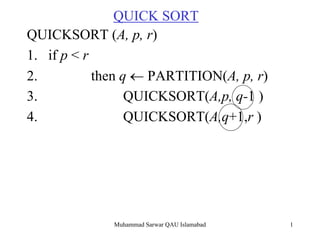
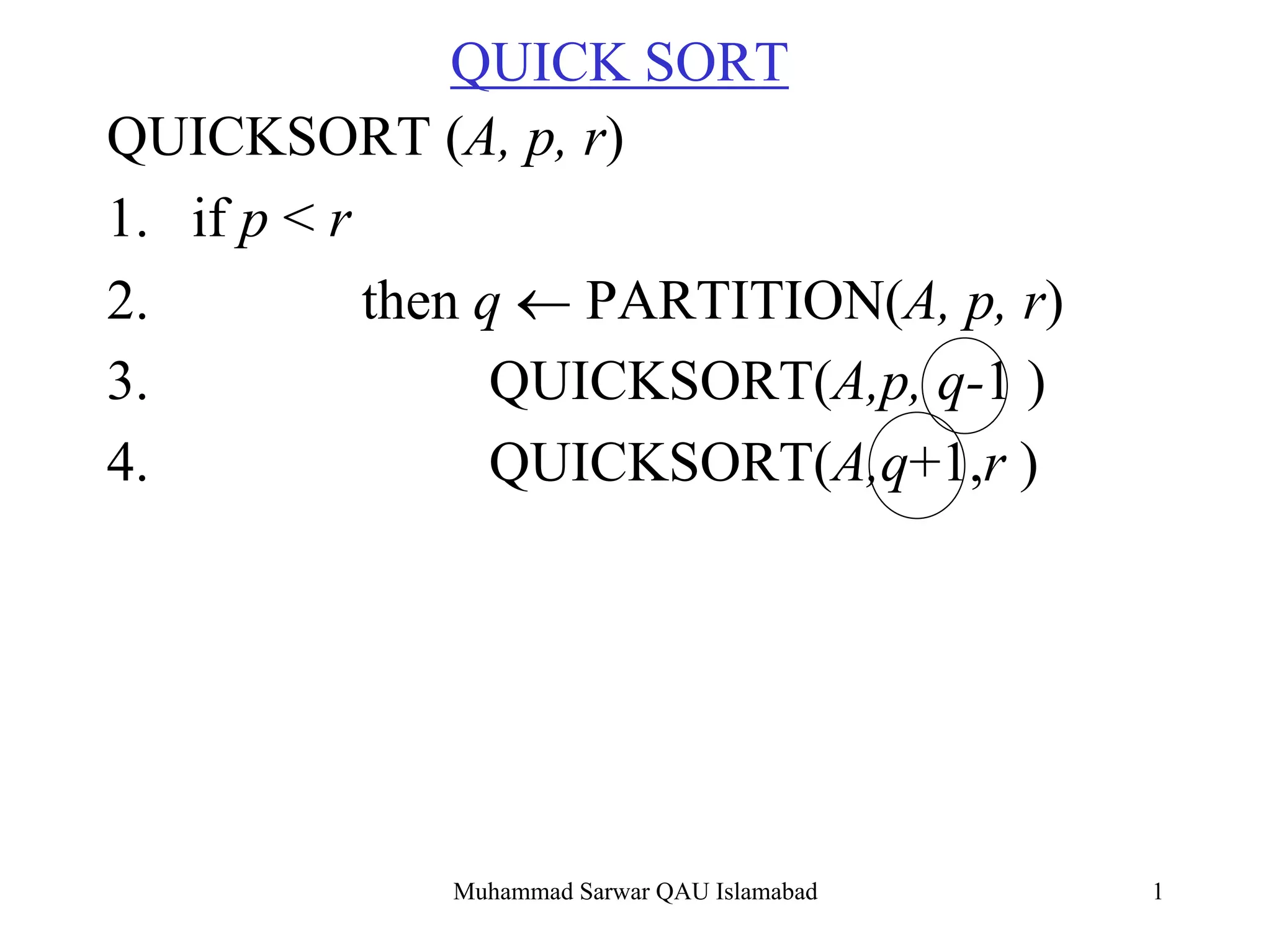
QUICKSORT (A, p, r)
1. if p < r
2. then q ← PARTITION(A, p, r)
3. QUICKSORT(A,p, q-1 )
4. QUICKSORT(A,q+1,r )
Muhammad Sarwar QAU Islamabad 2
PARTITION
PARTITION(A, p, r)
1. x←A[r]
2. i ← p-1
3. for j←p to r-1
4. if A[j]≤x then
5. i←i+1
6. exchange A[i]↔a[j]
7. exchange A[i+1]↔A[r]
8. return i+1
Muhammad Sarwar QAU Islamabad 3
QUICK SORT
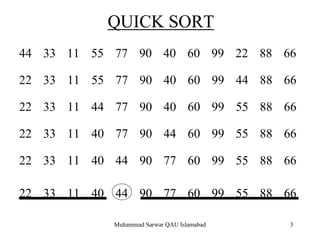
668822996040907755113344
668844996040907755113322
668855996040907744113322
668855996044907740113322
668855996077904440113322
668855996077904440113322
Muhammad Sarwar QAU Islamabad 4
PARTITION
PARTITION (A, p, r)
1. x←A[p], i ←p-1, j ←r+1
2. while TRUE
3. do repeat j ←j - 1
4. until A[j]≤ x
5. repeat i ←i+1
6. until A[i]≥ x
7. if i<j
8. then exchange A[i]↔A[j]
9. else return j
Muhammad Sarwar QAU Islamabad 5
PARTITION
PARTITION (A, p, r)
1. x←A[p], i ←p-1, j ←r+1
2. while TRUE
3. do repeat j ←j - 1
4. until A[j]≤ x
5. repeat i ←i+1
6. until A[i]≥ x
7. if i<j
8. then exchange A[i]↔A[j]
9. else return j
Muhammad Sarwar QAU Islamabad 6
PARTITION
1. left←beg, right ← end, loc ← beg
2. [SCAN FROM RIGHT TO LEFT]
a) repeat while a [loc]<=a [right] & loc!=right
right ← right-1
b) if loc=right then return loc
c) if A [loc]>A [right] then
i. interchange A [loc] & A [right]
ii. loc ← right go to step 3
3. [SCAN FROM LEFT TO RIGHT]
a) repeat while A [left]<=A [loc] & left!=loc
left ← left+1
b) if loc=left then return loc
c) if A [left]>A [loc] then
i. interchange A [left] & A [loc]
ii. loc ← left, go to step 2
Muhammad Sarwar QAU Islamabad 7
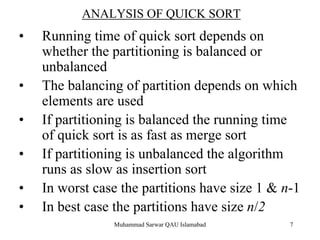
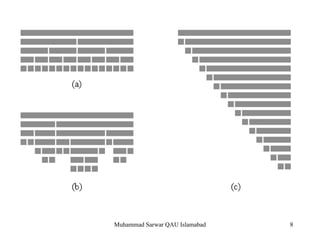
ANALYSIS OF QUICK SORT
• Running time of quick sort depends on
whether the partitioning is balanced or
unbalanced
• The balancing of partition depends on which
elements are used
• If partitioning is balanced the running time
of quick sort is as fast as merge sort
• If partitioning is unbalanced the algorithm
runs as slow as insertion sort
• In worst case the partitions have size 1 & n-1
• In best case the partitions have size n/2
Muhammad Sarwar QAU Islamabad 8
Muhammad Sarwar QAU Islamabad 9
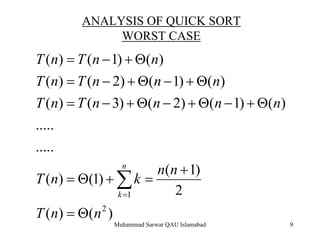
ANALYSIS OF QUICK SORT
WORST CASE
)()(
2
)1(
)1()(
.....
.....
)()1()2()3()(
)()1()2()(
)()1()(
2
1
nnT
nn
knT
nnnnTnT
nnnTnT
nnTnT
n
k
Θ=
+
=+Θ=
Θ+−Θ+−Θ+−=
Θ+−Θ+−=
Θ+−=
∑=
Muhammad Sarwar QAU Islamabad 10
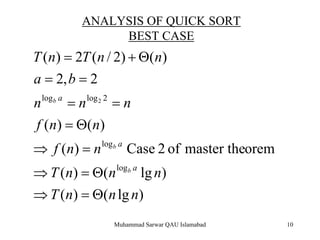
ANALYSIS OF QUICK SORT
BEST CASE
)lg()(
)lg()(
oremmaster theof2Case)(
)()(
2,2
)()2/(2)(
log
log
2loglog 2
nnnT
nnnT
nnf
nnf
nnn
ba
nnTnT
a
a
a
b
b
b
Θ=⇒
Θ=⇒
=⇒
Θ=
==
==
Θ+=
Muhammad Sarwar QAU Islamabad 11
QUICK SORT
• What value of q does PARTITION
return when all elements in the array
A[p…r] have the same value?
• q = ⎣(p+r)/2⎦
Muhammad Sarwar QAU Islamabad 12
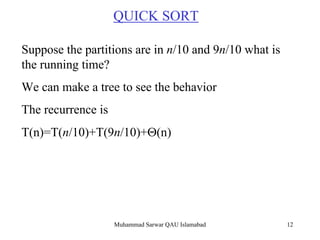
QUICK SORT
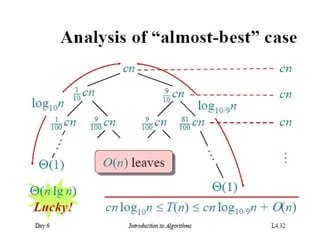
Suppose the partitions are in n/10 and 9n/10 what is
the running time?
We can make a tree to see the behavior
The recurrence is
T(n)=T(n/10)+T(9n/10)+Θ(n)
Muhammad Sarwar QAU Islamabad 13
Muhammad Sarwar QAU Islamabad 14
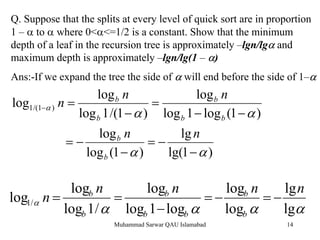
Q. Suppose that the splits at every level of quick sort are in proportion
1 – α to α where 0<α<=1/2 is a constant. Show that the minimum
depth of a leaf in the recursion tree is approximately –lgn/lgα and
maximum depth is approximately –lgn/lg(1 – α)
Ans:-If we expand the tree the side of α will end before the side of 1–α
)1lg(
lg
)1(log
log
)1(log1log
log
)1/(1log
log
log )1/(1
αα
αα
α
−
−=
−
−=
−−
=
−
=−
nn
nn
n
b
b
bb
b
b
b
αααα
α
lg
lg
log
log
log1log
log
/1log
log
log /1
nnnn
n
b
b
bb
b
b
b
−=−=
−
==

Quick sort algo analysis

  • 1.
    Muhammad Sarwar QAUIslamabad 1 QUICK SORT QUICKSORT (A, p, r) 1. if p < r 2. then q ← PARTITION(A, p, r) 3. QUICKSORT(A,p, q-1 ) 4. QUICKSORT(A,q+1,r )
  • 2.
    Muhammad Sarwar QAUIslamabad 2 PARTITION PARTITION(A, p, r) 1. x←A[r] 2. i ← p-1 3. for j←p to r-1 4. if A[j]≤x then 5. i←i+1 6. exchange A[i]↔a[j] 7. exchange A[i+1]↔A[r] 8. return i+1
  • 3.
    Muhammad Sarwar QAUIslamabad 3 QUICK SORT 668822996040907755113344 668844996040907755113322 668855996040907744113322 668855996044907740113322 668855996077904440113322 668855996077904440113322
  • 4.
    Muhammad Sarwar QAUIslamabad 4 PARTITION PARTITION (A, p, r) 1. x←A[p], i ←p-1, j ←r+1 2. while TRUE 3. do repeat j ←j - 1 4. until A[j]≤ x 5. repeat i ←i+1 6. until A[i]≥ x 7. if i<j 8. then exchange A[i]↔A[j] 9. else return j
  • 5.
    Muhammad Sarwar QAUIslamabad 5 PARTITION PARTITION (A, p, r) 1. x←A[p], i ←p-1, j ←r+1 2. while TRUE 3. do repeat j ←j - 1 4. until A[j]≤ x 5. repeat i ←i+1 6. until A[i]≥ x 7. if i<j 8. then exchange A[i]↔A[j] 9. else return j
  • 6.
    Muhammad Sarwar QAUIslamabad 6 PARTITION 1. left←beg, right ← end, loc ← beg 2. [SCAN FROM RIGHT TO LEFT] a) repeat while a [loc]<=a [right] & loc!=right right ← right-1 b) if loc=right then return loc c) if A [loc]>A [right] then i. interchange A [loc] & A [right] ii. loc ← right go to step 3 3. [SCAN FROM LEFT TO RIGHT] a) repeat while A [left]<=A [loc] & left!=loc left ← left+1 b) if loc=left then return loc c) if A [left]>A [loc] then i. interchange A [left] & A [loc] ii. loc ← left, go to step 2
  • 7.
    Muhammad Sarwar QAUIslamabad 7 ANALYSIS OF QUICK SORT • Running time of quick sort depends on whether the partitioning is balanced or unbalanced • The balancing of partition depends on which elements are used • If partitioning is balanced the running time of quick sort is as fast as merge sort • If partitioning is unbalanced the algorithm runs as slow as insertion sort • In worst case the partitions have size 1 & n-1 • In best case the partitions have size n/2
  • 8.
  • 9.
    Muhammad Sarwar QAUIslamabad 9 ANALYSIS OF QUICK SORT WORST CASE )()( 2 )1( )1()( ..... ..... )()1()2()3()( )()1()2()( )()1()( 2 1 nnT nn knT nnnnTnT nnnTnT nnTnT n k Θ= + =+Θ= Θ+−Θ+−Θ+−= Θ+−Θ+−= Θ+−= ∑=
  • 10.
    Muhammad Sarwar QAUIslamabad 10 ANALYSIS OF QUICK SORT BEST CASE )lg()( )lg()( oremmaster theof2Case)( )()( 2,2 )()2/(2)( log log 2loglog 2 nnnT nnnT nnf nnf nnn ba nnTnT a a a b b b Θ=⇒ Θ=⇒ =⇒ Θ= == == Θ+=
  • 11.
    Muhammad Sarwar QAUIslamabad 11 QUICK SORT • What value of q does PARTITION return when all elements in the array A[p…r] have the same value? • q = ⎣(p+r)/2⎦
  • 12.
    Muhammad Sarwar QAUIslamabad 12 QUICK SORT Suppose the partitions are in n/10 and 9n/10 what is the running time? We can make a tree to see the behavior The recurrence is T(n)=T(n/10)+T(9n/10)+Θ(n)
  • 13.
    Muhammad Sarwar QAUIslamabad 13
  • 14.
    Muhammad Sarwar QAUIslamabad 14 Q. Suppose that the splits at every level of quick sort are in proportion 1 – α to α where 0<α<=1/2 is a constant. Show that the minimum depth of a leaf in the recursion tree is approximately –lgn/lgα and maximum depth is approximately –lgn/lg(1 – α) Ans:-If we expand the tree the side of α will end before the side of 1–α )1lg( lg )1(log log )1(log1log log )1/(1log log log )1/(1 αα αα α − −= − −= −− = − =− nn nn n b b bb b b b αααα α lg lg log log log1log log /1log log log /1 nnnn n b b bb b b b −=−= − ==