Matching Techniques
Submitted To: Submitted by:
MS.Rupneet Kaur Kirti Nagpal
(17071313)
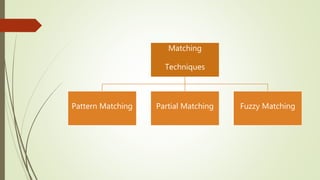
Matching
Techniques
Pattern Matching Partial Matching Fuzzy Matching
Pattern Matching :
 The match will be accomplished by comparing the the two
structures and testing for equality among the corresponding
parts.
 Pattern matching is used to find the pattern p is present to
given string or not.
 Pattern matching using the Matching Substring:
 Matching Substring:
 Many of the representation structures are just character
strings, a basic function required in many match algorithm is
that a substring s2 consisting of m characters . Where as
string s1 of n characters where m<=n.
 Approach to solving pattern matching:
 A direct approach to solving this problem is to compare the
two stings character by character , starting with the first
character of both s1 and s2.
 If any two characters disagree then process is repeated and
starting with the second character of s1 and matching again
against s2 character by character until a match found or
disagreement occurs.
 This process continues until a Match occurs or s1 has no more
characters.
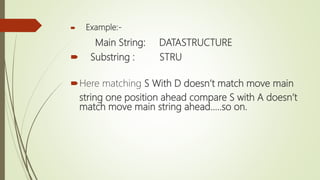
 Example:-
Main String: DATASTRUCTURE
 Substring : STRU
Here matching S With D doesn’t match move main
string one position ahead compare S with A doesn’t
match move main string ahead…..so on.
 Partial Matching :
 For many AI applications complete matching between two or
more structures is inappropriate.
 In partial matching meaning is same but terminology is
different.
 For eg. Input representation of speech waveforms or visual
scenes may have been corrupted by the noise or other
unwanted distortions.
 Partial matching may require finding a match between
key elements.
 Eg. Of partial Matching:
 “I prefer low –calorie choice”.
 “I want the low-calorie Item”.
 “The low –calorie one please”
In above all statements meaning same but terminology different.


Matching techniques

  • 1.
    Matching Techniques Submitted To:Submitted by: MS.Rupneet Kaur Kirti Nagpal (17071313)
  • 2.
  • 3.
    Pattern Matching : The match will be accomplished by comparing the the two structures and testing for equality among the corresponding parts.  Pattern matching is used to find the pattern p is present to given string or not.  Pattern matching using the Matching Substring:  Matching Substring:  Many of the representation structures are just character strings, a basic function required in many match algorithm is that a substring s2 consisting of m characters . Where as string s1 of n characters where m<=n.
  • 4.
     Approach tosolving pattern matching:  A direct approach to solving this problem is to compare the two stings character by character , starting with the first character of both s1 and s2.  If any two characters disagree then process is repeated and starting with the second character of s1 and matching again against s2 character by character until a match found or disagreement occurs.  This process continues until a Match occurs or s1 has no more characters.
  • 5.
     Example:- Main String:DATASTRUCTURE  Substring : STRU Here matching S With D doesn’t match move main string one position ahead compare S with A doesn’t match move main string ahead…..so on.
  • 6.
     Partial Matching:  For many AI applications complete matching between two or more structures is inappropriate.  In partial matching meaning is same but terminology is different.  For eg. Input representation of speech waveforms or visual scenes may have been corrupted by the noise or other unwanted distortions.  Partial matching may require finding a match between key elements.
  • 7.
     Eg. Ofpartial Matching:  “I prefer low –calorie choice”.  “I want the low-calorie Item”.  “The low –calorie one please” In above all statements meaning same but terminology different.
  • 8.