Chapter 2
The Relational Database
Model
2
Logical View of Data
Relational Database
Designer focuses on logical representation
rather than physical
Use of table advantageous
Structural and data independence
Related records stored in independent tables
Logical simplicity
Allows for more effective design strategies
3
Logical View of Data (con’t.)
Entities and Attributes
Entity is a person, place, event, or thing about
which data is collected
Attributes are characteristics of the entity
Tables
Holds related entities or entity set
Also called relations
Comprised of rows and columns
4
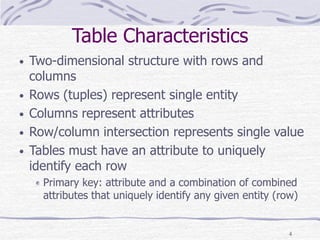
Table Characteristics
• Two-dimensional structure with rows and
columns
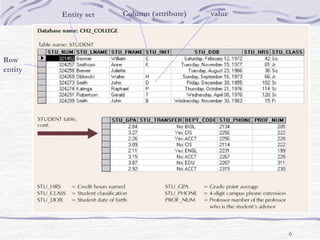
• Rows (tuples) represent single entity
• Columns represent attributes
• Row/column intersection represents single value
• Tables must have an attribute to uniquely
identify each row
Primary key: attribute and a combination of combined
attributes that uniquely identify any given entity (row)
5
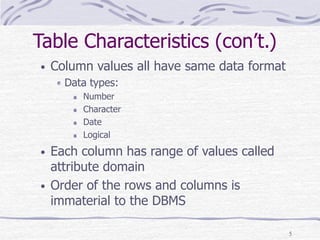
Table Characteristics (con’t.)
• Column values all have same data format
Data types:
Number
Character
Date
Logical
• Each column has range of values called
attribute domain
• Order of the rows and columns is
immaterial to the DBMS
6
Row
entity
Column (attribute)Entity set value
7
8
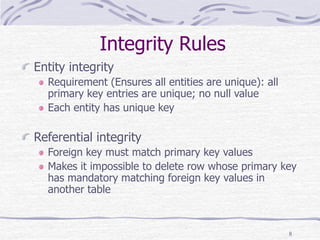
Integrity Rules
Entity integrity
Requirement (Ensures all entities are unique): all
primary key entries are unique; no null value
Each entity has unique key
Referential integrity
Foreign key must match primary key values
Makes it impossible to delete row whose primary key
has mandatory matching foreign key values in
another table
9
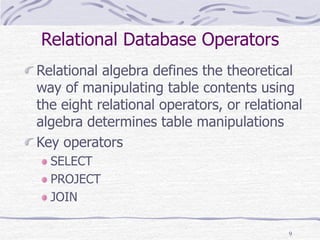
Relational Database Operators
Relational algebra defines the theoretical
way of manipulating table contents using
the eight relational operators, or relational
algebra determines table manipulations
Key operators
SELECT
PROJECT
JOIN
10
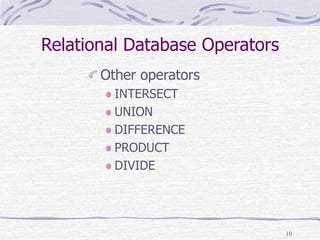
Relational Database Operators
Other operators
INTERSECT
UNION
DIFFERENCE
PRODUCT
DIVIDE
11
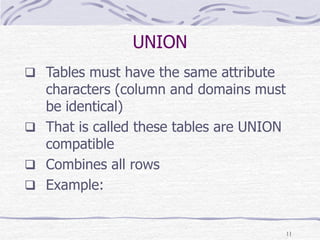
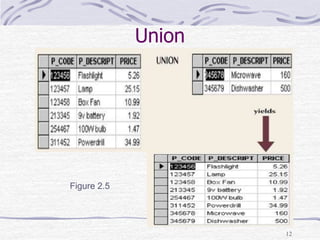
UNION
 Tables must have the same attribute
characters (column and domains must
be identical)
 That is called these tables are UNION
compatible
 Combines all rows
 Example:
12
Union
Figure 2.5
13
Intersect
 Tables must be UNION compatible
 Yield rows appear in both tables
 Example:
14
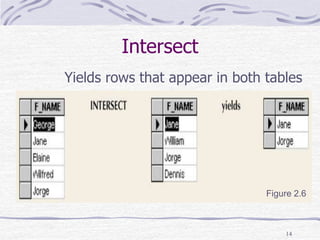
Yields rows that appear in both tables
Intersect
Figure 2.6
15
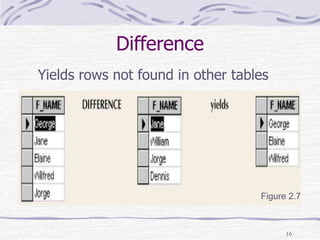
Difference
 Tables must be UNION compatible
 Find rows in table that are not
found in the other table.
 Example:
16
Yields rows not found in other tables
Difference
Figure 2.7
17
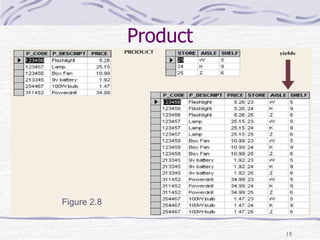
Product
 Yields all possible pairs of rows
from two tables
 Example:
18
Product
Figure 2.8
19
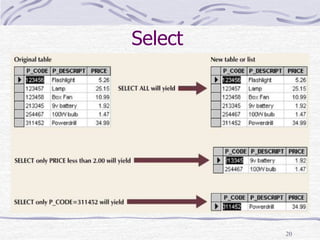
Select
 Yields values for all rows found in
a table.
 Select can be used to either list all
or list partial rows values that
match a specified criterion.
 Example:
20
Select
21
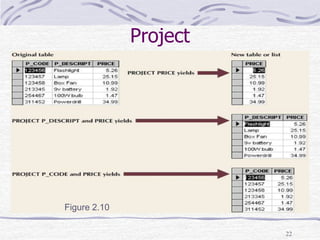
Project
 Project yields a vertical subset of
a table with selected attributes
 Example:
22
Project
Figure 2.10
23
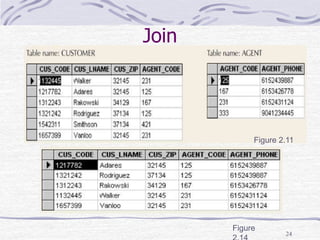
Join
 Combine information from multiple
tables
 Natural join process
 Product
 Select
 Project
 Example:
24
Join
Figure 2.11
Figure
25
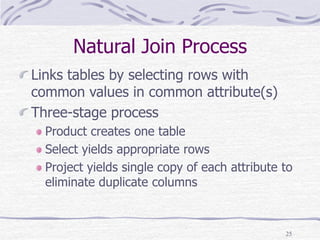
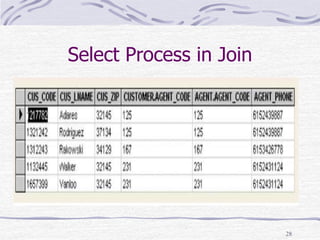
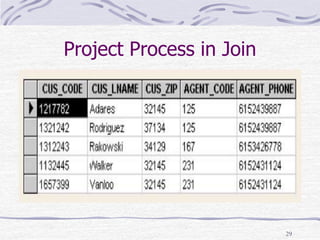
Links tables by selecting rows with
common values in common attribute(s)
Three-stage process
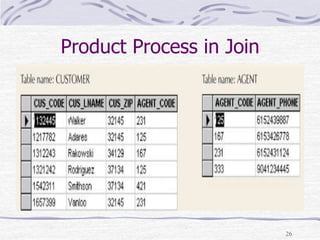
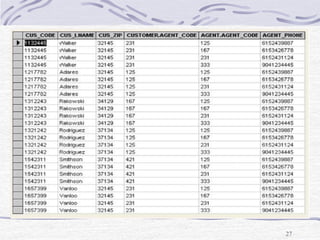
Product creates one table
Select yields appropriate rows
Project yields single copy of each attribute to
eliminate duplicate columns
Natural Join Process
26
Product Process in Join
27
28
Select Process in Join
29
Project Process in Join
30
Other Joins
EquiJOIN
Links tables based on equality condition that
compares specified columns of tables
Does not eliminate duplicate columns
Join criteria must be explicitly defined
31
Other Joins
EquiJOIN that compares specified columns
of each table using operator other than
equality one
Theta JOIN
Any other comparison operator is used, it is
generally called a theta JOIN
32
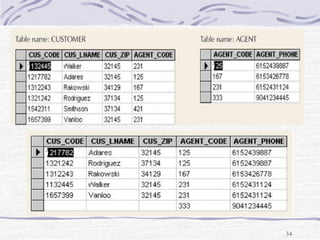
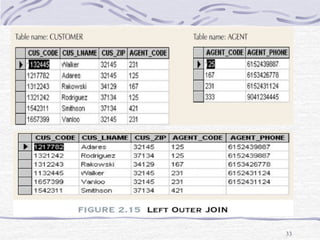
Other Joins
Outer JOIN
Matched pairs are retained
Unmatched values in other tables left null
Right and left outer JOIN
Example:
33
34
35
Divide
 Use of one single-column table
and one two-column table
 Find the values associate with A
and B Table
 Example:
36
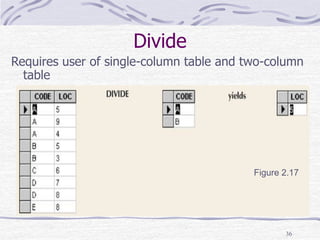
Requires user of single-column table and two-column
table
Divide
Figure 2.17
37
Data Dictionary and System Catalog
Data dictionary
Provides detailed account of all tables found within database
Metadata
Attribute names and characteristics
All members of database design and implementation teams use
the same table, attributes and characteristics
DBMS internally store data dictionary and additional information
containing relationship types, entity and
referential integrity check and enforcement.
Database designer’s database
System catalog
Detailed data dictionary; current relational database software
provides only a system catalog
Data dictionary can be derived from
Stores database characteristics and contents

The relational database model chapter 2

  • 1.
  • 2.
    2 Logical View ofData Relational Database Designer focuses on logical representation rather than physical Use of table advantageous Structural and data independence Related records stored in independent tables Logical simplicity Allows for more effective design strategies
  • 3.
    3 Logical View ofData (con’t.) Entities and Attributes Entity is a person, place, event, or thing about which data is collected Attributes are characteristics of the entity Tables Holds related entities or entity set Also called relations Comprised of rows and columns
  • 4.
    4 Table Characteristics • Two-dimensionalstructure with rows and columns • Rows (tuples) represent single entity • Columns represent attributes • Row/column intersection represents single value • Tables must have an attribute to uniquely identify each row Primary key: attribute and a combination of combined attributes that uniquely identify any given entity (row)
  • 5.
    5 Table Characteristics (con’t.) •Column values all have same data format Data types: Number Character Date Logical • Each column has range of values called attribute domain • Order of the rows and columns is immaterial to the DBMS
  • 6.
  • 7.
  • 8.
    8 Integrity Rules Entity integrity Requirement(Ensures all entities are unique): all primary key entries are unique; no null value Each entity has unique key Referential integrity Foreign key must match primary key values Makes it impossible to delete row whose primary key has mandatory matching foreign key values in another table
  • 9.
    9 Relational Database Operators Relationalalgebra defines the theoretical way of manipulating table contents using the eight relational operators, or relational algebra determines table manipulations Key operators SELECT PROJECT JOIN
  • 10.
    10 Relational Database Operators Otheroperators INTERSECT UNION DIFFERENCE PRODUCT DIVIDE
  • 11.
    11 UNION  Tables musthave the same attribute characters (column and domains must be identical)  That is called these tables are UNION compatible  Combines all rows  Example:
  • 12.
  • 13.
    13 Intersect  Tables mustbe UNION compatible  Yield rows appear in both tables  Example:
  • 14.
    14 Yields rows thatappear in both tables Intersect Figure 2.6
  • 15.
    15 Difference  Tables mustbe UNION compatible  Find rows in table that are not found in the other table.  Example:
  • 16.
    16 Yields rows notfound in other tables Difference Figure 2.7
  • 17.
    17 Product  Yields allpossible pairs of rows from two tables  Example:
  • 18.
  • 19.
    19 Select  Yields valuesfor all rows found in a table.  Select can be used to either list all or list partial rows values that match a specified criterion.  Example:
  • 20.
  • 21.
    21 Project  Project yieldsa vertical subset of a table with selected attributes  Example:
  • 22.
  • 23.
    23 Join  Combine informationfrom multiple tables  Natural join process  Product  Select  Project  Example:
  • 24.
  • 25.
    25 Links tables byselecting rows with common values in common attribute(s) Three-stage process Product creates one table Select yields appropriate rows Project yields single copy of each attribute to eliminate duplicate columns Natural Join Process
  • 26.
  • 27.
  • 28.
  • 29.
  • 30.
    30 Other Joins EquiJOIN Links tablesbased on equality condition that compares specified columns of tables Does not eliminate duplicate columns Join criteria must be explicitly defined
  • 31.
    31 Other Joins EquiJOIN thatcompares specified columns of each table using operator other than equality one Theta JOIN Any other comparison operator is used, it is generally called a theta JOIN
  • 32.
    32 Other Joins Outer JOIN Matchedpairs are retained Unmatched values in other tables left null Right and left outer JOIN Example:
  • 33.
  • 34.
  • 35.
    35 Divide  Use ofone single-column table and one two-column table  Find the values associate with A and B Table  Example:
  • 36.
    36 Requires user ofsingle-column table and two-column table Divide Figure 2.17
  • 37.
    37 Data Dictionary andSystem Catalog Data dictionary Provides detailed account of all tables found within database Metadata Attribute names and characteristics All members of database design and implementation teams use the same table, attributes and characteristics DBMS internally store data dictionary and additional information containing relationship types, entity and referential integrity check and enforcement. Database designer’s database System catalog Detailed data dictionary; current relational database software provides only a system catalog Data dictionary can be derived from Stores database characteristics and contents