*Corresponding Author: B.Usharani, Email: ushareddy.vja@gmail.com
RESEARCH ARTICLE
www.ajcse.info
Asian Journal of Computer Science Engineering2017; 2(4):17-21
Implementation of Lossless Compression Algorithms for Text Data
*B. Usharani
*Assistant Professor, Department of Computer Science and Engineering, KLEF, Andhra Pradesh, India.
Received on: 05/05/2017, Revised on: 25/07/2017, Accepted on: 10/08/2017
ABSTRACT
Compression is useful to reduce the number of bits needed to represent to data. Compressing saves speed
file transfer, and decrease costs for storage hardware and network bandwidth. Compression is applied by
a program that uses a algorithm to determine how to shrink the size of data. There are number of data
compression techniques used and they can be categorized as Lossy and Lossless Compression methods.
This paper examines Huffman and arithmetic lossless data compression algorithms and compares their
performance. A set of selected algorithms are implemented to examine the performance in compressing
text data. An experimental comparison of a number of two lossless data compression algorithms i.e.
arithmetic and Huffman is implemented in this paper. In this paper, some of the Lossless data
compression methods and their performance are given.
Keywords: Arithmetic coding, Huffman Algorithm, , Lossless compression, Run length coding, Variable
length encoding etc.
INTRODUCTION
Data Compression means to reduce the number of
bits to store or to transmit. Data compression
techniques are of two types:
1. Lossless data compression-the original
data can be reconstructed exactly from the
compressed data
2. Lossy data compression--the original data
cannot be reconstructed exactly from the
compressed data.
With lossless data compression technique every
single bit of data is to be remained originally after
the decompression .But with lossy compression
technique the file is to be reduced permanently by
eliminating the redundant data.
Fig .1 Compression Procedures
To compress the data there is the need to encode
the data
The basic coding concepts are
1. Fixed length coding
2. variable length coding
In fixed length coding, same number of bits are
used to represent each character. In variable
length coding variable number of bits are used to
represent a character. To avoid ambiguity no code
word is a prefix of another code word. The
variable length coding has a uniquely decodable
code.
LOSSLESS COMPRESSION TECHNIQUES
ARITHMETIC CODING
Arithmetic coding is based on the frequency of
symbols, and the whole message is represented by
a fractional number between 0 and 1. As the
message size becomes larger, the interval in which
the number belongs becomes narrower.
Arithmetic coding Algorithm
The algorithm for encoding a file using this
method works conceptually as follows [1]
:
1. The “current interval” [L,H) is initialized
to [0,1).
2. For each symbol that has to be encoded, do
the following procedure:
 Subdivide the current interval into
subintervals, one for each possible
alphabet symbol. The size of a symbol's
subinterval is proportional to the estimated
probability that the symbol will be the next
symbol in the file according to the model
of the input.
Usharani et al.  Implementation of Lossless Compression Algorithms for Text Data
© 2015, AJCSE. All Rights Reserved. 18
 Select the subinterval corresponding to the
symbol that actually occurs next in the file,
and make it the new current interval.
3. Output enough bits to distinguish the final
current interval from all other possible
final intervals.
Ex: COLLEGE
Table 1.Characters and corresponding frequencies
Arithmetic coding completely bypasses the idea of
replacing an input symbol with a specific code.
Instead, it takes a stream of input symbols and
replaces it with a single floating point number in
[0,1).
In arithmetic coding, a unique identifier or tag is
generated for the sequence to be encoded.
This tag corresponds to a binary fraction, which
becomes the binary code for the sequence.
We conceptually divide the approach into two
phases.
In the first phase, a unique identifier or tag is
generated for a given sequence of symbols.
This tag is then given a unique binary code
A unique arithmetic code can be generated for a
sequence of length m without the need for
generating code words for all sequences of length
m.
HUFFMAN ALGORITHM
Huffman constructs a code tree from the bottom
up (builds the codes from the right to left).The
algorithm starts by building a list of all the
alphabet symbols in descending order of their
probabilities. It then constructs a tree, with a
symbol at every leaf node from the bottom up.
This is done in steps, where at each step the two
symbols with the smallest probabilities are
selected, added to the top the partial tree, deleted
from the list, and replaced with an auxiliary
symbol representing the two original symbols.
When the list is reduced to just one auxiliary
symbol, the tree is complete. The tree is then
traversed to determine the codes of the symbols
[6]
.
The codes generated using Huffman technique or
procedure is called Huffman codes. These codes
are prefix codes and are optimum for a given
model (set of probabilities). A code in which no
codeword is a prefix to another codeword is called
a prefix code. The Huffman procedure is based on
two observations regarding optimum prefix codes.
1. In an optimum code, symbols that occur
more frequently (have a higher probability
of occurrence) will have shorter code
words than symbols that occur less
frequently.
2. In an optimum code, the two symbols that
occur least frequently will have the same
length. The code words corresponding to
the two lowest probability symbols differ
only in the last bit. [7]
Though the codes are of different bit lengths, they
can be uniquely decoded. Developing codes that
vary in length according to the probability of the
symbol they are encoding makes data
compression possible. And arranging the codes as
a binary tree solves the problem of decoding these
variable-length codes.[8]
The algorithm for the Huffman coding is
Huffman Algorithm:
1. Create a leaf node for each symbol and
add it to the queue.
2. While there is more than one node in the
queue:
AJCSE,
July-Aug,
2017,
Vol.
2,
Issue
4
Usharani et al.  Implementation of Lossless Compression Algorithms for Text Data
© 2015, AJCSE. All Rights Reserved. 19
 Remove the two nodes of highest
priority (lowest probability) from
the queue
 Create a new internal node with
these two nodes as children and
with probability equal to the sum
of the two nodes' probabilities.
 Add the new node to the queue.
3. The remaining node is the root node and
the tree is complete
The technique works by creating a binary tree of
nodes. These can be stored in a regular array, the
size of which depends on the number of symbols,
n. A node can be either a leaf node or an internal
node. Initially, all nodes are leaf nodes, which
contain the symbol itself, the weight (frequency
of appearance) of the symbol and optionally, a
link to a parent node which makes it easy to read
the code (in reverse) starting from a leaf node.
Internal nodes contain symbol weight, links to
two child nodes and the optional link to a parent
node. As a common convention, bit '0' represents
following the left child and bit '1' represents
following the right child. A finished tree has up to
n leaf nodes and n-1 internal nodes. A Huffman
tree that omits unused symbols produces the most
optimal code lengths [9].
Huffman coding is a variable length lossless
compression coding technique. Huffman
compression uses smaller codes for more
frequently occurring characters and larger codes
for less frequently occurring characters.
Fig 3: Characters and corresponding frequencies
The characters are arranged according to their
frequencies (in descending order).We start by
choosing the two smallest nodes There are three
nodes with the minimal weight of one. We choose
'G' and 'O' and combine them into a new tree
whose root is the sum of the weights chosen. We
replace those two nodes with the combined tree.
Fig 4: Combining the least two frequencies (G and o) as a
single node
Repeat that step, choose the next two minimal
nodes, it must be ‘C’ and the combined tree of ‘G’
and ‘O’. The collection of nodes shrinks by one
each iteration .we remove two nodes and adds a
new one back in.
Fig 5: Combining the least two frequencies(c and combined
tree of G and o) as a single node
Again, we pull out the two smallest nodes and
build a tree of weight 4(i.e. ‘E’ & ‘L’):
Fig 6: Combining the least two frequencies (E and L) as a
single node
Finally, we combine the last two to get the final
tree. The root node of the final tree will always
have a weight equal to the number of characters in
the input file.
Fig 7: Final Huffman tree
The Huffman tree after assigning 0 to the left
child and 1 to the right child will be seen as
Fig 8 Huffman Tree with 0‘s and 1‘s
Table 2: Characters and their corresponding ASCII code and
variable length code
AJCSE,
July-Aug,
2017,
Vol.
2,
Issue
4
Usharani et al.  Implementation of Lossless Compression Algorithms for Text Data
© 2015, AJCSE. All Rights Reserved. 20
RUN LENGTH CODING
RLE works by reducing the physical size of a
repeating string of characters. This repeating
string, called a run, is typically encoded into two
bytes. The first byte represents the number of
characters in the run and is called the run count. In
practice, an encoded run may contain 1 to 128 or
256 characters; the run count usually contains as
the number of characters minus one (a value in the
range of 0 to 127 or 255). The second byte is the
value of the character in the run, which is in the
range of 0 to 255, and is called the run value.
Uncompressed, a character run of 15 U characters
would normally require 15 bytes to store:
UUUUUUUUUUUUUUU
The same string after RLE encoding would
require only two bytes:
15U
The 15U code generated to represent the character
string is called an RLE packet. Here, the first byte,
15, is the run count and contains the number of
repetitions. The second byte, U, is the run value
and contains the actual repeated value in the run.
In the worst case situations the compressed files
are larger than original files. Uncompressed 12
characters are:
abcdefghijkl
The same string after RLE encoding would
require24 characters space
a1b1c1d1e1f1g1h1i1j1k1l1
RLE is usually applied to the files that contain
large number of consecutive occurrences of the
same data.
Run length Coding Algorithm
1. Pick the first character from source
string.
2. Append the picked character to the
destination string.
3. Count the number of subsequent
occurrences of the picked character
and append the count to destination
string.
4. Pick the next character and repeat steps
b) c) and d) if end of string is NOT
reached
E.g. For the word “COLLEGE “the RLE stored
asC1E2G1L2O1.
Run Length Coding Disadvantages
1. Compression ratio is low as compared to
other algorithms
2. In the worst case the size of output data
can be two times more than the size of
input data.
3. Compression efficiency restricted to a
particular type of content
4. Mainly utilized for encoding of
monochrome graphic data
5. RLE compression is only efficient with
files that contain lots of repetitive data
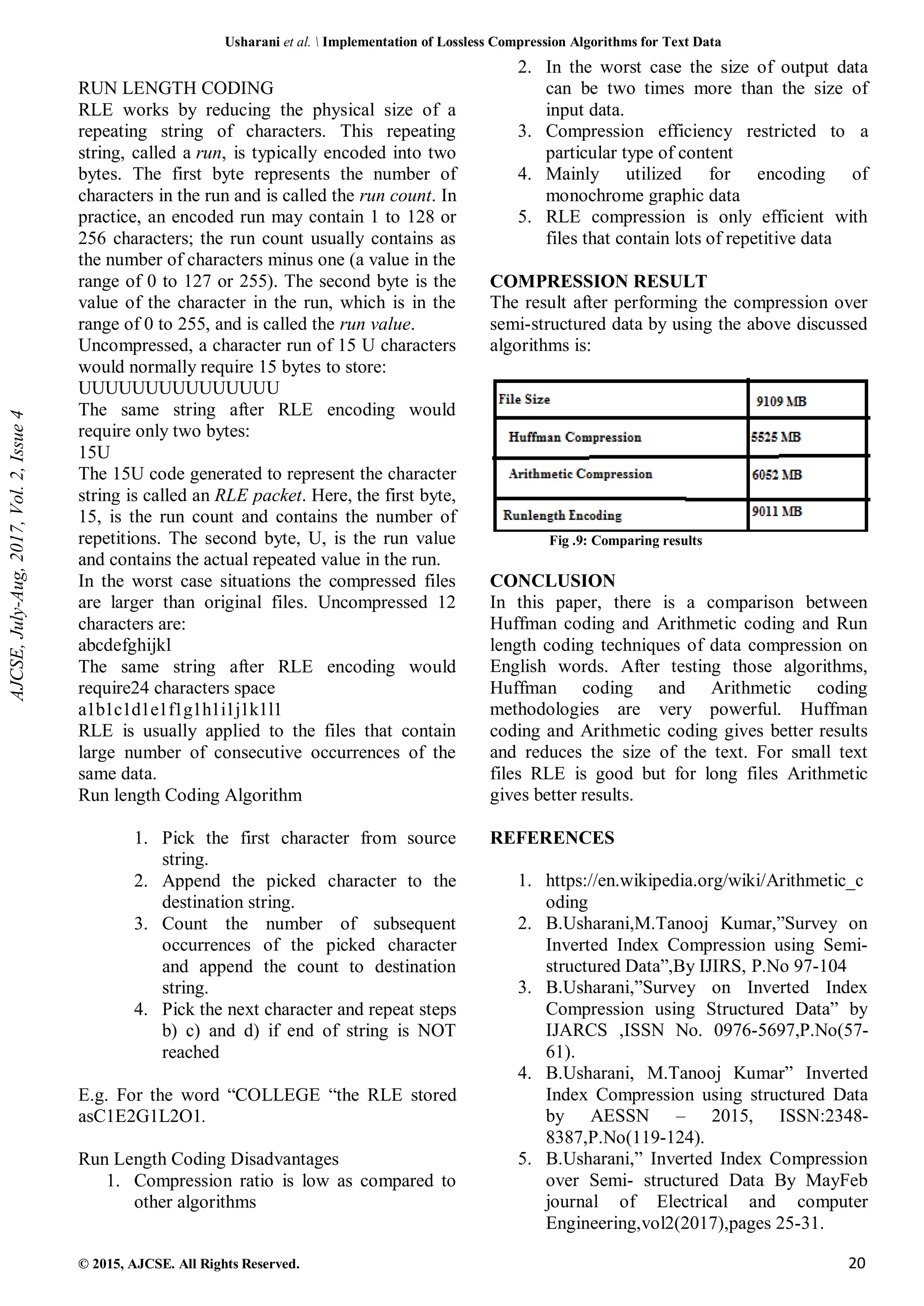
COMPRESSION RESULT
The result after performing the compression over
semi-structured data by using the above discussed
algorithms is:
Fig .9: Comparing results
CONCLUSION
In this paper, there is a comparison between
Huffman coding and Arithmetic coding and Run
length coding techniques of data compression on
English words. After testing those algorithms,
Huffman coding and Arithmetic coding
methodologies are very powerful. Huffman
coding and Arithmetic coding gives better results
and reduces the size of the text. For small text
files RLE is good but for long files Arithmetic
gives better results.
REFERENCES
1. https://en.wikipedia.org/wiki/Arithmetic_c
oding
2. B.Usharani,M.Tanooj Kumar,”Survey on
Inverted Index Compression using Semi-
structured Data”,By IJIRS, P.No 97-104
3. B.Usharani,”Survey on Inverted Index
Compression using Structured Data” by
IJARCS ,ISSN No. 0976-5697,P.No(57-
61).
4. B.Usharani, M.Tanooj Kumar” Inverted
Index Compression using structured Data
by AESSN – 2015, ISSN:2348-
8387,P.No(119-124).
5. B.Usharani,” Inverted Index Compression
over Semi- structured Data By MayFeb
journal of Electrical and computer
Engineering,vol2(2017),pages 25-31.
AJCSE,
July-Aug,
2017,
Vol.
2,
Issue
4
Usharani et al.  Implementation of Lossless Compression Algorithms for Text Data
© 2015, AJCSE. All Rights Reserved. 21
6. David Solomon ―,Data compression, The
completeReference‖, Fourth edition,
Springer
Khalidsayood,‖ Introduction to data
compression‖,Third edition
M.Nelson,J.L.Gailly,‖ The Data
CompressionBook‖, second edition
7. http://en.wikipedia.org/wiki/Huffman_codi
ng
AJCSE,
July-Aug,
2017,
Vol.
2,
Issue
4

Implementation of Lossless Compression Algorithms for Text Data

  • 1.
    *Corresponding Author: B.Usharani,Email: ushareddy.vja@gmail.com RESEARCH ARTICLE www.ajcse.info Asian Journal of Computer Science Engineering2017; 2(4):17-21 Implementation of Lossless Compression Algorithms for Text Data *B. Usharani *Assistant Professor, Department of Computer Science and Engineering, KLEF, Andhra Pradesh, India. Received on: 05/05/2017, Revised on: 25/07/2017, Accepted on: 10/08/2017 ABSTRACT Compression is useful to reduce the number of bits needed to represent to data. Compressing saves speed file transfer, and decrease costs for storage hardware and network bandwidth. Compression is applied by a program that uses a algorithm to determine how to shrink the size of data. There are number of data compression techniques used and they can be categorized as Lossy and Lossless Compression methods. This paper examines Huffman and arithmetic lossless data compression algorithms and compares their performance. A set of selected algorithms are implemented to examine the performance in compressing text data. An experimental comparison of a number of two lossless data compression algorithms i.e. arithmetic and Huffman is implemented in this paper. In this paper, some of the Lossless data compression methods and their performance are given. Keywords: Arithmetic coding, Huffman Algorithm, , Lossless compression, Run length coding, Variable length encoding etc. INTRODUCTION Data Compression means to reduce the number of bits to store or to transmit. Data compression techniques are of two types: 1. Lossless data compression-the original data can be reconstructed exactly from the compressed data 2. Lossy data compression--the original data cannot be reconstructed exactly from the compressed data. With lossless data compression technique every single bit of data is to be remained originally after the decompression .But with lossy compression technique the file is to be reduced permanently by eliminating the redundant data. Fig .1 Compression Procedures To compress the data there is the need to encode the data The basic coding concepts are 1. Fixed length coding 2. variable length coding In fixed length coding, same number of bits are used to represent each character. In variable length coding variable number of bits are used to represent a character. To avoid ambiguity no code word is a prefix of another code word. The variable length coding has a uniquely decodable code. LOSSLESS COMPRESSION TECHNIQUES ARITHMETIC CODING Arithmetic coding is based on the frequency of symbols, and the whole message is represented by a fractional number between 0 and 1. As the message size becomes larger, the interval in which the number belongs becomes narrower. Arithmetic coding Algorithm The algorithm for encoding a file using this method works conceptually as follows [1] : 1. The “current interval” [L,H) is initialized to [0,1). 2. For each symbol that has to be encoded, do the following procedure:  Subdivide the current interval into subintervals, one for each possible alphabet symbol. The size of a symbol's subinterval is proportional to the estimated probability that the symbol will be the next symbol in the file according to the model of the input.
  • 2.
    Usharani et al. Implementation of Lossless Compression Algorithms for Text Data © 2015, AJCSE. All Rights Reserved. 18  Select the subinterval corresponding to the symbol that actually occurs next in the file, and make it the new current interval. 3. Output enough bits to distinguish the final current interval from all other possible final intervals. Ex: COLLEGE Table 1.Characters and corresponding frequencies Arithmetic coding completely bypasses the idea of replacing an input symbol with a specific code. Instead, it takes a stream of input symbols and replaces it with a single floating point number in [0,1). In arithmetic coding, a unique identifier or tag is generated for the sequence to be encoded. This tag corresponds to a binary fraction, which becomes the binary code for the sequence. We conceptually divide the approach into two phases. In the first phase, a unique identifier or tag is generated for a given sequence of symbols. This tag is then given a unique binary code A unique arithmetic code can be generated for a sequence of length m without the need for generating code words for all sequences of length m. HUFFMAN ALGORITHM Huffman constructs a code tree from the bottom up (builds the codes from the right to left).The algorithm starts by building a list of all the alphabet symbols in descending order of their probabilities. It then constructs a tree, with a symbol at every leaf node from the bottom up. This is done in steps, where at each step the two symbols with the smallest probabilities are selected, added to the top the partial tree, deleted from the list, and replaced with an auxiliary symbol representing the two original symbols. When the list is reduced to just one auxiliary symbol, the tree is complete. The tree is then traversed to determine the codes of the symbols [6] . The codes generated using Huffman technique or procedure is called Huffman codes. These codes are prefix codes and are optimum for a given model (set of probabilities). A code in which no codeword is a prefix to another codeword is called a prefix code. The Huffman procedure is based on two observations regarding optimum prefix codes. 1. In an optimum code, symbols that occur more frequently (have a higher probability of occurrence) will have shorter code words than symbols that occur less frequently. 2. In an optimum code, the two symbols that occur least frequently will have the same length. The code words corresponding to the two lowest probability symbols differ only in the last bit. [7] Though the codes are of different bit lengths, they can be uniquely decoded. Developing codes that vary in length according to the probability of the symbol they are encoding makes data compression possible. And arranging the codes as a binary tree solves the problem of decoding these variable-length codes.[8] The algorithm for the Huffman coding is Huffman Algorithm: 1. Create a leaf node for each symbol and add it to the queue. 2. While there is more than one node in the queue: AJCSE, July-Aug, 2017, Vol. 2, Issue 4
  • 3.
    Usharani et al. Implementation of Lossless Compression Algorithms for Text Data © 2015, AJCSE. All Rights Reserved. 19  Remove the two nodes of highest priority (lowest probability) from the queue  Create a new internal node with these two nodes as children and with probability equal to the sum of the two nodes' probabilities.  Add the new node to the queue. 3. The remaining node is the root node and the tree is complete The technique works by creating a binary tree of nodes. These can be stored in a regular array, the size of which depends on the number of symbols, n. A node can be either a leaf node or an internal node. Initially, all nodes are leaf nodes, which contain the symbol itself, the weight (frequency of appearance) of the symbol and optionally, a link to a parent node which makes it easy to read the code (in reverse) starting from a leaf node. Internal nodes contain symbol weight, links to two child nodes and the optional link to a parent node. As a common convention, bit '0' represents following the left child and bit '1' represents following the right child. A finished tree has up to n leaf nodes and n-1 internal nodes. A Huffman tree that omits unused symbols produces the most optimal code lengths [9]. Huffman coding is a variable length lossless compression coding technique. Huffman compression uses smaller codes for more frequently occurring characters and larger codes for less frequently occurring characters. Fig 3: Characters and corresponding frequencies The characters are arranged according to their frequencies (in descending order).We start by choosing the two smallest nodes There are three nodes with the minimal weight of one. We choose 'G' and 'O' and combine them into a new tree whose root is the sum of the weights chosen. We replace those two nodes with the combined tree. Fig 4: Combining the least two frequencies (G and o) as a single node Repeat that step, choose the next two minimal nodes, it must be ‘C’ and the combined tree of ‘G’ and ‘O’. The collection of nodes shrinks by one each iteration .we remove two nodes and adds a new one back in. Fig 5: Combining the least two frequencies(c and combined tree of G and o) as a single node Again, we pull out the two smallest nodes and build a tree of weight 4(i.e. ‘E’ & ‘L’): Fig 6: Combining the least two frequencies (E and L) as a single node Finally, we combine the last two to get the final tree. The root node of the final tree will always have a weight equal to the number of characters in the input file. Fig 7: Final Huffman tree The Huffman tree after assigning 0 to the left child and 1 to the right child will be seen as Fig 8 Huffman Tree with 0‘s and 1‘s Table 2: Characters and their corresponding ASCII code and variable length code AJCSE, July-Aug, 2017, Vol. 2, Issue 4
  • 4.
    Usharani et al. Implementation of Lossless Compression Algorithms for Text Data © 2015, AJCSE. All Rights Reserved. 20 RUN LENGTH CODING RLE works by reducing the physical size of a repeating string of characters. This repeating string, called a run, is typically encoded into two bytes. The first byte represents the number of characters in the run and is called the run count. In practice, an encoded run may contain 1 to 128 or 256 characters; the run count usually contains as the number of characters minus one (a value in the range of 0 to 127 or 255). The second byte is the value of the character in the run, which is in the range of 0 to 255, and is called the run value. Uncompressed, a character run of 15 U characters would normally require 15 bytes to store: UUUUUUUUUUUUUUU The same string after RLE encoding would require only two bytes: 15U The 15U code generated to represent the character string is called an RLE packet. Here, the first byte, 15, is the run count and contains the number of repetitions. The second byte, U, is the run value and contains the actual repeated value in the run. In the worst case situations the compressed files are larger than original files. Uncompressed 12 characters are: abcdefghijkl The same string after RLE encoding would require24 characters space a1b1c1d1e1f1g1h1i1j1k1l1 RLE is usually applied to the files that contain large number of consecutive occurrences of the same data. Run length Coding Algorithm 1. Pick the first character from source string. 2. Append the picked character to the destination string. 3. Count the number of subsequent occurrences of the picked character and append the count to destination string. 4. Pick the next character and repeat steps b) c) and d) if end of string is NOT reached E.g. For the word “COLLEGE “the RLE stored asC1E2G1L2O1. Run Length Coding Disadvantages 1. Compression ratio is low as compared to other algorithms 2. In the worst case the size of output data can be two times more than the size of input data. 3. Compression efficiency restricted to a particular type of content 4. Mainly utilized for encoding of monochrome graphic data 5. RLE compression is only efficient with files that contain lots of repetitive data COMPRESSION RESULT The result after performing the compression over semi-structured data by using the above discussed algorithms is: Fig .9: Comparing results CONCLUSION In this paper, there is a comparison between Huffman coding and Arithmetic coding and Run length coding techniques of data compression on English words. After testing those algorithms, Huffman coding and Arithmetic coding methodologies are very powerful. Huffman coding and Arithmetic coding gives better results and reduces the size of the text. For small text files RLE is good but for long files Arithmetic gives better results. REFERENCES 1. https://en.wikipedia.org/wiki/Arithmetic_c oding 2. B.Usharani,M.Tanooj Kumar,”Survey on Inverted Index Compression using Semi- structured Data”,By IJIRS, P.No 97-104 3. B.Usharani,”Survey on Inverted Index Compression using Structured Data” by IJARCS ,ISSN No. 0976-5697,P.No(57- 61). 4. B.Usharani, M.Tanooj Kumar” Inverted Index Compression using structured Data by AESSN – 2015, ISSN:2348- 8387,P.No(119-124). 5. B.Usharani,” Inverted Index Compression over Semi- structured Data By MayFeb journal of Electrical and computer Engineering,vol2(2017),pages 25-31. AJCSE, July-Aug, 2017, Vol. 2, Issue 4
  • 5.
    Usharani et al. Implementation of Lossless Compression Algorithms for Text Data © 2015, AJCSE. All Rights Reserved. 21 6. David Solomon ―,Data compression, The completeReference‖, Fourth edition, Springer Khalidsayood,‖ Introduction to data compression‖,Third edition M.Nelson,J.L.Gailly,‖ The Data CompressionBook‖, second edition 7. http://en.wikipedia.org/wiki/Huffman_codi ng AJCSE, July-Aug, 2017, Vol. 2, Issue 4