HUMAN RESOURCES
PERFORMANCE, ENGAGEMENT,
REWARD & RECOGNITION
PRESENTED BY:
SALONI AGARWAL
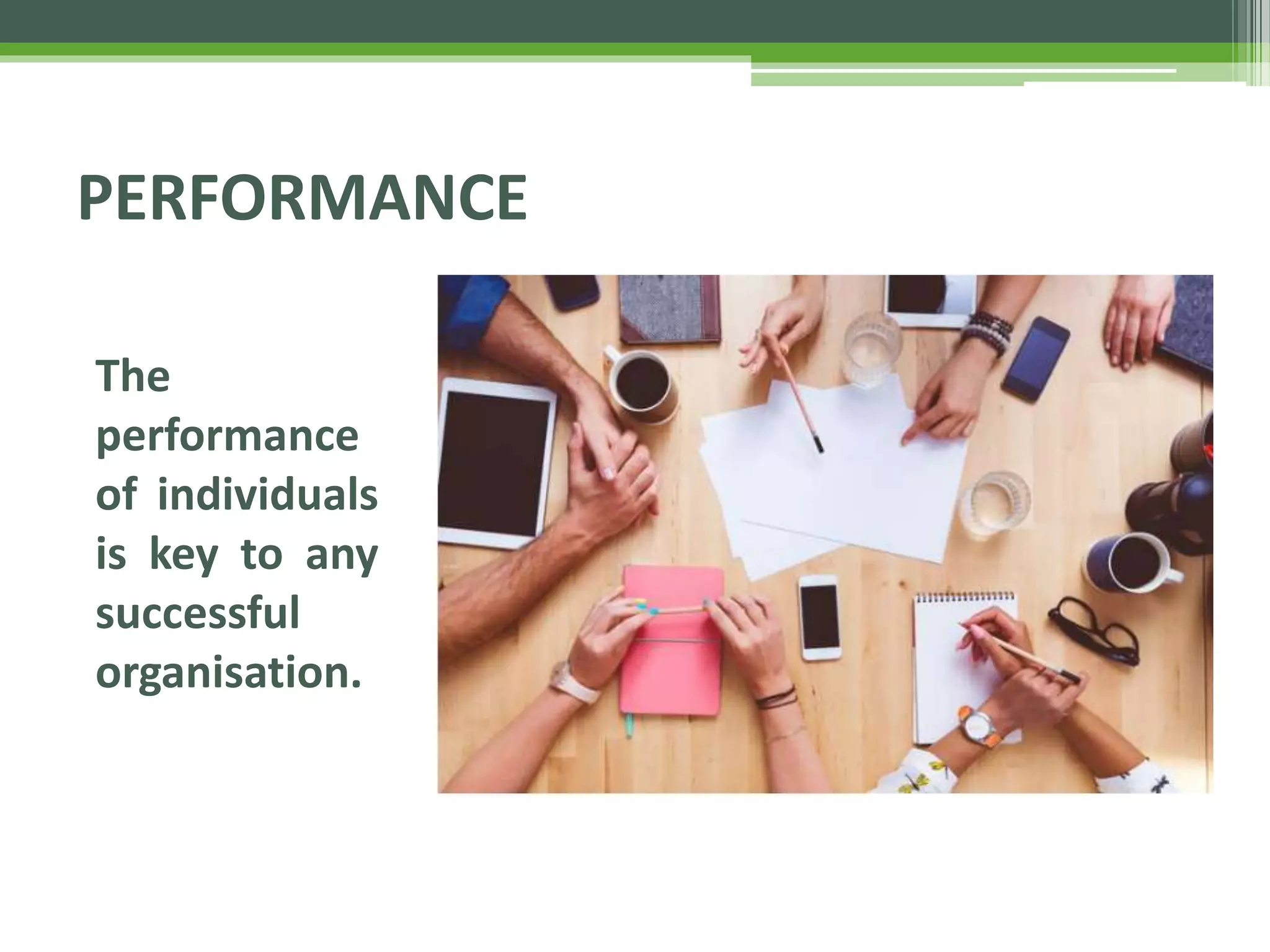
PERFORMANCE
The
performance
of individuals
is key to any
successful
organisation.
Strengths-based approach to performance
• More frequent personal conversations between managers
and their staff – for example, discussion of personal issues
and career ambitions and non-job-related chat.
• One-to-one conversations that were more effective in
supporting employee performance.
• People’s greatest opportunity for improvement comes from
understanding and building on their strengths, rather than
fixing their weaknesses. It is presented as a way to help
employees develop and improve their effectiveness and
performance.
Components of performance
• Mindset – attitudes, beliefs, thoughts and feelings
• Environment – the physical and non-physical space
around us.
• Teamwork – working with others.
Mindset
• People with a fixed mindset believe that abilities are
fixed, and are less likely to flourish. However, people
with a growth mindset believe that abilities can be
developed.
• Almost every area of human performance can be
dramatically influenced by how we think about our
talents and abilities.
Top tips – Concentrate on the task at hand, set clear
goals and gather feedback on your performance.
Environment
• The environment that you operate in influences
performance. This relates to the physical space around
us such as offices, meetings rooms and desk space.
• The non-physical environment is also key to consider
and is easier to manage. Novelty, unpredictability and
complexity in our work can help to focus our attention.
• Make sure you share your ideas with others and take a
stand for what you believe in.
Top tips – Set yourself challenges, introduce complexity
and take a stand for what you believe in.
Teamwork
• In workplace settings it is very important to work
as part of a team. HR professionals need to support
teams so that they can communicate effectively,
listen to each other and agree shared goals.
• Allow each team member to participate fully and
equally. Teams need to get the most from different
personalities and have a degree of freedom to
choose how they approach tasks.
Top tips – Get to know other team members, take
risks and support others.
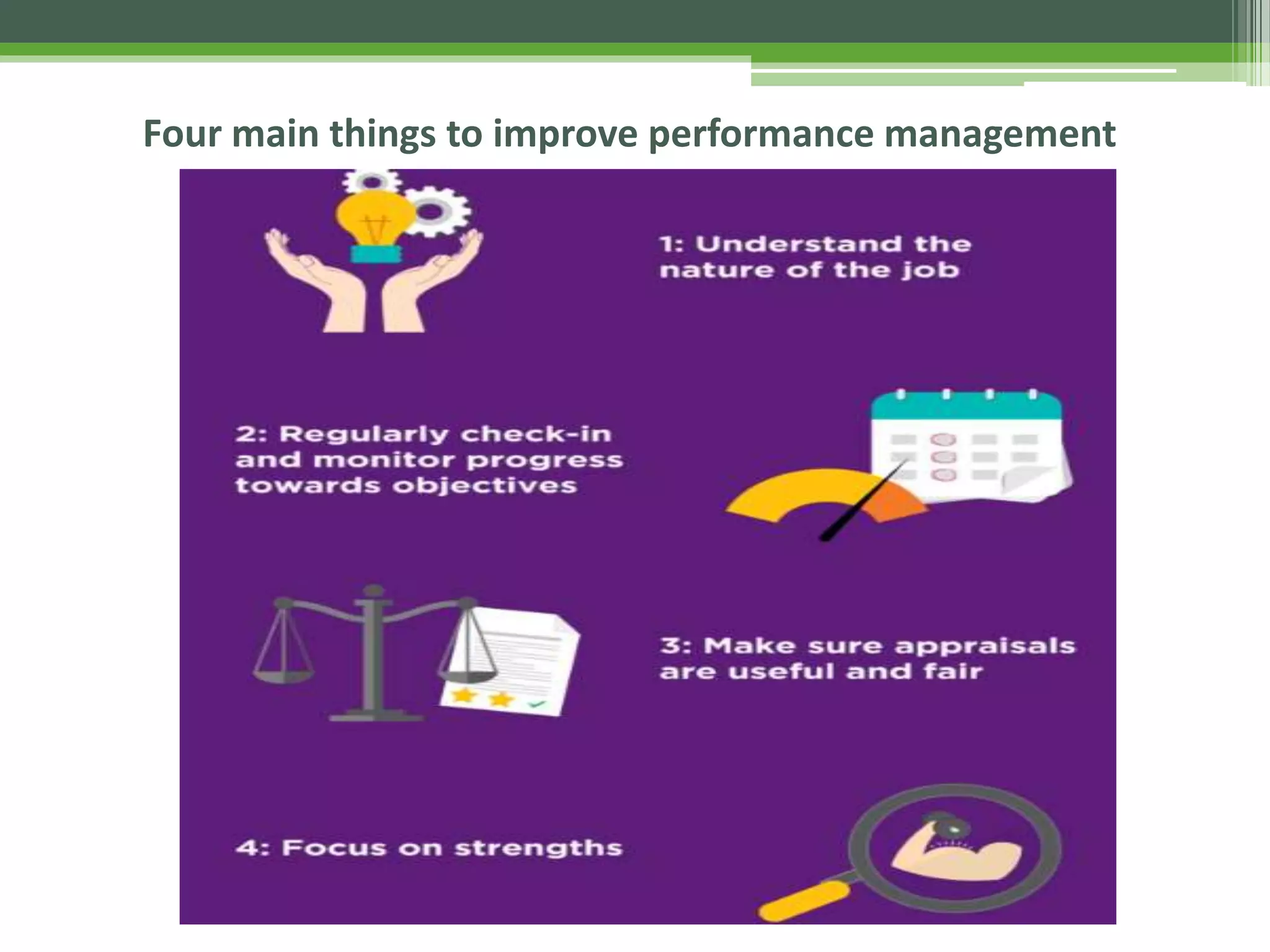
Four main things to improve performance management
EMPLOYEE ENGAGEMENT
• Employee engagement brings together job
satisfaction, motivation, work effort, organisational
commitment, shared purpose, energy and ‘flow’.
• In this way, employee engagement describes an
internal state of being – physical, mental and
emotional – and can also include behaviour, such as
commitment and ‘going the extra mile’.
Why engagement is important ?
• Engaged employers are happier, healthier and more
fulfilled, and they are also more motivated which helps
deliver improved business performance.
• The opposite is also true. Where a workforce is
disengaged, performance suffers, employees may leave,
and if the organisation is going through a period of
challenge such as significant change or restructuring (or
even just challenging customers) it can be much more
difficult for them.
• When employees are less engaged they are also less
likely to use their knowledge and skills for the good of
the organisation so collaboration and innovation suffer
too.
Building engagement
• Leadership that gives a ‘strong strategic narrative about
the organisation, where it’s come from and where it’s
going’.
• Line managers who motivate, empower and support
their employees.
• Employee voice throughout the organisation, to
challenge or reinforce ways of working and involve
employees in decision making.
• ‘Organisational integrity’: stated values are embedded
into organisational culture; what we say is what we do.
This closely relates to the sense of fairness and trust in
the organisation and the psychological contract, which
depend on employers delivering on their commitments
and fulfilling employees’ expectations.
REMUNERATION
• In HR, the pay is referred to as either ‘compensation
and benefits’, ‘reward and recognition’ or
‘remuneration’. This is reflective of the complex
nature of pay - there’s much more to it than putting
money into people’s accounts each week or month.
• Different approaches to pay depend on many factors
such as – geography, legislation, the labour market,
the organisational context and the type of role e.g.
an administrative role may be viewed differently to a
delivery driver role or a Chief Executive.
Financial reward
• Financial reward usually consists of both base
pay and variable pay. Base pay is the guaranteed
wage or salary for the work completed as per the
contract. Variable pay is additional pay, such as
overtime pay or bonuses for performance.
• There may also be payments for things like length of
service or for having a specific skill. All organisations
will take a different approach to what they include in
base versus variable pay, particularly depending on
the sector.
Examples of best benefits or ‘perks’
• At #1 – IKEA offers up to four months of paid
parental leave to both part-time and full-time
employees, providing they have at least one year of
experience at the company,
• At #12 – Deloitte offers two sabbatical programs: an
unpaid one-month sabbatical that can be taken for
any reason, and a 3-6 month sabbatical at 40% pay
that can be taken to pursue personal or professional
growth opportunities.
• At #15 – Microsoft offers an annual $800 “Stay Fit”
reimbursement program to help cover the cost of
gym memberships and fitness programs.
Non-financial reward
• Of course money is important but it isn’t the only factor.
The non-financial rewards are those other than pay and
benefits which reward people. They can also be
described as intrinsic rewards, which are those that
come from the work itself, rather than extrinsic
rewards like performance related pay, that organisations
provide to motivate employees.
• It’s thought that intrinsic rewards are more likely to have
a deeper and more long-term effect. Examples of
intrinsic rewards are:
▫ Giving employees opportunities to achieve and acquire
more autonomy, responsibility, and influence.
▫ Providing them with scope for personal growth.
▫ Recognising their contribution.
Total reward
• It is used to describe a reward strategy that brings
these non-financial components and all aspects of the
working experience into a total package.
• Don’t forget individual factors will determine how much
an employee values a specific reward: for some, flexible
working might be more important than anything else.
Performance related pay:
Is the process of linking levels of pay to individual, team
and organisation performance and traditionally it is
linked with the performance management process. Pay
is often managed by linking salary to individual
performance, which is usually measured against
objectives that have been agreed in advance.
 Human Resources - Performance, Engagement, Reward & Recognition

Human Resources - Performance, Engagement, Reward & Recognition

  • 1.
    HUMAN RESOURCES PERFORMANCE, ENGAGEMENT, REWARD& RECOGNITION PRESENTED BY: SALONI AGARWAL
  • 2.
  • 3.
    Strengths-based approach toperformance • More frequent personal conversations between managers and their staff – for example, discussion of personal issues and career ambitions and non-job-related chat. • One-to-one conversations that were more effective in supporting employee performance. • People’s greatest opportunity for improvement comes from understanding and building on their strengths, rather than fixing their weaknesses. It is presented as a way to help employees develop and improve their effectiveness and performance.
  • 4.
    Components of performance •Mindset – attitudes, beliefs, thoughts and feelings • Environment – the physical and non-physical space around us. • Teamwork – working with others.
  • 5.
    Mindset • People witha fixed mindset believe that abilities are fixed, and are less likely to flourish. However, people with a growth mindset believe that abilities can be developed. • Almost every area of human performance can be dramatically influenced by how we think about our talents and abilities. Top tips – Concentrate on the task at hand, set clear goals and gather feedback on your performance.
  • 6.
    Environment • The environmentthat you operate in influences performance. This relates to the physical space around us such as offices, meetings rooms and desk space. • The non-physical environment is also key to consider and is easier to manage. Novelty, unpredictability and complexity in our work can help to focus our attention. • Make sure you share your ideas with others and take a stand for what you believe in. Top tips – Set yourself challenges, introduce complexity and take a stand for what you believe in.
  • 7.
    Teamwork • In workplacesettings it is very important to work as part of a team. HR professionals need to support teams so that they can communicate effectively, listen to each other and agree shared goals. • Allow each team member to participate fully and equally. Teams need to get the most from different personalities and have a degree of freedom to choose how they approach tasks. Top tips – Get to know other team members, take risks and support others.
  • 8.
    Four main thingsto improve performance management
  • 9.
    EMPLOYEE ENGAGEMENT • Employeeengagement brings together job satisfaction, motivation, work effort, organisational commitment, shared purpose, energy and ‘flow’. • In this way, employee engagement describes an internal state of being – physical, mental and emotional – and can also include behaviour, such as commitment and ‘going the extra mile’.
  • 10.
    Why engagement isimportant ? • Engaged employers are happier, healthier and more fulfilled, and they are also more motivated which helps deliver improved business performance. • The opposite is also true. Where a workforce is disengaged, performance suffers, employees may leave, and if the organisation is going through a period of challenge such as significant change or restructuring (or even just challenging customers) it can be much more difficult for them. • When employees are less engaged they are also less likely to use their knowledge and skills for the good of the organisation so collaboration and innovation suffer too.
  • 11.
    Building engagement • Leadershipthat gives a ‘strong strategic narrative about the organisation, where it’s come from and where it’s going’. • Line managers who motivate, empower and support their employees. • Employee voice throughout the organisation, to challenge or reinforce ways of working and involve employees in decision making. • ‘Organisational integrity’: stated values are embedded into organisational culture; what we say is what we do. This closely relates to the sense of fairness and trust in the organisation and the psychological contract, which depend on employers delivering on their commitments and fulfilling employees’ expectations.
  • 12.
    REMUNERATION • In HR,the pay is referred to as either ‘compensation and benefits’, ‘reward and recognition’ or ‘remuneration’. This is reflective of the complex nature of pay - there’s much more to it than putting money into people’s accounts each week or month. • Different approaches to pay depend on many factors such as – geography, legislation, the labour market, the organisational context and the type of role e.g. an administrative role may be viewed differently to a delivery driver role or a Chief Executive.
  • 13.
    Financial reward • Financialreward usually consists of both base pay and variable pay. Base pay is the guaranteed wage or salary for the work completed as per the contract. Variable pay is additional pay, such as overtime pay or bonuses for performance. • There may also be payments for things like length of service or for having a specific skill. All organisations will take a different approach to what they include in base versus variable pay, particularly depending on the sector.
  • 14.
    Examples of bestbenefits or ‘perks’ • At #1 – IKEA offers up to four months of paid parental leave to both part-time and full-time employees, providing they have at least one year of experience at the company, • At #12 – Deloitte offers two sabbatical programs: an unpaid one-month sabbatical that can be taken for any reason, and a 3-6 month sabbatical at 40% pay that can be taken to pursue personal or professional growth opportunities. • At #15 – Microsoft offers an annual $800 “Stay Fit” reimbursement program to help cover the cost of gym memberships and fitness programs.
  • 15.
    Non-financial reward • Ofcourse money is important but it isn’t the only factor. The non-financial rewards are those other than pay and benefits which reward people. They can also be described as intrinsic rewards, which are those that come from the work itself, rather than extrinsic rewards like performance related pay, that organisations provide to motivate employees. • It’s thought that intrinsic rewards are more likely to have a deeper and more long-term effect. Examples of intrinsic rewards are: ▫ Giving employees opportunities to achieve and acquire more autonomy, responsibility, and influence. ▫ Providing them with scope for personal growth. ▫ Recognising their contribution.
  • 16.
    Total reward • Itis used to describe a reward strategy that brings these non-financial components and all aspects of the working experience into a total package. • Don’t forget individual factors will determine how much an employee values a specific reward: for some, flexible working might be more important than anything else. Performance related pay: Is the process of linking levels of pay to individual, team and organisation performance and traditionally it is linked with the performance management process. Pay is often managed by linking salary to individual performance, which is usually measured against objectives that have been agreed in advance.