CHAPTER 3
MOTIVATION, ATTITUDE AND JOB
SATISFACTION
© 2009 Prentice-Hall Inc. All rights reserved.
6-0
Chapter Learning Objectives
 After studying this chapter, you should be able to:
 Motivation by job design and alternative work arrangement
 Employee involvement
 Motivating by extrinsic and intrinsic rewards
 Impact of worker’s motivation on their behavior
 Attitude and components of attitude
 Job attitude
 Causes and outcomes of job satisfaction
CHAPTER 5
6-1
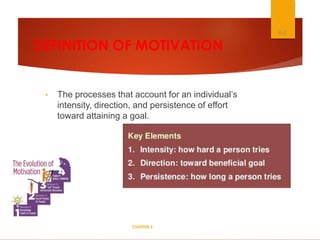
DEFINITION OF MOTIVATION
• The processes that account for an individual’s
intensity, direction, and persistence of effort
toward attaining a goal.
CHAPTER 5
6-2
MOTIVATING BY JOB DESIGN AND
ALTERNATIVE WORK ARRANGEMENT
 Job Design is a psychological theory of motivation that is
defined as the systematic and purposeful allocation of tasks
to groups and individuals within an organization.
 The five core characteristics of job design ;
 skill variety
 task identity
 task significance
 Autonomy
 job feedback
© 2009 Prentice-Hall Inc. All rights reserved.
6-
3
 Skills variety : This refers to the range of abilities needed to
perform a job. Employee motivation will increase if team
members are using a variety of diverse skills in their positions,
rather than one set skill repeatedly.
 Task identity : means the extent to which a job involves
completing an identifiable piece of work from start to finish, with
a visible outcome. Motivated employees will be more likely to
complete tasks if they identify with them and have seen them
through from start to finish.
 Task significance : The extent to which a job is important to and
impacts others within and outside of the organization is known as
task significance. When employees feel that their work is
significant to their organization, they are motivated to do well and
this will lead to increased employee productivity.
© 2009 Prentice-Hall Inc. All rights reserved.
6-
4
 Autonomy: It measures each employee’s level of freedom
and ability to schedule tasks. Employees like to be able to
make decisions and have flexibility in their roles.
 Job feedback: This refers to the degree to which an
employee receives direct feedback on their performance.
Team needs feedback in order to motivate employees long-
term. Managers need to provide feedback on performance
throughout each employee’s tenure, and not just at an
annual or biannual performance review.
© 2009 Prentice-Hall Inc. All rights reserved.
6-
5
ALTERNATIVE WORK
ARRANGEMENT
 Alternative work arrangements are work
arrangements that include flexible work
schedules, job sharing of one position
between several employees and having a
regular work location at a place other than
a campus work site.
© 2009 Prentice-Hall Inc. All rights reserved.
6-
6
Examples of Alternative work
arrangements:
 Flextime : Is a short for flexible work time or
flexible work arrangements. Flextime
employees must work a specific number of
hours per week but may vary their hours of
work, within limits.
 Job sharing: An arrangement that allows two
or more individuals to split a traditional 40-hour-
a-week job. It allows two or more individuals to
split a traditional full-time job
 Telecommuting : Working from home at least 2
days a week through virtual devices that are
linked to the employer’s office
© 2009 Prentice-Hall Inc. All rights reserved.
6-
7
EMPLOYEE INVOLVEMENT AND
PARTICIPATION (EIP)
 A participative process that uses the input of
employees to increase employee commitment to
organizational success.
© 2009 Prentice-Hall Inc. All rights reserved.
6-
8
Examples of Employee
Involvement Programs:
 Participative management program is joint
decision making, in which subordinates share
a significant degree of decision-making power
with their immediate superiors.
 Representative participation A system in
which workers participate in organizational
decision making through a small group of
representative employees
© 2009 Prentice-Hall Inc. All rights reserved.
6-
9
MOTIVATING BY EXTRINSIC AND
INTRINSIC REWARDS
 An intrinsic reward is an intangible award of recognition, a sense of
achievement, or a conscious satisfaction. For example, it is the
knowledge that you did something right, or you helped someone and
made their day better.
 An extrinsic reward is an award that is tangible or physically given to
you for accomplishing something. It is a tangible recognition of ones
endeavor. For example, it’s a certificate of accomplishment, a trophy or
medal for winning the race, a badge or points for doing something
right, or even a monetary reward for doing your job.
© 2009 Prentice-Hall Inc. All rights reserved.
6-
10
IMPACT OF WORKERS MOTIVATION ON
THEIR BEHAVIOR
Negative impact:
 It can create conflict and tension at your workplace. That’s because
employees who don’t receive the same level of motivation may feel
resentful toward those who do, which can create discord.
 Workers can become so focused on obtaining incentives that they feel
satisfied when they reach that goal and don’t push for more
Positive impact:
 Some staff are motivated by monetary and non-monetary incentives,
they tend to feel more empowered to do their jobs at a consistently high
level.
© 2009 Prentice-Hall Inc. All rights reserved.
6-
11
ATTITUDE AND COMPONENTS OF
ATTITUDE
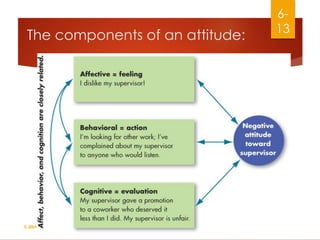
Attitudes are evaluative statements—either
favorable or unfavorable—about objects,
people, or events.
– They reflect how we feel about something.
© 2009 Prentice-Hall Inc. All rights reserved.
6-
12
The components of an attitude:
© 2009 Prentice-Hall Inc. All rights reserved.
6-
13
COMPARE THE MAJOR JOB ATTITUDES
Job Satisfaction
 A positive feeling about the job resulting from an
evaluation of its characteristics.
 Job Involvement
 Degree to which a person identifies with a job,
actively participates in it, and considers
performance important to self-worth.
 Psychological Empowerment
Belief in the degree of influence over one’s job,
competence, job meaningfulness, and
autonomy.
© 2009 Prentice-Hall Inc. All rights reserved.
6-
14
Organizational Commitment
 Identifying with a particular organization and its
goals and wishing to maintain membership in
the organization.
 Employees who are committed will be less likely
to engage in work withdrawal even if they are
dissatisfied, because they have a sense of
organizational loyalty.
© 2009 Prentice-Hall Inc. All rights reserved.
6-
15
CAUSES AND OUTCOMES OF JOB
SATISFACTION
Job Satisfaction
 A positive feeling about a job resulting from
an evaluation of its characteristics.
Two approaches for measuring job satisfaction
are popular
 The single global rating.
 The summation of job facets.
© 2009 Prentice-Hall Inc. All rights reserved.
6-
16
What causes job satisfaction?
 Job conditions
The intrinsic nature of the work itself, social
interactions, and supervision are important
predictors of satisfaction and employee well-
being.
 Personality
People who have positive core self-evaluations,
who believe in their inner worth and basic
competence, are more satisfied with their jobs
than those with negative core self-evaluations.
© 2009 Prentice-Hall Inc. All rights reserved.
6-
17
Outcomes of Job Satisfaction
• Job Performance
– Happy workers are more likely to be productive
workers.
• OCB
– People who are more satisfied with their jobs are
more likely to engage in OCB.
• Customer Satisfaction
– Satisfied employees increase customer satisfaction
and loyalty.
• Life Satisfaction
– Research shows that job satisfaction is positively
correlated with life satisfaction.
© 2009 Prentice-Hall Inc. All rights reserved.
6-
18
THANK YOU 
© 2009 Prentice-Hall Inc. All rights reserved.
6-
19

chapter 3_ MOTIVATION.ppt

  • 1.
    CHAPTER 3 MOTIVATION, ATTITUDEAND JOB SATISFACTION © 2009 Prentice-Hall Inc. All rights reserved. 6-0
  • 2.
    Chapter Learning Objectives After studying this chapter, you should be able to:  Motivation by job design and alternative work arrangement  Employee involvement  Motivating by extrinsic and intrinsic rewards  Impact of worker’s motivation on their behavior  Attitude and components of attitude  Job attitude  Causes and outcomes of job satisfaction CHAPTER 5 6-1
  • 3.
    DEFINITION OF MOTIVATION •The processes that account for an individual’s intensity, direction, and persistence of effort toward attaining a goal. CHAPTER 5 6-2
  • 4.
    MOTIVATING BY JOBDESIGN AND ALTERNATIVE WORK ARRANGEMENT  Job Design is a psychological theory of motivation that is defined as the systematic and purposeful allocation of tasks to groups and individuals within an organization.  The five core characteristics of job design ;  skill variety  task identity  task significance  Autonomy  job feedback © 2009 Prentice-Hall Inc. All rights reserved. 6- 3
  • 5.
     Skills variety: This refers to the range of abilities needed to perform a job. Employee motivation will increase if team members are using a variety of diverse skills in their positions, rather than one set skill repeatedly.  Task identity : means the extent to which a job involves completing an identifiable piece of work from start to finish, with a visible outcome. Motivated employees will be more likely to complete tasks if they identify with them and have seen them through from start to finish.  Task significance : The extent to which a job is important to and impacts others within and outside of the organization is known as task significance. When employees feel that their work is significant to their organization, they are motivated to do well and this will lead to increased employee productivity. © 2009 Prentice-Hall Inc. All rights reserved. 6- 4
  • 6.
     Autonomy: Itmeasures each employee’s level of freedom and ability to schedule tasks. Employees like to be able to make decisions and have flexibility in their roles.  Job feedback: This refers to the degree to which an employee receives direct feedback on their performance. Team needs feedback in order to motivate employees long- term. Managers need to provide feedback on performance throughout each employee’s tenure, and not just at an annual or biannual performance review. © 2009 Prentice-Hall Inc. All rights reserved. 6- 5
  • 7.
    ALTERNATIVE WORK ARRANGEMENT  Alternativework arrangements are work arrangements that include flexible work schedules, job sharing of one position between several employees and having a regular work location at a place other than a campus work site. © 2009 Prentice-Hall Inc. All rights reserved. 6- 6
  • 8.
    Examples of Alternativework arrangements:  Flextime : Is a short for flexible work time or flexible work arrangements. Flextime employees must work a specific number of hours per week but may vary their hours of work, within limits.  Job sharing: An arrangement that allows two or more individuals to split a traditional 40-hour- a-week job. It allows two or more individuals to split a traditional full-time job  Telecommuting : Working from home at least 2 days a week through virtual devices that are linked to the employer’s office © 2009 Prentice-Hall Inc. All rights reserved. 6- 7
  • 9.
    EMPLOYEE INVOLVEMENT AND PARTICIPATION(EIP)  A participative process that uses the input of employees to increase employee commitment to organizational success. © 2009 Prentice-Hall Inc. All rights reserved. 6- 8
  • 10.
    Examples of Employee InvolvementPrograms:  Participative management program is joint decision making, in which subordinates share a significant degree of decision-making power with their immediate superiors.  Representative participation A system in which workers participate in organizational decision making through a small group of representative employees © 2009 Prentice-Hall Inc. All rights reserved. 6- 9
  • 11.
    MOTIVATING BY EXTRINSICAND INTRINSIC REWARDS  An intrinsic reward is an intangible award of recognition, a sense of achievement, or a conscious satisfaction. For example, it is the knowledge that you did something right, or you helped someone and made their day better.  An extrinsic reward is an award that is tangible or physically given to you for accomplishing something. It is a tangible recognition of ones endeavor. For example, it’s a certificate of accomplishment, a trophy or medal for winning the race, a badge or points for doing something right, or even a monetary reward for doing your job. © 2009 Prentice-Hall Inc. All rights reserved. 6- 10
  • 12.
    IMPACT OF WORKERSMOTIVATION ON THEIR BEHAVIOR Negative impact:  It can create conflict and tension at your workplace. That’s because employees who don’t receive the same level of motivation may feel resentful toward those who do, which can create discord.  Workers can become so focused on obtaining incentives that they feel satisfied when they reach that goal and don’t push for more Positive impact:  Some staff are motivated by monetary and non-monetary incentives, they tend to feel more empowered to do their jobs at a consistently high level. © 2009 Prentice-Hall Inc. All rights reserved. 6- 11
  • 13.
    ATTITUDE AND COMPONENTSOF ATTITUDE Attitudes are evaluative statements—either favorable or unfavorable—about objects, people, or events. – They reflect how we feel about something. © 2009 Prentice-Hall Inc. All rights reserved. 6- 12
  • 14.
    The components ofan attitude: © 2009 Prentice-Hall Inc. All rights reserved. 6- 13
  • 15.
    COMPARE THE MAJORJOB ATTITUDES Job Satisfaction  A positive feeling about the job resulting from an evaluation of its characteristics.  Job Involvement  Degree to which a person identifies with a job, actively participates in it, and considers performance important to self-worth.  Psychological Empowerment Belief in the degree of influence over one’s job, competence, job meaningfulness, and autonomy. © 2009 Prentice-Hall Inc. All rights reserved. 6- 14
  • 16.
    Organizational Commitment  Identifyingwith a particular organization and its goals and wishing to maintain membership in the organization.  Employees who are committed will be less likely to engage in work withdrawal even if they are dissatisfied, because they have a sense of organizational loyalty. © 2009 Prentice-Hall Inc. All rights reserved. 6- 15
  • 17.
    CAUSES AND OUTCOMESOF JOB SATISFACTION Job Satisfaction  A positive feeling about a job resulting from an evaluation of its characteristics. Two approaches for measuring job satisfaction are popular  The single global rating.  The summation of job facets. © 2009 Prentice-Hall Inc. All rights reserved. 6- 16
  • 18.
    What causes jobsatisfaction?  Job conditions The intrinsic nature of the work itself, social interactions, and supervision are important predictors of satisfaction and employee well- being.  Personality People who have positive core self-evaluations, who believe in their inner worth and basic competence, are more satisfied with their jobs than those with negative core self-evaluations. © 2009 Prentice-Hall Inc. All rights reserved. 6- 17
  • 19.
    Outcomes of JobSatisfaction • Job Performance – Happy workers are more likely to be productive workers. • OCB – People who are more satisfied with their jobs are more likely to engage in OCB. • Customer Satisfaction – Satisfied employees increase customer satisfaction and loyalty. • Life Satisfaction – Research shows that job satisfaction is positively correlated with life satisfaction. © 2009 Prentice-Hall Inc. All rights reserved. 6- 18
  • 20.
    THANK YOU  ©2009 Prentice-Hall Inc. All rights reserved. 6- 19