By Sara M. Aljanabi
KAU- 1801395
Outlines
• Definition of motivation.
• Elements of motivation.
• Types of motivation.
• Motivation theories.
• Job characteristic and motivation.
• Motivation strategies.
• Motivation and money.
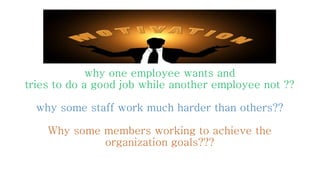
why one employee wants and
tries to do a good job while another employee not ??
why some staff work much harder than others??
Why some members working to achieve the
organization goals???
What Is Motivation?
motivation defined as “the psychological forces within a person that
determine the direction of that person’s behaviour in an organization,
effort level, and persistence in the face of obstacles”.
Motivation is important because it explains why employees behave as
they do.
Elements of motivation
There are many behaviours
(some appropriate, some
inappropriate) that the
jobholder can engage in.
All these component are
connected to gather.
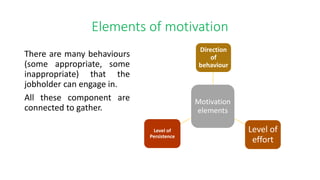
Motivation
elements
Direction
of
behaviour
Level of
effort
Level of
Persistence
1- Direction of behaviour the behaviour employees choose to perform
from the many potential behaviours they could perform.
2- Level of effort It is not enough for an organization to motivate
employees to perform desired functional behaviours; the organization
must also motivate them to work hard at these behaviours.
3- Level of Persistence how hard does a person keep trying to perform
a chosen behaviour successfully.
The relation Between Motivation and
Performance
Performance is an evaluation of the results of a person’s behaviour: It
involves determining how well or poorly a person has accomplished a
task or done a job.
Motivation is only one factor among many that contributes to an
employee’s job performance.
 Many other factors affect performance: personality and ability, the
difficulty of the task, the availability of resources, working conditions,
and chance or luck.
High level of motivation does not always result in a high level of
performance.
High performance does not necessarily imply that motivation is high.
Employees with low motivation may perform at a high level if they have
a great deal of ability.
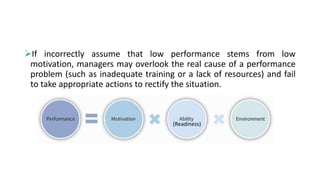
If incorrectly assume that low performance stems from low
motivation, managers may overlook the real cause of a performance
problem (such as inadequate training or a lack of resources) and fail
to take appropriate actions to rectify the situation.
(Readiness)
Types of motivation
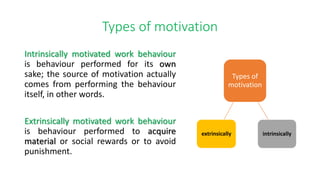
Intrinsically motivated work behaviour
is behaviour performed for its own
sake; the source of motivation actually
comes from performing the behaviour
itself, in other words.
Extrinsically motivated work behaviour
is behaviour performed to acquire
material or social rewards or to avoid
punishment.
Types of
motivation
intrinsicallyextrinsically
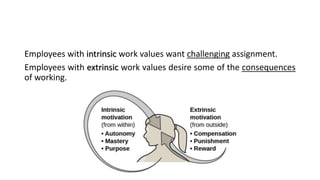
Employees with intrinsic work values want challenging assignment.
Employees with extrinsic work values desire some of the consequences
of working.
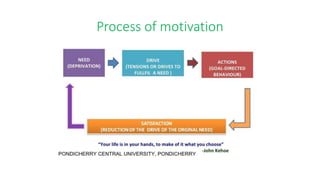
Process of motivation
Theories of Motivation
Theories about work motivation provide answers to such questions by
explaining why employees behave as they do in organizations.
1. Need theory
Need theory focuses on the outcome side. need theory is that
employees have needs that they are motivated to satisfy in the
workplace.
Maslow’s Hierarchy of Needs
Alderfer’s ERG Theory
Existence, relatedness and growth
2. Expectancy Theory
Expectancy theory focuses on employees’ perceptions, how
employees decide which specific behaviours to perform and how
much effort to exert.
employees will not be motivated to contribute their inputs to the
organization unless they believe it will result in achieving a given level
of performance. Employees’ beliefs about the relationship between
their inputs and the performance level they reach are.
Expectancy theory identifies three major factors that determine an
employee’s motivation: valence, instrumentality, and expectancy
valence refers to the desirability of an outcome to an individual
employee. Valence can be positive or negative and can vary in size or
magnitude.
Instrumentality the second key determinant of motivation according
to expectancy theory, is an employee’s perception about the extent to
which performing certain behaviours or performing at a certain level
will lead to the attainment of a particular outcome.
Expectancy is an employee’s perception about the extent to which his
or her effort will result in a certain level of job performance.
P165-167
3. Equity Theory
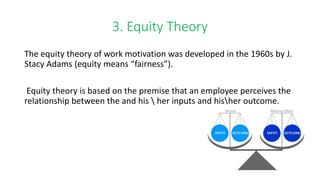
The equity theory of work motivation was developed in the 1960s by J.
Stacy Adams (equity means “fairness”).
Equity theory is based on the premise that an employee perceives the
relationship between the and his  her inputs and hisher outcome.
outcome/input ratio the relationship between
what an employee gets from a job (outcomes)
and what the employee contributes to the job
(inputs).
Referent is other person, is simply another
employee or group of employees perceived to
be similar to oneself.
Organizational Justice Theory
Organizational justice theory is a group of theories that focus on the
nature, determinants, and consequences of organizational justice.
it is often called a theory of distributive justice.
ORGANIZATIONAL JUSTICE
An employee’s perception of overall fairness in his or her organization.
Forms of Organizational Justice
DISTRIBUTIVE JUSTICE The perceived fairness of the distribution of outcomes
in an organization.
such as pay, promotions, and desirable working conditions and assignments.
PROCEDURAL JUSTICE The perceived fairness of the procedures used to
make decisions about the distribution of outcomes in an organization.
how performance levels are evaluated, how grievances or disputes are
handled (if, for example, an employee disagrees with a manager’s evaluation
of his or her performance)
INTERPERSONAL JUSTICE The perceived fairness of the interpersonal
treatment employees receive from the distributors of outcomes or
their managers.
It is important for managers to be courteous and polite and to treat
employees with dignity and respect to promote interpersonal justice.
INFORMATIONAL JUSTICE Employee perceptions of the extent to which
managers explain their decisions and the procedures they used to
arrive at these decisions.
Job characteristic and motivation
• P 193
(Empowering theory)
Motivation strategies
Motivation strategies aim to
create a working environment
and to develop policies and
practices that will provide for
higher levels of performance
from employees.
Job Rotation is a management approach where employees are shifted
between two or more assignments or jobs at regular intervals of time
in order to expose them to all verticals of an organization.
It is a pre-planned approach with an objective to test the employee
skills and competencies in order to place him or her at the right place.
it reduces the monotony of the job and gives them a wider
experience and helps them gain more insights.
Job enlargement is a job design technique wherein there is an increase
in the number of tasks associated with a certain job. In other words, it
means increasing the scope of one's duties and responsibilities. The
increase in scope is quantitative in nature and not qualitative and at
the same level.
Job enlargement is a horizontal restructuring method that aims at
increase in the workforce flexibility and at the same time reducing
monotony that may creep up over a period of time
Job Enrichment and Job Enlargement
The difference between job enrichment and job enlargement is
essentially of quantity and quality. Whereas job enlargement means
increasing the scope of job quantitatively by adding up more tasks,
job enrichment means improvement in the quality of job such that
employees are more satisfied and fulfilled.
job enrichment an employee finds satisfaction and contentment in
his job and through job enlargement employee feels more
responsible and worthwhile in the organization.
Job enrichment means a vertical expansion in duties and
responsibilities and span of control whereas in job enlargement the
expansion is horizontal in nature.
Job enrichment has been found to have greater impact in terms of
motivation when compared to job enlargement.
It is the process of making a job more interesting, challenging and
satisfying for the employees.
Motivation and money
Money is a powerful motivating force because
it is linked directly or indirectly to the
satisfaction of many needs. Money may in
itself have no intrinsic meaning, but it
acquires significant motivating power because
it comes to symbolize so many intangible
goals.
Summary
• Work motivation is the psychological forces within a person that
determine the direction of the person’s behaviour in an organization,
the person’s level of effort, and the person’s level of persistence in
the face of obstacles.
• Intrinsically motivated behaviour is behaviour performed for its own
sake. Extrinsically motivated behaviour is behaviour performed to
acquire material or social rewards or to avoid punishment.
• Need theory, expectancy theory, equity theory, and organizational
justice theory are complementary approaches to understanding
motivation
• Discuses the different elements of work
motivation?
• Discuses why some staff working to
achieve the organization goals and other
staff are not?
References
Understanding and Managing Organizational Behavior, Jennifer M. George,
Gareth R. Jones. Prentice Hall, New Jersey 07458.

Motivation

  • 1.
    By Sara M.Aljanabi KAU- 1801395
  • 2.
    Outlines • Definition ofmotivation. • Elements of motivation. • Types of motivation. • Motivation theories. • Job characteristic and motivation. • Motivation strategies. • Motivation and money.
  • 3.
    why one employeewants and tries to do a good job while another employee not ?? why some staff work much harder than others?? Why some members working to achieve the organization goals???
  • 4.
    What Is Motivation? motivationdefined as “the psychological forces within a person that determine the direction of that person’s behaviour in an organization, effort level, and persistence in the face of obstacles”. Motivation is important because it explains why employees behave as they do.
  • 5.
    Elements of motivation Thereare many behaviours (some appropriate, some inappropriate) that the jobholder can engage in. All these component are connected to gather. Motivation elements Direction of behaviour Level of effort Level of Persistence
  • 6.
    1- Direction ofbehaviour the behaviour employees choose to perform from the many potential behaviours they could perform. 2- Level of effort It is not enough for an organization to motivate employees to perform desired functional behaviours; the organization must also motivate them to work hard at these behaviours. 3- Level of Persistence how hard does a person keep trying to perform a chosen behaviour successfully.
  • 8.
    The relation BetweenMotivation and Performance Performance is an evaluation of the results of a person’s behaviour: It involves determining how well or poorly a person has accomplished a task or done a job. Motivation is only one factor among many that contributes to an employee’s job performance.  Many other factors affect performance: personality and ability, the difficulty of the task, the availability of resources, working conditions, and chance or luck.
  • 9.
    High level ofmotivation does not always result in a high level of performance. High performance does not necessarily imply that motivation is high. Employees with low motivation may perform at a high level if they have a great deal of ability.
  • 10.
    If incorrectly assumethat low performance stems from low motivation, managers may overlook the real cause of a performance problem (such as inadequate training or a lack of resources) and fail to take appropriate actions to rectify the situation. (Readiness)
  • 11.
    Types of motivation Intrinsicallymotivated work behaviour is behaviour performed for its own sake; the source of motivation actually comes from performing the behaviour itself, in other words. Extrinsically motivated work behaviour is behaviour performed to acquire material or social rewards or to avoid punishment. Types of motivation intrinsicallyextrinsically
  • 12.
    Employees with intrinsicwork values want challenging assignment. Employees with extrinsic work values desire some of the consequences of working.
  • 13.
  • 14.
    Theories of Motivation Theoriesabout work motivation provide answers to such questions by explaining why employees behave as they do in organizations.
  • 15.
    1. Need theory Needtheory focuses on the outcome side. need theory is that employees have needs that they are motivated to satisfy in the workplace.
  • 16.
  • 17.
    Alderfer’s ERG Theory Existence,relatedness and growth
  • 18.
    2. Expectancy Theory Expectancytheory focuses on employees’ perceptions, how employees decide which specific behaviours to perform and how much effort to exert. employees will not be motivated to contribute their inputs to the organization unless they believe it will result in achieving a given level of performance. Employees’ beliefs about the relationship between their inputs and the performance level they reach are.
  • 19.
    Expectancy theory identifiesthree major factors that determine an employee’s motivation: valence, instrumentality, and expectancy valence refers to the desirability of an outcome to an individual employee. Valence can be positive or negative and can vary in size or magnitude.
  • 20.
    Instrumentality the secondkey determinant of motivation according to expectancy theory, is an employee’s perception about the extent to which performing certain behaviours or performing at a certain level will lead to the attainment of a particular outcome. Expectancy is an employee’s perception about the extent to which his or her effort will result in a certain level of job performance. P165-167
  • 21.
    3. Equity Theory Theequity theory of work motivation was developed in the 1960s by J. Stacy Adams (equity means “fairness”). Equity theory is based on the premise that an employee perceives the relationship between the and his her inputs and hisher outcome.
  • 22.
    outcome/input ratio therelationship between what an employee gets from a job (outcomes) and what the employee contributes to the job (inputs). Referent is other person, is simply another employee or group of employees perceived to be similar to oneself.
  • 23.
    Organizational Justice Theory Organizationaljustice theory is a group of theories that focus on the nature, determinants, and consequences of organizational justice. it is often called a theory of distributive justice. ORGANIZATIONAL JUSTICE An employee’s perception of overall fairness in his or her organization.
  • 24.
  • 25.
    Forms of OrganizationalJustice DISTRIBUTIVE JUSTICE The perceived fairness of the distribution of outcomes in an organization. such as pay, promotions, and desirable working conditions and assignments. PROCEDURAL JUSTICE The perceived fairness of the procedures used to make decisions about the distribution of outcomes in an organization. how performance levels are evaluated, how grievances or disputes are handled (if, for example, an employee disagrees with a manager’s evaluation of his or her performance)
  • 26.
    INTERPERSONAL JUSTICE Theperceived fairness of the interpersonal treatment employees receive from the distributors of outcomes or their managers. It is important for managers to be courteous and polite and to treat employees with dignity and respect to promote interpersonal justice. INFORMATIONAL JUSTICE Employee perceptions of the extent to which managers explain their decisions and the procedures they used to arrive at these decisions.
  • 27.
    Job characteristic andmotivation • P 193 (Empowering theory)
  • 28.
    Motivation strategies Motivation strategiesaim to create a working environment and to develop policies and practices that will provide for higher levels of performance from employees.
  • 30.
    Job Rotation isa management approach where employees are shifted between two or more assignments or jobs at regular intervals of time in order to expose them to all verticals of an organization. It is a pre-planned approach with an objective to test the employee skills and competencies in order to place him or her at the right place. it reduces the monotony of the job and gives them a wider experience and helps them gain more insights.
  • 31.
    Job enlargement isa job design technique wherein there is an increase in the number of tasks associated with a certain job. In other words, it means increasing the scope of one's duties and responsibilities. The increase in scope is quantitative in nature and not qualitative and at the same level. Job enlargement is a horizontal restructuring method that aims at increase in the workforce flexibility and at the same time reducing monotony that may creep up over a period of time
  • 32.
    Job Enrichment andJob Enlargement The difference between job enrichment and job enlargement is essentially of quantity and quality. Whereas job enlargement means increasing the scope of job quantitatively by adding up more tasks, job enrichment means improvement in the quality of job such that employees are more satisfied and fulfilled. job enrichment an employee finds satisfaction and contentment in his job and through job enlargement employee feels more responsible and worthwhile in the organization.
  • 33.
    Job enrichment meansa vertical expansion in duties and responsibilities and span of control whereas in job enlargement the expansion is horizontal in nature. Job enrichment has been found to have greater impact in terms of motivation when compared to job enlargement. It is the process of making a job more interesting, challenging and satisfying for the employees.
  • 34.
    Motivation and money Moneyis a powerful motivating force because it is linked directly or indirectly to the satisfaction of many needs. Money may in itself have no intrinsic meaning, but it acquires significant motivating power because it comes to symbolize so many intangible goals.
  • 35.
    Summary • Work motivationis the psychological forces within a person that determine the direction of the person’s behaviour in an organization, the person’s level of effort, and the person’s level of persistence in the face of obstacles. • Intrinsically motivated behaviour is behaviour performed for its own sake. Extrinsically motivated behaviour is behaviour performed to acquire material or social rewards or to avoid punishment. • Need theory, expectancy theory, equity theory, and organizational justice theory are complementary approaches to understanding motivation
  • 36.
    • Discuses thedifferent elements of work motivation? • Discuses why some staff working to achieve the organization goals and other staff are not?
  • 37.
    References Understanding and ManagingOrganizational Behavior, Jennifer M. George, Gareth R. Jones. Prentice Hall, New Jersey 07458.