MOTIVATIONAL
TECHNIQUES
(Including Job Satisfaction)
Chapter covers…
 Management by Objectives (MBO)- Definition,
Elements, Advantages, Limitations, Suggestions
 Job Satisfaction- Definition, Factors,
Consequences, Theories
 Job Enrichment- Definition, Characteristics,
Advantages, Limitations
 Job Enlargement- Definition, Advantages,
Disadvantages, Job Enlargement Vs. Job
Enrichment
 Job Rotation- Meaning, Advantages,
Disadvantages
MANAGEMENT BY
OBJECTIVES
“The system of management by objectives can be
described as a process whereby the superior and
subordinate managers of an organization jointly
identify its common goals, define each individual’s
major areas of responsibility in terms of results
expected of him and use these measures as
guides for operating the unit and assessing the
contribution of each of its members.”
- George S. Ordiorne
ELEMENTS IN THE MBO
PROCESS
Setting
Overall
Central
Goals
Setting
Individual
Goals
Periodic
Performance
Appraisal &
Feedback
Final
Appraisal
o Central Goal Setting
o Departmental and Individual Goal Setting
o Revision of Job Descriptions
o Matching Goals and Resource Allocation
o Freedom of Implementation
o Establishing Check Points
o Appraisal of Performance
o Counseling
ADVANTAGES OF MBO
 Improved Performance
 Greater Sense of Identification
 Maximum Utilization of Human Resources
 No Role Ambiguity
 Improved Communication
 Improved Organizational Structure
 Device of Organizational Control
 Career Development of the Employees
 Result Based Performance Evaluation
 Stimulating the Motivation of Employees
LIMITATIONS OF MBO
 Lack of Support of Top Management
 Resentful Attitude of Subordinates
 Difficulties in Quantifying the Goals and Objectives
 Costly and Time Consuming Process
 Emphasis on Short-term Goals
 Lack of Adequate Skills and Training
 Poor Integration
 Lack of Follow-up
 Difficulty in Achieving Group Goals
 Inflexibility
 Limited Application
 Long Gestation Period
SUGGESTIONS FOR
EFFECTIVE IMPLEMENTATION
OF MBO
 Top Management Support and Commitment
 Clear Goal Setting
 Participative Goal Setting
 Overall Philosophy of Management
 Decentralization of Authority
 Revision and Modification of Goals
 Orientation and Training of Executives
 Integration of MBO Programme
JOB SATISFACTION
“Job Satisfaction is the amount of pleasure or
contentment associated with a job. If you
like your job intensely, you will experience
high job satisfaction. If you dislike your job,
you will experience job dissatisfaction.”
- Andrew Brin
FACTORS INFLUENCING JOB
SATISFACTION
ORGANISATIO
NAL FACTORS
• Salaries &
Wages
• Promotion
Changes
• Company
Policies
WORK
ENVIRONMENTA
L FACTORS
• Supervision
• Work
Group
• Working
Conditions
WORK ITSELF
• Job Scope
• Variety
• Autonomy
and
Freedom
• Role
Ambiguity
and Role
Conflict
• Interesting
Work
PERSONAL
FACTORS
• Age and
Seniority
• Tenure
• Personality
CONSEQUENCES OF JOB
SATISFACTION
 Job Satisfaction and Productivity
 Job Satisfaction and Employee Turnover
 Job Satisfaction and Absenteeism
 Job Satisfaction and Union Activities
 Job Satisfaction and Safety
 Other effects of Job Satisfaction
THEORIES OF JOB
SATISFACTION
NEED FULFILLMENT THEORY
EQUITY THEORY
TWO FACTOR THEORY
DISCREPANCY THEORY
EQUITY DISCREPANCY THEORY
SOCIAL REFERENCE GROUP THEORY
JOB ENRICHMENT
“Job Enrichment is a motivational technique which
emphasizes the need for challenging and
interesting work. It suggests that jobs be
redesigned so that intrinsic satisfaction is derived
from doing the job. In its best applications, it leads
to a vertically enhanced job by adding functions
from other organizational levels, making it contain
more variety and challenge and offer autonomy
and pride to the employee.”
- Beatty and Schneider
CHARACTERISTICS OF JOB
ENRICHMENT
1. Direct Feedback
2. Client Relationships
3. New learning
4. Scheduling Own Work
5. Unique Experience
6. Control Over Resources
7. Direct Communication Authority
8. Personal Accountability
ADVANTAGES OF JOB ENRICHMENT
o Removes frustrations of employees
o Reduces the rate of employee turnover and
absenteeism
o Motivates the employees
o Task enforcement is made easy and skills of
workers are increased
o Employee satisfaction
o Qualitative and quantitative improvement in output
o Enhances creativity
LIMITATIONS OF JOB
ENRICHMENT
 Tendency to refuse challenging works
 No scope for enrichment in highly skilled
professionals
 Technology may not permit enrichment of all the
jobs
 Very costly
 Employees may not have the caliber though they
prefer to have job enrichment
 Decreased productivity
 Enrichment become static after some time
 It may create negative impact on employees
 Workers may resist to top managers’ challenges
JOB ENLARGEMENT
“Job Enlargement is the process of allowing individual workers
to determine their own pace (within limits), to serve as their
own inspectors by giving them responsibility for quality
control, to repair their own mistakes, to be responsible for
their own machine set-up and repair, and to attain choice of
method.”
- Hulin and Blood
ADVANTAGES OF JOB
ENLARGEMENT
 Variety of tasks
 Enlarged and meaningful work modules
 Optimum utilization of abilities
 Worker paced control
 Meaningful feedback
DISADVANTAGES OF JOB
ENLARGEMENT
 Costly affair
 Productivity falls in the short run
 Due to the increased workload, employee unions
argue for increased pay
 Some jobs may tend to be routine and boring even
after enlargement
JOB ENLARGEMENT JOB ENRICHMENT
 Involves horizontal loading or
expansion of job
 Purpose is to reduce
monotony in performing
certain repetitive jobs by
lengthening the cycle of
operations
 May not call for the acquisition
of higher level or new skills on
the part of the job holders
 Job holder may need more
external direction and control
in view of enlargement of the
scope and responsibilities
 Involves vertical loading of
functions & responsibilities of
employees
 Purpose is to make the job
more lively, challenging and
satisfying.
 Requires the development
and utilization of higher skills,
initiative and innovation on the
part of job holders
 Employee uses his own
capabilities and self direction
and control. He needs less of
external direction and control
JOB ROTATION
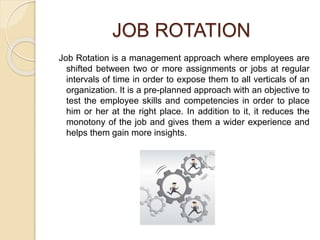
Job Rotation is a management approach where employees are
shifted between two or more assignments or jobs at regular
intervals of time in order to expose them to all verticals of an
organization. It is a pre-planned approach with an objective to
test the employee skills and competencies in order to place
him or her at the right place. In addition to it, it reduces the
monotony of the job and gives them a wider experience and
helps them gain more insights.
ADVANTAGES OF JOB
ROTATION
 Reduces boredom and monotony through
diversifying the employees activities
 Employees with a wider range of skills give
management more flexibility in scheduling work,
adapting to changes and filling vacancies
 It broadens the range of experience of employees
and is an effective training technique
DRAWBACKS OF JOB
ROTATION
 Disruption of work
 Increased training costs
 May de-motivate intelligent and ambitious trainees
 Not everybody possess the technical knowledge
and skills to move from one job to another
 No appreciable change in employee satisfaction.
THE END

Motivational Techniques

  • 1.
  • 2.
    Chapter covers…  Managementby Objectives (MBO)- Definition, Elements, Advantages, Limitations, Suggestions  Job Satisfaction- Definition, Factors, Consequences, Theories  Job Enrichment- Definition, Characteristics, Advantages, Limitations  Job Enlargement- Definition, Advantages, Disadvantages, Job Enlargement Vs. Job Enrichment  Job Rotation- Meaning, Advantages, Disadvantages
  • 3.
    MANAGEMENT BY OBJECTIVES “The systemof management by objectives can be described as a process whereby the superior and subordinate managers of an organization jointly identify its common goals, define each individual’s major areas of responsibility in terms of results expected of him and use these measures as guides for operating the unit and assessing the contribution of each of its members.” - George S. Ordiorne
  • 4.
    ELEMENTS IN THEMBO PROCESS Setting Overall Central Goals Setting Individual Goals Periodic Performance Appraisal & Feedback Final Appraisal
  • 5.
    o Central GoalSetting o Departmental and Individual Goal Setting o Revision of Job Descriptions o Matching Goals and Resource Allocation o Freedom of Implementation o Establishing Check Points o Appraisal of Performance o Counseling
  • 6.
    ADVANTAGES OF MBO Improved Performance  Greater Sense of Identification  Maximum Utilization of Human Resources  No Role Ambiguity  Improved Communication  Improved Organizational Structure  Device of Organizational Control  Career Development of the Employees  Result Based Performance Evaluation  Stimulating the Motivation of Employees
  • 7.
    LIMITATIONS OF MBO Lack of Support of Top Management  Resentful Attitude of Subordinates  Difficulties in Quantifying the Goals and Objectives  Costly and Time Consuming Process  Emphasis on Short-term Goals  Lack of Adequate Skills and Training  Poor Integration  Lack of Follow-up  Difficulty in Achieving Group Goals  Inflexibility  Limited Application  Long Gestation Period
  • 8.
    SUGGESTIONS FOR EFFECTIVE IMPLEMENTATION OFMBO  Top Management Support and Commitment  Clear Goal Setting  Participative Goal Setting  Overall Philosophy of Management  Decentralization of Authority  Revision and Modification of Goals  Orientation and Training of Executives  Integration of MBO Programme
  • 9.
    JOB SATISFACTION “Job Satisfactionis the amount of pleasure or contentment associated with a job. If you like your job intensely, you will experience high job satisfaction. If you dislike your job, you will experience job dissatisfaction.” - Andrew Brin
  • 10.
    FACTORS INFLUENCING JOB SATISFACTION ORGANISATIO NALFACTORS • Salaries & Wages • Promotion Changes • Company Policies WORK ENVIRONMENTA L FACTORS • Supervision • Work Group • Working Conditions WORK ITSELF • Job Scope • Variety • Autonomy and Freedom • Role Ambiguity and Role Conflict • Interesting Work PERSONAL FACTORS • Age and Seniority • Tenure • Personality
  • 11.
    CONSEQUENCES OF JOB SATISFACTION Job Satisfaction and Productivity  Job Satisfaction and Employee Turnover  Job Satisfaction and Absenteeism  Job Satisfaction and Union Activities  Job Satisfaction and Safety  Other effects of Job Satisfaction
  • 12.
    THEORIES OF JOB SATISFACTION NEEDFULFILLMENT THEORY EQUITY THEORY TWO FACTOR THEORY DISCREPANCY THEORY EQUITY DISCREPANCY THEORY SOCIAL REFERENCE GROUP THEORY
  • 13.
    JOB ENRICHMENT “Job Enrichmentis a motivational technique which emphasizes the need for challenging and interesting work. It suggests that jobs be redesigned so that intrinsic satisfaction is derived from doing the job. In its best applications, it leads to a vertically enhanced job by adding functions from other organizational levels, making it contain more variety and challenge and offer autonomy and pride to the employee.” - Beatty and Schneider
  • 14.
    CHARACTERISTICS OF JOB ENRICHMENT 1.Direct Feedback 2. Client Relationships 3. New learning 4. Scheduling Own Work 5. Unique Experience 6. Control Over Resources 7. Direct Communication Authority 8. Personal Accountability
  • 15.
    ADVANTAGES OF JOBENRICHMENT o Removes frustrations of employees o Reduces the rate of employee turnover and absenteeism o Motivates the employees o Task enforcement is made easy and skills of workers are increased o Employee satisfaction o Qualitative and quantitative improvement in output o Enhances creativity
  • 16.
    LIMITATIONS OF JOB ENRICHMENT Tendency to refuse challenging works  No scope for enrichment in highly skilled professionals  Technology may not permit enrichment of all the jobs  Very costly  Employees may not have the caliber though they prefer to have job enrichment  Decreased productivity  Enrichment become static after some time  It may create negative impact on employees  Workers may resist to top managers’ challenges
  • 17.
    JOB ENLARGEMENT “Job Enlargementis the process of allowing individual workers to determine their own pace (within limits), to serve as their own inspectors by giving them responsibility for quality control, to repair their own mistakes, to be responsible for their own machine set-up and repair, and to attain choice of method.” - Hulin and Blood
  • 18.
    ADVANTAGES OF JOB ENLARGEMENT Variety of tasks  Enlarged and meaningful work modules  Optimum utilization of abilities  Worker paced control  Meaningful feedback
  • 19.
    DISADVANTAGES OF JOB ENLARGEMENT Costly affair  Productivity falls in the short run  Due to the increased workload, employee unions argue for increased pay  Some jobs may tend to be routine and boring even after enlargement
  • 20.
    JOB ENLARGEMENT JOBENRICHMENT  Involves horizontal loading or expansion of job  Purpose is to reduce monotony in performing certain repetitive jobs by lengthening the cycle of operations  May not call for the acquisition of higher level or new skills on the part of the job holders  Job holder may need more external direction and control in view of enlargement of the scope and responsibilities  Involves vertical loading of functions & responsibilities of employees  Purpose is to make the job more lively, challenging and satisfying.  Requires the development and utilization of higher skills, initiative and innovation on the part of job holders  Employee uses his own capabilities and self direction and control. He needs less of external direction and control
  • 21.
    JOB ROTATION Job Rotationis a management approach where employees are shifted between two or more assignments or jobs at regular intervals of time in order to expose them to all verticals of an organization. It is a pre-planned approach with an objective to test the employee skills and competencies in order to place him or her at the right place. In addition to it, it reduces the monotony of the job and gives them a wider experience and helps them gain more insights.
  • 22.
    ADVANTAGES OF JOB ROTATION Reduces boredom and monotony through diversifying the employees activities  Employees with a wider range of skills give management more flexibility in scheduling work, adapting to changes and filling vacancies  It broadens the range of experience of employees and is an effective training technique
  • 23.
    DRAWBACKS OF JOB ROTATION Disruption of work  Increased training costs  May de-motivate intelligent and ambitious trainees  Not everybody possess the technical knowledge and skills to move from one job to another  No appreciable change in employee satisfaction.
  • 24.