MOTIVATION IN HUMAN
RESOURCE MANAGEMENT
Presented by
Aashique P J
Ananya P P
Anumol George
Nigita Ros Sajan
Arya S B
Ravi sankar
1
Motivation
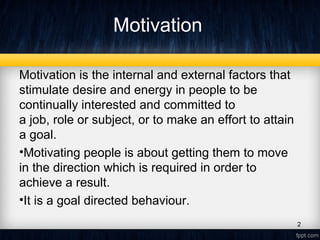
Motivation is the internal and external factors that
stimulate desire and energy in people to be
continually interested and committed to
a job, role or subject, or to make an effort to attain
a goal.
•Motivating people is about getting them to move
in the direction which is required in order to
achieve a result.
•It is a goal directed behaviour.
2
According to Stephen P Robbins Motivation is
“defined as the willingness to exert high
levels of effort towards organizational goals”
3
Nature and Importance of Motivation
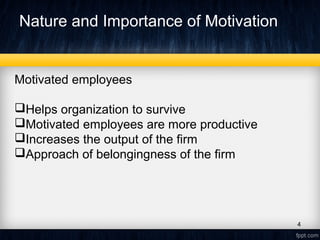
Motivated employees
Helps organization to survive
Motivated employees are more productive
Increases the output of the firm
Approach of belongingness of the firm
4
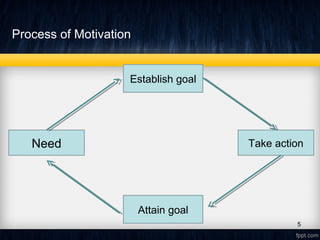
Process of Motivation
Need
Establish goal
Take action
Attain goal
5
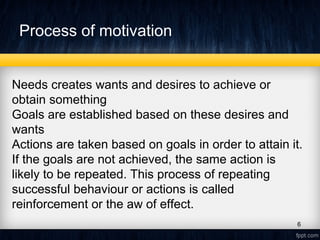
Process of motivation
Needs creates wants and desires to achieve or
obtain something
Goals are established based on these desires and
wants
Actions are taken based on goals in order to attain it.
If the goals are not achieved, the same action is
likely to be repeated. This process of repeating
successful behaviour or actions is called
reinforcement or the aw of effect.
6
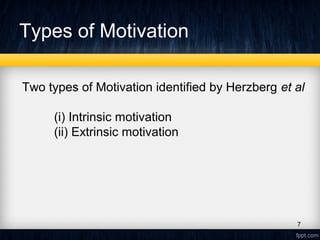
Types of Motivation
Two types of Motivation identified by Herzberg et al
(i) Intrinsic motivation
(ii) Extrinsic motivation
7
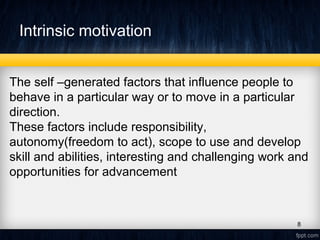
Intrinsic motivation
The self –generated factors that influence people to
behave in a particular way or to move in a particular
direction.
These factors include responsibility,
autonomy(freedom to act), scope to use and develop
skill and abilities, interesting and challenging work and
opportunities for advancement
8
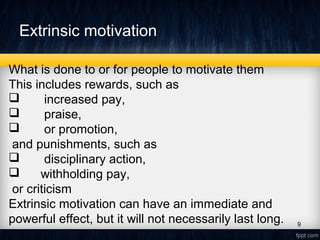
Extrinsic motivation
What is done to or for people to motivate them
This includes rewards, such as
 increased pay,
 praise,
 or promotion,
and punishments, such as
 disciplinary action,
 withholding pay,
or criticism
Extrinsic motivation can have an immediate and
powerful effect, but it will not necessarily last long. 9
Motivation Theory
The most influential theories of motivation are:
(i) Maslow’s Need Hierarchy Theory
(ii) Herzberg’s two factor model
10
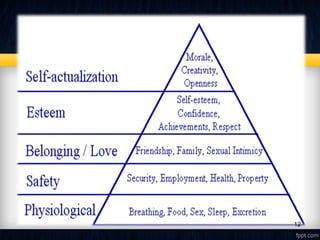
(i) Maslow’s need hierarchy
Abraham Maslow organized five major types of
human needs into a hierarchy.
The need hierarchy illustrates Maslow's conception of
people satisfying their needs in a specified order,
from bottom to top.
11
12
Theory states that
when a lower level need is satisfied, the next
highest becomes dominant and the individual’s
attention is turned to satisfying this higher need
13
(ii) Herzberg’s two factor theory
Frederick Herzberg developed the two-factor
theory of motivation based on satisfiers and
dissatisfiers.
Satisfiers are motivators associated with job
satisfaction while dissatisfiers are motivators
associated with hygiene or maintenance.
Satisfiers include achievement, responsibility,
advancement, and recognition 14
Satisfiers are all intrinsic motivators
Dissatisfiers are extrinsic motivators and include a
company’s policies and administration such as
supervision, peers, working conditions, and salary.
15
 The Two-Factor theory implies that the
managers must stress upon guaranteeing the
adequacy of the hygiene factors to avoid
employee dissatisfaction
 The managers must make sure that the work is
stimulating and rewarding so that the
employees are motivated to work and perform
harder and better
16
Methods for Motivating Employees
a. Rewards: 
Employees constantly look for payoffs for
their efforts.
They expect that good job performance lead to
organizational goal attainment, which in turn leads to
satisfying their individual goals or needs.
17
b. Challenging Jobs:
 This is done through job enrichment.
 Job enrichment means building motivators like
opportunities for achievement into the job by
making it more interesting and challenging
18
c. Using Merit Pay: 
 A merit raise is
a salary increase, usually permanent,
that is based on the
employee's individual performance.
 It is a continuing increment
rather than a single payment like a bonus.
 Relying heavily on merit rewards can be
a problem because the reinforcement benefits of
merit pay is usually only determined once per year19
d. Using Spot Awards:
   A spot award is one given to
an employee as soon as the laudable
performance is observed.
 These awards are consistent with principles
of motivation because they
are contingent on good performance and are awarded
immediately
20
e. Using Skill-Based Pay
 With skill-based pay, employees are paid for the
range, depth, and types of skills and knowledge
they are capable of using rather than for the job the
y currently hold
 The reward is a formal and concrete recognition
that the person can do the more challenging job well.
21
In a nutshell…..
 What is motivation
 Nature and importance of motivation
 Process of motivation
 Types of motivation
 Theories of motivation
 Methods of motivation 22
23

MOTIVATION IN HUMAN RESOURCE MANAGEMENT;

  • 1.
    MOTIVATION IN HUMAN RESOURCEMANAGEMENT Presented by Aashique P J Ananya P P Anumol George Nigita Ros Sajan Arya S B Ravi sankar 1
  • 2.
    Motivation Motivation is theinternal and external factors that stimulate desire and energy in people to be continually interested and committed to a job, role or subject, or to make an effort to attain a goal. •Motivating people is about getting them to move in the direction which is required in order to achieve a result. •It is a goal directed behaviour. 2
  • 3.
    According to StephenP Robbins Motivation is “defined as the willingness to exert high levels of effort towards organizational goals” 3
  • 4.
    Nature and Importanceof Motivation Motivated employees Helps organization to survive Motivated employees are more productive Increases the output of the firm Approach of belongingness of the firm 4
  • 5.
    Process of Motivation Need Establishgoal Take action Attain goal 5
  • 6.
    Process of motivation Needscreates wants and desires to achieve or obtain something Goals are established based on these desires and wants Actions are taken based on goals in order to attain it. If the goals are not achieved, the same action is likely to be repeated. This process of repeating successful behaviour or actions is called reinforcement or the aw of effect. 6
  • 7.
    Types of Motivation Twotypes of Motivation identified by Herzberg et al (i) Intrinsic motivation (ii) Extrinsic motivation 7
  • 8.
    Intrinsic motivation The self–generated factors that influence people to behave in a particular way or to move in a particular direction. These factors include responsibility, autonomy(freedom to act), scope to use and develop skill and abilities, interesting and challenging work and opportunities for advancement 8
  • 9.
    Extrinsic motivation What isdone to or for people to motivate them This includes rewards, such as  increased pay,  praise,  or promotion, and punishments, such as  disciplinary action,  withholding pay, or criticism Extrinsic motivation can have an immediate and powerful effect, but it will not necessarily last long. 9
  • 10.
    Motivation Theory The mostinfluential theories of motivation are: (i) Maslow’s Need Hierarchy Theory (ii) Herzberg’s two factor model 10
  • 11.
    (i) Maslow’s needhierarchy Abraham Maslow organized five major types of human needs into a hierarchy. The need hierarchy illustrates Maslow's conception of people satisfying their needs in a specified order, from bottom to top. 11
  • 12.
  • 13.
    Theory states that whena lower level need is satisfied, the next highest becomes dominant and the individual’s attention is turned to satisfying this higher need 13
  • 14.
    (ii) Herzberg’s twofactor theory Frederick Herzberg developed the two-factor theory of motivation based on satisfiers and dissatisfiers. Satisfiers are motivators associated with job satisfaction while dissatisfiers are motivators associated with hygiene or maintenance. Satisfiers include achievement, responsibility, advancement, and recognition 14
  • 15.
    Satisfiers are allintrinsic motivators Dissatisfiers are extrinsic motivators and include a company’s policies and administration such as supervision, peers, working conditions, and salary. 15
  • 16.
     The Two-Factortheory implies that the managers must stress upon guaranteeing the adequacy of the hygiene factors to avoid employee dissatisfaction  The managers must make sure that the work is stimulating and rewarding so that the employees are motivated to work and perform harder and better 16
  • 17.
    Methods for MotivatingEmployees a. Rewards:  Employees constantly look for payoffs for their efforts. They expect that good job performance lead to organizational goal attainment, which in turn leads to satisfying their individual goals or needs. 17
  • 18.
    b. Challenging Jobs:  Thisis done through job enrichment.  Job enrichment means building motivators like opportunities for achievement into the job by making it more interesting and challenging 18
  • 19.
    c. Using Merit Pay:   Amerit raise is a salary increase, usually permanent, that is based on the employee's individual performance.  It is a continuing increment rather than a single payment like a bonus.  Relying heavily on merit rewards can be a problem because the reinforcement benefits of merit pay is usually only determined once per year19
  • 20.
    d. Using Spot Awards:   A spot award is one given to an employee as soon as the laudable performance is observed.  These awards are consistent with principles of motivation because they are contingent on good performance and are awarded immediately 20
  • 21.
    e. Using Skill-Based Pay  Withskill-based pay, employees are paid for the range, depth, and types of skills and knowledge they are capable of using rather than for the job the y currently hold  The reward is a formal and concrete recognition that the person can do the more challenging job well. 21
  • 22.
    In a nutshell….. What is motivation  Nature and importance of motivation  Process of motivation  Types of motivation  Theories of motivation  Methods of motivation 22
  • 23.