What is incentives?
Why Incentives are Important?
What makes an Incentives plan effective?
Basic forms of incentives.
Classification of Incentives Plans
What is incentives?
The term INCENTIVES mean, something which
encourages a person to do something. Or the “extra
financial reward/ motivation”.
Why Incentives are Important?
Incentives are considered beneficial to both employers as well as
employees in following ways.
Workers are likely to work at their best when they are offered
monetary rewards for good performance.
 In the absence of mutual trust between management & workers, an
incentives may be viewed as an attempt to improve production/ profit only.
 Payment of incentives should be free from bias & established through
scientific/ proper work study.
 It should be easy to understand & simple to operate so that employee can
calculate their own earnings.
 It should provide equal opportunity to all workers to earn incentives pay.
 Plan should be flexible to adopt any changes later on.
 Payment of incentives should be prompt i.e. as early as possible.
 It should be adequate to motivate each employees.
 Every plan should be reviewed periodically.
What makes an Incentives plan effective?
Basic forms of incentives.
Basic forms of
incentives
Bonuses Merit
Commission for
sales people
Salary plan
Commission
plan
Combination
of both
 Bonus
 Incentive payment that is supplemental to the
base wage for cost reduction, quality
improvement, or other performance criteria.
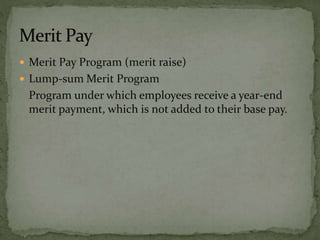
 Merit Pay Program (merit raise)
 Lump-sum Merit Program
Program under which employees receive a year-end
merit payment, which is not added to their base pay.
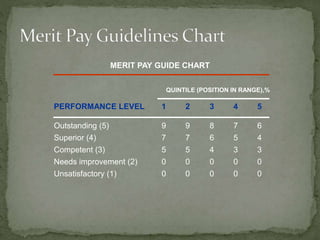
QUINTILE (POSITION IN RANGE),%
PERFORMANCE LEVEL 1 2 3 4 5
Outstanding (5) 9 9 8 7 6
Superior (4) 7 7 6 5 4
Competent (3) 5 5 4 3 3
Needs improvement (2) 0 0 0 0 0
Unsatisfactory (1) 0 0 0 0 0
MERIT PAY GUIDE CHART
Classification of Incentives Plans
 Profit sharing
 Co-partnership
 Gain-sharing
 ESOPs
 Stock Options
Incentives plans
Output-based
Individual
Time-based
Organization- wide Group
Time-based
 Time based incentive plan
– Under time based plan, per hour wage rate is determined &
incentives paid on the bases of time saved.
– Time based incentives plane is divided in four different ways.
– Hasley plan, Rowan plan, Emerson plan, Bedeuax plan.
– This all plan more or less follow same method i.e. (pay bonus on the
basis of timed saved by employee), but with different formula.
 Output based incentive plan
– Under output based plan, per piece wage rate is determined &
incentives paid on the bases of output produced. i.e. more output in
standard time OR standard output in less time.
– For output based incentive following 3 method can be used.
– Taylor plan, Merrick plan, Gnatt plan.
Individual
 Profit sharing
– Profit sharing is an arrangement by which employees receive in
addition to wages, a share is fixed in advance in profit of the
enterprise.
– It is an agreement between employer & his employee.
– According to International Labour Organization, “Profit-sharing is a
method of industrial remuneration under which an employer
undertakes to pay to employee, a share in net profit of the enterprise
in addition to regular wages”
 Co-partnership
– Co-partnership is an extension of profit-sharing.
– Under this method worker’s share in company’s profit is paid in the
form of share by which they become entitled to participate in
decision-making process.
Organization- wide – 1
 Gain-sharing
– This method aims at increasing productivity & decreasing labour
cost & sharing the result gains wit employee.
– It is based on a mathematical formula which compares a standard
perform with actual performance during given period.
– When actual performance exceed the standard performance, shaving
are shared with employees.
 ESOPs (Employee Stock Option Plans)
– This method is originated in the USA in early 90s.
– Under this plan, the eligible employee are allotted company’s share
below the market price.
– The term “stoke option” implies the right of eligible employee to
purchase a certain amount of stoke in future at an agreed price.
– The eligibility criteria may include length of service, contribution to
the department etc…
Organization- wide – 2
 Stock Options
A stock option is an incentive offered to employees that
want to invest their money into the company stock by
purchasing stock with pre-tax money. According to HR
Guide, employees that participate in a stock option
incentive plan are able to defer paying income tax on
the gains realized by their stock purchases until the
stock is sold. The company itself does not get any kind
of tax break by offering a stock option incentive, but it
does reap the benefits of selling more stock.
Organization- wide – 3
 Group based or team-based incentives plans reward all team members
equally based on overall performance of the team member.
 Under group based incentive plan, individual out put can’t be
measured.
 So team performance is evaluated on the basis of time taken rather
than output produced, if team complete their target in well advanced
to standard time the team member are eligible for incentives.
 Payment to team members may be made in the form of cash bonus or
in the form of non-cash reward such as pleasure trip, times off or
luxury items.
 Team based incentives foster cohesiveness among tem members.
 Methods for team based incentives plans are
– Preistman’s production plan
– Rucker plan
– Scalon plan
– Town plan and so on…
Group
Incentive ppt

Incentive ppt

  • 2.
    What is incentives? WhyIncentives are Important? What makes an Incentives plan effective? Basic forms of incentives. Classification of Incentives Plans
  • 3.
    What is incentives? Theterm INCENTIVES mean, something which encourages a person to do something. Or the “extra financial reward/ motivation”.
  • 4.
    Why Incentives areImportant? Incentives are considered beneficial to both employers as well as employees in following ways. Workers are likely to work at their best when they are offered monetary rewards for good performance.
  • 5.
     In theabsence of mutual trust between management & workers, an incentives may be viewed as an attempt to improve production/ profit only.  Payment of incentives should be free from bias & established through scientific/ proper work study.  It should be easy to understand & simple to operate so that employee can calculate their own earnings.  It should provide equal opportunity to all workers to earn incentives pay.  Plan should be flexible to adopt any changes later on.  Payment of incentives should be prompt i.e. as early as possible.  It should be adequate to motivate each employees.  Every plan should be reviewed periodically. What makes an Incentives plan effective?
  • 6.
    Basic forms ofincentives. Basic forms of incentives Bonuses Merit Commission for sales people Salary plan Commission plan Combination of both
  • 7.
     Bonus  Incentivepayment that is supplemental to the base wage for cost reduction, quality improvement, or other performance criteria.
  • 8.
     Merit PayProgram (merit raise)  Lump-sum Merit Program Program under which employees receive a year-end merit payment, which is not added to their base pay.
  • 9.
    QUINTILE (POSITION INRANGE),% PERFORMANCE LEVEL 1 2 3 4 5 Outstanding (5) 9 9 8 7 6 Superior (4) 7 7 6 5 4 Competent (3) 5 5 4 3 3 Needs improvement (2) 0 0 0 0 0 Unsatisfactory (1) 0 0 0 0 0 MERIT PAY GUIDE CHART
  • 10.
    Classification of IncentivesPlans  Profit sharing  Co-partnership  Gain-sharing  ESOPs  Stock Options Incentives plans Output-based Individual Time-based Organization- wide Group Time-based
  • 11.
     Time basedincentive plan – Under time based plan, per hour wage rate is determined & incentives paid on the bases of time saved. – Time based incentives plane is divided in four different ways. – Hasley plan, Rowan plan, Emerson plan, Bedeuax plan. – This all plan more or less follow same method i.e. (pay bonus on the basis of timed saved by employee), but with different formula.  Output based incentive plan – Under output based plan, per piece wage rate is determined & incentives paid on the bases of output produced. i.e. more output in standard time OR standard output in less time. – For output based incentive following 3 method can be used. – Taylor plan, Merrick plan, Gnatt plan. Individual
  • 12.
     Profit sharing –Profit sharing is an arrangement by which employees receive in addition to wages, a share is fixed in advance in profit of the enterprise. – It is an agreement between employer & his employee. – According to International Labour Organization, “Profit-sharing is a method of industrial remuneration under which an employer undertakes to pay to employee, a share in net profit of the enterprise in addition to regular wages”  Co-partnership – Co-partnership is an extension of profit-sharing. – Under this method worker’s share in company’s profit is paid in the form of share by which they become entitled to participate in decision-making process. Organization- wide – 1
  • 13.
     Gain-sharing – Thismethod aims at increasing productivity & decreasing labour cost & sharing the result gains wit employee. – It is based on a mathematical formula which compares a standard perform with actual performance during given period. – When actual performance exceed the standard performance, shaving are shared with employees.  ESOPs (Employee Stock Option Plans) – This method is originated in the USA in early 90s. – Under this plan, the eligible employee are allotted company’s share below the market price. – The term “stoke option” implies the right of eligible employee to purchase a certain amount of stoke in future at an agreed price. – The eligibility criteria may include length of service, contribution to the department etc… Organization- wide – 2
  • 14.
     Stock Options Astock option is an incentive offered to employees that want to invest their money into the company stock by purchasing stock with pre-tax money. According to HR Guide, employees that participate in a stock option incentive plan are able to defer paying income tax on the gains realized by their stock purchases until the stock is sold. The company itself does not get any kind of tax break by offering a stock option incentive, but it does reap the benefits of selling more stock. Organization- wide – 3
  • 15.
     Group basedor team-based incentives plans reward all team members equally based on overall performance of the team member.  Under group based incentive plan, individual out put can’t be measured.  So team performance is evaluated on the basis of time taken rather than output produced, if team complete their target in well advanced to standard time the team member are eligible for incentives.  Payment to team members may be made in the form of cash bonus or in the form of non-cash reward such as pleasure trip, times off or luxury items.  Team based incentives foster cohesiveness among tem members.  Methods for team based incentives plans are – Preistman’s production plan – Rucker plan – Scalon plan – Town plan and so on… Group