EMPLOYEE 
BENEFITS AND 
COMPENSATION 
PHILOSOPHY OF REWARD 
MANAGEMENT 
Habibu Ayuba; B.Sc; PGDE; M.Sc; ACA in-view 
08030527135 
11/01/14 octorber,2013 1
OBJECTIVES OF THE PRESENTATION 
At the end of the session the 
participants should be able to: 
 Define the philosophy of a reward 
management. 
 Understand the characteristics/qualities of the 
sound philosophy of the reward management. 
 Examine the factors influencing organizational 
philosophy of reward management. 
 Identify predetermined dangerous myths about 
employees’ pay. 
11/01/14 octorber,2013 2
Philosophy of reward/compensation 
management 
A philosophy is seen as a critical examination of the ground 
for the fundamental beliefs and analysis of the basic 
concepts employed in the expression of such beliefs. 
 Therefore, Philosophy of reward is a set of beliefs and guiding 
principles that are consistent with the value of the organization 
which is built in the companies’ compensation package and is 
aimed at achieving the following: 
 fairness, 
 equity, 
 efficiency 
 consistency and 
 transparency in the compensation system. 
The philosophy emphases on investing in the human capital 
thereby a reasonable returns (Return on investment) as 
required can be achieved. 
11/01/14 octorber,2013 3
Philosophy of rewards… 
cont…. 
 The philosophy assumes that the reward should be designed to reward 
employees differently in accordance with their contribution to 
organizational goal. 
 The reward policy must be strategic aimed at achieving longer term 
result with regard to how employee should be valued for what they do or 
what they achieve. 
 Its implementation always flows from the business strategy. 
 The philosophy adopts total reward approach to compensation which is 
aimed at achieving employees’ Motivation, Commitment, Engagement 
and Development. 
 It assumes to be acting as an integral part of a company’s overall 
Human resource management approach in managing people. 
 It is also affected by the organizational business strategy and human 
resources strategy. The formulation and survival of sound philosophy of 
reward management is relied on the external environment’s action and 
factors. These factors are herewith highlighted next. 
11/01/14 octorber,2013 4
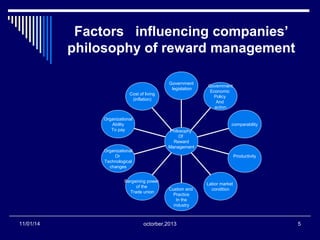
Factors influencing companies’ 
philosophy of reward management 
Cost of living 
(inflation) 
Organizational 
Ability 
To pay 
Organizational 
Or 
Technological 
changes 
Bargaining power 
Government 
legislation 
Philosophy 
Of 
Reward 
Management 
of the 
Trade union Custom and 
Practice 
In the 
industry 
Government 
Economic 
Policy 
comparability 
And 
action 
Labor market 
condition 
Productivity 
11/01/14 octorber,2013 5
Characteristics/Qualities 
of the 
Philosophy of Reward Management 
 Notably; managers are confronted with numerous 
challenges in determining how to reward employees. 
 There needs to balance the market competitiveness , 
internal equity, organizational performance and individual 
performance when designing attractive pay system that 
will shape organizational philosophy of reward 
management. 
 These qualities; as presented next; have been empirically 
determined as factors that contribute to and strongly 
related to/associated with employees'’ perception of pay, 
their attitude and pay/ job satisfaction. 
11/01/14 octorber,2013 6
Fairness 
as characteristic of the sound philosophy 
 Fairness: implies that the philosophy should be capable 
of being maintained to ensure that the compensation 
system treat all the stakeholders equally and without 
favoring any group (management versus subordinates, 
company versus staff etc) at the expense of another. 
 Reward programs, policies and practices that are not 
perceived as fair will not necessarily and successfully 
attract, retain and engage employees. 
 Reward fairness (Scott. D, McMullen. T, and Royal .M; 
2011) have been found to be strongly related to 
employee attitude including pay satisfaction. 
11/01/14 octorber,2013 7
Equity and justice 
as characteristic of the sound philosophy 
 Equity: implies that not only justice according to 
natural law/right or freedom from bias or 
favoritism the system is free from but all jobs 
are categorized into job grades with reference 
to the job content and job sizes so as the same 
salary/pay range is apply to individuals of the 
same job grade. 
 Equity and justice are related concepts that 
have been determined as related constructs 
that are found to be strongly related to 
employees’ pay satisfaction. 
11/01/14 octorber,2013 8
Efficiency 
as characteristic of the sound philosophy 
 Efficiency: implies that an achievement of the 
compensation’ system principles is made at a 
reasonable cost and within the organizational 
budget. 
 Efficient compensation system is the package 
whose components are items that are related to 
employees’ pay only. 
 All other items of pay such as vouchers to 
assist someone, training allowance if it is not 
paid together with salary, Executive donation 
and gifts Etc; should not constitute part of 
compensation package. 
11/01/14 octorber,2013 9
Consistency 
as characteristic of the sound philosophy 
 Consistency: implies an ability of a 
reward system to be designed and 
prepared to maintain uniformity in pay 
structure thereby all similar items or 
individuals are treated equally over a 
long period of time. 
 It enhances employees’ feeling of 
equitably treated. 
11/01/14 octorber,2013 10
Transparency 
as characteristic of the sound philosophy 
 Transparency: implies that the 
compensation system is designed in 
such a way that all stakeholders can 
interpret it with minimum effort and is 
accessible to all stakeholders. 
 Transparent reward system enhances 
employees’ satisfaction on pay. 
11/01/14 octorber,2013 11
Dangerous Myths 
about 
Employees’ Pay 
Myth is a popular belief/tradition that has grown up around 
something/someone embodying the ideals and institutions of a 
society or its segment and usually is having an imaginary or 
unverifiable existence. 
The dangerous myths about employee compensation are as 
follows: 
 People works for money. 
 Employee incentive pay improves his performance. 
 Labor rates and labor costs are the same. 
 Labor costs are lowered by cutting labor rate. 
 Labor costs constitute a significant proportion of 
organization's total costs. 
 Low labor costs are a potent and sustainable competitive 
weapon to organization 
11/01/14 octorber,2013 12
Six Dangerous Myths 
Managers are made to believe due to 
the much circulated conventional 
wisdom and public discussion about pay 
which are largely misleading, incorrect 
and sometime both. This results in 
business person and managers ended 
up adopting wrongheaded notions about 
how to pay employees and why. This 
belief serves as genesis of these six(6) 
dangerous Myths about Pay. 
11/01/14 octorber,2013 13
Employees work for Money 
 Money is not a motivator as discovered. It is 
hygienic factor which only make employees to 
experience job no satisfaction. 
 To be satisfied with the work, employees need 
the job to be even more meaningful to their 
lives. To be a work works to have fun. Thus, the 
company/manager who share the belief usually 
ends up as bribing their employees which later 
in the long run manifest itself as employees’ 
lack of loyalty and commitment to the 
organization. 
11/01/14 octorber,2013 14
Employee incentive pay 
improves his performance 
 It was discovered in practice and in reality, it 
rather undermines performance of the individual 
and the organization. 
 Studies have strongly suggested that individual 
employee’s incentives pay undermine team 
work and encourages a short-term focus. 
 It leads people to believe that pay is not related 
to performance at all, instead, it is about having 
right relationships and ingratiating personality. 
11/01/14 octorber,2013 15
Labor Rate and Labor Cost are the same 
 Labor rates are straight total wages 
divided by the time/output. 
 Labor cost, however, is a calculation of 
how much a company pays its people in 
one hand and how much they produce, 
on the other hand. 
 Labor rate is relative to time/output while 
labor cost is relative to employees’ 
productivity. 
11/01/14 octorber,2013 16
Labor costs are lowered by cutting labor rate 
 This belief is bought by managers who agree 
that labor costs are the same with labor rates. 
 Thus, since labor costs are the function of labor 
rates and labor productivity simultaneously, 
lowering them requires the need to address 
both productivity and rate. But, denominator 
Mangers find it difficult to do that. 
 That is why, sometime, lowering labor rate, 
instead, increases labor costs. Because, 
productivity may suffer due to low morale of 
employees. 
11/01/14 octorber,2013 17
Labor costs constitute a 
significant proportion of total 
organizational cost 
 The assertion is true only if the labor costs is 
proportional to a total costs. 
 It is noted that labor costs, sometime, do not 
proportionally vary with the total organizational 
cost. Because, labor costs usually vary widely 
according to the type of industry and 
companies. 
 This has encouraged denominator managers to 
improves their performance by cutting labor 
cost which is the only most immediate 
malleable expenses. 
 Managers should be developed and trained to 
act as numerator managers. 
11/01/14 octorber,2013 18
Low labor costs are a potent 
and sustainable competitive 
weapon 
 Although, professor porter suggested in his generic 
strategy (costs, differentiation, focus), he does not say 
labor cost along is the total cost of an organization. 
 Low labor costs is good, but, is a most slippery and least 
sustainable way to compete. It can easily be copied. 
 There are many competitive strategic advantage through 
quality, product/service, customer care services, 
product/process/service innovation or technology 
leadership which a company can adopt and are even 
very difficult to be imitated than the labor costs cut. 
11/01/14 octorber,2013 19
conclusion 
 Critically examining these myths, one can 
observe how the belief system usually 
undermine the effort of company to justify the 
qualities/characteristics of sound philosophy of 
reward management. 
 In addition, it is observed that many 
motivational theories’ assertions have 
confirmed many of these submission. 
 The relevant theories include: Two factors 
theory of motivation (Herzberg,1966); Equity 
theory of motivation (Adams, 1963); 
Expectancy theory of motivation (Vroom,1964) 
to name but few. 
11/01/14 octorber,2013 20
Thanks for Listening and 
Attendance 
11/01/14 octorber,2013 21

Employee benefits and compensation2

  • 1.
    EMPLOYEE BENEFITS AND COMPENSATION PHILOSOPHY OF REWARD MANAGEMENT Habibu Ayuba; B.Sc; PGDE; M.Sc; ACA in-view 08030527135 11/01/14 octorber,2013 1
  • 2.
    OBJECTIVES OF THEPRESENTATION At the end of the session the participants should be able to:  Define the philosophy of a reward management.  Understand the characteristics/qualities of the sound philosophy of the reward management.  Examine the factors influencing organizational philosophy of reward management.  Identify predetermined dangerous myths about employees’ pay. 11/01/14 octorber,2013 2
  • 3.
    Philosophy of reward/compensation management A philosophy is seen as a critical examination of the ground for the fundamental beliefs and analysis of the basic concepts employed in the expression of such beliefs.  Therefore, Philosophy of reward is a set of beliefs and guiding principles that are consistent with the value of the organization which is built in the companies’ compensation package and is aimed at achieving the following:  fairness,  equity,  efficiency  consistency and  transparency in the compensation system. The philosophy emphases on investing in the human capital thereby a reasonable returns (Return on investment) as required can be achieved. 11/01/14 octorber,2013 3
  • 4.
    Philosophy of rewards… cont….  The philosophy assumes that the reward should be designed to reward employees differently in accordance with their contribution to organizational goal.  The reward policy must be strategic aimed at achieving longer term result with regard to how employee should be valued for what they do or what they achieve.  Its implementation always flows from the business strategy.  The philosophy adopts total reward approach to compensation which is aimed at achieving employees’ Motivation, Commitment, Engagement and Development.  It assumes to be acting as an integral part of a company’s overall Human resource management approach in managing people.  It is also affected by the organizational business strategy and human resources strategy. The formulation and survival of sound philosophy of reward management is relied on the external environment’s action and factors. These factors are herewith highlighted next. 11/01/14 octorber,2013 4
  • 5.
    Factors influencing companies’ philosophy of reward management Cost of living (inflation) Organizational Ability To pay Organizational Or Technological changes Bargaining power Government legislation Philosophy Of Reward Management of the Trade union Custom and Practice In the industry Government Economic Policy comparability And action Labor market condition Productivity 11/01/14 octorber,2013 5
  • 6.
    Characteristics/Qualities of the Philosophy of Reward Management  Notably; managers are confronted with numerous challenges in determining how to reward employees.  There needs to balance the market competitiveness , internal equity, organizational performance and individual performance when designing attractive pay system that will shape organizational philosophy of reward management.  These qualities; as presented next; have been empirically determined as factors that contribute to and strongly related to/associated with employees'’ perception of pay, their attitude and pay/ job satisfaction. 11/01/14 octorber,2013 6
  • 7.
    Fairness as characteristicof the sound philosophy  Fairness: implies that the philosophy should be capable of being maintained to ensure that the compensation system treat all the stakeholders equally and without favoring any group (management versus subordinates, company versus staff etc) at the expense of another.  Reward programs, policies and practices that are not perceived as fair will not necessarily and successfully attract, retain and engage employees.  Reward fairness (Scott. D, McMullen. T, and Royal .M; 2011) have been found to be strongly related to employee attitude including pay satisfaction. 11/01/14 octorber,2013 7
  • 8.
    Equity and justice as characteristic of the sound philosophy  Equity: implies that not only justice according to natural law/right or freedom from bias or favoritism the system is free from but all jobs are categorized into job grades with reference to the job content and job sizes so as the same salary/pay range is apply to individuals of the same job grade.  Equity and justice are related concepts that have been determined as related constructs that are found to be strongly related to employees’ pay satisfaction. 11/01/14 octorber,2013 8
  • 9.
    Efficiency as characteristicof the sound philosophy  Efficiency: implies that an achievement of the compensation’ system principles is made at a reasonable cost and within the organizational budget.  Efficient compensation system is the package whose components are items that are related to employees’ pay only.  All other items of pay such as vouchers to assist someone, training allowance if it is not paid together with salary, Executive donation and gifts Etc; should not constitute part of compensation package. 11/01/14 octorber,2013 9
  • 10.
    Consistency as characteristicof the sound philosophy  Consistency: implies an ability of a reward system to be designed and prepared to maintain uniformity in pay structure thereby all similar items or individuals are treated equally over a long period of time.  It enhances employees’ feeling of equitably treated. 11/01/14 octorber,2013 10
  • 11.
    Transparency as characteristicof the sound philosophy  Transparency: implies that the compensation system is designed in such a way that all stakeholders can interpret it with minimum effort and is accessible to all stakeholders.  Transparent reward system enhances employees’ satisfaction on pay. 11/01/14 octorber,2013 11
  • 12.
    Dangerous Myths about Employees’ Pay Myth is a popular belief/tradition that has grown up around something/someone embodying the ideals and institutions of a society or its segment and usually is having an imaginary or unverifiable existence. The dangerous myths about employee compensation are as follows:  People works for money.  Employee incentive pay improves his performance.  Labor rates and labor costs are the same.  Labor costs are lowered by cutting labor rate.  Labor costs constitute a significant proportion of organization's total costs.  Low labor costs are a potent and sustainable competitive weapon to organization 11/01/14 octorber,2013 12
  • 13.
    Six Dangerous Myths Managers are made to believe due to the much circulated conventional wisdom and public discussion about pay which are largely misleading, incorrect and sometime both. This results in business person and managers ended up adopting wrongheaded notions about how to pay employees and why. This belief serves as genesis of these six(6) dangerous Myths about Pay. 11/01/14 octorber,2013 13
  • 14.
    Employees work forMoney  Money is not a motivator as discovered. It is hygienic factor which only make employees to experience job no satisfaction.  To be satisfied with the work, employees need the job to be even more meaningful to their lives. To be a work works to have fun. Thus, the company/manager who share the belief usually ends up as bribing their employees which later in the long run manifest itself as employees’ lack of loyalty and commitment to the organization. 11/01/14 octorber,2013 14
  • 15.
    Employee incentive pay improves his performance  It was discovered in practice and in reality, it rather undermines performance of the individual and the organization.  Studies have strongly suggested that individual employee’s incentives pay undermine team work and encourages a short-term focus.  It leads people to believe that pay is not related to performance at all, instead, it is about having right relationships and ingratiating personality. 11/01/14 octorber,2013 15
  • 16.
    Labor Rate andLabor Cost are the same  Labor rates are straight total wages divided by the time/output.  Labor cost, however, is a calculation of how much a company pays its people in one hand and how much they produce, on the other hand.  Labor rate is relative to time/output while labor cost is relative to employees’ productivity. 11/01/14 octorber,2013 16
  • 17.
    Labor costs arelowered by cutting labor rate  This belief is bought by managers who agree that labor costs are the same with labor rates.  Thus, since labor costs are the function of labor rates and labor productivity simultaneously, lowering them requires the need to address both productivity and rate. But, denominator Mangers find it difficult to do that.  That is why, sometime, lowering labor rate, instead, increases labor costs. Because, productivity may suffer due to low morale of employees. 11/01/14 octorber,2013 17
  • 18.
    Labor costs constitutea significant proportion of total organizational cost  The assertion is true only if the labor costs is proportional to a total costs.  It is noted that labor costs, sometime, do not proportionally vary with the total organizational cost. Because, labor costs usually vary widely according to the type of industry and companies.  This has encouraged denominator managers to improves their performance by cutting labor cost which is the only most immediate malleable expenses.  Managers should be developed and trained to act as numerator managers. 11/01/14 octorber,2013 18
  • 19.
    Low labor costsare a potent and sustainable competitive weapon  Although, professor porter suggested in his generic strategy (costs, differentiation, focus), he does not say labor cost along is the total cost of an organization.  Low labor costs is good, but, is a most slippery and least sustainable way to compete. It can easily be copied.  There are many competitive strategic advantage through quality, product/service, customer care services, product/process/service innovation or technology leadership which a company can adopt and are even very difficult to be imitated than the labor costs cut. 11/01/14 octorber,2013 19
  • 20.
    conclusion  Criticallyexamining these myths, one can observe how the belief system usually undermine the effort of company to justify the qualities/characteristics of sound philosophy of reward management.  In addition, it is observed that many motivational theories’ assertions have confirmed many of these submission.  The relevant theories include: Two factors theory of motivation (Herzberg,1966); Equity theory of motivation (Adams, 1963); Expectancy theory of motivation (Vroom,1964) to name but few. 11/01/14 octorber,2013 20
  • 21.
    Thanks for Listeningand Attendance 11/01/14 octorber,2013 21