Performance-based pay and
        teachers:


 AN EXAMINATION OF CONSEQUENCES ON
  INTRINSIC MOTIVATION AND WORKER-
       EMPLOYEE RELATIONSHIPS.
Introduction


 How performance-based pay affects teaching
 profession
Introduction


 Extrinsic Motivators (or rewards) Influences:
   Intrinsic motivation

   Working relationships
    Superiors
    Colleagues
Introduction


 Poor student achievement:
   Increased awareness toward public education

   Resulted in many new education reforms
Introduction


 Performance-based pay is used to:
   Motivate teachers

   Raise instructional quality

   Increase student achievement

   Locating inadequate teachers
Outline
Outline

 Types of Incentives
 Use of rewards in different countries
Outline

 Types of Incentives
 Use of rewards in different countries
 Reasons for using performance-based pay
Outline

 Types of Incentives
 Use of rewards in different countries
 Reasons for using performance-based pay
 What research says about the use of performance-
 based pay
Outline

 Types of Incentives
 Use of rewards in different countries
 Reasons for using performance-based pay
 What research says about the use of performance-
  based pay
 Methods used to evaluate teachers
Outline

 Types of Incentives
 Use of rewards in different countries
 Reasons for using performance-based pay
 What research says about the use of performance-
  based pay
 Methods used to evaluate teachers
 Factors which lead to reduced teacher morale
Outline

 Types of Incentives
 Use of rewards in different countries
 Reasons for using performance-based pay
 What research says about the use of performance-
  based pay
 Methods used to evaluate teachers
 Factors which lead to reduced teacher morale
 Risks of using rewards in the workplace
Outline

 Types of Incentives
 Use of rewards in different countries
 Reasons for using performance-based pay
 What research says about the use of performance-
    based pay
   Methods used to evaluate teachers
   Factors which lead to reduced teacher morale
   Risks of using rewards in the workplace
   Conclusion
Types of Incentives

Monetary             Non-Monetary
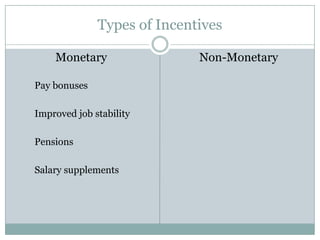
Types of Incentives

    Monetary                 Non-Monetary

Pay bonuses

Improved job stability

Pensions

Salary supplements
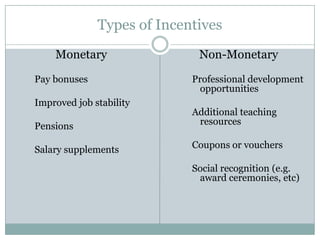
Types of Incentives
    Monetary                 Non-Monetary

Pay bonuses                 Professional development
                              opportunities
Improved job stability
                            Additional teaching
Pensions                     resources

Salary supplements          Coupons or vouchers

                            Social recognition (e.g.
                             award ceremonies, etc)
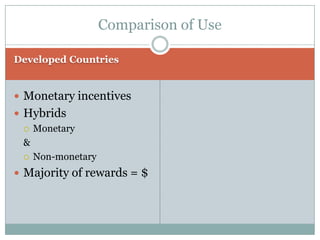
Comparison of Use

Developed Countries


 Monetary incentives
 Hybrids
   Monetary

  &
   Non-monetary

 Majority of rewards = $
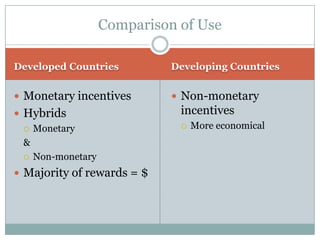
Comparison of Use

Developed Countries          Developing Countries


 Monetary incentives         Non-monetary
 Hybrids                     incentives
   Monetary                     More economical
  &
   Non-monetary

 Majority of rewards = $
Rationale

Improve student academic achievement.

Improve instructional abilities and quality

Increase education standards

Increased teacher work ethic
Capitalism & Education


 Money is the only true form of motivation
 Corporate routines and ethos have influenced
 mainstream education
Capitalism & Education


 Money is the only true form of motivation
 Corporate routines and ethos have influenced
  mainstream education
 Competition for additional funding
     Race to the Top
 Competition will produce
   Increased levels of instruction
   New “types” of teachers who thrive in a competitive
    environment
   A means to identify and remove weak performers
Research says…


 Performance-based pay ≠ Increased student
 achievement
Research says…


 Performance-based pay ≠ Increased student
  achievement
 Frequency of work-related incentives is increasing
Research says…


 Performance-based pay ≠ Increased student
  achievement
 Frequency of work-related incentives is increasing
 Performance-based pay ≠ Increased work quality
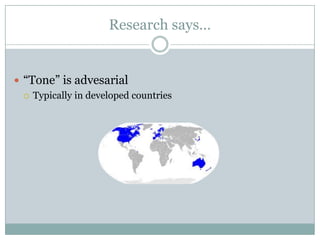
Research says…


 “Tone” is advesarial
   Typically in developed countries
Research says… Benefits?


 Reduced teacher mobility between schools
   “Undesirable” schools experienced increased teacher stability
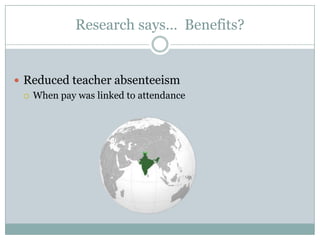
Research says… Benefits?


 Reduced teacher absenteeism
   When pay was linked to attendance
Benefits? However…


 Some teachers sought out schools with performance-
 based pay
    Good teachers moved in order to qualify for higher earnings
    Struggling schools could not hold onto good teachers
Research says…


 Performance based-pay needs to be
   Linked to instructional quality
Research says…


 Performance based-pay needs to be
   Linked to instructional quality

   Transparent to teachers that evaluation methods truly assess
    high quality instruction
Teacher Evaluation

 All tasks are not created equal
   Nor should be evaluated equally
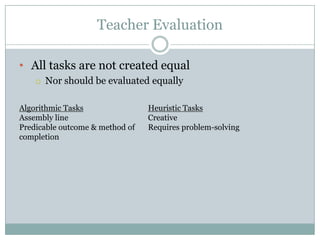
Teacher Evaluation

• All tasks are not created equal
    o Nor should be evaluated equally

Algorithmic Tasks                Heuristic Tasks
Assembly line                    Creative
Predicable outcome & method of   Requires problem-solving
completion
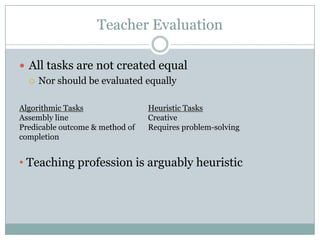
Teacher Evaluation

 All tasks are not created equal
   Nor should be evaluated equally


Algorithmic Tasks                Heuristic Tasks
Assembly line                    Creative
Predicable outcome & method of   Requires problem-solving
completion


• Teaching profession is arguably heuristic
Teacher Evaluation


 How evaluations are used:
   Administrators
      Utilized results to assess teacher’s involvement in school (outside
       of regular teaching schedule)
Teacher Evaluation


 How evaluations are used:
   Administrators
        Utilized results to assess teacher’s involvement in school (outside
         of regular teaching schedule)
    Teachers
      Want results to reflect teaching strengths
      Identify instructional areas that need improvement
Human Motivation Theories


 Range of human needs
   Basic  Food, water, shelter

   Complex  Interests, potential activities that lead to success
Human Motivation Theories


 Extrinsic rewards
   Reduce intrinsic motivation

   Potentially reduce perceived worker autonomy
Human Motivation & Autonomy


 Autonomy is a common thread between many
  human motivation theories
 Autonomy is reduced:
    With overuse use of worker monitoring
    Increased frequency of worker evaluations
Human Motivation & Mainstream Ideals


 Intrinsic motivation & autonomy are given little
  consideration
 Motivation ≠ Intrinsic + Extrinsic according to
  economists
 Money represents the only motivator for all workers
Quality of Work


 Decreased motivation = decreased quality
Quality of Work


 Decreased motivation = decreased quality
 Worker apathy is created with perceived loss of
 autonomy and reduce intrinsic motivation
Low Teacher Morale


 Factors leading to reduced morale:
   Low fixed wages (more common in developing countries)
Low Teacher Morale


 Factors leading to reduced morale:
   Low fixed wages (more common in developing countries)

   New policies
Low Teacher Morale


 Factors leading to reduced morale:
   Low fixed wages (more common in developing countries)

   New policies

   Reduced teacher bargaining rights
Risks of Using Incentives


 Opportunistic behaviour
   Teaching to test

   Reduced teamwork

   Increased teacher mobility
Risks of Using Incentives


 Opportunistic behaviour
   Teaching to test

   Reduced teamwork

   Increased teacher mobility

 Narrowed focus
   Focus on achieving rewards becomes teacher’s primary
    concern
   Aspects of job deemed irrelevant if they did not contribute to
    attaining incentive(s)
Risks of Using Incentives


 Opportunistic behaviour
   Teaching to test
   Reduced teamwork
   Increased teacher mobility

 Narrowed focus
   Focus on achieving rewards becomes teacher’s primary
    concern
   Aspects of job deemed irrelevant if they did not contribute to
    attaining incentive(s)
 Increased resentment toward authority
Conclusion


 Research fails to determine that performance-based
  pays increases:
     Student achievement
     Instructional quality
 Planning process:
   Requires much consideration before implementation

   Should be transparent

   Should allow teacher input
Conclusion


 Alternative Rewards
   Greater consideration for non-monetary incentives

   Alternative rewards may also create cost-saving incentives

 Trust
   Shift in focus from competition to collaboration

   Trust (with accurate tools to measure accountability) should be
    placed back into the teaching profession
References

Amiable, T.M. (1993). Motivational synergy: Toward new
 conceptualization of intrinsic and extrinsic motivation in the
 workplace. Human Resource Management Review, 3(3), 185.
 doi:10.1016/1053-4822(93)90012-S

Andrews, H.A. (2011). Supporting quality teachers with recognition.
  Australian Journal of Teacher Education, 36(12), 59-70.

Ballot, D. (2001). Pay for performance in public schools. Economics
  of Education Review, 20, 51-61.
References

Barkema, H.G. (1995). Do job executives work harder when they are
  monitored? Kyklos, 48, 19–42.

Buck, S., & Greene, J.P. (2011). Blocked, diluted, and co-opted:
  Interest groups wage war against merit pay. Education Next, 11(2),
  26-31.

Camerer, C.F. (2010). Removing financial incentives demotivates the
  brain. Proceedings of the National Academy of Sciences of The
  United States of America, 107(49), 20849-20850.
  doi:10.1073/pnas.1016108107
References

Chamberlin, R., Wragg, T., Haynes, G., &Wragg, C. (2002).
  Performance-related pay and the teaching profession: A review of
  the literature. Research Papers in Education, 17(1), 31-49.
  doi:10.1080/02671520110102534

Cohen, D.K., &Murnane, R.J. (1985). The merits of merit pay.
  Retrieved from
  http://eric.ed.gov/ERICWebPortal/search/detailmini.jsp?_nfpb=tr
  ue&_&ERICExtSearch_SearchValue_0=ED270843&ERICExtSearc
  h_SearchType_0=no&accno=ED270843

Deckop&Cirka. (2000). The risk and reward of a double-edged sword:
  Effects of a merit pay program on intrinsic motivation. Nonprofit &
  Voluntary Sector Quarterly, 29(3), 400-418.
  doi:10.1177/0899764000293003
References

Dee, T.S., & Keys, B.J. (2004). Does merit pay reward good teachers?
  Evidence from a randomized experiment. Journal of Policy
  Analysis & Management, 23(3), 471-488. doi:10.1002/pam.20022

Frey, B.S. (1993). Does monitoring increase work effort? The rivalry
  between trust and loyalty. Economic Inquiry, 31(4), 663–670.
  doi:10.1111/j.1465-7295.1993.tb00897.x

Frey, B.S., &Jegen, R. (2001). Motivation crowding theory. Journal of
  Economic Surveys, 15(5), 589–611. doi:10.1111/1467-6419.00150
References

Goodman, S., & Turner, L. (2011). Does whole-school performance pay
  improve student learning? Evidence from the New York City
  schools. Education Next, 11(2), 67-71.

Griffith, S.A. (2008). A proposed model for assessing quality of
  education. International Review Of Education, 54(1), 99-112.
  doi:10.1007/s11159-007-9072-x

Guarino, C.M., Brown, A.B., & Wyse, A.E. (2011). Can districts keep
  good teachers in the schools that need them most?. Economics of
  Education Review, 30(5), 962-979.
References

Hatry, H.P., Greiner, J.M., & Urban Inst., W.C. (1984). Issues in
 teacher incentive plans. Retrieved from
 http://eric.ed.gov/ERICWebPortal/search/detailmini.jsp?_nfpb=tr
 ue&_&ERICExtSearch_SearchValue_0=ED244340&ERICExtSearc
 h_SearchType_0=no&accno=ED244340

Howell, W., Peterson, P.E., & West, M. (2011a). The public weighs in
 on school reform: Intense controversies do not alter public thinking,
 but teachers differ more sharply than ever. Education Next, 11(4),
 10-22.

Howell, W., West, M., & Peterson, P.E. (2011b). Meeting of the minds.
 Education Next, 11(1), 20-31.
References

James, H.S. (2005). Why did you do that? An economic examination
  of the effect of extrinsic compensation on intrinsic motivation and
  performance. Journal Of Economic Psychology, 26(4), 549-566.
  doi:10.1016/j.joep.2004.11.002

Kessler, I., & Purcell, J. (1991). Performance-related pay: theory and
  practice. Paper presented at the 10th Colloquium for the European
  Group of Organisation Studies, Vienna, July 1991. Oxford:
  Templeton College: The Oxford Centre for Management Studies.

Kobakhidze, M. (2010). Teacher incentives and the future of merit-
  based pay in Georgia. European Education, 42(3), 68-89.
  doi:10.2753/EUE1056-4934420304
References

Lavy, L. (2007). Using performance-based pay to improve the quality
  of teachers. Future of Children, 17(1), 87–108.
  doi:10.1353/foc.2007.0007

Locke, E., Feren, D., McCaleb, V., Shaw, K., & Denny, A. (1980). The
  relative effectiveness of four ways of motivating employee
  performance. In Changes in Working Life, ed. KD Duncan, MM
  Gruenberg, D Wallis, pp. 363–88. New York: Wiley

Markova, G., & Ford, C. (2011). Is money the panacea? Rewards for
 knowledge workers. International Journal Of Productivity And
 Performance Management, 60(8), 813-823.
 doi:10.1108/17410401111182206
References

Matsumura, L., Garnier, H., Pascal, J., &Valdés, R. (2002). Measuring
 instructional quality in accountability systems: Classroom
 assignments and student achievement. Educational
 Assessment,8(3), 207-229. doi:10.1207/S15326977EA0803_01

McCollum, S. (2001). How merit pay improves education. Educational
 Leadership, 58(5), 21-24.

McKeachie, W.J. (1997). Student ratings the validity of use. American
 Psychologist 52(11), 1218–1225. doi:10.1037//0003-
 066X.52.11.1218
References

McLeod, D.B., Stake, R.E., Schappelle, B., Mellissinos, M., &Gierl. M.
 (1996). Setting the standards: NCTM’s role in the reform of
 mathematics education. In: Bold Ventures: U.S. Innovations in
 Science And Mathematics Education. Vol 3: Cases in Mathematics
 Education, ed. by Senta A. Raizen and Edward D. Britton, 13–132.
 Dordrecht, The Netherlands: Kluwer.

Muralidharan, K., &Sundararaman, V. (2011). Teacher opinions on
 performance pay: Evidence from India. Economics of Education
 Review, 30(3), 394-403. doi:10.1016/j.econedurev.2011.02.001

Murayama, K., Matsumoto, M., Izuma, K., & Matsumoto, K. (2010).
 Neural basis of the undermining effect of monetary reward on
 intrinsic motivation. Proceedings of The National Academy of
 Sciences of The United States of America, 107(49), 20911-20916.
 doi:10.1073/pnas.1013305107
References

Murnane, R.J., & Cohen, D.K. (1985). Merit pay and the evaluation
 problem: why most merit pay plans fail and a few survive. Harvard
 Educational Review, 56(1), 1–17.

Osterloh, M., & Frey, B.S. (2000). Motivation, knowledge transfer,
  and organizational forms. Organization Science, 11(5), 538-72.

Pink, D.H. (2009). Drive: The surprising truth about what motivates
  us. New York, NY: Riverhead Books.
References

Pfau, B.N., & Kay, I.T. (2002). The five key elements of a total rewards
  and accountability orientation. Benefits Quarterly, 18(3), 7-15.

Podgursky, M., & Springer, M.G. (2007). Credentials versus
  performance: Review of the teacher performance pay research.
  Peabody Journal of Education (0161956X), 82(4), 551-573.
  doi:10.1080/01619560701602934

Pouliakas, K. (2010). Pay enough, don't pay too much or don't pay at
  all? The impact of bonus intensity on job satisfaction.
  Kyklos, 63(4), 597-626. doi:10.1111/j.1467-6435.2010.00490.x
References

Ramirez, A. (2001). How merit pay undermines education.
  Educational Leadership, 58(5), 16-20.

Rynes, S.L., Gerhart, B., & Parks, L. (2005). Personnel psychology:
  Performance evaluation and pay for performance. Annual Review of
  Psychology, 56(1), 571-600.
  doi:10.1146/annurev.psych.56.091103.070254

Scott, T. (2011). A nation at risk to win the future: The state of public
  education in the U.S. Journal for Critical Education Policy Studies,
  9(1), 267-316.
References

Smarick, A. (2011). Diplomatic mission: President Obama's path to
  performance pay. Education Next, 11(1), 56-63.

Vallerand, R., &Bissonette, R. (1992). Intrinsic, extrinsic, and
  amotivational styles as predictors of behavior: A prospective study.
  Journal of Personality 60(3), 599-620. doi:10.1111/j.1467-
  6494.1992.tb00922.x

Vest, M.J., Scott, K., Vest, J.M., & Markham, S.E. (2000). Factors
  influencing employee beliefs that pay is tied to performance.
  Journal of Business & Psychology, 14(4), 553.
References

Weinert, F.E., &Helmke, A. (1995). Interclassroom differences in
 instructional quality and interindividual differences in cognitive.
 Educational Psychologist, 30(1), 15.
 doi:10.1207/s15326985ep3001_2

Wilkesmann, U., &Schmid, C.J. (2012). The impacts of new
 governance on teaching at German universities. Findings from a
 national survey. Higher Education: The International Journal of
 Higher Education And Educational Planning, 63(1), 33-52.
 doi:10.1007/s10734-011-9423-1

Woessmann, L. (2011a). Cross-country evidence on teacher
 performance pay. Economics of Education Review, 30(3), 404-418.
 doi:10.1016/j.econedurev.2010.12.008
References

Woessmann, L. (2011b). Merit pay international. Education Next,
 11(2), 72-77.

Zhao, J., & Gallant, D.J. (2012). Student evaluation of instruction in
  higher education: Exploring issues of validity and reliability.
  Assessment & Evaluation in Higher Education, 37(2), 227-235.

Performance based pay

  • 1.
    Performance-based pay and teachers: AN EXAMINATION OF CONSEQUENCES ON INTRINSIC MOTIVATION AND WORKER- EMPLOYEE RELATIONSHIPS.
  • 2.
    Introduction  How performance-basedpay affects teaching profession
  • 3.
    Introduction  Extrinsic Motivators(or rewards) Influences:  Intrinsic motivation  Working relationships  Superiors  Colleagues
  • 4.
    Introduction  Poor studentachievement:  Increased awareness toward public education  Resulted in many new education reforms
  • 5.
    Introduction  Performance-based payis used to:  Motivate teachers  Raise instructional quality  Increase student achievement  Locating inadequate teachers
  • 6.
  • 7.
    Outline  Types ofIncentives  Use of rewards in different countries
  • 8.
    Outline  Types ofIncentives  Use of rewards in different countries  Reasons for using performance-based pay
  • 9.
    Outline  Types ofIncentives  Use of rewards in different countries  Reasons for using performance-based pay  What research says about the use of performance- based pay
  • 10.
    Outline  Types ofIncentives  Use of rewards in different countries  Reasons for using performance-based pay  What research says about the use of performance- based pay  Methods used to evaluate teachers
  • 11.
    Outline  Types ofIncentives  Use of rewards in different countries  Reasons for using performance-based pay  What research says about the use of performance- based pay  Methods used to evaluate teachers  Factors which lead to reduced teacher morale
  • 12.
    Outline  Types ofIncentives  Use of rewards in different countries  Reasons for using performance-based pay  What research says about the use of performance- based pay  Methods used to evaluate teachers  Factors which lead to reduced teacher morale  Risks of using rewards in the workplace
  • 13.
    Outline  Types ofIncentives  Use of rewards in different countries  Reasons for using performance-based pay  What research says about the use of performance- based pay  Methods used to evaluate teachers  Factors which lead to reduced teacher morale  Risks of using rewards in the workplace  Conclusion
  • 14.
  • 15.
    Types of Incentives Monetary Non-Monetary Pay bonuses Improved job stability Pensions Salary supplements
  • 16.
    Types of Incentives Monetary Non-Monetary Pay bonuses Professional development opportunities Improved job stability Additional teaching Pensions resources Salary supplements Coupons or vouchers Social recognition (e.g. award ceremonies, etc)
  • 17.
    Comparison of Use DevelopedCountries  Monetary incentives  Hybrids  Monetary &  Non-monetary  Majority of rewards = $
  • 18.
    Comparison of Use DevelopedCountries Developing Countries  Monetary incentives  Non-monetary  Hybrids incentives  Monetary  More economical &  Non-monetary  Majority of rewards = $
  • 19.
    Rationale Improve student academicachievement. Improve instructional abilities and quality Increase education standards Increased teacher work ethic
  • 20.
    Capitalism & Education Money is the only true form of motivation  Corporate routines and ethos have influenced mainstream education
  • 21.
    Capitalism & Education Money is the only true form of motivation  Corporate routines and ethos have influenced mainstream education  Competition for additional funding  Race to the Top  Competition will produce  Increased levels of instruction  New “types” of teachers who thrive in a competitive environment  A means to identify and remove weak performers
  • 22.
    Research says…  Performance-basedpay ≠ Increased student achievement
  • 23.
    Research says…  Performance-basedpay ≠ Increased student achievement  Frequency of work-related incentives is increasing
  • 24.
    Research says…  Performance-basedpay ≠ Increased student achievement  Frequency of work-related incentives is increasing  Performance-based pay ≠ Increased work quality
  • 25.
    Research says…  “Tone”is advesarial  Typically in developed countries
  • 26.
    Research says… Benefits? Reduced teacher mobility between schools  “Undesirable” schools experienced increased teacher stability
  • 27.
    Research says… Benefits? Reduced teacher absenteeism  When pay was linked to attendance
  • 28.
    Benefits? However…  Someteachers sought out schools with performance- based pay  Good teachers moved in order to qualify for higher earnings  Struggling schools could not hold onto good teachers
  • 29.
    Research says…  Performancebased-pay needs to be  Linked to instructional quality
  • 30.
    Research says…  Performancebased-pay needs to be  Linked to instructional quality  Transparent to teachers that evaluation methods truly assess high quality instruction
  • 31.
    Teacher Evaluation  Alltasks are not created equal  Nor should be evaluated equally
  • 32.
    Teacher Evaluation • Alltasks are not created equal o Nor should be evaluated equally Algorithmic Tasks Heuristic Tasks Assembly line Creative Predicable outcome & method of Requires problem-solving completion
  • 33.
    Teacher Evaluation  Alltasks are not created equal  Nor should be evaluated equally Algorithmic Tasks Heuristic Tasks Assembly line Creative Predicable outcome & method of Requires problem-solving completion • Teaching profession is arguably heuristic
  • 34.
    Teacher Evaluation  Howevaluations are used:  Administrators  Utilized results to assess teacher’s involvement in school (outside of regular teaching schedule)
  • 35.
    Teacher Evaluation  Howevaluations are used:  Administrators  Utilized results to assess teacher’s involvement in school (outside of regular teaching schedule)  Teachers  Want results to reflect teaching strengths  Identify instructional areas that need improvement
  • 36.
    Human Motivation Theories Range of human needs  Basic  Food, water, shelter  Complex  Interests, potential activities that lead to success
  • 37.
    Human Motivation Theories Extrinsic rewards  Reduce intrinsic motivation  Potentially reduce perceived worker autonomy
  • 38.
    Human Motivation &Autonomy  Autonomy is a common thread between many human motivation theories  Autonomy is reduced:  With overuse use of worker monitoring  Increased frequency of worker evaluations
  • 39.
    Human Motivation &Mainstream Ideals  Intrinsic motivation & autonomy are given little consideration  Motivation ≠ Intrinsic + Extrinsic according to economists  Money represents the only motivator for all workers
  • 40.
    Quality of Work Decreased motivation = decreased quality
  • 41.
    Quality of Work Decreased motivation = decreased quality  Worker apathy is created with perceived loss of autonomy and reduce intrinsic motivation
  • 42.
    Low Teacher Morale Factors leading to reduced morale:  Low fixed wages (more common in developing countries)
  • 43.
    Low Teacher Morale Factors leading to reduced morale:  Low fixed wages (more common in developing countries)  New policies
  • 44.
    Low Teacher Morale Factors leading to reduced morale:  Low fixed wages (more common in developing countries)  New policies  Reduced teacher bargaining rights
  • 45.
    Risks of UsingIncentives  Opportunistic behaviour  Teaching to test  Reduced teamwork  Increased teacher mobility
  • 46.
    Risks of UsingIncentives  Opportunistic behaviour  Teaching to test  Reduced teamwork  Increased teacher mobility  Narrowed focus  Focus on achieving rewards becomes teacher’s primary concern  Aspects of job deemed irrelevant if they did not contribute to attaining incentive(s)
  • 47.
    Risks of UsingIncentives  Opportunistic behaviour  Teaching to test  Reduced teamwork  Increased teacher mobility  Narrowed focus  Focus on achieving rewards becomes teacher’s primary concern  Aspects of job deemed irrelevant if they did not contribute to attaining incentive(s)  Increased resentment toward authority
  • 48.
    Conclusion  Research failsto determine that performance-based pays increases:  Student achievement  Instructional quality  Planning process:  Requires much consideration before implementation  Should be transparent  Should allow teacher input
  • 49.
    Conclusion  Alternative Rewards  Greater consideration for non-monetary incentives  Alternative rewards may also create cost-saving incentives  Trust  Shift in focus from competition to collaboration  Trust (with accurate tools to measure accountability) should be placed back into the teaching profession
  • 50.
    References Amiable, T.M. (1993).Motivational synergy: Toward new conceptualization of intrinsic and extrinsic motivation in the workplace. Human Resource Management Review, 3(3), 185. doi:10.1016/1053-4822(93)90012-S Andrews, H.A. (2011). Supporting quality teachers with recognition. Australian Journal of Teacher Education, 36(12), 59-70. Ballot, D. (2001). Pay for performance in public schools. Economics of Education Review, 20, 51-61.
  • 51.
    References Barkema, H.G. (1995).Do job executives work harder when they are monitored? Kyklos, 48, 19–42. Buck, S., & Greene, J.P. (2011). Blocked, diluted, and co-opted: Interest groups wage war against merit pay. Education Next, 11(2), 26-31. Camerer, C.F. (2010). Removing financial incentives demotivates the brain. Proceedings of the National Academy of Sciences of The United States of America, 107(49), 20849-20850. doi:10.1073/pnas.1016108107
  • 52.
    References Chamberlin, R., Wragg,T., Haynes, G., &Wragg, C. (2002). Performance-related pay and the teaching profession: A review of the literature. Research Papers in Education, 17(1), 31-49. doi:10.1080/02671520110102534 Cohen, D.K., &Murnane, R.J. (1985). The merits of merit pay. Retrieved from http://eric.ed.gov/ERICWebPortal/search/detailmini.jsp?_nfpb=tr ue&_&ERICExtSearch_SearchValue_0=ED270843&ERICExtSearc h_SearchType_0=no&accno=ED270843 Deckop&Cirka. (2000). The risk and reward of a double-edged sword: Effects of a merit pay program on intrinsic motivation. Nonprofit & Voluntary Sector Quarterly, 29(3), 400-418. doi:10.1177/0899764000293003
  • 53.
    References Dee, T.S., &Keys, B.J. (2004). Does merit pay reward good teachers? Evidence from a randomized experiment. Journal of Policy Analysis & Management, 23(3), 471-488. doi:10.1002/pam.20022 Frey, B.S. (1993). Does monitoring increase work effort? The rivalry between trust and loyalty. Economic Inquiry, 31(4), 663–670. doi:10.1111/j.1465-7295.1993.tb00897.x Frey, B.S., &Jegen, R. (2001). Motivation crowding theory. Journal of Economic Surveys, 15(5), 589–611. doi:10.1111/1467-6419.00150
  • 54.
    References Goodman, S., &Turner, L. (2011). Does whole-school performance pay improve student learning? Evidence from the New York City schools. Education Next, 11(2), 67-71. Griffith, S.A. (2008). A proposed model for assessing quality of education. International Review Of Education, 54(1), 99-112. doi:10.1007/s11159-007-9072-x Guarino, C.M., Brown, A.B., & Wyse, A.E. (2011). Can districts keep good teachers in the schools that need them most?. Economics of Education Review, 30(5), 962-979.
  • 55.
    References Hatry, H.P., Greiner,J.M., & Urban Inst., W.C. (1984). Issues in teacher incentive plans. Retrieved from http://eric.ed.gov/ERICWebPortal/search/detailmini.jsp?_nfpb=tr ue&_&ERICExtSearch_SearchValue_0=ED244340&ERICExtSearc h_SearchType_0=no&accno=ED244340 Howell, W., Peterson, P.E., & West, M. (2011a). The public weighs in on school reform: Intense controversies do not alter public thinking, but teachers differ more sharply than ever. Education Next, 11(4), 10-22. Howell, W., West, M., & Peterson, P.E. (2011b). Meeting of the minds. Education Next, 11(1), 20-31.
  • 56.
    References James, H.S. (2005).Why did you do that? An economic examination of the effect of extrinsic compensation on intrinsic motivation and performance. Journal Of Economic Psychology, 26(4), 549-566. doi:10.1016/j.joep.2004.11.002 Kessler, I., & Purcell, J. (1991). Performance-related pay: theory and practice. Paper presented at the 10th Colloquium for the European Group of Organisation Studies, Vienna, July 1991. Oxford: Templeton College: The Oxford Centre for Management Studies. Kobakhidze, M. (2010). Teacher incentives and the future of merit- based pay in Georgia. European Education, 42(3), 68-89. doi:10.2753/EUE1056-4934420304
  • 57.
    References Lavy, L. (2007).Using performance-based pay to improve the quality of teachers. Future of Children, 17(1), 87–108. doi:10.1353/foc.2007.0007 Locke, E., Feren, D., McCaleb, V., Shaw, K., & Denny, A. (1980). The relative effectiveness of four ways of motivating employee performance. In Changes in Working Life, ed. KD Duncan, MM Gruenberg, D Wallis, pp. 363–88. New York: Wiley Markova, G., & Ford, C. (2011). Is money the panacea? Rewards for knowledge workers. International Journal Of Productivity And Performance Management, 60(8), 813-823. doi:10.1108/17410401111182206
  • 58.
    References Matsumura, L., Garnier,H., Pascal, J., &Valdés, R. (2002). Measuring instructional quality in accountability systems: Classroom assignments and student achievement. Educational Assessment,8(3), 207-229. doi:10.1207/S15326977EA0803_01 McCollum, S. (2001). How merit pay improves education. Educational Leadership, 58(5), 21-24. McKeachie, W.J. (1997). Student ratings the validity of use. American Psychologist 52(11), 1218–1225. doi:10.1037//0003- 066X.52.11.1218
  • 59.
    References McLeod, D.B., Stake,R.E., Schappelle, B., Mellissinos, M., &Gierl. M. (1996). Setting the standards: NCTM’s role in the reform of mathematics education. In: Bold Ventures: U.S. Innovations in Science And Mathematics Education. Vol 3: Cases in Mathematics Education, ed. by Senta A. Raizen and Edward D. Britton, 13–132. Dordrecht, The Netherlands: Kluwer. Muralidharan, K., &Sundararaman, V. (2011). Teacher opinions on performance pay: Evidence from India. Economics of Education Review, 30(3), 394-403. doi:10.1016/j.econedurev.2011.02.001 Murayama, K., Matsumoto, M., Izuma, K., & Matsumoto, K. (2010). Neural basis of the undermining effect of monetary reward on intrinsic motivation. Proceedings of The National Academy of Sciences of The United States of America, 107(49), 20911-20916. doi:10.1073/pnas.1013305107
  • 60.
    References Murnane, R.J., &Cohen, D.K. (1985). Merit pay and the evaluation problem: why most merit pay plans fail and a few survive. Harvard Educational Review, 56(1), 1–17. Osterloh, M., & Frey, B.S. (2000). Motivation, knowledge transfer, and organizational forms. Organization Science, 11(5), 538-72. Pink, D.H. (2009). Drive: The surprising truth about what motivates us. New York, NY: Riverhead Books.
  • 61.
    References Pfau, B.N., &Kay, I.T. (2002). The five key elements of a total rewards and accountability orientation. Benefits Quarterly, 18(3), 7-15. Podgursky, M., & Springer, M.G. (2007). Credentials versus performance: Review of the teacher performance pay research. Peabody Journal of Education (0161956X), 82(4), 551-573. doi:10.1080/01619560701602934 Pouliakas, K. (2010). Pay enough, don't pay too much or don't pay at all? The impact of bonus intensity on job satisfaction. Kyklos, 63(4), 597-626. doi:10.1111/j.1467-6435.2010.00490.x
  • 62.
    References Ramirez, A. (2001).How merit pay undermines education. Educational Leadership, 58(5), 16-20. Rynes, S.L., Gerhart, B., & Parks, L. (2005). Personnel psychology: Performance evaluation and pay for performance. Annual Review of Psychology, 56(1), 571-600. doi:10.1146/annurev.psych.56.091103.070254 Scott, T. (2011). A nation at risk to win the future: The state of public education in the U.S. Journal for Critical Education Policy Studies, 9(1), 267-316.
  • 63.
    References Smarick, A. (2011).Diplomatic mission: President Obama's path to performance pay. Education Next, 11(1), 56-63. Vallerand, R., &Bissonette, R. (1992). Intrinsic, extrinsic, and amotivational styles as predictors of behavior: A prospective study. Journal of Personality 60(3), 599-620. doi:10.1111/j.1467- 6494.1992.tb00922.x Vest, M.J., Scott, K., Vest, J.M., & Markham, S.E. (2000). Factors influencing employee beliefs that pay is tied to performance. Journal of Business & Psychology, 14(4), 553.
  • 64.
    References Weinert, F.E., &Helmke,A. (1995). Interclassroom differences in instructional quality and interindividual differences in cognitive. Educational Psychologist, 30(1), 15. doi:10.1207/s15326985ep3001_2 Wilkesmann, U., &Schmid, C.J. (2012). The impacts of new governance on teaching at German universities. Findings from a national survey. Higher Education: The International Journal of Higher Education And Educational Planning, 63(1), 33-52. doi:10.1007/s10734-011-9423-1 Woessmann, L. (2011a). Cross-country evidence on teacher performance pay. Economics of Education Review, 30(3), 404-418. doi:10.1016/j.econedurev.2010.12.008
  • 65.
    References Woessmann, L. (2011b).Merit pay international. Education Next, 11(2), 72-77. Zhao, J., & Gallant, D.J. (2012). Student evaluation of instruction in higher education: Exploring issues of validity and reliability. Assessment & Evaluation in Higher Education, 37(2), 227-235.