EXPLOSIVE
FORMING
-Submitted by
N.V.A.S.M.SASTRY
9820010002
1
Introduction • It Is a forming process
• It uses a explosive to carry out the
process.
• Two different types of arrangements
available.
• Uses the explosive force to shape the
metals
• Mainly used for sheet metals
2
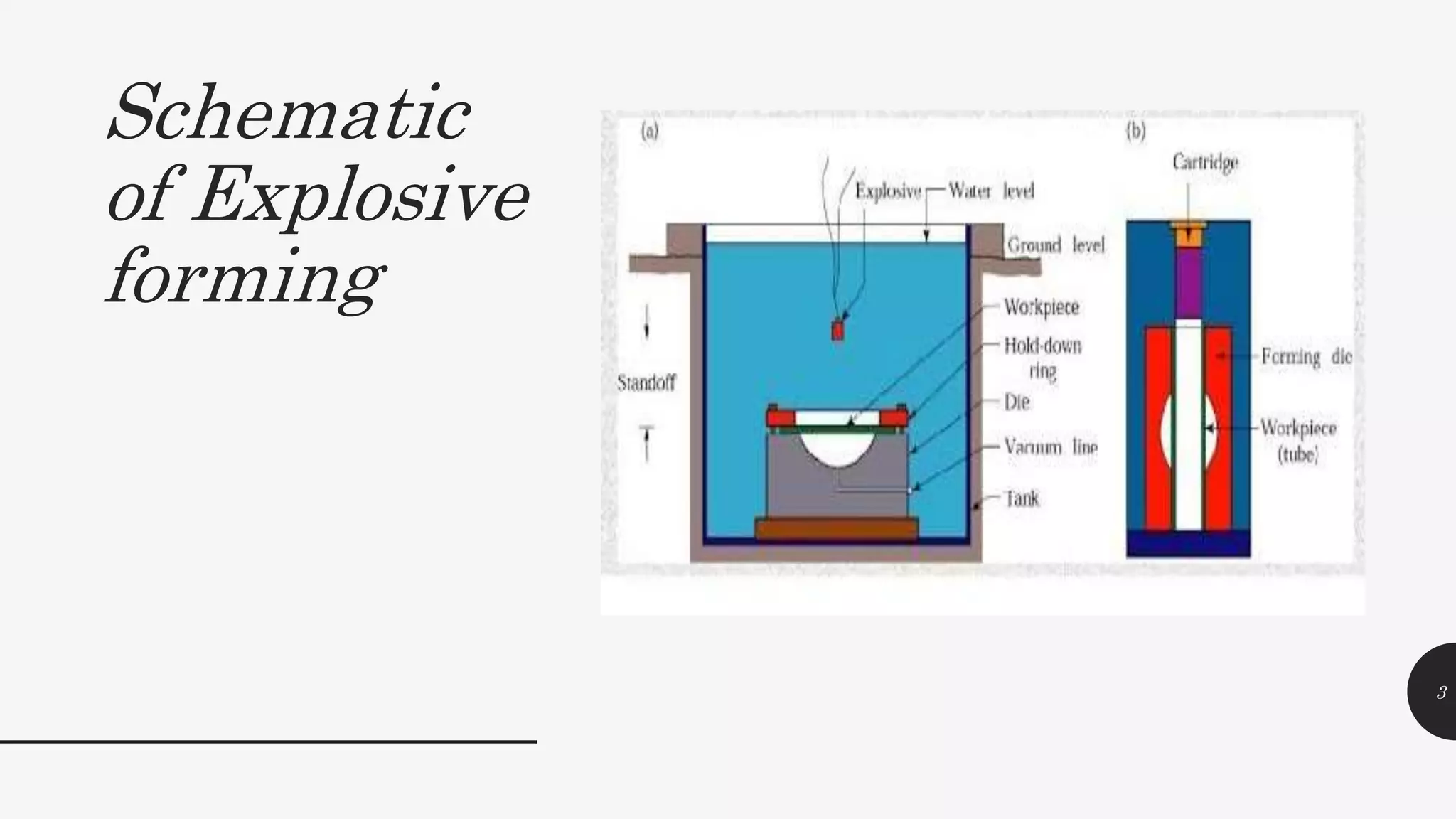
Schematic
of Explosive
forming
3
Types of
Arrangements/
Techniques
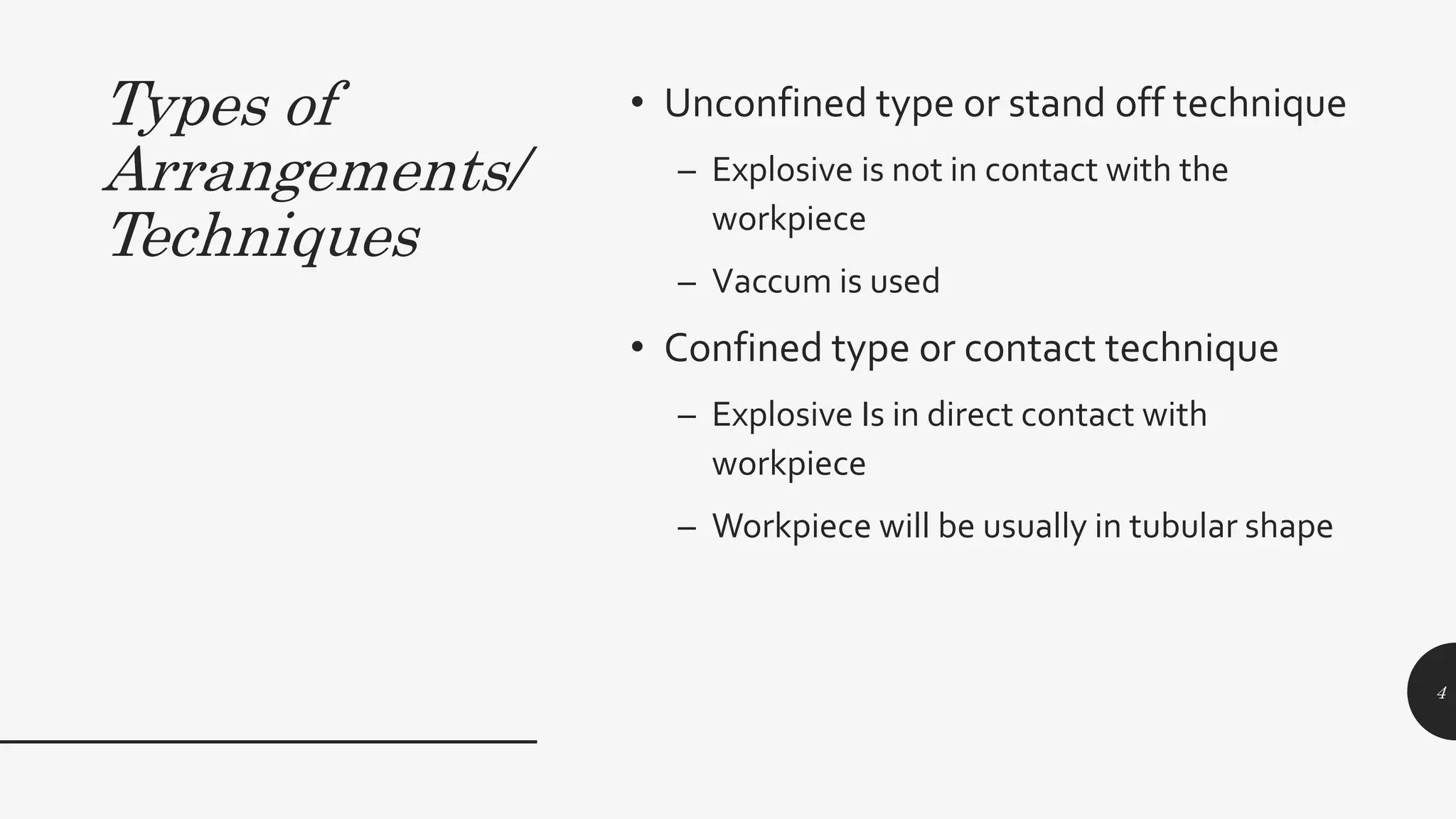
• Unconfined type or stand off technique
– Explosive is not in contact with the
workpiece
– Vaccum is used
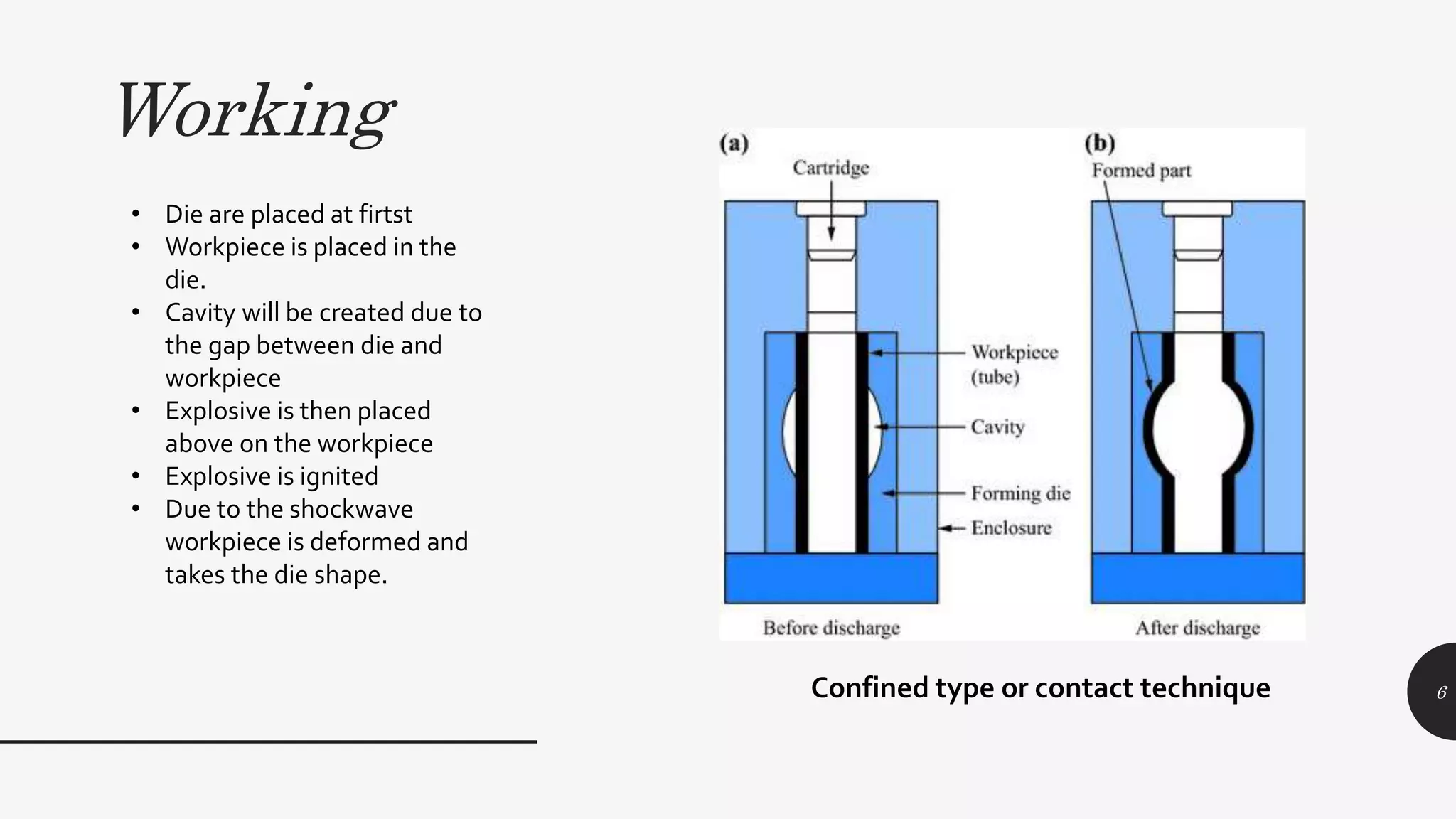
• Confined type or contact technique
– Explosive Is in direct contact with
workpiece
– Workpiece will be usually in tubular shape
4
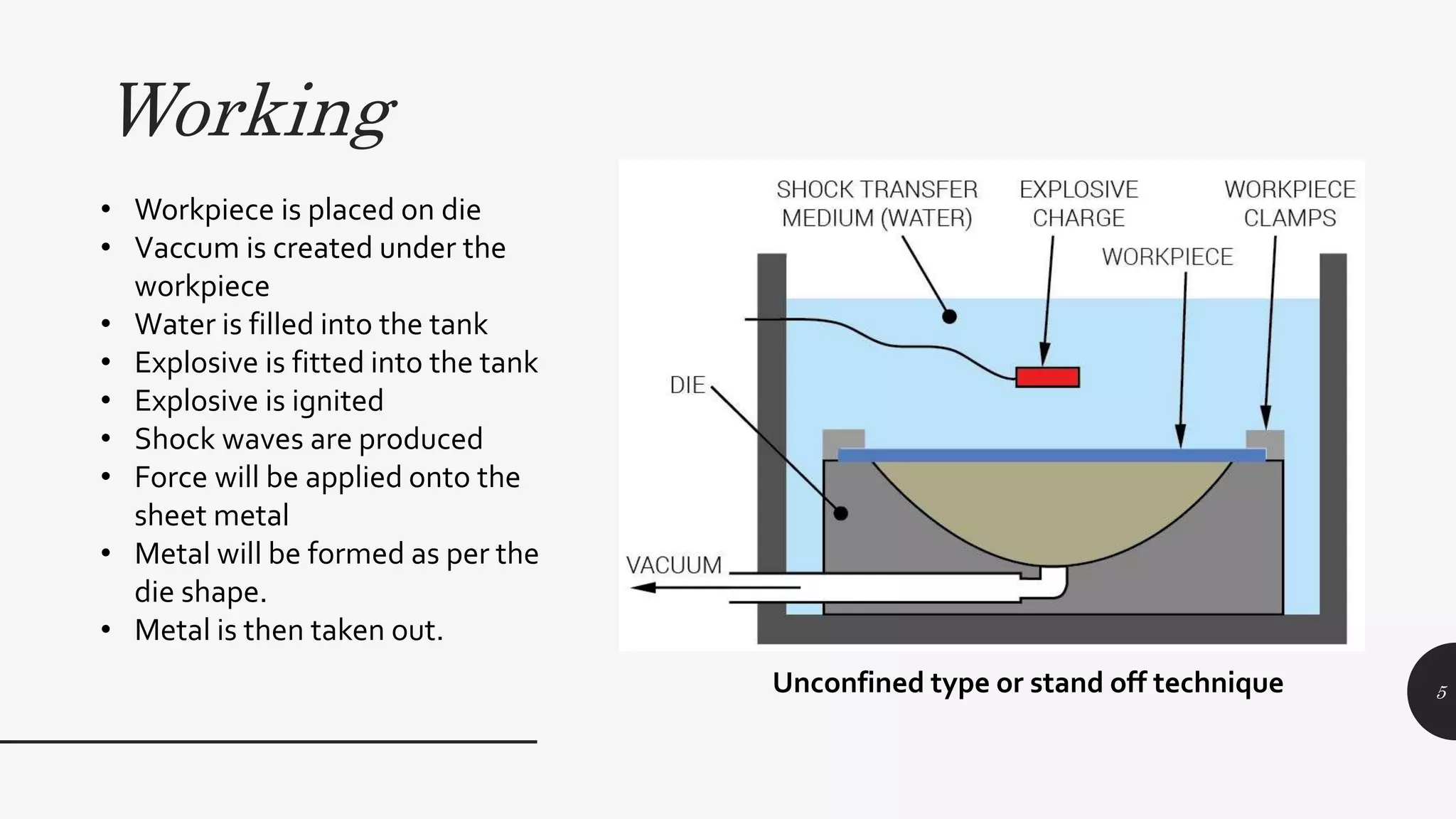
Working
5
• Workpiece is placed on die
• Vaccum is created under the
workpiece
• Water is filled into the tank
• Explosive is fitted into the tank
• Explosive is ignited
• Shock waves are produced
• Force will be applied onto the
sheet metal
• Metal will be formed as per the
die shape.
• Metal is then taken out.
Unconfined type or stand off technique
Working
6
Confined type or contact technique
• Die are placed at firtst
• Workpiece is placed in the
die.
• Cavity will be created due to
the gap between die and
workpiece
• Explosive is then placed
above on the workpiece
• Explosive is ignited
• Due to the shockwave
workpiece is deformed and
takes the die shape.
Experimental
Set up in the
Research paper
7
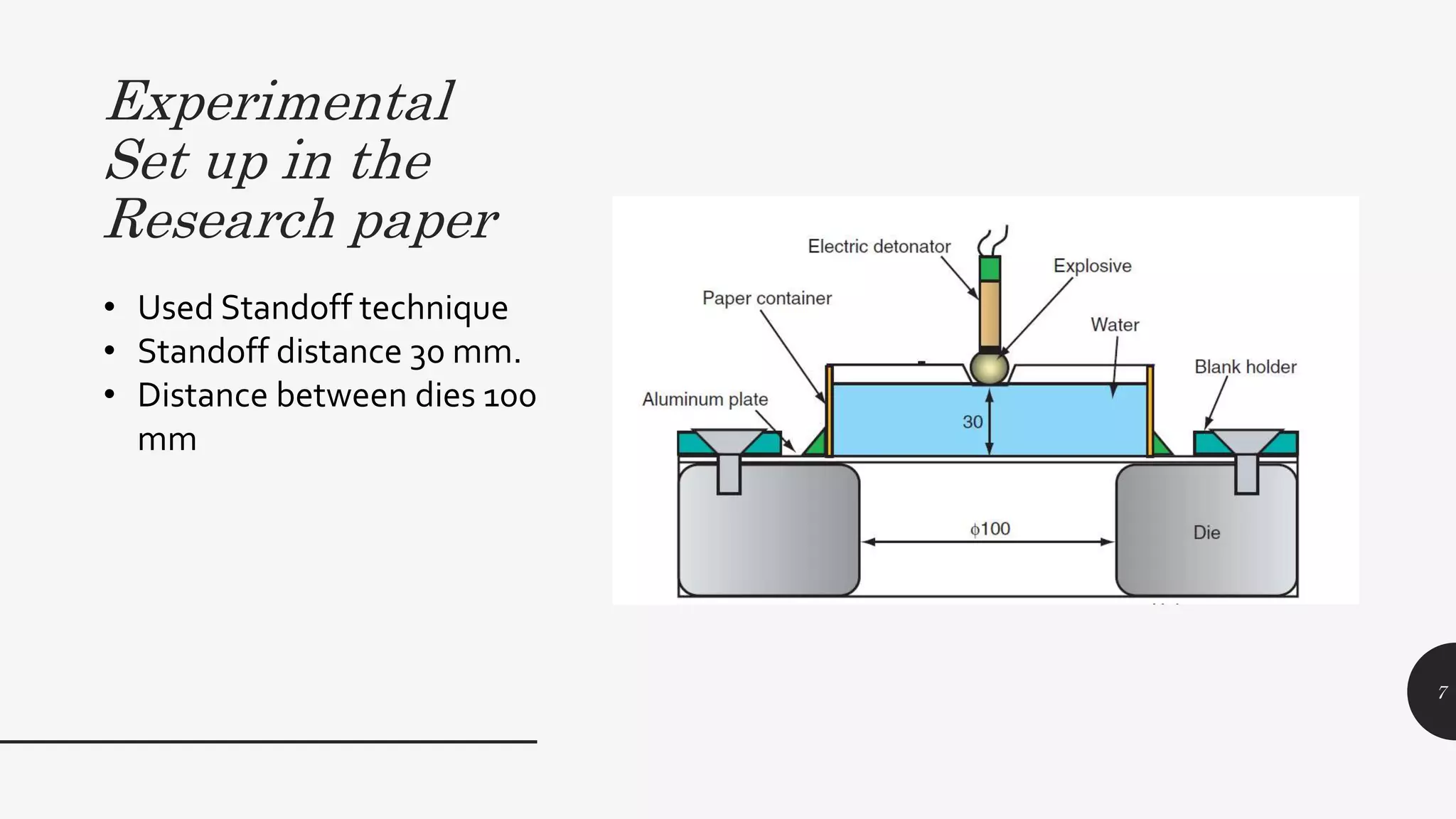
• Used Standoff technique
• Standoff distance 30 mm.
• Distance between dies 100
mm
Deformation
process of
aluminum plate
8
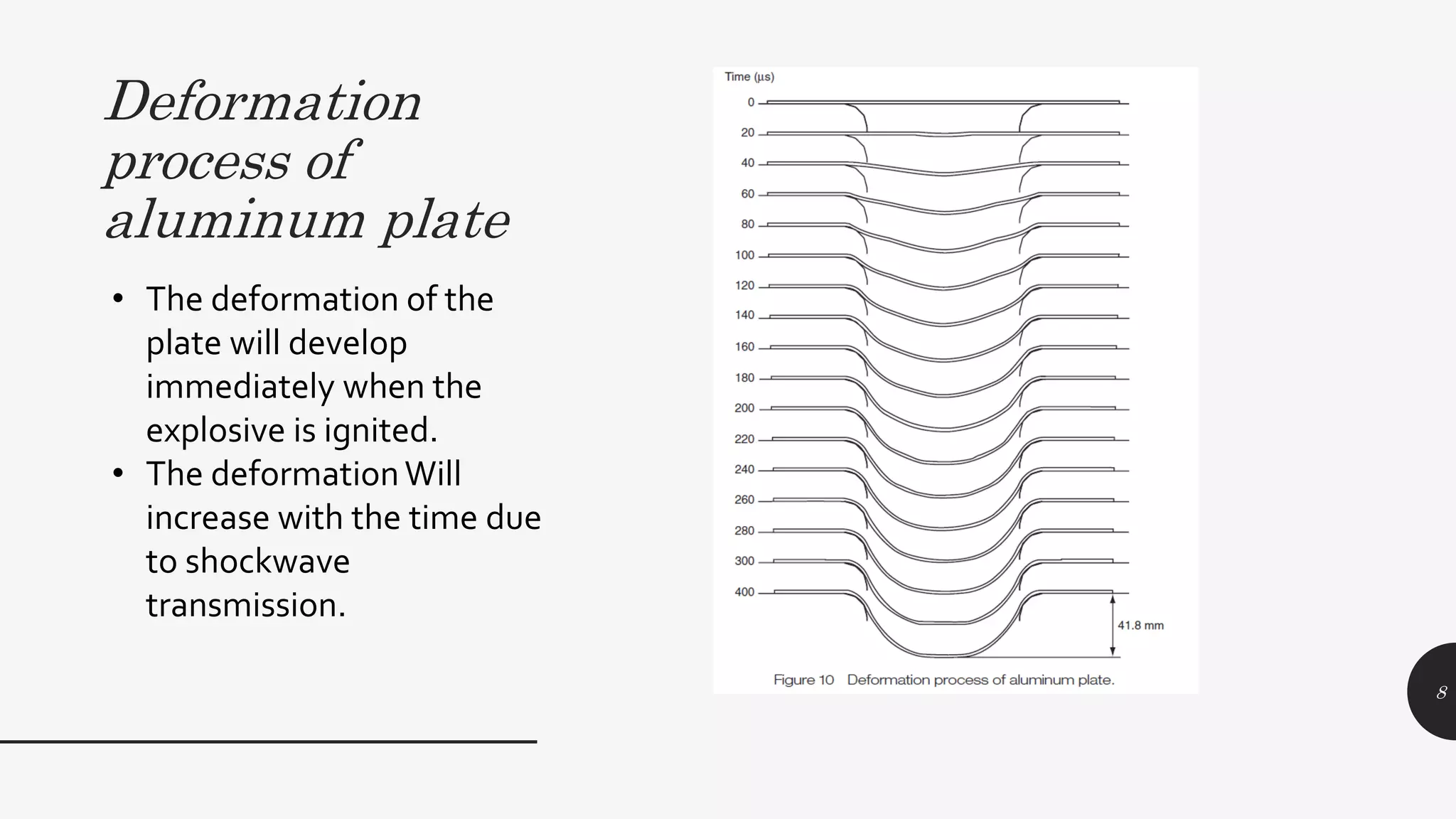
• The deformation of the
plate will develop
immediately when the
explosive is ignited.
• The deformationWill
increase with the time due
to shockwave
transmission.
Propagation of
shockwave
9
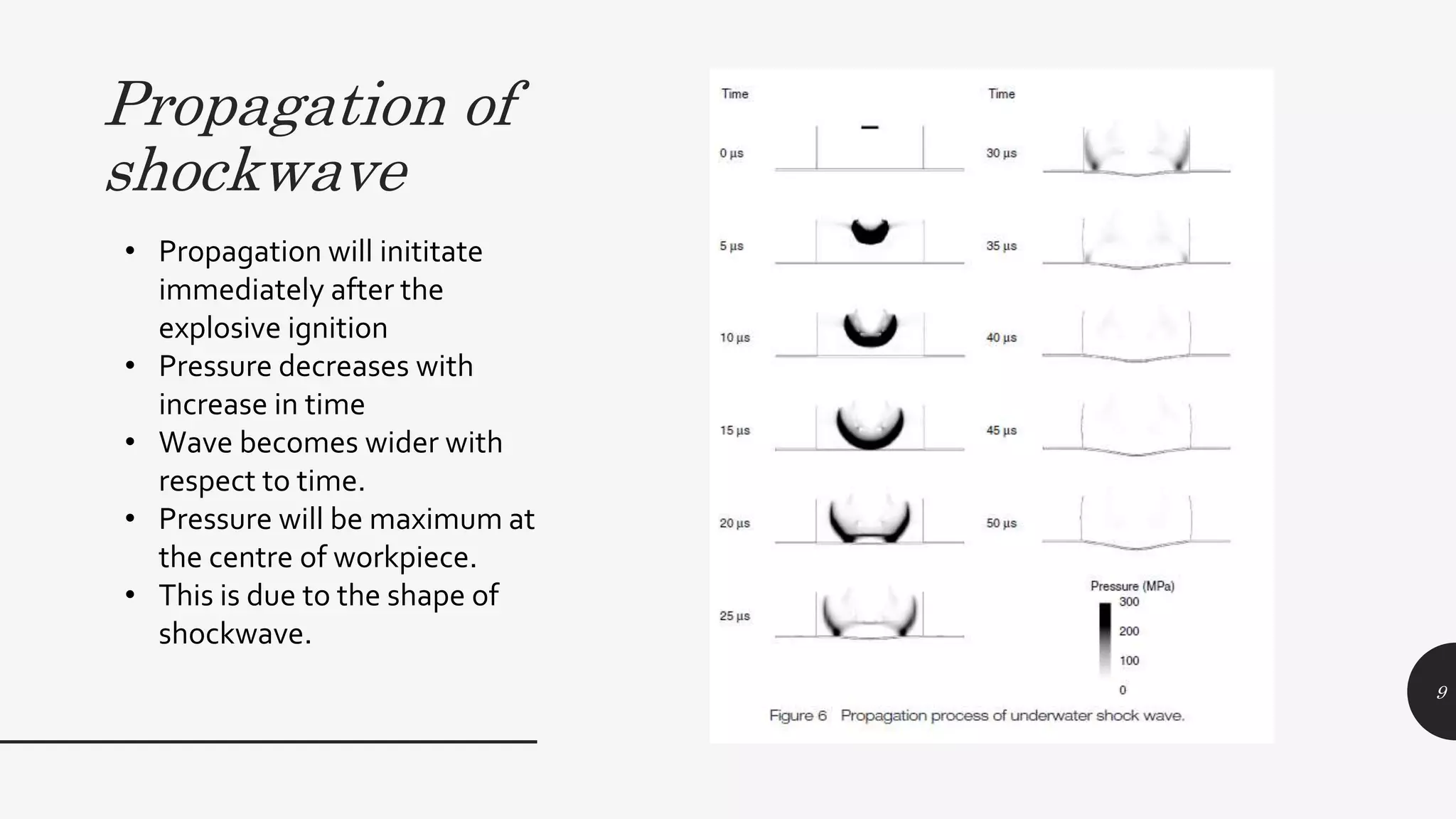
• Propagation will inititate
immediately after the
explosive ignition
• Pressure decreases with
increase in time
• Wave becomes wider with
respect to time.
• Pressure will be maximum at
the centre of workpiece.
• This is due to the shape of
shockwave.
Pro’s and
con’s
• Pro’s
– Extremely large components can be made
easily
– Eliminates costly welds
– Maintains precise tolerances
– Reduces tooling cost
– Controls smoothness of contours
– Less production lead time
– Parts which can’t formed by conventional
methods can also be formed
– Large and thick components can be made
easily 10
Pro’s and
con’s
• Con’s
– The metal to be formed must have high
impact resistance and ductility
– The geometries must be simple like
flat,cylindrical,conical
– Requires heavy protection equipment
– High labour cost
– Not suitable for small and thin works
– Dies must be larger and thicker.
– Usage of explosive must is quite risky
11
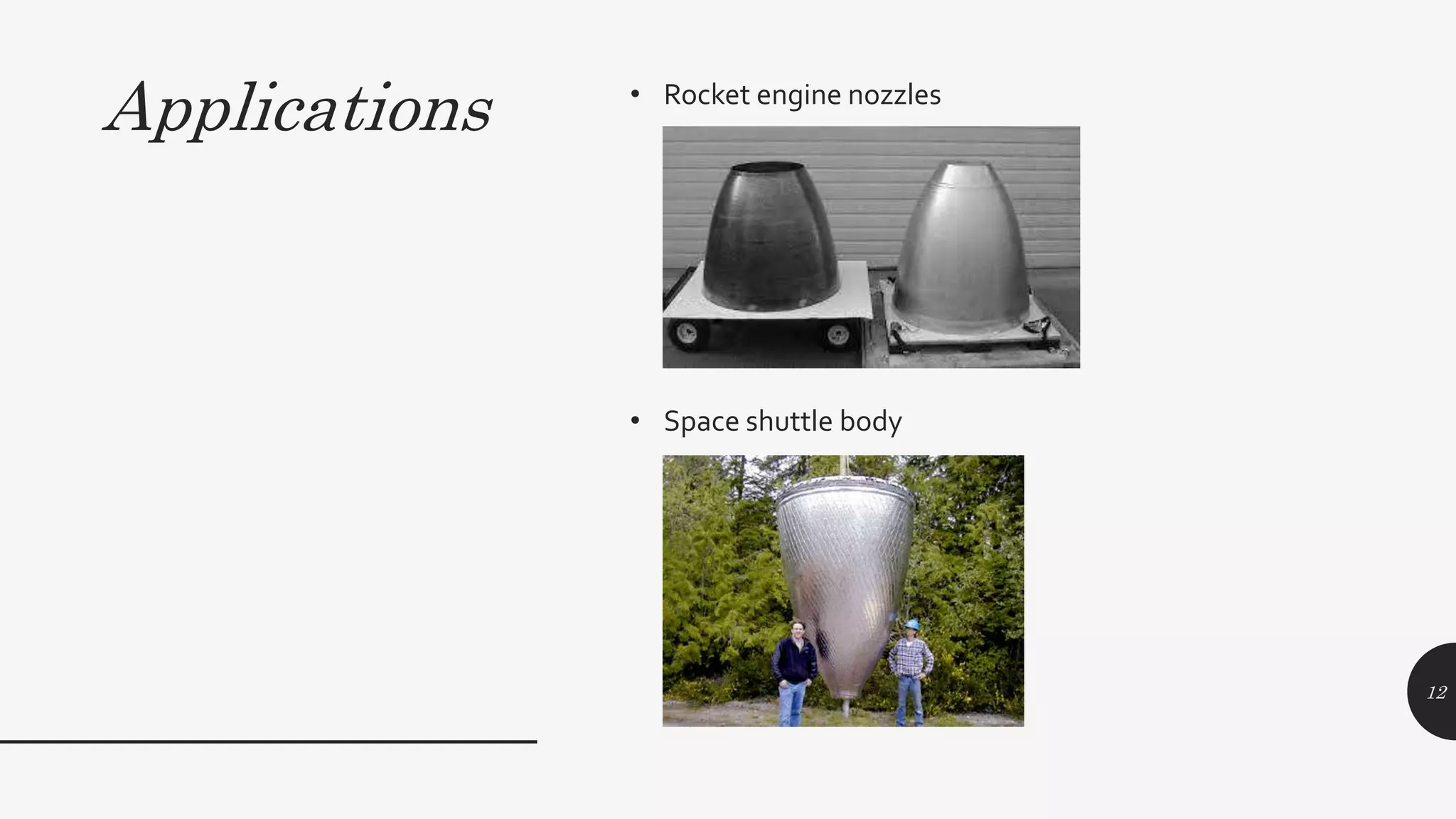
Applications • Rocket engine nozzles
• Space shuttle body
12
Inferences
from the
research
paper
• The amount of deformation of the aluminum plate
from top to bottom surface at 400 μs was shown as 39
mm.
• When the shock wave acting on the central part of the
plate is large, the deformation velocity rises rapidly to
about 280 m/s.
• Peak velocity at center of the aluminum plate
increased up to about 280 m/s.
• Movement of the initial velocity increase is from the
central part of the aluminum plate gradually toward
outer side, with the peak value decreasing as it moves
from the central area to outer side.
• As the distance between the die or the radius value
decreases then velocity will increase very rapidly. 13
Reference Research article details
14
15

Explosive forming

  • 1.
  • 2.
    Introduction • ItIs a forming process • It uses a explosive to carry out the process. • Two different types of arrangements available. • Uses the explosive force to shape the metals • Mainly used for sheet metals 2
  • 3.
  • 4.
    Types of Arrangements/ Techniques • Unconfinedtype or stand off technique – Explosive is not in contact with the workpiece – Vaccum is used • Confined type or contact technique – Explosive Is in direct contact with workpiece – Workpiece will be usually in tubular shape 4
  • 5.
    Working 5 • Workpiece isplaced on die • Vaccum is created under the workpiece • Water is filled into the tank • Explosive is fitted into the tank • Explosive is ignited • Shock waves are produced • Force will be applied onto the sheet metal • Metal will be formed as per the die shape. • Metal is then taken out. Unconfined type or stand off technique
  • 6.
    Working 6 Confined type orcontact technique • Die are placed at firtst • Workpiece is placed in the die. • Cavity will be created due to the gap between die and workpiece • Explosive is then placed above on the workpiece • Explosive is ignited • Due to the shockwave workpiece is deformed and takes the die shape.
  • 7.
    Experimental Set up inthe Research paper 7 • Used Standoff technique • Standoff distance 30 mm. • Distance between dies 100 mm
  • 8.
    Deformation process of aluminum plate 8 •The deformation of the plate will develop immediately when the explosive is ignited. • The deformationWill increase with the time due to shockwave transmission.
  • 9.
    Propagation of shockwave 9 • Propagationwill inititate immediately after the explosive ignition • Pressure decreases with increase in time • Wave becomes wider with respect to time. • Pressure will be maximum at the centre of workpiece. • This is due to the shape of shockwave.
  • 10.
    Pro’s and con’s • Pro’s –Extremely large components can be made easily – Eliminates costly welds – Maintains precise tolerances – Reduces tooling cost – Controls smoothness of contours – Less production lead time – Parts which can’t formed by conventional methods can also be formed – Large and thick components can be made easily 10
  • 11.
    Pro’s and con’s • Con’s –The metal to be formed must have high impact resistance and ductility – The geometries must be simple like flat,cylindrical,conical – Requires heavy protection equipment – High labour cost – Not suitable for small and thin works – Dies must be larger and thicker. – Usage of explosive must is quite risky 11
  • 12.
    Applications • Rocketengine nozzles • Space shuttle body 12
  • 13.
    Inferences from the research paper • Theamount of deformation of the aluminum plate from top to bottom surface at 400 μs was shown as 39 mm. • When the shock wave acting on the central part of the plate is large, the deformation velocity rises rapidly to about 280 m/s. • Peak velocity at center of the aluminum plate increased up to about 280 m/s. • Movement of the initial velocity increase is from the central part of the aluminum plate gradually toward outer side, with the peak value decreasing as it moves from the central area to outer side. • As the distance between the die or the radius value decreases then velocity will increase very rapidly. 13
  • 14.
  • 15.