S U B M I T T E D B Y : V A R U N G U L I A
1 2 M E U 0 8 9
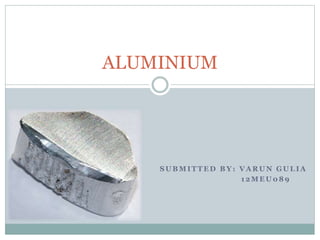
ALUMINIUM
INTRODUCTION
 Aluminium is a chemical element with
symbol Al and atomic number 13.
 Aluminium is the third most abundant
element (after oxygen and silicon), and the most
abundant metal in the Earth's crust.
 It is a soft, nonmagnetic, ductile metal.
 Insoluble in water and alcohol.
 High electrical and thermal conductivity.
CHARACTERISTICS
 Aluminium is a relatively soft, durable, lightweight.
 Appearance ranges from silver to dull grey (depends
on surface roughness).
 Yield strength of pure aluminium is 7–11 MPa,
while aluminium alloys have yield strengths ranging
from 200 MPa to 600 MPa.
 Melting point: 660 °C
 Boiling point: 2500 °C
 Density: 2.70 g/cm³
CORROSION RESISTANCE
 When the surface of aluminium metal is exposed to
air, a protective oxide coating forms almost
instantaneously.
 If the oxide becomes scratched and aluminium metal
exposed, more oxide is formed and the protected
layer renewed.
 This oxide layer is corrosion resistant.
 This oxide layer is one of the main reasons for
aluminium good corrosion properties. The layer is
stable in the general pH range 4 – 9.
STRENGTH
 Aluminium alloys commonly have tensile strengths
of between 70 and 700 MPa.
 Aluminium does not become brittle at low
temperatures.
 At high temperatures, aluminium’s strength
decreases.
 The low density of aluminium does not affect its
strength.
CONDUCTIVITY
 Aluminium is an excellent conductor of heat and
electricity.
 Aluminium conductor weighs approximately half as
much as a copper conductor having the same
conductivity.
 Resistivity: 2,82×10⁻⁸ Ωm
 Thermal Conductivity : 202.4 W/mK
 Commonly used material in power transmission
lines.
REFLECTIVITY
 Aluminium is a good reflector of both visible light
and heat.
 Aluminium serves as a good reflector (approximately
92%) of visible light and an excellent reflector (as
much as 98%) infrared radiation.
 Aluminium is extremely reflective, when
polished and that together with its low weight,
makes it an ideal material for reflectors ,for example,
light fittings or rescue blankets.
DUCTILITY & MALLEABILITY
 High Ductility & Malleability.
 Large coefficient of linear expansion.
 Aluminium is the 2nd most malleable and 6th most
ductile metal.
MACHINING
 Aluminium is easily worked using most machining
methods – milling, drilling, cutting, punching,
bending, etc. Furthermore, the energy input during
machining is low.
FORMABILITY
 With the metal either hot or cold, this property is
also exploited in the rolling of strips and foils, as well
as in bending and other forming operations.
IMPERMEABLE AND ODOURLESS
 Aluminium foil, even when it is rolled to only 0.007
mm thickness, is still completely impermeable.
 Non-Toxic
 Releases no aroma or taste substances which makes
it ideal for packaging sensitive products such as food
or pharmaceuticals.
ISOTOPES
 22 known isotopes from 21Al to 42Al.
 4 isomers
 Only 27Al is stable
 26Al is a radioactive isotope
 27Al has a natural abundance of 99.9+ %
 Other than 26Al, all radioisotopes have half-lives
under 7 minutes
 Aluminium isotopes have found practical application
in dating marine sediments, manganese nodules,
glacial ice.
OCCURRENCE
 Aluminium is highly reactive and does not occur in
the free state.
 It is widely distributed and it is third in abundance
on earth.
 Aluminium has three principal ores
 Gibbsite or Hydrargillite, Al2O3.3H2O,
 Bauxite, Al2O3.2H2O, Diaspore, Al2O3.H2O, and
 Cryolite, AlF3.3HF.
 Aluminium also occurs in the form of its Aluminium
Oxide, Al2O3, in the semiprecious stones.
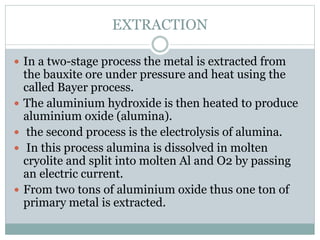
EXTRACTION
 In a two-stage process the metal is extracted from
the bauxite ore under pressure and heat using the
called Bayer process.
 The aluminium hydroxide is then heated to produce
aluminium oxide (alumina).
 the second process is the electrolysis of alumina.
 In this process alumina is dissolved in molten
cryolite and split into molten Al and O2 by passing
an electric current.
 From two tons of aluminium oxide thus one ton of
primary metal is extracted.
BAYER’s PROCESS
 Convert Bauxite to Alumina.
 Crush and Grind: The ore is then fed into large
grinding mills and mixed with a caustic soda solution
(sodium hydroxide) at high temperature and
pressure.
 Digesters: The slurry is pumped to a digester where
the chemical reaction to dissolve the alumina takes
place.
 Flash Cooling: The slurry is pumped into a series of
flash tanks to reduce the pressure and heat.
 Settlers: Settling is achieved primarily by using
gravity, although some chemicals are added to aid
the process.
 Precipitation: The clear sodium aluminate from the
settling and filtering operation is pumped into
precipitators.
 Calcination : Calcination is a heating process to
remove the chemically combined water from the
alumina hydrate.
 Al2O3 + 2 NaOH → 2 NaAlO2 + H2O
 2 NaAlO2 + CO2 → 2 Al(OH)3 + Na2CO3 + H2O
 2 H2O + NaAlO2 → Al(OH)3 + NaOH
 2 Al(OH)3 → Al2O3 + 3 H2O
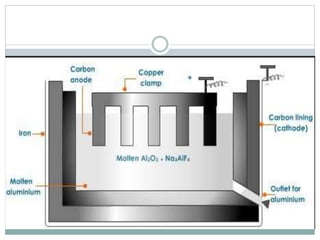
HALL-HEROULT PROCESS
 Convert Alumina to Aluminium.
 The aluminium oxide is mixed with cryolite (made of
sodium fluoride and aluminium fluoride) and then
heated to about 980 °C to melt the solids.
 The molten mixture is then electrolysed with a very
large current.
 Aluminium ions are reduced to form aluminium
metal (at the cathode).
 Oxygen gas is formed at the anode.
ALUMINIUM ALLOY’s
 Aluminum alloys can be can be classified as
Wrought alloys
 Cast alloys
 Each of these alloys can be further classified
as
Non Heat treatable alloys
Heat treatable alloys
WROUGHT ALLOY
 Each alloy is given a four-digit number, where the
first digit indicates the major alloying element.
 There are 7 series of Wrought alloy
 1000 series are pure Al with a min 99% aluminium
content by weight and can be work hardened.
 2000 series are alloyed with Cu, can be hardened to
strengths comparable to steel.
 3000 series are alloyed with Manganese.
 4000 series are alloyed with silicon. They are also
known as silumin.
 5000 series are alloyed with Magnesium.
 6000 series are alloyed with magnesium and silicon.
They are easy to machine, are weldable.
 7000 series are alloyed with zinc.
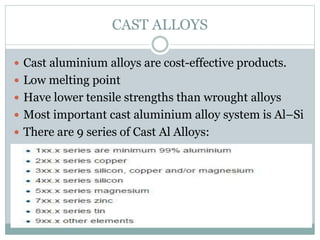
CAST ALLOYS
 Cast aluminium alloys are cost-effective products.
 Low melting point
 Have lower tensile strengths than wrought alloys
 Most important cast aluminium alloy system is Al–Si
 There are 9 series of Cast Al Alloys:
MAJOR ALLOYING ELEMENTS
USES OF ALUMINIUM
TRANSPORT
 Aluminum alloys are widely used for aeronautical
applications because of high strength weight ratio.
 Aluminium-Scandium alloys are used in Aerospace
industries.
 In automobiles for reducing weight of the vehicle
thus reducing fuel consumption.
 In trucks and buses (sheet and plate for bodies)
 In Cars(engine blocks, cylinder heads,body panels)
PACKAGING
 Aluminium is used in the form of alloy sheet for
beverage can bodies and tops.
 As foil for household and commercial wrap, and in
manufactured packaging products such as cartons
for fruit juice and packaging for pharmaceuticals.
 1000 series alloys as foil for food wrapping.
 In construction, aluminium is used in sheet products
for roofing and wall cladding, in extrusions for
windows and doors, and in castings for builders'
hardware.
 In the electrical sector, aluminium is used in the
form of wire, normally reinforced with steel to form
cables.
 House hold and consumer items such as utensils
RECYCLING
 Aluminium is theoretically 100%
recyclable without any loss of its
natural qualities.
 Recycling involves melting the
scrap, a process that requires
only 5% of the energy used to
produce aluminium from ore.
 Recycled aluminium is known as
secondary aluminium, but
maintains the same physical
properties as primary aluminium.
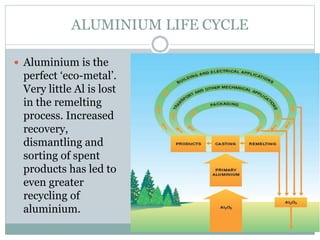
ALUMINIUM LIFE CYCLE
 Aluminium is the
perfect ‘eco-metal’.
Very little Al is lost
in the remelting
process. Increased
recovery,
dismantling and
sorting of spent
products has led to
even greater
recycling of
aluminium.
REFERENCE
 sam.davyson.com/as/physics/aluminium
 riotintoalcan.com/ENG/ourproducts/1542_alumini
um_and_its_uses.aspl
 en.wikipedia.org
THANK YOU

Aluminium

  • 1.
    S U BM I T T E D B Y : V A R U N G U L I A 1 2 M E U 0 8 9 ALUMINIUM
  • 2.
    INTRODUCTION  Aluminium isa chemical element with symbol Al and atomic number 13.  Aluminium is the third most abundant element (after oxygen and silicon), and the most abundant metal in the Earth's crust.  It is a soft, nonmagnetic, ductile metal.  Insoluble in water and alcohol.  High electrical and thermal conductivity.
  • 3.
    CHARACTERISTICS  Aluminium isa relatively soft, durable, lightweight.  Appearance ranges from silver to dull grey (depends on surface roughness).  Yield strength of pure aluminium is 7–11 MPa, while aluminium alloys have yield strengths ranging from 200 MPa to 600 MPa.  Melting point: 660 °C  Boiling point: 2500 °C  Density: 2.70 g/cm³
  • 4.
    CORROSION RESISTANCE  Whenthe surface of aluminium metal is exposed to air, a protective oxide coating forms almost instantaneously.  If the oxide becomes scratched and aluminium metal exposed, more oxide is formed and the protected layer renewed.  This oxide layer is corrosion resistant.  This oxide layer is one of the main reasons for aluminium good corrosion properties. The layer is stable in the general pH range 4 – 9.
  • 5.
    STRENGTH  Aluminium alloyscommonly have tensile strengths of between 70 and 700 MPa.  Aluminium does not become brittle at low temperatures.  At high temperatures, aluminium’s strength decreases.  The low density of aluminium does not affect its strength.
  • 6.
    CONDUCTIVITY  Aluminium isan excellent conductor of heat and electricity.  Aluminium conductor weighs approximately half as much as a copper conductor having the same conductivity.  Resistivity: 2,82×10⁻⁸ Ωm  Thermal Conductivity : 202.4 W/mK  Commonly used material in power transmission lines.
  • 7.
    REFLECTIVITY  Aluminium isa good reflector of both visible light and heat.  Aluminium serves as a good reflector (approximately 92%) of visible light and an excellent reflector (as much as 98%) infrared radiation.  Aluminium is extremely reflective, when polished and that together with its low weight, makes it an ideal material for reflectors ,for example, light fittings or rescue blankets.
  • 8.
    DUCTILITY & MALLEABILITY High Ductility & Malleability.  Large coefficient of linear expansion.  Aluminium is the 2nd most malleable and 6th most ductile metal. MACHINING  Aluminium is easily worked using most machining methods – milling, drilling, cutting, punching, bending, etc. Furthermore, the energy input during machining is low.
  • 9.
    FORMABILITY  With themetal either hot or cold, this property is also exploited in the rolling of strips and foils, as well as in bending and other forming operations. IMPERMEABLE AND ODOURLESS  Aluminium foil, even when it is rolled to only 0.007 mm thickness, is still completely impermeable.  Non-Toxic  Releases no aroma or taste substances which makes it ideal for packaging sensitive products such as food or pharmaceuticals.
  • 10.
    ISOTOPES  22 knownisotopes from 21Al to 42Al.  4 isomers  Only 27Al is stable  26Al is a radioactive isotope  27Al has a natural abundance of 99.9+ %  Other than 26Al, all radioisotopes have half-lives under 7 minutes  Aluminium isotopes have found practical application in dating marine sediments, manganese nodules, glacial ice.
  • 11.
    OCCURRENCE  Aluminium ishighly reactive and does not occur in the free state.  It is widely distributed and it is third in abundance on earth.  Aluminium has three principal ores  Gibbsite or Hydrargillite, Al2O3.3H2O,  Bauxite, Al2O3.2H2O, Diaspore, Al2O3.H2O, and  Cryolite, AlF3.3HF.  Aluminium also occurs in the form of its Aluminium Oxide, Al2O3, in the semiprecious stones.
  • 12.
    EXTRACTION  In atwo-stage process the metal is extracted from the bauxite ore under pressure and heat using the called Bayer process.  The aluminium hydroxide is then heated to produce aluminium oxide (alumina).  the second process is the electrolysis of alumina.  In this process alumina is dissolved in molten cryolite and split into molten Al and O2 by passing an electric current.  From two tons of aluminium oxide thus one ton of primary metal is extracted.
  • 13.
    BAYER’s PROCESS  ConvertBauxite to Alumina.  Crush and Grind: The ore is then fed into large grinding mills and mixed with a caustic soda solution (sodium hydroxide) at high temperature and pressure.  Digesters: The slurry is pumped to a digester where the chemical reaction to dissolve the alumina takes place.  Flash Cooling: The slurry is pumped into a series of flash tanks to reduce the pressure and heat.
  • 14.
     Settlers: Settlingis achieved primarily by using gravity, although some chemicals are added to aid the process.  Precipitation: The clear sodium aluminate from the settling and filtering operation is pumped into precipitators.  Calcination : Calcination is a heating process to remove the chemically combined water from the alumina hydrate.
  • 15.
     Al2O3 +2 NaOH → 2 NaAlO2 + H2O  2 NaAlO2 + CO2 → 2 Al(OH)3 + Na2CO3 + H2O  2 H2O + NaAlO2 → Al(OH)3 + NaOH  2 Al(OH)3 → Al2O3 + 3 H2O
  • 16.
    HALL-HEROULT PROCESS  ConvertAlumina to Aluminium.  The aluminium oxide is mixed with cryolite (made of sodium fluoride and aluminium fluoride) and then heated to about 980 °C to melt the solids.  The molten mixture is then electrolysed with a very large current.  Aluminium ions are reduced to form aluminium metal (at the cathode).  Oxygen gas is formed at the anode.
  • 18.
    ALUMINIUM ALLOY’s  Aluminumalloys can be can be classified as Wrought alloys  Cast alloys  Each of these alloys can be further classified as Non Heat treatable alloys Heat treatable alloys
  • 19.
    WROUGHT ALLOY  Eachalloy is given a four-digit number, where the first digit indicates the major alloying element.  There are 7 series of Wrought alloy
  • 20.
     1000 seriesare pure Al with a min 99% aluminium content by weight and can be work hardened.  2000 series are alloyed with Cu, can be hardened to strengths comparable to steel.  3000 series are alloyed with Manganese.  4000 series are alloyed with silicon. They are also known as silumin.  5000 series are alloyed with Magnesium.  6000 series are alloyed with magnesium and silicon. They are easy to machine, are weldable.  7000 series are alloyed with zinc.
  • 21.
    CAST ALLOYS  Castaluminium alloys are cost-effective products.  Low melting point  Have lower tensile strengths than wrought alloys  Most important cast aluminium alloy system is Al–Si  There are 9 series of Cast Al Alloys:
  • 22.
  • 23.
    USES OF ALUMINIUM TRANSPORT Aluminum alloys are widely used for aeronautical applications because of high strength weight ratio.  Aluminium-Scandium alloys are used in Aerospace industries.  In automobiles for reducing weight of the vehicle thus reducing fuel consumption.  In trucks and buses (sheet and plate for bodies)  In Cars(engine blocks, cylinder heads,body panels)
  • 24.
    PACKAGING  Aluminium isused in the form of alloy sheet for beverage can bodies and tops.  As foil for household and commercial wrap, and in manufactured packaging products such as cartons for fruit juice and packaging for pharmaceuticals.  1000 series alloys as foil for food wrapping.
  • 25.
     In construction,aluminium is used in sheet products for roofing and wall cladding, in extrusions for windows and doors, and in castings for builders' hardware.  In the electrical sector, aluminium is used in the form of wire, normally reinforced with steel to form cables.  House hold and consumer items such as utensils
  • 26.
    RECYCLING  Aluminium istheoretically 100% recyclable without any loss of its natural qualities.  Recycling involves melting the scrap, a process that requires only 5% of the energy used to produce aluminium from ore.  Recycled aluminium is known as secondary aluminium, but maintains the same physical properties as primary aluminium.
  • 27.
    ALUMINIUM LIFE CYCLE Aluminium is the perfect ‘eco-metal’. Very little Al is lost in the remelting process. Increased recovery, dismantling and sorting of spent products has led to even greater recycling of aluminium.
  • 28.
  • 29.