A
Seminar Report
On
HYDROFORMING
Guided By ;D.H.Patel

Prepared by :Patel Mehul.A
Patel Jay
OUTLINE:
•
•
•
•
•
•
•
•

What is Hydroforming
Types of hydroforming
Application
Design Considerations
Advantages/Disadvantages
Economics of Hydroforming
Reference Websites and Links
Conclusion
HYDROFORMING
Hydroforming is a manufacturing process
where liquid pressure is used to form
complex shapes.
There are two types of hydroforming:
1) Tube hydroforming
2) Sheet hydroforming
TUBE HYDROFORMING
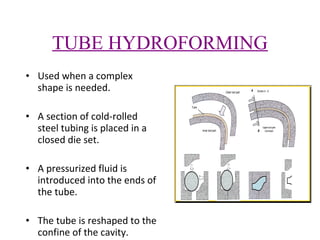
• Used when a complex
shape is needed.

Outer tool part

Section A - A

Tube

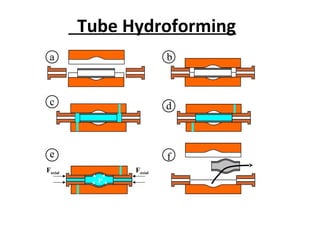
• A section of cold-rolled
steel tubing is placed in a
closed die set.
• A pressurized fluid is
introduced into the ends of
the tube.
• The tube is reshaped to the
confine of the cavity.

Inner tool part

Upper tool part
not shown
Tube Hydroforming
a

b

c

d

e

f

Faxial

Faxial
P
SHEET HYDROFORMING
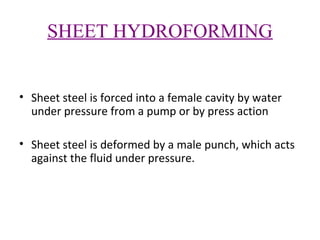
• Sheet steel is forced into a female cavity by water
under pressure from a pump or by press action
• Sheet steel is deformed by a male punch, which acts
against the fluid under pressure.
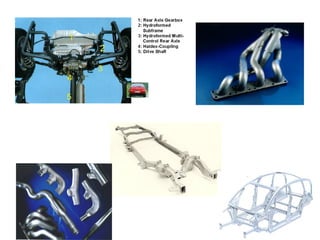
APPLICATIONS
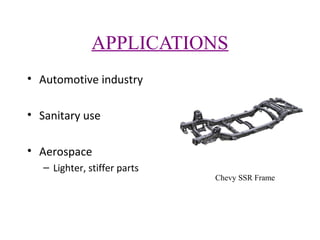
• Automotive industry
• Sanitary use
• Aerospace
– Lighter, stiffer parts

Chevy SSR Frame
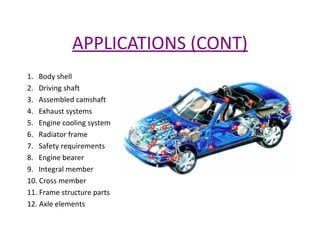
APPLICATIONS (CONT)
1. Body shell
2. Driving shaft
3. Assembled camshaft
4. Exhaust systems
5. Engine cooling system
6. Radiator frame
7. Safety requirements
8. Engine bearer
9. Integral member
10. Cross member
11. Frame structure parts
12. Axle elements
MATERIALS
• Steel (mild and harder steels)
• Stainless Steel
• Aluminum alloys
DESIGN CONSIDERATIONS
• Hydroforming is generally defined as either lowpressure or high pressure.
• The demarcation point is 83MPa
• Constant pressure volumetric expansion
< 5% required to shape the part = Low pressure
> 5% (but < 25%) = High Pressure
DESIGN CONSIDERATIONS
Product
-

Geometry, thickness distribution
Dimensional accuracy/tolerances
Surface finish
Microstructure, mechanical and
metallurgical
properties, hardness
Tool/Dies
-Geometry of tools

- Material hardness

- Surface conditions

- Stiffness and accuracy
Equipment
- Press capacity

- Speed/production rate

- Force/energy capabilities

- Rigidity and accuracy
Work piece/Material
-Flow stress as a function of strain, strain rate and
microstructure
-Workability as a function of strain, strain rate
and microstructure
- Surface conditions
- Geometry of tubing ( outside diameter, tube wall
thickness, roundness, properties of welding line,
etc.)
Deformation zone
-Deformation mechanics, model used for
analysis
- Metal flow, velocities, strain rates,
strains (kinematics)

- Stresses (variation during deformation)
ADVANTAGES
•
•
•

•
•
•

•
•

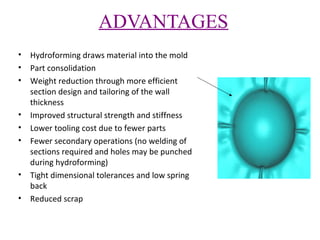
Hydroforming draws material into the mold
Part consolidation
Weight reduction through more efficient
section design and tailoring of the wall
thickness
Improved structural strength and stiffness
Lower tooling cost due to fewer parts
Fewer secondary operations (no welding of
sections required and holes may be punched
during hydroforming)
Tight dimensional tolerances and low spring
back
Reduced scrap
ADVANTAGES (CONT.)
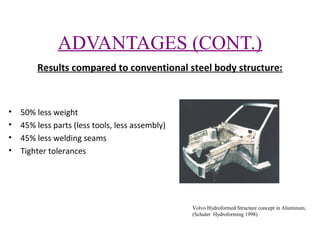
Results compared to conventional steel body structure:

•
•
•
•

50% less weight
45% less parts (less tools, less assembly)
45% less welding seams
Tighter tolerances

Volvo Hydroformed Structure concept in Aluminum,
(Schuler Hydroforming 1998)
DISADVANTAGES
• Slow cycle time
• Expensive equipment and lack of extensive knowledge
base for process and tool design
• Requires new welding techniques for assembly.
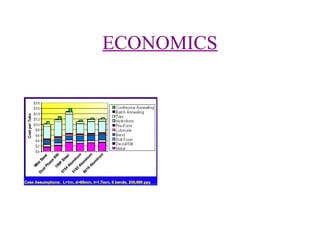
ECONOMICS
INFORMATION ON THE WEB
•
•
•
•
•
•
•
•

www.hydroforming.net
www.vari-form.com
www.hdt-gti.com
www.revindustries.com
www.autosteel.org
www.schuler-hydroforming.de
www.egr.msu.edu/~aenader
nsmwww.eng.ohio-state.edu/html/tube_hydroforming.html
CONCLUSION
• Hydroforming is an innovative forming process
• Hydroforming is becoming more popular
(ie.automotive and aerospace industries)
• The advantages outweigh the limitations
• Material selection is broad and continues to increase
• Information can be found everywhere!

Hydro forming

  • 1.
    A Seminar Report On HYDROFORMING Guided By;D.H.Patel Prepared by :Patel Mehul.A Patel Jay
  • 2.
    OUTLINE: • • • • • • • • What is Hydroforming Typesof hydroforming Application Design Considerations Advantages/Disadvantages Economics of Hydroforming Reference Websites and Links Conclusion
  • 3.
    HYDROFORMING Hydroforming is amanufacturing process where liquid pressure is used to form complex shapes. There are two types of hydroforming: 1) Tube hydroforming 2) Sheet hydroforming
  • 4.
    TUBE HYDROFORMING • Usedwhen a complex shape is needed. Outer tool part Section A - A Tube • A section of cold-rolled steel tubing is placed in a closed die set. • A pressurized fluid is introduced into the ends of the tube. • The tube is reshaped to the confine of the cavity. Inner tool part Upper tool part not shown
  • 5.
  • 7.
    SHEET HYDROFORMING • Sheetsteel is forced into a female cavity by water under pressure from a pump or by press action • Sheet steel is deformed by a male punch, which acts against the fluid under pressure.
  • 9.
    APPLICATIONS • Automotive industry •Sanitary use • Aerospace – Lighter, stiffer parts Chevy SSR Frame
  • 10.
    APPLICATIONS (CONT) 1. Bodyshell 2. Driving shaft 3. Assembled camshaft 4. Exhaust systems 5. Engine cooling system 6. Radiator frame 7. Safety requirements 8. Engine bearer 9. Integral member 10. Cross member 11. Frame structure parts 12. Axle elements
  • 12.
    MATERIALS • Steel (mildand harder steels) • Stainless Steel • Aluminum alloys
  • 13.
    DESIGN CONSIDERATIONS • Hydroformingis generally defined as either lowpressure or high pressure. • The demarcation point is 83MPa • Constant pressure volumetric expansion < 5% required to shape the part = Low pressure > 5% (but < 25%) = High Pressure
  • 14.
    DESIGN CONSIDERATIONS Product - Geometry, thicknessdistribution Dimensional accuracy/tolerances Surface finish Microstructure, mechanical and metallurgical properties, hardness
  • 15.
    Tool/Dies -Geometry of tools -Material hardness - Surface conditions - Stiffness and accuracy
  • 16.
    Equipment - Press capacity -Speed/production rate - Force/energy capabilities - Rigidity and accuracy
  • 17.
    Work piece/Material -Flow stressas a function of strain, strain rate and microstructure -Workability as a function of strain, strain rate and microstructure - Surface conditions - Geometry of tubing ( outside diameter, tube wall thickness, roundness, properties of welding line, etc.)
  • 18.
    Deformation zone -Deformation mechanics,model used for analysis - Metal flow, velocities, strain rates, strains (kinematics) - Stresses (variation during deformation)
  • 19.
    ADVANTAGES • • • • • • • • Hydroforming draws materialinto the mold Part consolidation Weight reduction through more efficient section design and tailoring of the wall thickness Improved structural strength and stiffness Lower tooling cost due to fewer parts Fewer secondary operations (no welding of sections required and holes may be punched during hydroforming) Tight dimensional tolerances and low spring back Reduced scrap
  • 20.
    ADVANTAGES (CONT.) Results comparedto conventional steel body structure: • • • • 50% less weight 45% less parts (less tools, less assembly) 45% less welding seams Tighter tolerances Volvo Hydroformed Structure concept in Aluminum, (Schuler Hydroforming 1998)
  • 21.
    DISADVANTAGES • Slow cycletime • Expensive equipment and lack of extensive knowledge base for process and tool design • Requires new welding techniques for assembly.
  • 22.
  • 23.
    INFORMATION ON THEWEB • • • • • • • • www.hydroforming.net www.vari-form.com www.hdt-gti.com www.revindustries.com www.autosteel.org www.schuler-hydroforming.de www.egr.msu.edu/~aenader nsmwww.eng.ohio-state.edu/html/tube_hydroforming.html
  • 24.
    CONCLUSION • Hydroforming isan innovative forming process • Hydroforming is becoming more popular (ie.automotive and aerospace industries) • The advantages outweigh the limitations • Material selection is broad and continues to increase • Information can be found everywhere!