CONSTRUCTIVIS
M
An Overview
BEFORE WE BEGIN
How do you learn?
How do you come to understand something
new?
Write on a piece of paper and add more as we
go along today. Keep the list running.
CONSTRUCTIVISM IS…
 A learning theory
 A theory of how people gain
knowledge
 Based on observation and scientific
study and supported by decades of
research
BELIEFS OF CONSTRUCTIVISM
 People build or construct their own understanding, knowledge and
learning. (clay)
 People learn best by a repeated and active process of experience
and reflection.
 When people come across new information, they have to figure
out how and where it fits in or does not fit in with their existing
knowledge.
 People are active creators of their own knowledge. To do this,
they must ask questions, explore, and assess their own
knowledge.
CONSTRUCTIVISM IS NOT…
And….
AND IS CERTAINLY NOT…
Sheldon Teaching Penny Physics
WHAT ARE SOME OF IT’S
COMPONENTS?
 Construction
 Activity
 Reflection
 Collaboration
 Inquiry
 Emerging Quality
THE WHO’S WHO OF
CONSTRUCTIVISM
Early Thinkers
CONFUCIUS
“ Learning without
reflection is a
waste, reflection
without learning is
dangerous”.
SOCRATES
He asked
directed
questions that led
his students to
realize for
themselves the
weaknesses in
their thinking.
THE WHO’S WHO OF
CONSTRUCTIVISM
20th Century – Big Names
JEAN PIAGET
 Swiss-born professor of
psychology and sociology,
 How does knowledge
grow?
 Found humans learn
through the construction of
Progressively complex
logical structures, from
infancy through to
adulthood.
 His work is considered the
foundation of
Constructivism.
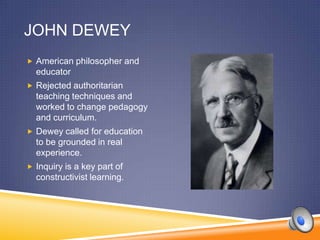
JOHN DEWEY
 American philosopher and
educator
 Rejected authoritarian
teaching techniques and
worked to change pedagogy
and curriculum.
 Dewey called for education
to be grounded in real
experience.
 Inquiry is a key part of
constructivist learning.
THE WHO’S WHO OF
CONSTRUCTIVISM
20th Century – Other Thinkers and Contributors (just to name a few!)
MARIA MONTESSORI
 First woman to attend medical
school in Italy and to achieve
Doctor of Medicine.
 Through her work with
handicapped and socially
deprived children, she
developed her educational
method and found it to be
applicable to all children.
 She has had an impact on the
field of education.
 Piaget received Montessori
training and even the head of
the Swiss Montessori Society
and was the director at a
modified Montessori school.
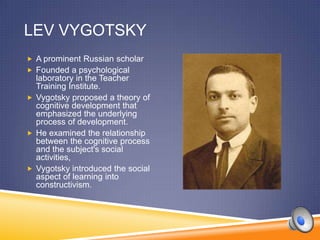
LEV VYGOTSKY
 A prominent Russian scholar
 Founded a psychological
laboratory in the Teacher
Training Institute.
 Vygotsky proposed a theory of
cognitive development that
emphasized the underlying
process of development.
 He examined the relationship
between the cognitive process
and the subject's social
activities,
 Vygotsky introduced the social
aspect of learning into
constructivism.
JEROME BRUNER
 An American psychologist
 Emphasized the student's
active role in the learning
process.
 Asserted that the learner
formulates hypotheses,
constructs new ideas, and
selects information that is
integrated into existing
knowledge and experience.
 Advocates teaching activities
that allow students to
discover and construct
knowledge.
WHAT THE CRITICS SAY:
It works with more privileged populations.
Leads to "group think”.
There is not enough hard evidence that
methods aligned with constructivism work.
CLOSING
Your lists
Beliefs of Constructivism
 Questions
Thank You
REFERENCES
 Tracey, Diane H., and Lesley Mandel Morrow. Lenses on reading:
An introduction to theories and models. Guilford Publications,
2012.
 http://www.delsolschool.org/
 http://www.thirteen.org/edonline/concept2class/constructivism/ind
ex.html
 http://www.sedl.org/scimath/compass/v01n03/1.html
 Images from Google Images

Msj constructivism copy

  • 1.
  • 2.
    BEFORE WE BEGIN Howdo you learn? How do you come to understand something new? Write on a piece of paper and add more as we go along today. Keep the list running.
  • 3.
    CONSTRUCTIVISM IS…  Alearning theory  A theory of how people gain knowledge  Based on observation and scientific study and supported by decades of research
  • 4.
    BELIEFS OF CONSTRUCTIVISM People build or construct their own understanding, knowledge and learning. (clay)  People learn best by a repeated and active process of experience and reflection.  When people come across new information, they have to figure out how and where it fits in or does not fit in with their existing knowledge.  People are active creators of their own knowledge. To do this, they must ask questions, explore, and assess their own knowledge.
  • 5.
  • 6.
    AND IS CERTAINLYNOT… Sheldon Teaching Penny Physics
  • 7.
    WHAT ARE SOMEOF IT’S COMPONENTS?  Construction  Activity  Reflection  Collaboration  Inquiry  Emerging Quality
  • 8.
    THE WHO’S WHOOF CONSTRUCTIVISM Early Thinkers
  • 9.
    CONFUCIUS “ Learning without reflectionis a waste, reflection without learning is dangerous”.
  • 10.
    SOCRATES He asked directed questions thatled his students to realize for themselves the weaknesses in their thinking.
  • 11.
    THE WHO’S WHOOF CONSTRUCTIVISM 20th Century – Big Names
  • 12.
    JEAN PIAGET  Swiss-bornprofessor of psychology and sociology,  How does knowledge grow?  Found humans learn through the construction of Progressively complex logical structures, from infancy through to adulthood.  His work is considered the foundation of Constructivism.
  • 13.
    JOHN DEWEY  Americanphilosopher and educator  Rejected authoritarian teaching techniques and worked to change pedagogy and curriculum.  Dewey called for education to be grounded in real experience.  Inquiry is a key part of constructivist learning.
  • 14.
    THE WHO’S WHOOF CONSTRUCTIVISM 20th Century – Other Thinkers and Contributors (just to name a few!)
  • 15.
    MARIA MONTESSORI  Firstwoman to attend medical school in Italy and to achieve Doctor of Medicine.  Through her work with handicapped and socially deprived children, she developed her educational method and found it to be applicable to all children.  She has had an impact on the field of education.  Piaget received Montessori training and even the head of the Swiss Montessori Society and was the director at a modified Montessori school.
  • 16.
    LEV VYGOTSKY  Aprominent Russian scholar  Founded a psychological laboratory in the Teacher Training Institute.  Vygotsky proposed a theory of cognitive development that emphasized the underlying process of development.  He examined the relationship between the cognitive process and the subject's social activities,  Vygotsky introduced the social aspect of learning into constructivism.
  • 17.
    JEROME BRUNER  AnAmerican psychologist  Emphasized the student's active role in the learning process.  Asserted that the learner formulates hypotheses, constructs new ideas, and selects information that is integrated into existing knowledge and experience.  Advocates teaching activities that allow students to discover and construct knowledge.
  • 18.
    WHAT THE CRITICSSAY: It works with more privileged populations. Leads to "group think”. There is not enough hard evidence that methods aligned with constructivism work.
  • 19.
    CLOSING Your lists Beliefs ofConstructivism  Questions Thank You
  • 20.
    REFERENCES  Tracey, DianeH., and Lesley Mandel Morrow. Lenses on reading: An introduction to theories and models. Guilford Publications, 2012.  http://www.delsolschool.org/  http://www.thirteen.org/edonline/concept2class/constructivism/ind ex.html  http://www.sedl.org/scimath/compass/v01n03/1.html  Images from Google Images