Introduction to Teaching William Allan Kritsonis, PhD Please silence all phones and pagers.
Field Experience How did it go?
Articles Article – 10 points Format – 10 points Introduction – 20 points Body – 30 points Conclusion – 20 points Grammar – 10 points
Articles “This report was very eye-opening.” “This surprised me because…” “I support this article and agree on…” “Even though I feel the study was unfair, I can still understand…”
Philosophy: a study of theories of knowledge, truth, existence, and good Theory: a set of related principles that are based on observation and are used to explain additional observations Philosophy of education: provides a framework for thinking about educational issues, and it guides professional practice How do I get one???
Teachers acquire a philosophical framework to guide their practice by becoming knowledgeable and reflective, which allows them to make professional decisions that promote as much growth in their students as possible.
Traditional Schools of Philosophy 4 cohesive philosophies on which most educational decisions are based: Idealism Realism Pragmatism Existentialism
Idealism Plato, Greek Philosopher A traditional philosophy asserting that, because the physical world is constantly changing, ideas are the only reliable form of reality
Idealism and Teaching Socratic method: questioning Believe that teaching and learning should focus on ideas.  Teachers provide guidance by helping students become more precise and logical thinkers  Criticized for being cold because it emphasizes the rational and logical over other dimensions of the human experience.
Realism Aristotle, Greek Philosopher Holds that the features of the universe exist whether or not a human being is there to perceive them There are important ideas and facts that must be understood and they can only be understood by studying the material world
Realism and Teaching Curriculum emphasizes essentials like math, science, reading, and writing Teachers emphasize observation, experimentation, and critical reasoning De-emphasize feelings and other personal factors Criticized for failing to take the whole person into account in the learning process
Pragmatism John Dewey, American Philosopher A traditional philosophy that rejects the idea of absolute, unchanging truth, instead asserting that truth is what works
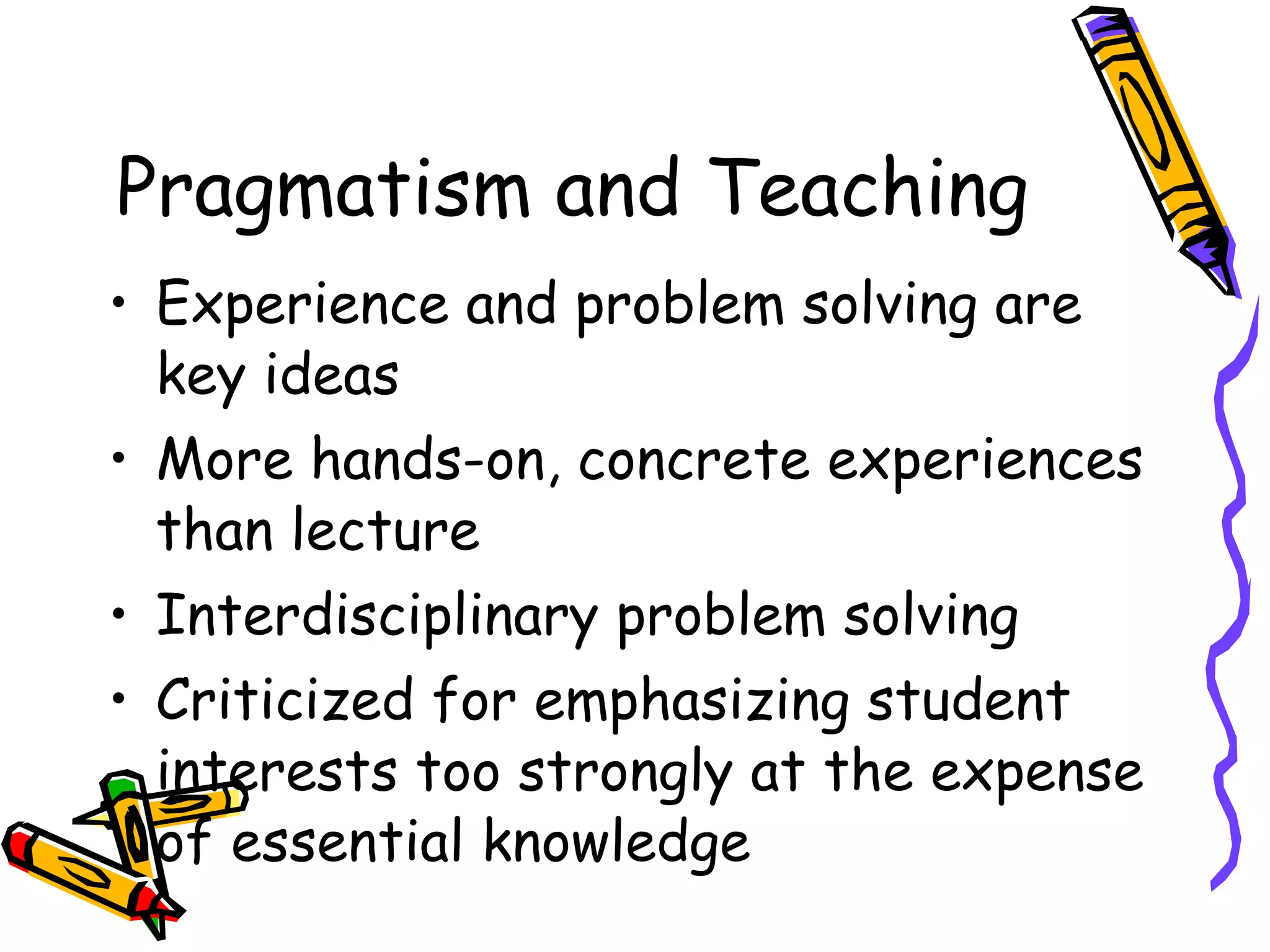
Pragmatism and Teaching Experience and problem solving are key ideas More hands-on, concrete experiences than lecture Interdisciplinary problem solving Criticized for emphasizing student interests too strongly at the expense of essential knowledge
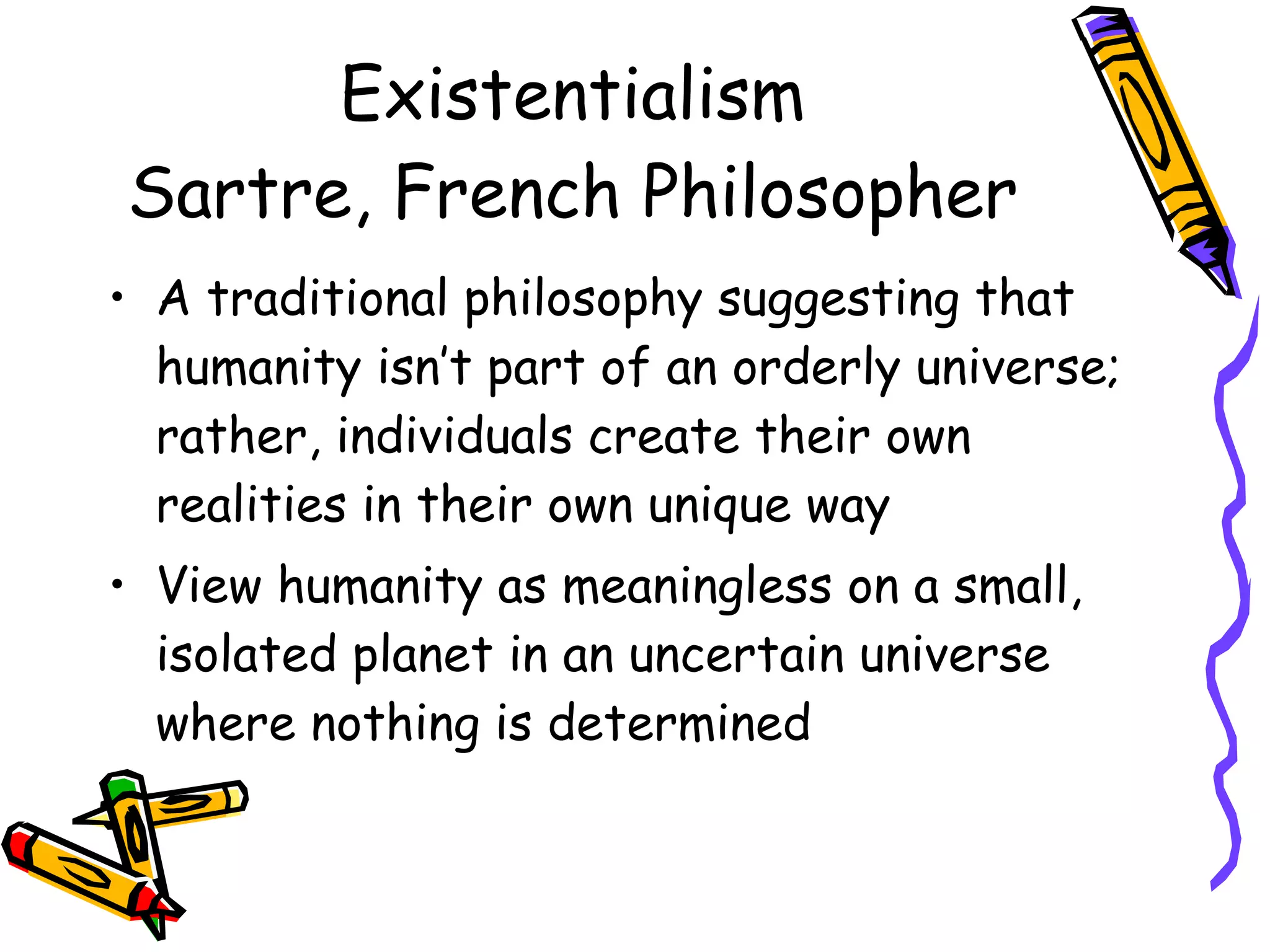
Existentialism Sartre, French Philosopher A traditional philosophy suggesting that humanity isn’t part of an orderly universe; rather, individuals create their own realities in their own unique way View humanity as meaningless on a small, isolated planet in an uncertain universe where nothing is determined
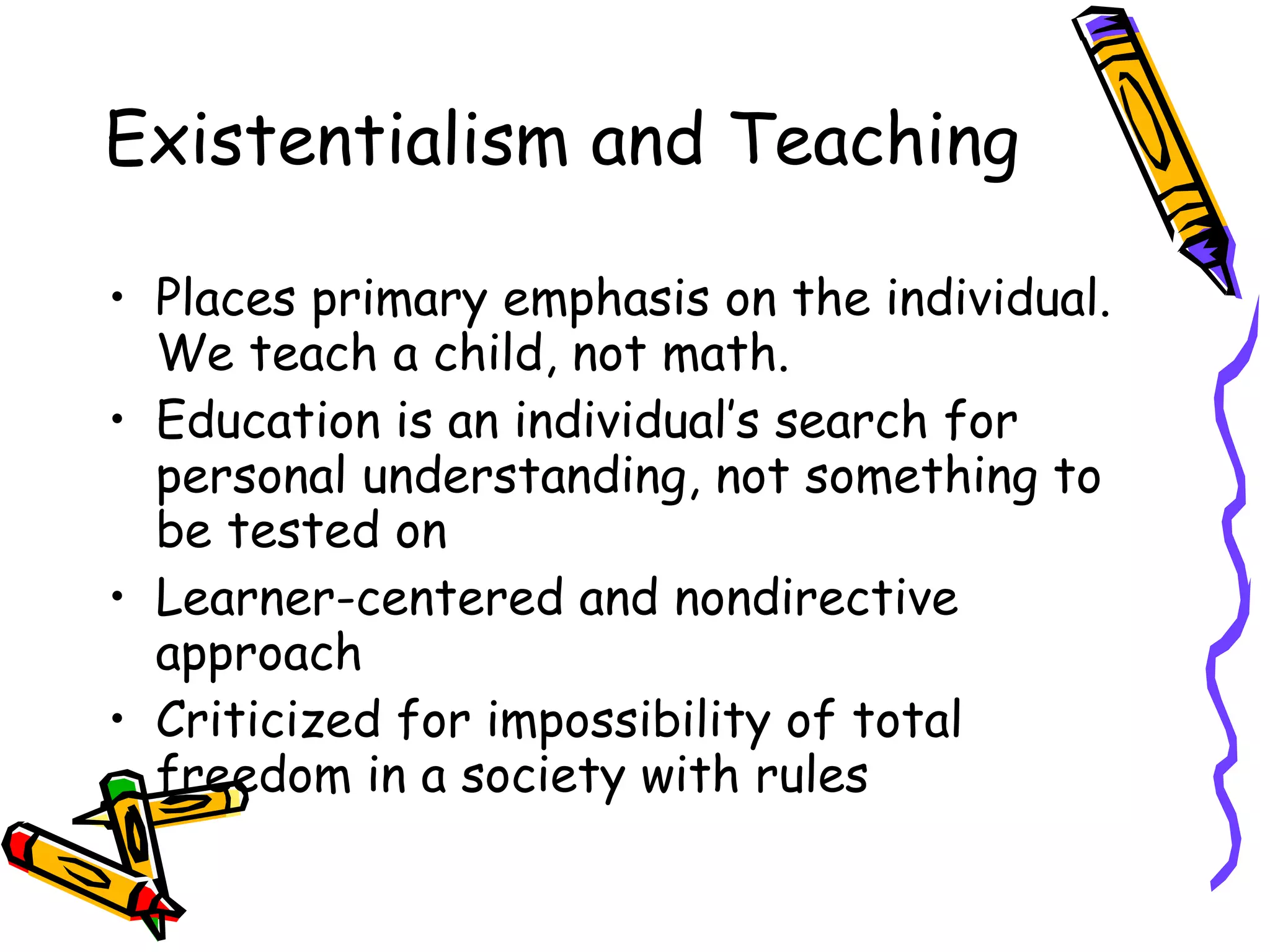
Existentialism and Teaching Places primary emphasis on the individual.  We teach a child, not math. Education is an individual’s search for personal understanding, not something to be tested on Learner-centered and nondirective approach Criticized for impossibility of total freedom in a society with rules
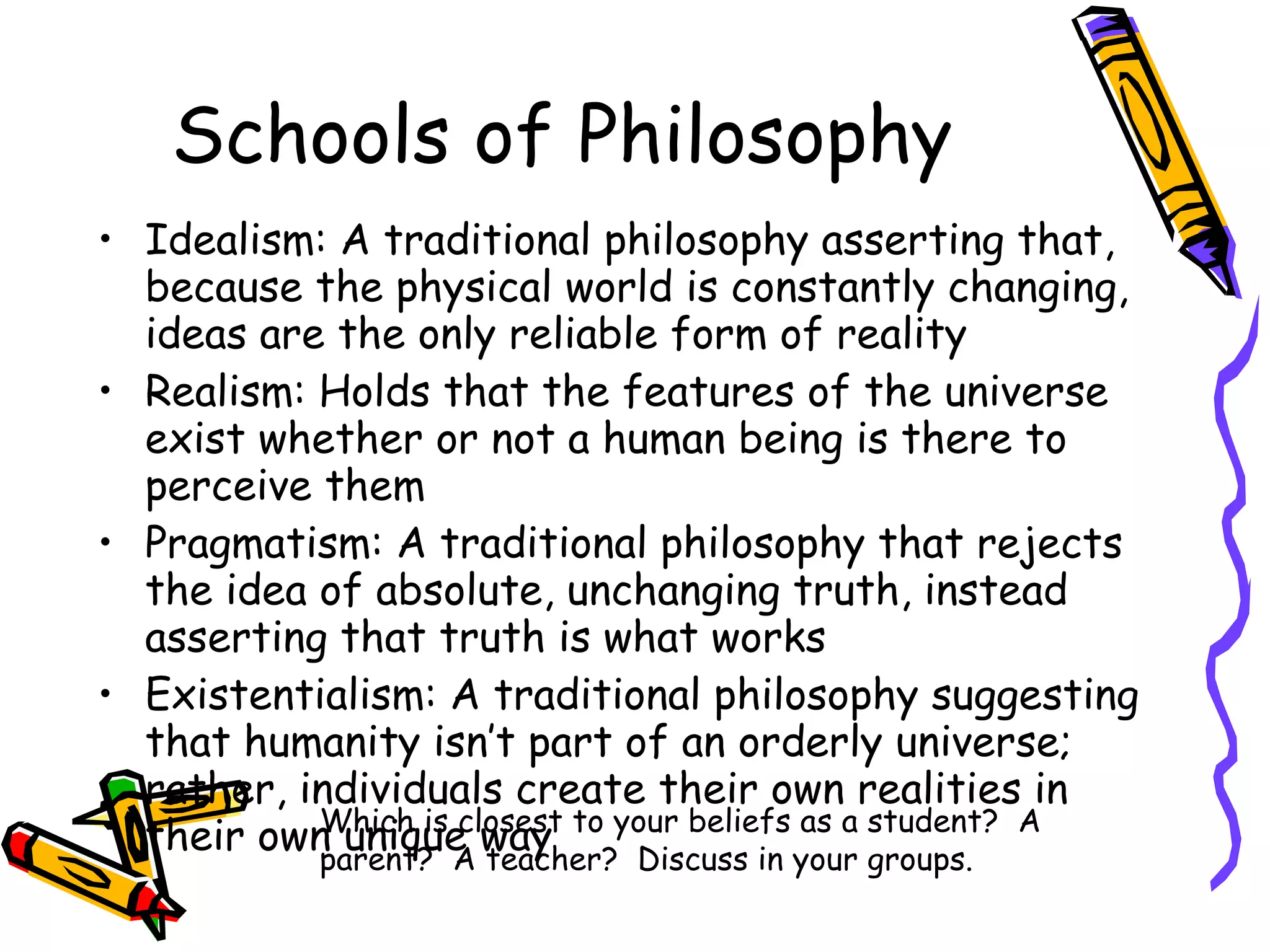
Schools of Philosophy Idealism: A traditional philosophy asserting that, because the physical world is constantly changing, ideas are the only reliable form of reality Realism: Holds that the features of the universe exist whether or not a human being is there to perceive them Pragmatism: A traditional philosophy that rejects the idea of absolute, unchanging truth, instead asserting that truth is what works Existentialism: A traditional philosophy suggesting that humanity isn’t part of an orderly universe; rather, individuals create their own realities in their own unique way Which is closest to your beliefs as a student?  A parent?  A teacher?  Discuss in your groups.
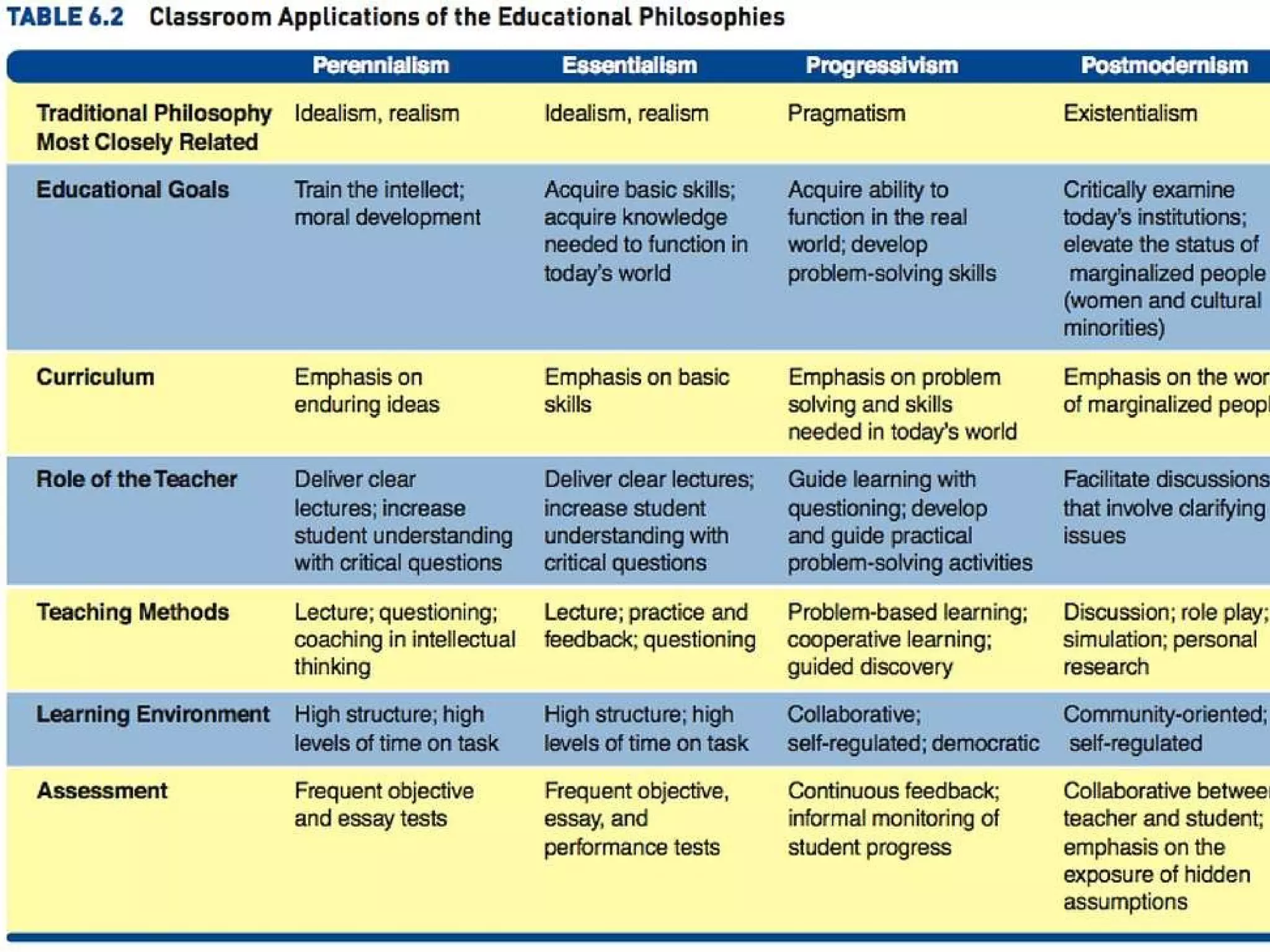
Philosophies of Education Perennialism Essentialism Progressivism Postmodernism
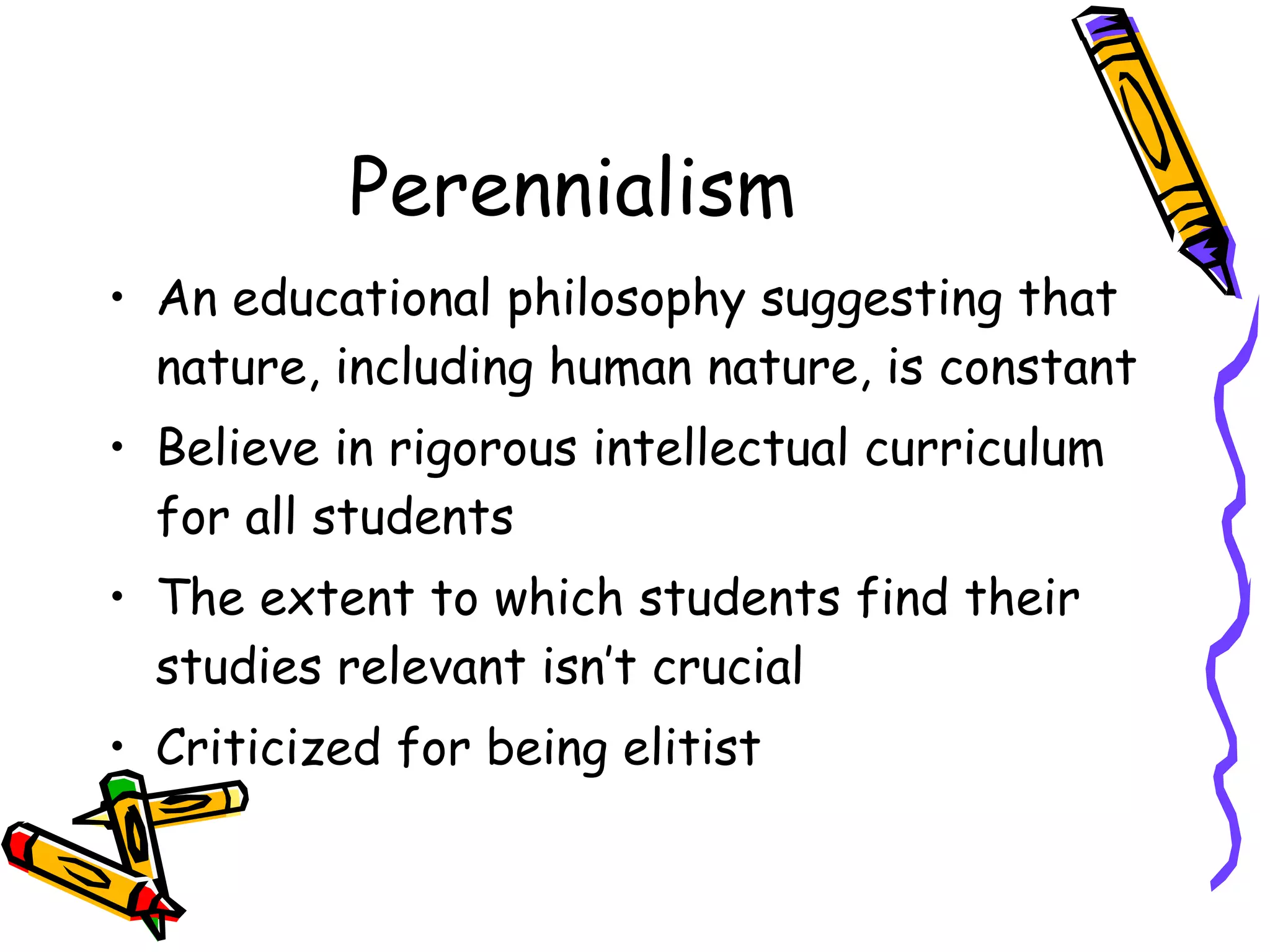
Perennialism An educational philosophy suggesting that nature, including human nature, is constant Believe in rigorous intellectual curriculum for all students The extent to which students find their studies relevant isn’t crucial Criticized for being elitist
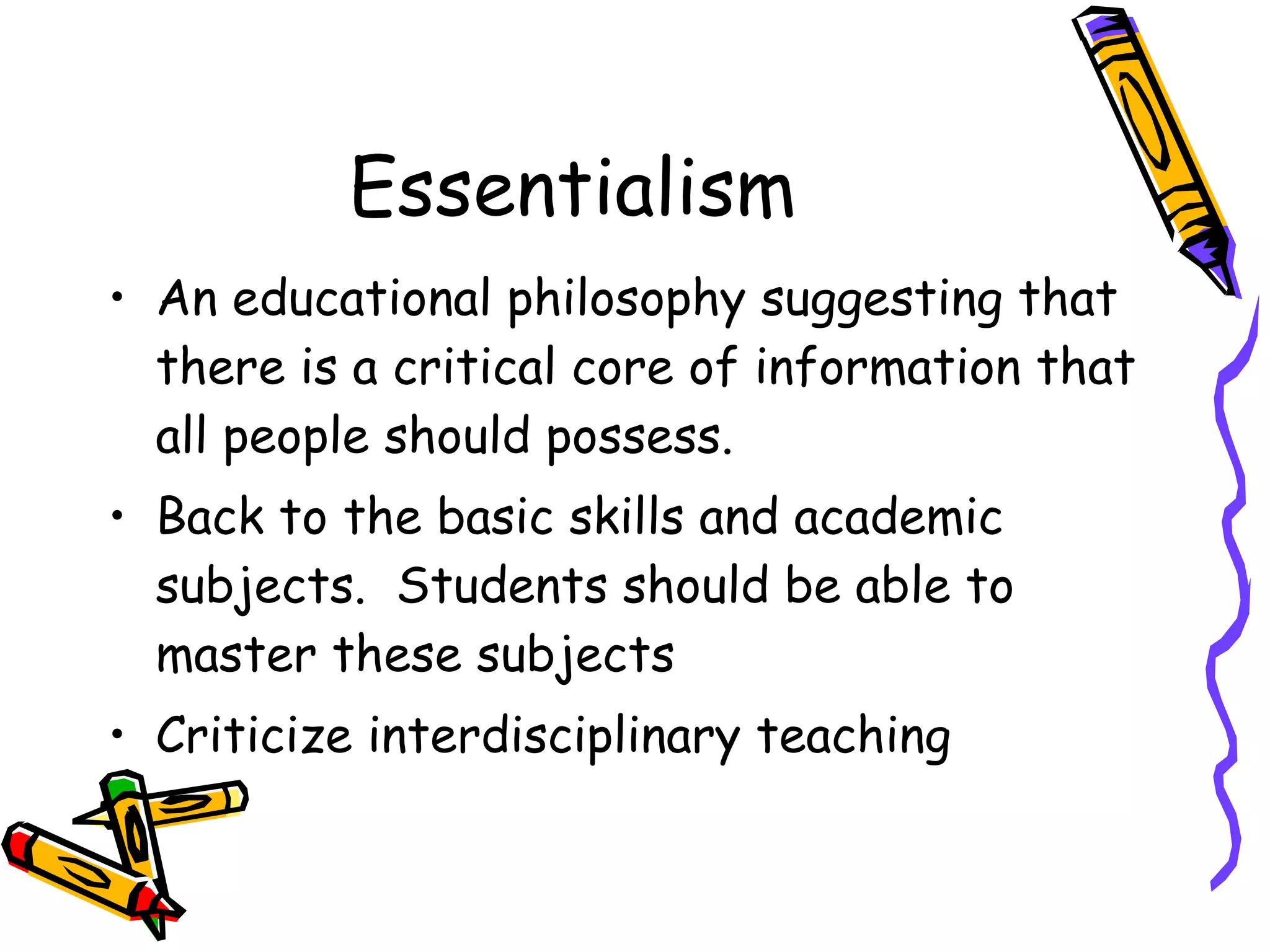
Essentialism An educational philosophy suggesting that there is a critical core of information that all people should possess.  Back to the basic skills and academic subjects.  Students should be able to master these subjects Criticize interdisciplinary teaching
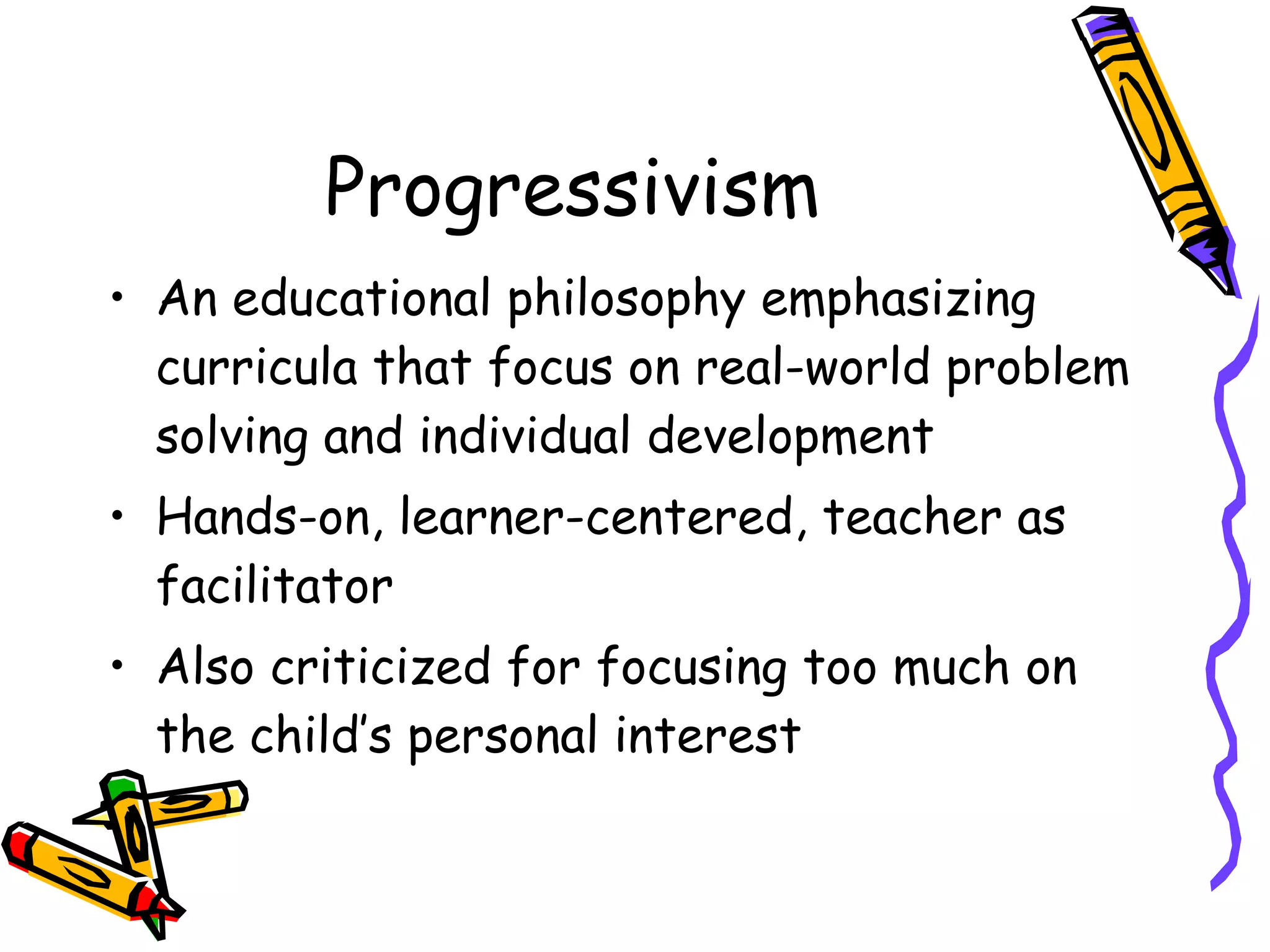
Progressivism An educational philosophy emphasizing curricula that focus on real-world problem solving and individual development Hands-on, learner-centered, teacher as facilitator Also criticized for focusing too much on the child’s personal interest
Postmodernism An educational philosophy that contends that many of the institutions in our society, including schools, are used by those in power to control and marginalize those who lack power Study events from the view of the marginalized party’s perspective
©2005 by Pearson Education, Inc.  All Rights Reserved  Which most accurately describes your views of education, from the perspective of a real teacher?  Comment on your paper.
Let’s watch the DVD segment referred to on page 203.
Read pages 204-207 and create your own Philosophy of Education Statement.  Be sure to use philosophy names. It should be typed, double spaced with standard fonts and margins.  Length is up to you, but less than one page is not recommended. Exit: There is nothing more to turn in, but you need to stay until you have a handle on how to begin your paper.

Chapter 6

  • 1.
    Introduction to TeachingWilliam Allan Kritsonis, PhD Please silence all phones and pagers.
  • 2.
  • 3.
    Articles Article –10 points Format – 10 points Introduction – 20 points Body – 30 points Conclusion – 20 points Grammar – 10 points
  • 4.
    Articles “This reportwas very eye-opening.” “This surprised me because…” “I support this article and agree on…” “Even though I feel the study was unfair, I can still understand…”
  • 5.
    Philosophy: a studyof theories of knowledge, truth, existence, and good Theory: a set of related principles that are based on observation and are used to explain additional observations Philosophy of education: provides a framework for thinking about educational issues, and it guides professional practice How do I get one???
  • 6.
    Teachers acquire aphilosophical framework to guide their practice by becoming knowledgeable and reflective, which allows them to make professional decisions that promote as much growth in their students as possible.
  • 7.
    Traditional Schools ofPhilosophy 4 cohesive philosophies on which most educational decisions are based: Idealism Realism Pragmatism Existentialism
  • 8.
    Idealism Plato, GreekPhilosopher A traditional philosophy asserting that, because the physical world is constantly changing, ideas are the only reliable form of reality
  • 9.
    Idealism and TeachingSocratic method: questioning Believe that teaching and learning should focus on ideas. Teachers provide guidance by helping students become more precise and logical thinkers Criticized for being cold because it emphasizes the rational and logical over other dimensions of the human experience.
  • 10.
    Realism Aristotle, GreekPhilosopher Holds that the features of the universe exist whether or not a human being is there to perceive them There are important ideas and facts that must be understood and they can only be understood by studying the material world
  • 11.
    Realism and TeachingCurriculum emphasizes essentials like math, science, reading, and writing Teachers emphasize observation, experimentation, and critical reasoning De-emphasize feelings and other personal factors Criticized for failing to take the whole person into account in the learning process
  • 12.
    Pragmatism John Dewey,American Philosopher A traditional philosophy that rejects the idea of absolute, unchanging truth, instead asserting that truth is what works
  • 13.
    Pragmatism and TeachingExperience and problem solving are key ideas More hands-on, concrete experiences than lecture Interdisciplinary problem solving Criticized for emphasizing student interests too strongly at the expense of essential knowledge
  • 14.
    Existentialism Sartre, FrenchPhilosopher A traditional philosophy suggesting that humanity isn’t part of an orderly universe; rather, individuals create their own realities in their own unique way View humanity as meaningless on a small, isolated planet in an uncertain universe where nothing is determined
  • 15.
    Existentialism and TeachingPlaces primary emphasis on the individual. We teach a child, not math. Education is an individual’s search for personal understanding, not something to be tested on Learner-centered and nondirective approach Criticized for impossibility of total freedom in a society with rules
  • 16.
    Schools of PhilosophyIdealism: A traditional philosophy asserting that, because the physical world is constantly changing, ideas are the only reliable form of reality Realism: Holds that the features of the universe exist whether or not a human being is there to perceive them Pragmatism: A traditional philosophy that rejects the idea of absolute, unchanging truth, instead asserting that truth is what works Existentialism: A traditional philosophy suggesting that humanity isn’t part of an orderly universe; rather, individuals create their own realities in their own unique way Which is closest to your beliefs as a student? A parent? A teacher? Discuss in your groups.
  • 17.
    Philosophies of EducationPerennialism Essentialism Progressivism Postmodernism
  • 18.
    Perennialism An educationalphilosophy suggesting that nature, including human nature, is constant Believe in rigorous intellectual curriculum for all students The extent to which students find their studies relevant isn’t crucial Criticized for being elitist
  • 19.
    Essentialism An educationalphilosophy suggesting that there is a critical core of information that all people should possess. Back to the basic skills and academic subjects. Students should be able to master these subjects Criticize interdisciplinary teaching
  • 20.
    Progressivism An educationalphilosophy emphasizing curricula that focus on real-world problem solving and individual development Hands-on, learner-centered, teacher as facilitator Also criticized for focusing too much on the child’s personal interest
  • 21.
    Postmodernism An educationalphilosophy that contends that many of the institutions in our society, including schools, are used by those in power to control and marginalize those who lack power Study events from the view of the marginalized party’s perspective
  • 22.
    ©2005 by PearsonEducation, Inc. All Rights Reserved Which most accurately describes your views of education, from the perspective of a real teacher? Comment on your paper.
  • 23.
    Let’s watch theDVD segment referred to on page 203.
  • 24.
    Read pages 204-207and create your own Philosophy of Education Statement. Be sure to use philosophy names. It should be typed, double spaced with standard fonts and margins. Length is up to you, but less than one page is not recommended. Exit: There is nothing more to turn in, but you need to stay until you have a handle on how to begin your paper.