Pragmatism
(Experimentalism)
Kristen Karazsia
Educational Philosophies Presentation
Sept. 28, 2015
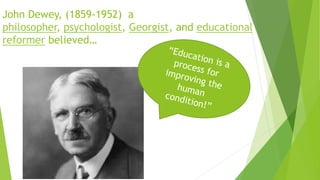
John Dewey, (1859-1952) a
philosopher, psychologist, Georgist, and educational
reformer believed…
Out with the old (religion), in with the new
(critical thinking)…
At a time when society was religion-based and human-centered, a
change occurred thanks to the minds of men like scientist Charles Darwin,
mathematician Charles Pierce, and psychologist William James.
Darwin, who wrote “The Origin of Species” shook previously-held views
about creation and religion. Pierce and James developed principles that 1.
rejected dogmas or preconceived truths and 2. promoted testing to verify
ideas.
The fresh approach taken by these men caused a shift in educational
philosophy called PRAGMATISM (Experimentalism).
According to page 32 of “Philosophical
Foundations of Curriculum…”
1. Pragmatism is based on change, process, and relativity.
2. Pragmatism construes knowledge as a process in which
reality is constantly changing.
As a result…
3. Pragmatic learning environments are constantly changing
to meet the ever-changing student.
4. Pragmatic learning occurs as a person engages in problem
solving in a way that is transferable to other walks of life.
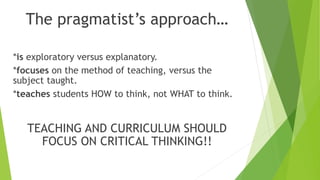
The pragmatist’s approach…
*is exploratory versus explanatory.
*focuses on the method of teaching, versus the
subject taught.
*teaches students HOW to think, not WHAT to think.
TEACHING AND CURRICULUM SHOULD
FOCUS ON CRITICAL THINKING!!
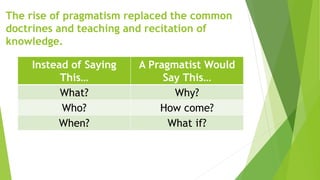
The rise of pragmatism replaced the common
doctrines and teaching and recitation of
knowledge.
Instead of Saying
This…
A Pragmatist Would
Say This…
What? Why?
Who? How come?
When? What if?
Works Cited…
 Ornstein, Allan, C. & Hunkins, F. (2013). Curriculum: Foundations, Principles,
and Issues. Boston, MA: Pearson.

Pragmatism (experimentalism)

  • 1.
  • 2.
    John Dewey, (1859-1952)a philosopher, psychologist, Georgist, and educational reformer believed…
  • 3.
    Out with theold (religion), in with the new (critical thinking)… At a time when society was religion-based and human-centered, a change occurred thanks to the minds of men like scientist Charles Darwin, mathematician Charles Pierce, and psychologist William James. Darwin, who wrote “The Origin of Species” shook previously-held views about creation and religion. Pierce and James developed principles that 1. rejected dogmas or preconceived truths and 2. promoted testing to verify ideas. The fresh approach taken by these men caused a shift in educational philosophy called PRAGMATISM (Experimentalism).
  • 4.
    According to page32 of “Philosophical Foundations of Curriculum…” 1. Pragmatism is based on change, process, and relativity. 2. Pragmatism construes knowledge as a process in which reality is constantly changing. As a result… 3. Pragmatic learning environments are constantly changing to meet the ever-changing student. 4. Pragmatic learning occurs as a person engages in problem solving in a way that is transferable to other walks of life.
  • 5.
    The pragmatist’s approach… *isexploratory versus explanatory. *focuses on the method of teaching, versus the subject taught. *teaches students HOW to think, not WHAT to think. TEACHING AND CURRICULUM SHOULD FOCUS ON CRITICAL THINKING!!
  • 6.
    The rise ofpragmatism replaced the common doctrines and teaching and recitation of knowledge. Instead of Saying This… A Pragmatist Would Say This… What? Why? Who? How come? When? What if?
  • 7.
    Works Cited…  Ornstein,Allan, C. & Hunkins, F. (2013). Curriculum: Foundations, Principles, and Issues. Boston, MA: Pearson.