TEACHING
ANDRAGOGY
AN OVER VIEW
P r o f . ( D r. ) P a r v e e n P a n d i t
P r i n c i p a l ,
I n s t i t u t e o f A d v a n c e d S t u d i e s I n E d u c a t i o n , M . A .
R o a d S r i n a g a r
INTRODUCTION
“Androgogy ” – “Andros” Means ‘Man’
“Ago” Means ‘to lead’
“Man Leading”
Alexander Kapp (1833) Theory of Adult Education
Malcolm Knowles (1967 Used (ANDRAGOGY)
Yogosla vian Journal “Andragogija”-1969
Science of understanding & Supporting Life Long and Life wide
Education of Adults
Interactive Teaching & Learning
•Amalogam of subject – Centered
•Education and Student – Centered
•Integration of Students experience
and learning needs with Structured
curriculum
•Abstract World “with Real World”
Origin Of SCE
• US Transformation from Agrarian to industrial
Society
• Commercialization / Investment
i. Production / Economy
ii. Business & Industry
Prevailing Conditions
Subject Centred Education.
“One Imposition from above and from outside… Learning here means
acquisition of what is already incorporated in books and in the heads of
the elders ” (Dewey -1947)
Part I
S U B J E C T – C E N T R I C
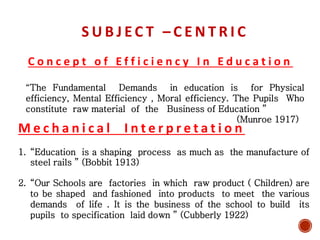
C o n c e p t o f E f f i c i e n c y I n E d u c a t i o n
“The Fundamental Demands in education is for Physical
efficiency, Mental Efficiency , Moral efficiency. The Pupils Who
constitute raw material of the Business of Education ”
(Munroe 1917)
M e c h a n i c a l I n t e r p r e t a t i o n
1. “Education is a shaping process as much as the manufacture of
steel rails ” (Bobbit 1913)
2. “Our Schools are factories in which raw product ( Children) are
to be shaped and fashioned into products to meet the various
demands of life . It is the business of the school to build its
pupils to specification laid down ” (Cubberly 1922)
S U B J E C T – C E N T R I C
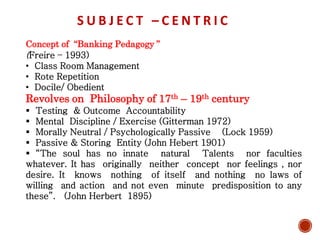
Concept of “Banking Pedagogy ”
(Freire – 1993)
• Class Room Management
• Rote Repetition
• Docile/ Obedient
Revolves on Philosophy of 17th – 19th century
 Testing & Outcome Accountability
 Mental Discipline / Exercise (Gitterman 1972)
 Morally Neutral / Psychologically Passive (Lock 1959)
 Passive & Storing Entity (John Hebert 1901)
 “The soul has no innate natural Talents nor faculties
whatever. It has originally neither concept nor feelings , nor
desire. It knows nothing of itself and nothing no laws of
willing and action and not even minute predisposition to any
these”. (John Herbert 1895)
S U B J E C T – C E N T R I C
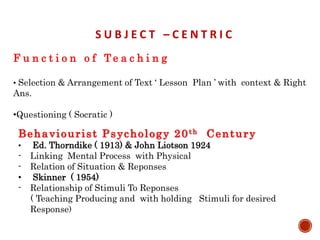
F u n c t i o n o f T e a c h i n g
• Selection & Arrangement of Text ‘ Lesson Plan ’ with context & Right
Ans.
•Questioning ( Socratic )
Behaviourist Psychology 20th Century
• Ed. Thorndike ( 1913) & John Liotson 1924
- Linking Mental Process with Physical
- Relation of Situation & Reponses
• Skinner ( 1954)
- Relationship of Stimuli To Reponses
( Teaching Producing and with holding Stimuli for desired
Response)
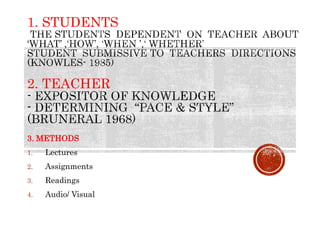
1. STUDENTS
2. TEACHER
3. METHODS
1. Lectures
2. Assignments
3. Readings
4. Audio/ Visual
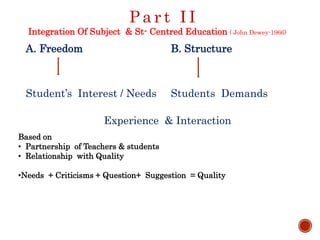
P a r t I I
Integration Of Subject & St- Centred Education ( John Dewey-1966)
Based on
• Partnership of Teachers & students
• Relationship with Quality
•Needs + Criticisms + Question+ Suggestion = Quality
A. Freedom B. Structure
Student’s Interest / Needs Students Demands
Experience & Interaction
I n t e r a c t i v e Te c h n o l o g y
“ Four Assumptions of Adult – Learning ”
(Knowles -1972)
1. The Adult learner is self – Directed.
2. The adult leaner has accumulated life experiences
3. Timing is an essential factor.
4. Adult Learner have a problem – cantered approaches .
Andragogical Principles / Methods/ Skill
1. Creating a climate for collaborative learning.
2. Creating a supportive and trusting Psychological
and social climate is even more important than
Physical Setting.
3. Tasks for collaboration are
i. A Class tone.
ii. Collaborative peer learning.
iii. Relationship with teacher/ instructor.
iv. Identifying potential obstacles.
v. Self Directed learning
vi. Class assignments.
Providing Structures For Collaborative Learning
Skilfully asked questions are a primary methods for
lending structure to class discussions (Gitterman 1995)
• Ask questions in early classes which invites opinions and
have no right or wrong answer.
• Direct students to talk to each other and build on their
respective contribution.
• Deepen the conversation by using more discriminating
questions which call for facts , inference, explanations
and evaluative Judgements as students comfort and
confidence increases.
• Periodically pull together and summarize salient
themes.
Dealing With Obstacles To Peer Learning.
When class obstacles interfere with
learning, We have to help students
overcome the obstacles throughout the
course, the teacher has to reach for
students’ hesitations, concerns, and
confusion and deals with obstacles that
interfere with peer learning
E x p e r i e n c i n g A b s t r a c t i o n s : -
• Educators must be careful about presenting
students with a “closed system” of knowledge .
• Unique situations (mentally challenged adult,
quiet child, angry teenager, etc.).
• Mezirow (2000) suggests that learning from
experience leads to construction of revised or
new interpretations of both the abstraction and
the experience.
O p e r a t i o n a l i z i n g A b s t r a c t i o n s :
• “Knowing that” (having facts and information) and
“knowing how” (using facts and information) can be
extremely useful (Ryle 1949).
• Students integrate the affective (feeling), imaginal
(perceiving), conceptual (thinking) and practical
(behaving) modes of learning (Heron 1996, 1992;
Kolb 1984).
Building Generalizations And Critical Thinking
The active pragmatic idea of leaping the barrier
from learning to thinking.
Steps for Development of Critical Thinking
1. Recognize and define a broader conceptual issue;
2. Gather and consider relevant information;
3. Form a tentative generalization;
4. Try it out (fly it on a flagpole);
5. Evaluate, refine, and decide whether it holds up.
R O L E O F A T E A C H E R
Balancing Lecture, Discussion, Role Play, And
Visual Methods
• At the outset, inform students what you plan to cover and
your basic thesis or argument (the prologue helps students
follow your presentation);
• By repetition and voice modulation, the lecture’s main points
are emphasized;
• By uses of analogy, metaphors, illustrations, build bridges
and connections between the content and methods of your
discipline and students’ experiences;
• Humor provides a common class reaction, a relaxing
moment, and mobilizes interest and attention; and
• Visual presentations help students to visualize the content to
be learned.
Learning is “caught” not “taught.” If we teach
empowerment but are authoritarian in our
approach; if we exhort intellectual curiosity and
critical thinking and, in turn, we are dogmatic and
rushed in our own preparation and thinking,
students will internalize what we do and not what
we say. Our message and our behaviour have to be
congruent.
Knowls:-
Pedagogy – Andorogagy represents a contanum
ranging from teacher dominated to student
directed learning & both approaches are
appropriate with children & adult depending on the
situation.
References:
• Brockett, R.B. “Its Time to move on?” British
Columbia,2000.
•Davenport, J. and Davenport, J. “A Chronology and analysis
of the Andragogy Debate” Adult Education Quarterly,1985.
•Grace, A.P. “Taking a Critical Pose: Andragogy” Journal 1996.
•Hartee, A. “Malcolm Knowles: Theory of Androgogy: A
Critique” Journal 1984.
•Knowles, M.S. “Andragogy, Not Pedagogy’ 1968
•Little, D. “Toward Recovering and Reconstructing
Andragogy” Adult Education Research Conference, 1994.
•Savicevic, D.M. “Modern Conceptions of Andragogy” 1991.
Thanks

Teaching Andragogy An Overvew

  • 1.
    TEACHING ANDRAGOGY AN OVER VIEW Pr o f . ( D r. ) P a r v e e n P a n d i t P r i n c i p a l , I n s t i t u t e o f A d v a n c e d S t u d i e s I n E d u c a t i o n , M . A . R o a d S r i n a g a r
  • 2.
    INTRODUCTION “Androgogy ” –“Andros” Means ‘Man’ “Ago” Means ‘to lead’ “Man Leading” Alexander Kapp (1833) Theory of Adult Education Malcolm Knowles (1967 Used (ANDRAGOGY) Yogosla vian Journal “Andragogija”-1969 Science of understanding & Supporting Life Long and Life wide Education of Adults
  • 3.
    Interactive Teaching &Learning •Amalogam of subject – Centered •Education and Student – Centered •Integration of Students experience and learning needs with Structured curriculum •Abstract World “with Real World”
  • 4.
    Origin Of SCE •US Transformation from Agrarian to industrial Society • Commercialization / Investment i. Production / Economy ii. Business & Industry Prevailing Conditions Subject Centred Education. “One Imposition from above and from outside… Learning here means acquisition of what is already incorporated in books and in the heads of the elders ” (Dewey -1947) Part I
  • 5.
    S U BJ E C T – C E N T R I C C o n c e p t o f E f f i c i e n c y I n E d u c a t i o n “The Fundamental Demands in education is for Physical efficiency, Mental Efficiency , Moral efficiency. The Pupils Who constitute raw material of the Business of Education ” (Munroe 1917) M e c h a n i c a l I n t e r p r e t a t i o n 1. “Education is a shaping process as much as the manufacture of steel rails ” (Bobbit 1913) 2. “Our Schools are factories in which raw product ( Children) are to be shaped and fashioned into products to meet the various demands of life . It is the business of the school to build its pupils to specification laid down ” (Cubberly 1922)
  • 6.
    S U BJ E C T – C E N T R I C Concept of “Banking Pedagogy ” (Freire – 1993) • Class Room Management • Rote Repetition • Docile/ Obedient Revolves on Philosophy of 17th – 19th century  Testing & Outcome Accountability  Mental Discipline / Exercise (Gitterman 1972)  Morally Neutral / Psychologically Passive (Lock 1959)  Passive & Storing Entity (John Hebert 1901)  “The soul has no innate natural Talents nor faculties whatever. It has originally neither concept nor feelings , nor desire. It knows nothing of itself and nothing no laws of willing and action and not even minute predisposition to any these”. (John Herbert 1895)
  • 7.
    S U BJ E C T – C E N T R I C F u n c t i o n o f T e a c h i n g • Selection & Arrangement of Text ‘ Lesson Plan ’ with context & Right Ans. •Questioning ( Socratic ) Behaviourist Psychology 20th Century • Ed. Thorndike ( 1913) & John Liotson 1924 - Linking Mental Process with Physical - Relation of Situation & Reponses • Skinner ( 1954) - Relationship of Stimuli To Reponses ( Teaching Producing and with holding Stimuli for desired Response)
  • 8.
    1. STUDENTS 2. TEACHER 3.METHODS 1. Lectures 2. Assignments 3. Readings 4. Audio/ Visual
  • 9.
    P a rt I I Integration Of Subject & St- Centred Education ( John Dewey-1966) Based on • Partnership of Teachers & students • Relationship with Quality •Needs + Criticisms + Question+ Suggestion = Quality A. Freedom B. Structure Student’s Interest / Needs Students Demands Experience & Interaction
  • 10.
    I n te r a c t i v e Te c h n o l o g y “ Four Assumptions of Adult – Learning ” (Knowles -1972) 1. The Adult learner is self – Directed. 2. The adult leaner has accumulated life experiences 3. Timing is an essential factor. 4. Adult Learner have a problem – cantered approaches .
  • 11.
    Andragogical Principles /Methods/ Skill 1. Creating a climate for collaborative learning. 2. Creating a supportive and trusting Psychological and social climate is even more important than Physical Setting. 3. Tasks for collaboration are i. A Class tone. ii. Collaborative peer learning. iii. Relationship with teacher/ instructor. iv. Identifying potential obstacles. v. Self Directed learning vi. Class assignments.
  • 12.
    Providing Structures ForCollaborative Learning Skilfully asked questions are a primary methods for lending structure to class discussions (Gitterman 1995) • Ask questions in early classes which invites opinions and have no right or wrong answer. • Direct students to talk to each other and build on their respective contribution. • Deepen the conversation by using more discriminating questions which call for facts , inference, explanations and evaluative Judgements as students comfort and confidence increases. • Periodically pull together and summarize salient themes.
  • 13.
    Dealing With ObstaclesTo Peer Learning. When class obstacles interfere with learning, We have to help students overcome the obstacles throughout the course, the teacher has to reach for students’ hesitations, concerns, and confusion and deals with obstacles that interfere with peer learning
  • 14.
    E x pe r i e n c i n g A b s t r a c t i o n s : - • Educators must be careful about presenting students with a “closed system” of knowledge . • Unique situations (mentally challenged adult, quiet child, angry teenager, etc.). • Mezirow (2000) suggests that learning from experience leads to construction of revised or new interpretations of both the abstraction and the experience.
  • 15.
    O p er a t i o n a l i z i n g A b s t r a c t i o n s : • “Knowing that” (having facts and information) and “knowing how” (using facts and information) can be extremely useful (Ryle 1949). • Students integrate the affective (feeling), imaginal (perceiving), conceptual (thinking) and practical (behaving) modes of learning (Heron 1996, 1992; Kolb 1984).
  • 16.
    Building Generalizations AndCritical Thinking The active pragmatic idea of leaping the barrier from learning to thinking. Steps for Development of Critical Thinking 1. Recognize and define a broader conceptual issue; 2. Gather and consider relevant information; 3. Form a tentative generalization; 4. Try it out (fly it on a flagpole); 5. Evaluate, refine, and decide whether it holds up.
  • 17.
    R O LE O F A T E A C H E R Balancing Lecture, Discussion, Role Play, And Visual Methods • At the outset, inform students what you plan to cover and your basic thesis or argument (the prologue helps students follow your presentation); • By repetition and voice modulation, the lecture’s main points are emphasized; • By uses of analogy, metaphors, illustrations, build bridges and connections between the content and methods of your discipline and students’ experiences; • Humor provides a common class reaction, a relaxing moment, and mobilizes interest and attention; and • Visual presentations help students to visualize the content to be learned.
  • 18.
    Learning is “caught”not “taught.” If we teach empowerment but are authoritarian in our approach; if we exhort intellectual curiosity and critical thinking and, in turn, we are dogmatic and rushed in our own preparation and thinking, students will internalize what we do and not what we say. Our message and our behaviour have to be congruent. Knowls:- Pedagogy – Andorogagy represents a contanum ranging from teacher dominated to student directed learning & both approaches are appropriate with children & adult depending on the situation.
  • 19.
    References: • Brockett, R.B.“Its Time to move on?” British Columbia,2000. •Davenport, J. and Davenport, J. “A Chronology and analysis of the Andragogy Debate” Adult Education Quarterly,1985. •Grace, A.P. “Taking a Critical Pose: Andragogy” Journal 1996. •Hartee, A. “Malcolm Knowles: Theory of Androgogy: A Critique” Journal 1984. •Knowles, M.S. “Andragogy, Not Pedagogy’ 1968 •Little, D. “Toward Recovering and Reconstructing Andragogy” Adult Education Research Conference, 1994. •Savicevic, D.M. “Modern Conceptions of Andragogy” 1991.
  • 20.