PRAGMATISM
Dewey, James & Peirce
Proponents
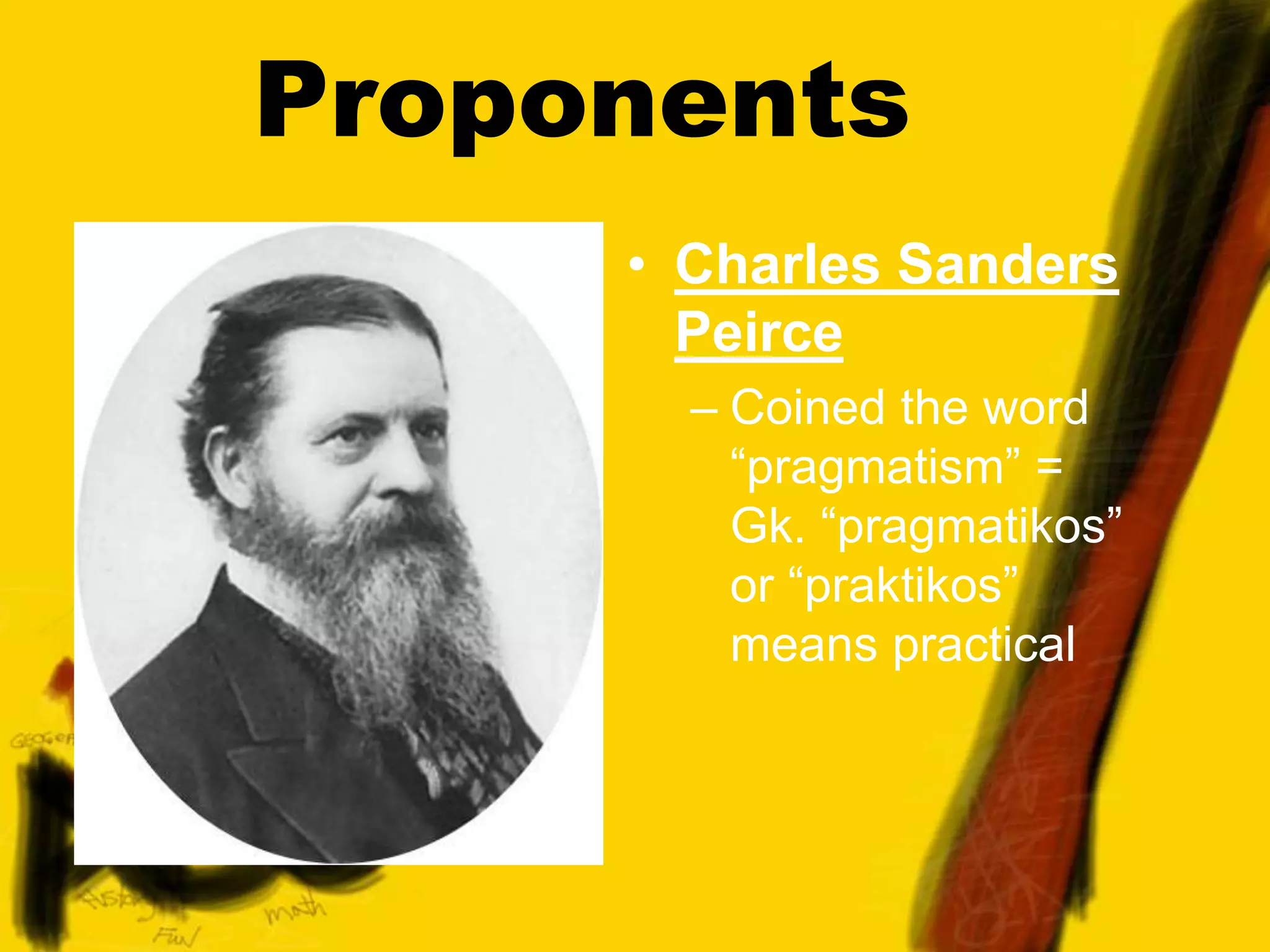
• Charles Sanders
Peirce
– Coined the word
“pragmatism” =
Gk. “pragmatikos”
or “praktikos”
means practical
Proponents
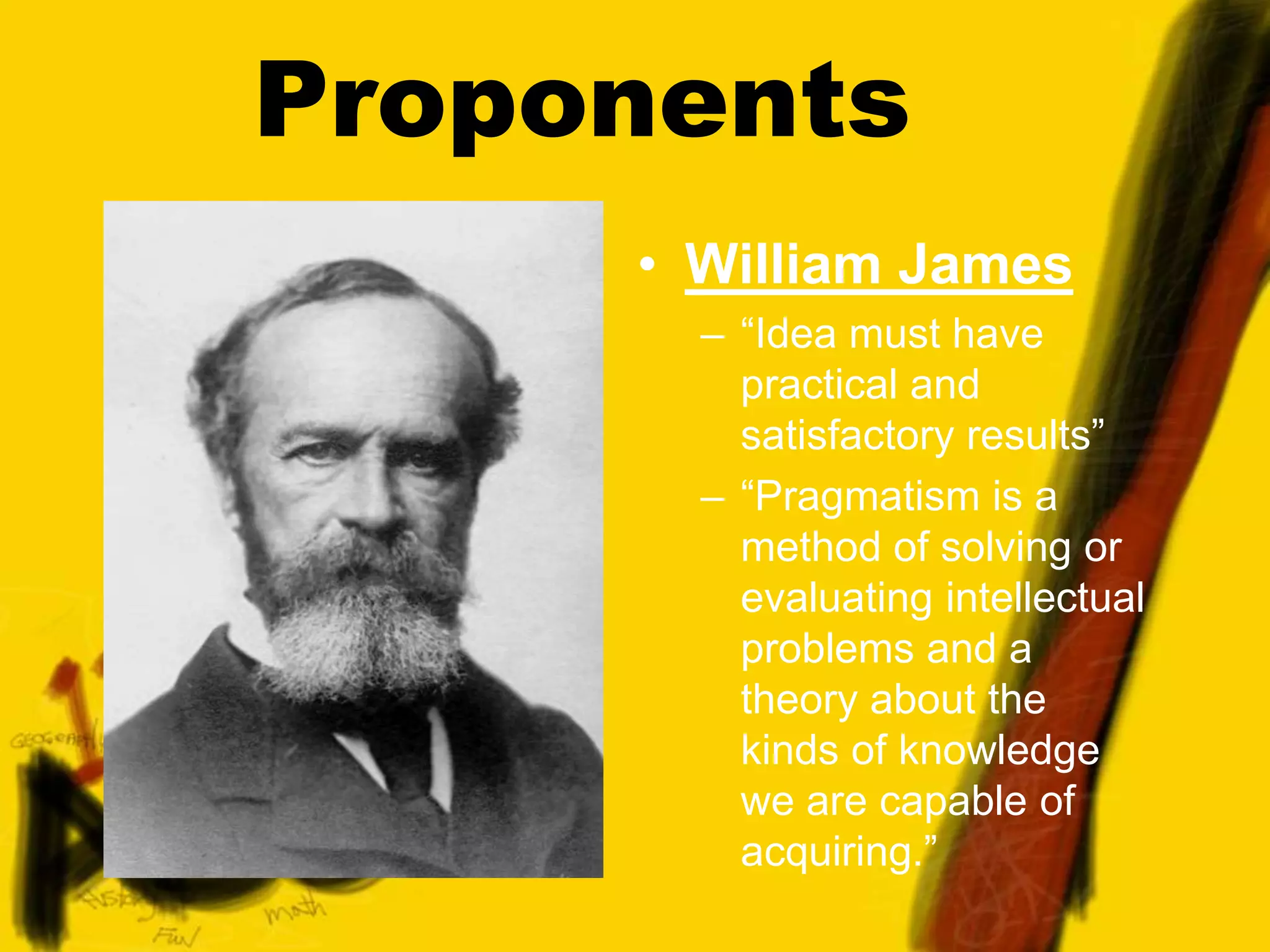
• William James
– “Idea must have
practical and
satisfactory results”
– “Pragmatism is a
method of solving or
evaluating intellectual
problems and a
theory about the
kinds of knowledge
we are capable of
acquiring.”
Proponents
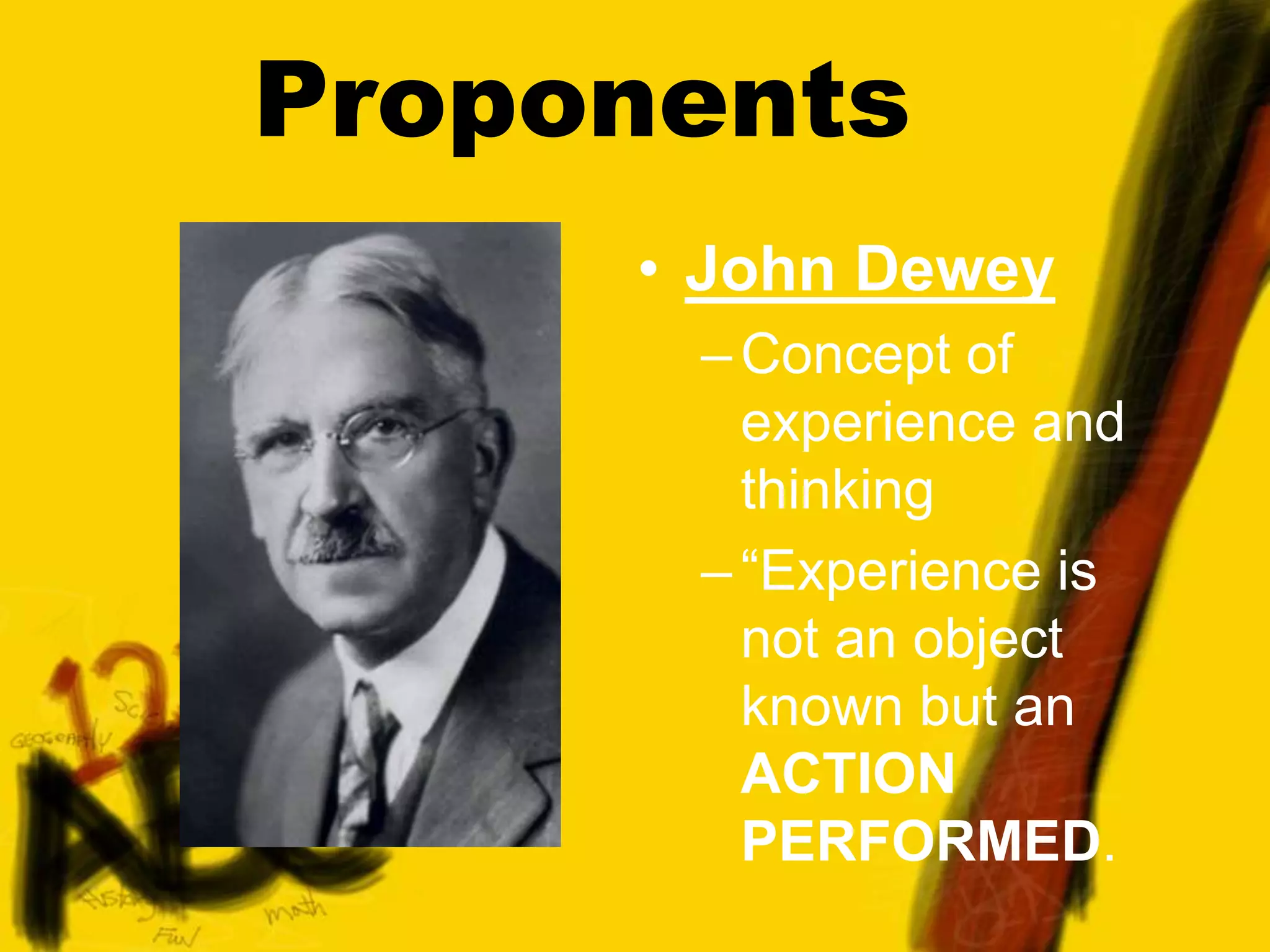
• John Dewey
–Concept of
experience and
thinking
–“Experience is
not an object
known but an
ACTION
PERFORMED.
Proponents
• John Dewey
– Thinking arises as a means of dealing
with these disturbing situations by
working out hypotheses, or guides to
future instructions.
– Believes that if the student learned how
to solve, presumably, he would be better
fit for living in our ever-changing world
with its manifold perplexities.
Pragmatism
Generic Notions
• Pragmatism is the philosophy that
encourages people to find processes that
work in order to achieve their desired ends.
• Reality is that everything changes. (Theme:
the world is constantly changing and we have
to adapt)
Pragmatism
• They study the past but they are generally
more interested in contemporary issues and
in discovering solutions to problems in
present-day terms.
• They are action-oriented, experientially
grounded, and will generally pose questions
such as:
Pragmatism
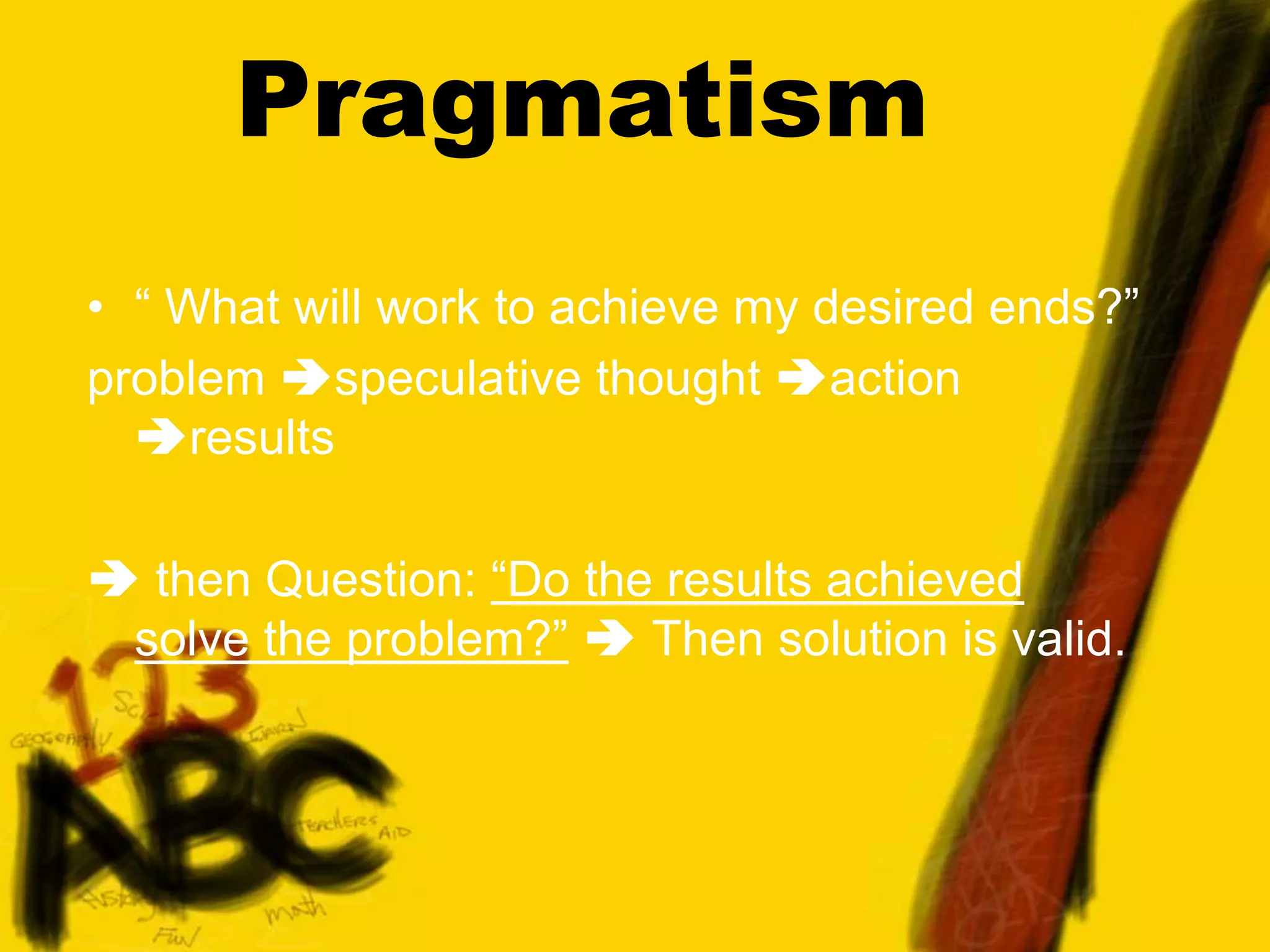
• “ What will work to achieve my desired ends?”
problem speculative thought action
results
 then Question: “Do the results achieved
solve the problem?”  Then solution is valid.
Field of Philosophy
Philosophy of Education
• Metaphysics
• Epistemology
• Axiology
• Educational Implications
Metaphysics
• Studies the nature of reality and
being.
• What is real?
Metaphysics
• Reality is the interaction of an
individual with environment or
experience.
• It is ALWAYS changing.
Epistemology
• Inquires about the nature,
presuppositions, scope of knowledge.
• What is true?
Epistemology
• Knowing results from experiencing
• Use of scientific method
Axiology
• Studies the nature, status, and types of
values.
• What is right?
Axiology
• Values are situational or relative.
Educational Implications
• Organized instruction around problem-
solving according to the scientific
method.
Pragmatism
as Applied in
Education
Goal of Education
• Develop and apply practical knowledge
and skills for life in a progressive
democratic society.
• Individual growth through processes,
experience and problem solving.
Nature of Curriculum
• Child & process - centered
Role of Learners
• Active learning and participation
• Problem-solvers
• Observe the scientific method
• Curious
• Critical result & process oriented
Role of Teacher
• Teach inductive and deductive
reasoning, the scientific method, and
the powers of observation and practice.
• Facilitator/dynamic
• Good classroom manager
• Result and process-oriented
Method of Teaching
• Hands-on curricula
• Group work
• Scientific method
• Experimental
Subjects Studied
• Emphasis on citizenship, knowledge
and skills applicable to daily life and
career or job preparation.
Nature of Classroom
• Flexible
• Rich in opportunities for students to
experience what they are learning
Source of Knowing
• Challenging EXPERIENCE
Influences on the Present
Educational System
• Learning by EXPERIENCE
Thank you & God bless!

Philosophical Foundation of Education: Pragmatism