
PRAGMATISM
What is Pragmatism?
The term pragmatism derives its
origin from a Greek word meaning to
do, to make, to accomplish. So the
use of words likes ‘action’ or
‘practice’ or ‘activity’. Action gets
priority over thought. Experience is
at the centre of the universe.
Everyone is tested on the touch-stone
of experience. Beliefs and ideas are
true if they are workable and profitable
otherwise false.
PRAGMATISM asa
philosophicalmovement
 A philosophical movement first given systematic
expression and consists of varying but
associated theories, originally developed by
Charles S. Peirce and William James and later taken up
and transformed by John Dewey. Distinguished
by the doctrine that the meaning of an idea or a
proposition lies in its observable practical
consequences.
 Pragmatists emphasize the practical function of
knowledge as an instrument for adapting to
reality and controlling it.
Main Proponents
of Pragmatism
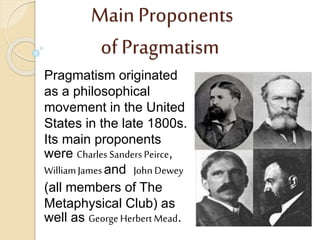
Pragmatism originated
as a philosophical
movement in the United
States in the late 1800s.
Its main proponents
were Charles Sanders Peirce,
WilliamJamesand John Dewey
(all members of The
Metaphysical Club) as
well as George Herbert Mead.
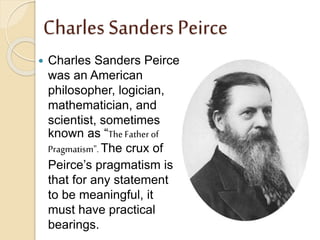
Charles Sanders Peirce
 Charles Sanders Peirce
was an American
philosopher, logician,
mathematician, and
scientist, sometimes
known as “The Father of
Pragmatism". The crux of
Peirce’s pragmatism is
that for any statement
to be meaningful, it
must have practical
bearings.
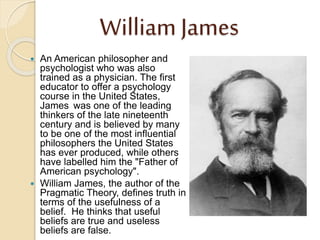
William James
 An American philosopher and
psychologist who was also
trained as a physician. The first
educator to offer a psychology
course in the United States,
James was one of the leading
thinkers of the late nineteenth
century and is believed by many
to be one of the most influential
philosophers the United States
has ever produced, while others
have labelled him the "Father of
American psychology".
 William James, the author of the
Pragmatic Theory, defines truth in
terms of the usefulness of a
belief. He thinks that useful
beliefs are true and useless
beliefs are false.
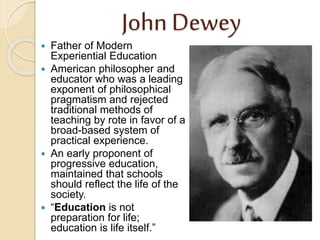
John Dewey
 Father of Modern
Experiential Education
 American philosopher and
educator who was a leading
exponent of philosophical
pragmatism and rejected
traditional methods of
teaching by rote in favor of a
broad-based system of
practical experience.
 An early proponent of
progressive education,
maintained that schools
should reflect the life of the
society.
 “Education is not
preparation for life;
education is life itself.”
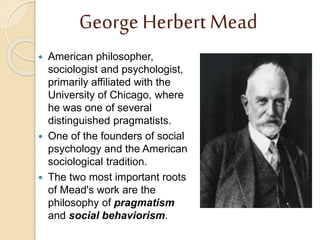
George Herbert Mead
 American philosopher,
sociologist and psychologist,
primarily affiliated with the
University of Chicago, where
he was one of several
distinguished pragmatists.
 One of the founders of social
psychology and the American
sociological tradition.
 The two most important roots
of Mead's work are the
philosophy of pragmatism
and social behaviorism.
FORMS OF PRAGMATISM
1. HUMANISTIC PRAGMATISM
This type of pragmatism is particularly
found in social sciences. According to
it the satisfaction of human nature is
the criterion of utility. In philosophy, in
religion and even in science man is
the aim of all thinking and everything
else is a means to achieve human
satisfaction.
2. EXPERIMENTAL PRAGMATISM
Modern science is based upon
experimental method. The fact that
can be ascertained by experiment is
true. No truth is final, truth is known
only to the extent it is useful in
practice. The pragmatists use this
criterion of truth in every field of life.
The human problems can be solved
only through experiment.
3. NOMINALISTIC PRAGMATISM
When we make any experiment we
attend to the result. Our aim is
examination of the material. Some
hypothesis about the results
invariably precedes every
experiment. According to nominalistic
pragmatism, the results of an
experiment are always particular and
concrete, never general and abstract.
4. BIOLOGICAL PRAGMATISM
Experimentalism of John Dewey is
based upon this biological
pragmatism according to which the
ultimate aim of all knowledge is
harmony of the man with the
environment. Education develops
social skill which facilitates one’s
life. The school is a miniature
society which prepares the child for
future life.
PRINCIPLESOF
PRAGMATISM
PLURALISM
Philosophically, the pragmatists
are pluralists. According to
them there are as many words
as human beings. The ultimate
reality is not one but many.
Everyone searches truth and
aim of life according to his
experiences.
EMPHASISON CHANGE
The pragmatists emphasize
change. The world is a process,
a constant flux. Truth is always
in the making. The world is ever
progressing and evolving.
Therefore, everything here is
changing.
UTILITARIANISM
Pragmatists are utility is the test
of all truth and reality. A useful
principle is true. Utility means
fulfillment of human purposes.
The results decide the good
and evil of anything, idea,
beliefs and acts. Utility means
satisfaction of human needs.
CHANGING AIM AND VALUES
The aim and values of life
change in different times and
climes. The old aims and values,
therefore, cannot be accepted
as they are. Human life and the
world is a laboratory in which the
aims and values are developed.
Thankyou!!!

Pragmatism by jenrap14

  • 1.
  • 2.
    What is Pragmatism? Theterm pragmatism derives its origin from a Greek word meaning to do, to make, to accomplish. So the use of words likes ‘action’ or ‘practice’ or ‘activity’. Action gets priority over thought. Experience is at the centre of the universe. Everyone is tested on the touch-stone of experience. Beliefs and ideas are true if they are workable and profitable otherwise false.
  • 3.
    PRAGMATISM asa philosophicalmovement  Aphilosophical movement first given systematic expression and consists of varying but associated theories, originally developed by Charles S. Peirce and William James and later taken up and transformed by John Dewey. Distinguished by the doctrine that the meaning of an idea or a proposition lies in its observable practical consequences.  Pragmatists emphasize the practical function of knowledge as an instrument for adapting to reality and controlling it.
  • 4.
    Main Proponents of Pragmatism Pragmatismoriginated as a philosophical movement in the United States in the late 1800s. Its main proponents were Charles Sanders Peirce, WilliamJamesand John Dewey (all members of The Metaphysical Club) as well as George Herbert Mead.
  • 5.
    Charles Sanders Peirce Charles Sanders Peirce was an American philosopher, logician, mathematician, and scientist, sometimes known as “The Father of Pragmatism". The crux of Peirce’s pragmatism is that for any statement to be meaningful, it must have practical bearings.
  • 6.
    William James  AnAmerican philosopher and psychologist who was also trained as a physician. The first educator to offer a psychology course in the United States, James was one of the leading thinkers of the late nineteenth century and is believed by many to be one of the most influential philosophers the United States has ever produced, while others have labelled him the "Father of American psychology".  William James, the author of the Pragmatic Theory, defines truth in terms of the usefulness of a belief. He thinks that useful beliefs are true and useless beliefs are false.
  • 7.
    John Dewey  Fatherof Modern Experiential Education  American philosopher and educator who was a leading exponent of philosophical pragmatism and rejected traditional methods of teaching by rote in favor of a broad-based system of practical experience.  An early proponent of progressive education, maintained that schools should reflect the life of the society.  “Education is not preparation for life; education is life itself.”
  • 8.
    George Herbert Mead American philosopher, sociologist and psychologist, primarily affiliated with the University of Chicago, where he was one of several distinguished pragmatists.  One of the founders of social psychology and the American sociological tradition.  The two most important roots of Mead's work are the philosophy of pragmatism and social behaviorism.
  • 9.
    FORMS OF PRAGMATISM 1.HUMANISTIC PRAGMATISM This type of pragmatism is particularly found in social sciences. According to it the satisfaction of human nature is the criterion of utility. In philosophy, in religion and even in science man is the aim of all thinking and everything else is a means to achieve human satisfaction.
  • 10.
    2. EXPERIMENTAL PRAGMATISM Modernscience is based upon experimental method. The fact that can be ascertained by experiment is true. No truth is final, truth is known only to the extent it is useful in practice. The pragmatists use this criterion of truth in every field of life. The human problems can be solved only through experiment.
  • 11.
    3. NOMINALISTIC PRAGMATISM Whenwe make any experiment we attend to the result. Our aim is examination of the material. Some hypothesis about the results invariably precedes every experiment. According to nominalistic pragmatism, the results of an experiment are always particular and concrete, never general and abstract.
  • 12.
    4. BIOLOGICAL PRAGMATISM Experimentalismof John Dewey is based upon this biological pragmatism according to which the ultimate aim of all knowledge is harmony of the man with the environment. Education develops social skill which facilitates one’s life. The school is a miniature society which prepares the child for future life.
  • 13.
  • 14.
    PLURALISM Philosophically, the pragmatists arepluralists. According to them there are as many words as human beings. The ultimate reality is not one but many. Everyone searches truth and aim of life according to his experiences.
  • 15.
    EMPHASISON CHANGE The pragmatistsemphasize change. The world is a process, a constant flux. Truth is always in the making. The world is ever progressing and evolving. Therefore, everything here is changing.
  • 16.
    UTILITARIANISM Pragmatists are utilityis the test of all truth and reality. A useful principle is true. Utility means fulfillment of human purposes. The results decide the good and evil of anything, idea, beliefs and acts. Utility means satisfaction of human needs.
  • 17.
    CHANGING AIM ANDVALUES The aim and values of life change in different times and climes. The old aims and values, therefore, cannot be accepted as they are. Human life and the world is a laboratory in which the aims and values are developed.
  • 18.