

























2
Chromato-graphy / -graph /Chromato-graphy / -graph /
-gram / -grapher-gram / -grapher
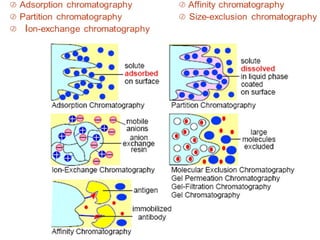
• Chromatography:Chromatography: Separation techniqueSeparation technique
• Chromatograph:Chromatograph: InstrumentInstrument
• Chromatogram:Chromatogram: ObtainedObtained “Picture/Spectra”“Picture/Spectra”
• Chromatographer:Chromatographer: PersonPerson
Invention of Chromatography byInvention of Chromatography by
M. TswettM. Tswett
Ether
CaCO3
Chlorophyll
ChromatoChromatography
ColorsColors
Comparing Chromatography toComparing Chromatography to
the Flow of a River...the Flow of a River...
Base
Water flow
Light leaf
Heavy stone
5
Mobile Phase / StationaryMobile Phase / Stationary
PhasePhase
• A site in which a moving phaseA site in which a moving phase
((mobile phasemobile phase) and a non-) and a non-
moving phase (moving phase (stationarystationary
phasephase) make contact via an) make contact via an
interface that is set up.interface that is set up.
• The affinity with the mobileThe affinity with the mobile
phase and stationary phasephase and stationary phase
varies with the solute.varies with the solute. →→
SeparationSeparation occurs due tooccurs due to
differences in the speed ofdifferences in the speed of
motion.motion.
Strong Weak
Mobile phaseMobile phase
StationaryStationary
phasephase
7
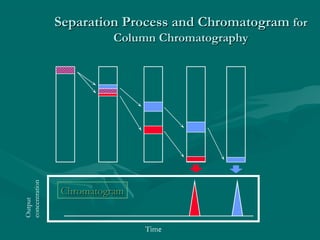
Separation Process and ChromatogramSeparation Process and Chromatogram forfor
Column ChromatographyColumn Chromatography
Output
concentration
Time
ChromatogramChromatogram
8
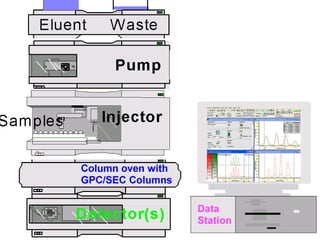
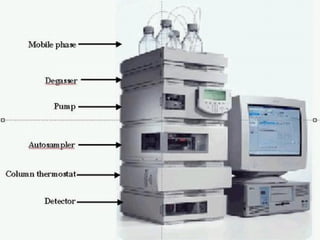
Pump
Sample injection unit
(injector)
Column
Column oven
(thermostatic column
chamber)
Detector
Eluent
(mobile phase)
Drain
Data processor
Degasser
Flow Channel Diagram for High PerformanceFlow Channel Diagram for High Performance
Liquid ChromatographLiquid Chromatograph
11
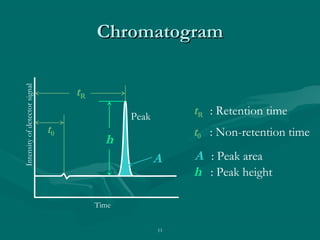
ChromatogramChromatogram
tR
t0
Intensityofdetectorsignal
Time
Peak tR : Retention time
h
A
t0 : Non-retention time
A : Peak area
h : Peak height
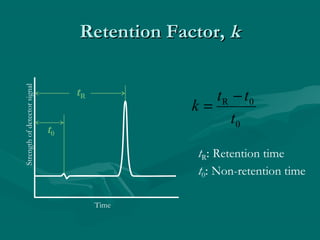
Retention Factor,Retention Factor, kk
tR
t0
Strengthofdetectorsignal
Time
tR: Retention time
t0: Non-retention time
0
0R
t
tt
k
−
=
13
Theoretical Plate Number,Theoretical Plate Number, NN
W
W1/2
H1/2
H
2
.
21
R
R
/
R
W
t
W
2
2
2
π
545
16
•
=
=
=
Area
Ht
t
N
14
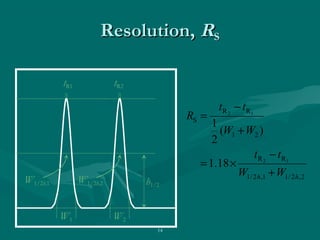
Resolution,Resolution, RRSS
2,2/11,2/1
RR
21
RR
S
12
12
18.1
)(
2
1
hh WW
tt
WW
tt
R
+
−
×=
+
−
=
tR1 tR2
W1 W2
W1/2h,1 W1/2h,2 h1/2
16
Objectives of PretreatmentObjectives of Pretreatment
• To improve sensitivity and selectivityTo improve sensitivity and selectivity
• To improve the accuracy of quantitative valuesTo improve the accuracy of quantitative values
• To protect and prevent the deterioration ofTo protect and prevent the deterioration of
columns and analytical instrumentscolumns and analytical instruments
• To simplify measurement operations andTo simplify measurement operations and
proceduresprocedures
• To stabilize target substancesTo stabilize target substances
17
Filtration and Centrifugal SeparationFiltration and Centrifugal Separation
• In general, filter everyIn general, filter every
sample before injection!sample before injection!
• It is convenient to use aIt is convenient to use a
disposable filter with a poredisposable filter with a pore
diameter of approx. 0.45diameter of approx. 0.45
µµm.m.
• Centrifugal separation isCentrifugal separation is
applicable for samples thatapplicable for samples that
are difficult to filter.are difficult to filter. Filter Syringe
18
DeproteinizationDeproteinization
• PrecipitationPrecipitation
– Addition of organic solvent (e.g., Acetonitrile)Addition of organic solvent (e.g., Acetonitrile)
– Addition of acid (e.g., Trichloroacetic acid,Addition of acid (e.g., Trichloroacetic acid,
Perchloric acid)Perchloric acid)
– Addition of heavy metal or neutral salt(AmmoniumAddition of heavy metal or neutral salt(Ammonium
Sulfate)Sulfate)
• UltrafiltrationUltrafiltration
19
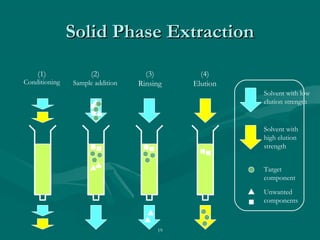
Solid Phase ExtractionSolid Phase Extraction
(1)
Conditioning
(2)
Sample addition
(3)
Rinsing
(4)
Elution
Solvent with low
elution strength
Solvent with
high elution
strength
Target
component
Unwanted
components
20
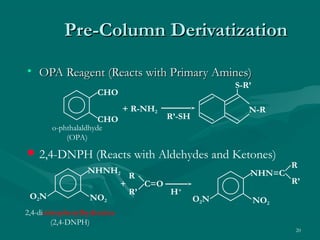
Pre-Column DerivatizationPre-Column Derivatization
• OPA Reagent (Reacts with Primary Amines)OPA Reagent (Reacts with Primary Amines)
o-phthalaldhyde
(OPA)
+ R-NH2 N-R
S-R’
R’-SH
NO2
2,4-dinitrophenylhydrazine
(2,4-DNPH)
+
CHO
CHO
 2,4-DNPH (Reacts with Aldehydes and Ketones)
O2N
NHNH2
C=O
R
R’
NO2
O2N
NHN=C
H+
R
R’
HPLC ApplicationsHPLC Applications
Chemical
Environmenta
l
Pharmaceuticals
Consumer Products
Clinical
Polystyrenes
Dyes
Phthalates
Tetracyclines
Corticosteroids
Antidepressants
Barbiturates
Amino Acids
vitamins
Bioscience
Proteins
Peptides
Nucleotides
Lipids
Antioxidants
Sugars
Polyaromatic Hydrocarbons
Inorganic Ions
herbicides
23
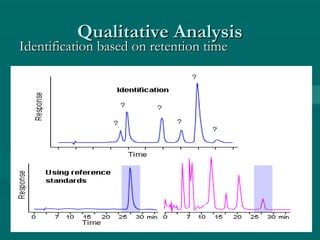
Qualitative AnalysisQualitative Analysis
Identification based on retention timeIdentification based on retention time
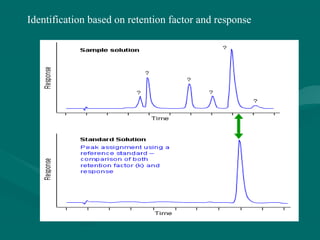
Identification based on retention factor and response
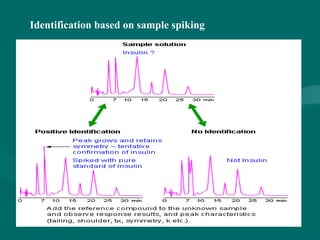
Identification based on sample spiking
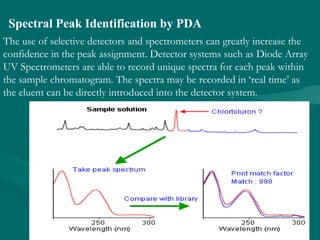
Spectral Peak Identification by PDA
The use of selective detectors and spectrometers can greatly increase the
confidence in the peak assignment. Detector systems such as Diode Array
UV Spectrometers are able to record unique spectra for each peak within
the sample chromatogram. The spectra may be recorded in ‘real time’ as
the eluent can be directly introduced into the detector system.
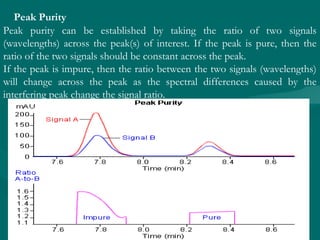
Peak Purity
Peak purity can be established by taking the ratio of two signals
(wavelengths) across the peak(s) of interest. If the peak is pure, then the
ratio of the two signals should be constant across the peak.
If the peak is impure, then the ratio between the two signals (wavelengths)
will change across the peak as the spectral differences caused by the
interfering peak change the signal ratio.
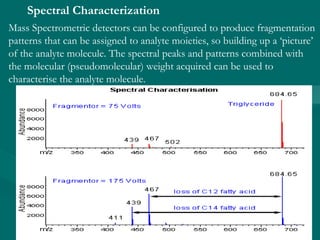
Spectral Characterization
Mass Spectrometric detectors can be configured to produce fragmentation
patterns that can be assigned to analyte moieties, so building up a ‘picture’
of the analyte molecule. The spectral peaks and patterns combined with
the molecular (pseudomolecular) weight acquired can be used to
characterise the analyte molecule.
29
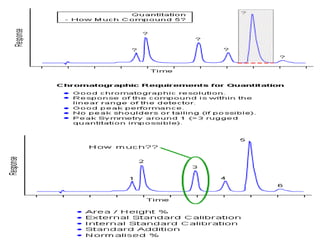
Quantitative AnalysisQuantitative Analysis
• Quantitation performed with peak area orQuantitation performed with peak area or
height.height.
• Calibration curve created beforehand using aCalibration curve created beforehand using a
standard.standard.
• - External standard method- External standard method
– Absolute calibration curve methodAbsolute calibration curve method
– Internal standard methodInternal standard method
– Standard addition methodStandard addition method
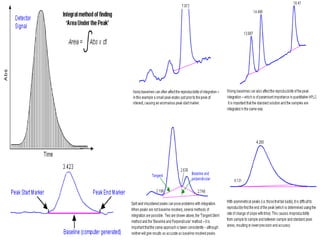
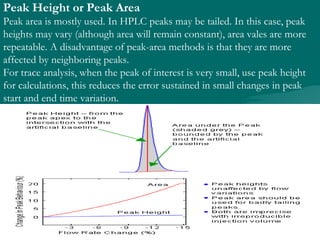
Peak Height or Peak Area
Peak area is mostly used. In HPLC peaks may be tailed. In this case, peak
heights may vary (although area will remain constant), area vales are more
repeatable. A disadvantage of peak-area methods is that they are more
affected by neighboring peaks.
For trace analysis, when the peak of interest is very small, use peak height
for calculations, this reduces the error sustained in small changes in peak
start and end time variation.
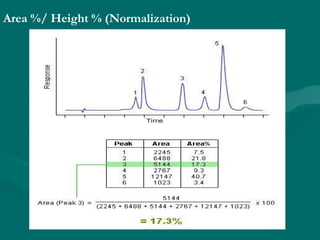
Area %/ Height % (Normalization)
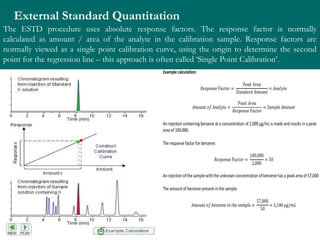
External Standard Quantitation
The ESTD procedure uses absolute response factors. The response factor is normally
calculated as amount / area of the analyte in the calibration sample. Response factors are
normally viewed as a single point calibration curve, using the origin to determine the second
point for the regression line – this approach is often called ‘Single Point Calibration’.
37
Calibration Curve for AbsoluteCalibration Curve for Absolute
Calibration Curve MethodCalibration Curve Method
C1
C4
C3
C2
Concentration
Area
A1
A2
A3
A4
C1 C2 C3 C4
A1
A2
A3
A4
Concentration
Peakarea
Calibration curveCalibration curve
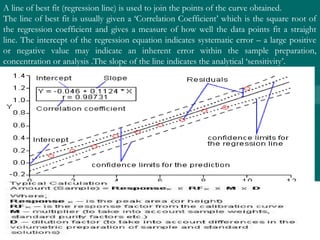
A line of best fit (regression line) is used to join the points of the curve obtained.
The line of best fit is usually given a ‘Correlation Coefficient’ which is the square root of
the regression coefficient and gives a measure of how well the data points fit a straight
line. The intercept of the regression equation indicates systematic error – a large positive
or negative value may indicate an inherent error within the sample preparation,
concentration or analysis .The slope of the line indicates the analytical ‘sensitivity’.
The Matrix Effect
The matrix effect problem occurs
when the unknown sample contains
many impurities.
If impurities present in the
unknown interact with the analyte
to change the instrumental response
or themselves produce an
instrumental response, then a
calibration curve based on pure
analyte samples will give an
incorrect determination
Suggested method:
1. Internal Standard Method
2. Standard Addition Methods
Internal Standard Method
Internal standards are used to adjust for variations in analytical response
due to instrumental and/or matrix effects and variations in the amount of
sample due to variable injection volumes.
•It must have similar chemical properties to the target substance.
•Its peak must appear relatively near that of the target substance.
•It must not already be contained in the actual samples.
•Its peak must be completely separated from those of other sample
components.
•It must be added at a concentration that will produce a peak-area or
peak height ratio of about unity with compound(s) of interest
• It must be stable; unreactive with sample components, column packing,
or mobile phase
• It is desirable for it to be commercially available in high purity
•Are added in the concentration range 0.3 – 0.5 portion of the expected
MAXIMUM analyte concentration
Drug Substance Internal Standard
Cholesterol compounds 19-hydroxycholesterol
Phenolic acid 2,3,4 trihydroxybenzoic acid
Thuringiensin Adenosine Monophosphate
Oxolinic Acid Nalidixic Acid
Chlormadinone Acetate Medroxyprogesterone-17-Acetate
Acetylsalicylic Acid Salicylic Acid
Sorbitol Methyl Nonadecanate
Simvastatin Lovastatin
Diazepam And Oxazepam Prazepam
43
Calibration Curve for InternalCalibration Curve for Internal
Standard MethodStandard Method
C1
C4
C3
C2
Concentration Area
A1
A2
A3
A4
C1/CIS C2 /CIS C3 /CIS C4 /CIS
A1/AIS
A2 /AIS
A3 /AIS
A4 /AIS
Concentration of target substance /
Concentration of internal standard
Areafortargetsubstance/Areaforinternalstandard
Calibration curveCalibration curve
Target
substance
Internal
standard
CIS
CIS
CIS
CIS
AIS
AIS
AIS
AIS
44
Advantages of InternalAdvantages of Internal
Standard Method (1)Standard Method (1)
• Not affected by inconsistencies in injection volume.Not affected by inconsistencies in injection volume.
10 µL
injected
9 µL
injected
CX / CIS
AX / AIS
X
IS
X
IS
Same areaSame area
ratioratio
45
Advantages of InternalAdvantages of Internal
Standard Method (2)Standard Method (2)
• Not affected by the pretreatment recovery rate.Not affected by the pretreatment recovery rate.
100%
recovery rate
90%
recovery
rate
CX / CIS
AX/AIS
X
IS
X
IS
Same areaSame area
ratioratio
Standard Addition MethodsStandard Addition Methods
 Better method to use when matrix effects can be substantialBetter method to use when matrix effects can be substantial
 Standards are added directly to aliquots of the sample, therefore matrixStandards are added directly to aliquots of the sample, therefore matrix
components are the same.components are the same.
 Procedure:Procedure:
• Obtain several aliquots of sample (all with the same volume).Obtain several aliquots of sample (all with the same volume).
• known and unknown are the same analyteknown and unknown are the same analyte
• Spike the sample aliquots ==> add different volume of standardsSpike the sample aliquots ==> add different volume of standards
with the same concentration to the aliquots of samplewith the same concentration to the aliquots of sample
• Dilute each solution (sample + standard) to a fixed volumeDilute each solution (sample + standard) to a fixed volume
• Measure the analyte concentrationMeasure the analyte concentration
48
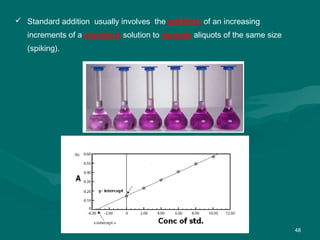
 Standard addition usually involves the addition of an increasing
increments of a standard solution to sample aliquots of the same size
(spiking).
49
 Glucose in blood serum isGlucose in blood serum is
determined spectrophotometrically bydetermined spectrophotometrically by
the formation of athe formation of a colored complexcolored complex
withwith o-toludineo-toludine..
Six identicalSix identical 50.050.0 µµL samplesL samples ofof
blood serum were treated withblood serum were treated with
increasing amount of knownincreasing amount of known
standardsstandards of glucose.of glucose.
The following results were obtained:The following results were obtained:
What is the glucose concentration inWhat is the glucose concentration in
the blood serum samples.the blood serum samples.
Example of Standard Addition Data
The magnitude of the x-intercept is the
concentration of the glucose in the
original solution. To understand why this
is so, consider the absorbance at the
following two values:
•at x = 0, the value of y is the
absorbance of the solution with no
added standard (i.e., it corresponds to
the concentration of silver that we
ultimately want).
•at the x-intercept, there is no
absorbance.
Thus, the magnitude of the difference
between x=0 and the x-intercept is the
concentration of silver that is needed to
produce the signal for the original
solution of interest! Our job now is to
determine the x-intercept.
51
 The value of glucose in the original sample is found by determiningThe value of glucose in the original sample is found by determining
the x-intercept by extrapolation, i.e.,the x-intercept by extrapolation, i.e., finding the value of x when y = 0.finding the value of x when y = 0.
 Or by using the values shown by the Linear Fit and the form of theOr by using the values shown by the Linear Fit and the form of the
linear equationlinear equation
y = mx + by = mx + b
0 = 0.006580 = 0.00658xx + 0.229+ 0.229
Solving for x,Solving for x,
xx = -0.229/0.00658 == -0.229/0.00658 = - 34.8- 34.8 µµg.g.
 The amount of glucose in unknown glucose sample, that had noThe amount of glucose in unknown glucose sample, that had no
standard glucose was added, isstandard glucose was added, is 34.8034.80 µµg.g.
Since the volume was 50.0Since the volume was 50.0 µµL, the [Glucose] = 34.8L, the [Glucose] = 34.8 µµg / 50g / 50 µµL orL or
11 µµg/g/µµL. This could also be expressed as [Glucose] = 0.696 mg/mLL. This could also be expressed as [Glucose] = 0.696 mg/mL
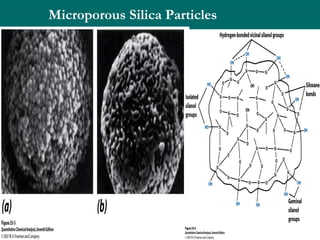
Microporous Silica Particles
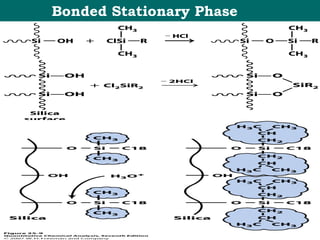
Bonded Stationary Phase
New generation of organo-silane material incorporates ethylene bridges into porous silica.
Tetraethoxysilane + Bis(tetraethoxysilyl)ethane = Polyethoxysilane.
• Provide pH stability from 1-12
• Five times more durability than earlier hybrids.
•The homogenous surface offers some steric selectivity.
Ethylene Bridged Hybrid [BEH] HPLC Column.
BEH C18 BEH ShieldRP18 BEH C8 BEH Phenyl BEH
HILIC
BEH Amide
Ligand
Type
Trifunctonal
C18
Monofunctional
Embedded Polar
Trifunctional
C8
Trifunctional
Phenyl-Hexyl
Unbonded
BEH
Particle
Trifunctional
Carbamoyl
Ligand
Density
3.1μmol/m2
3.3μmol/m2
3.2μmol/m2
3.0μmol/m2
n/a 7.5 μmol/m2
Carbon
Load
18% 17% 13% 15% Unbonded 12%
Endcap
Style
Proprietary TMS Proprietary Proprietary N/A None
pH Range 1-12 2-11 1-12 1-12 1-9 1-11
Temp.Limit 60 o
C 45o
C 60 o
C 60 o
C 45 o
C 90 o
C
Pore
Diameter
130AO
130AO
130AO
130AO
130AO
130AO
Surface
Area
185m2
/g 185m2
/g 185m2
/g 185m2
/g 185m2
/g 185m2
/g
Particle
Sizes
1.7,2.5,3.5,5
μm
1.7,2.5,3.5,5μm 1.7,2.5,3.5,5μ
m
1.7,2.5,3.5,5μ
m
1.7,2.5,3.5
,5μm
1.7,2.5,3.5,5
μm
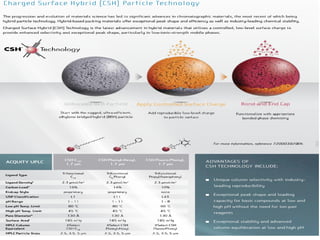
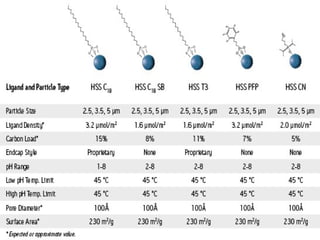
Charged Surface Hybrid column
When the silica surface, including both inner-pore area and outer-pore
surface, is covalently modified by silyl ligands bearing charges, an
opposite charges—can be permanently attached to the outer-surface by
electrostatic attraction while being excluded from entering the pores. As
a result, a material with a charged inner-pore surface and an oppositely-
charged exterior surface can be created.
CSH 130 C18= BEH 130 Base particle + low level of basic moieties + tri
functional C18 / End cap.
•Positive surface charge and Acidic pH.
•Used for impurity profiling in stability indicating methods and/or forced
degradation studies .
The advantages of CSH Technology include:
· Superior peak shape for basic compounds
· Increased loading capacity
· Rapid column equilibration after changing mobile phase pH
· Improved batch to batch reproducibility
· Exceptional stability at low and high pH.
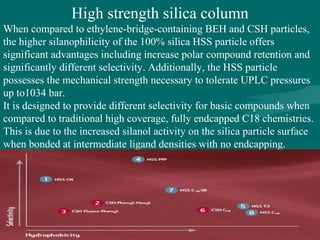
High strength silica column
When compared to ethylene-bridge-containing BEH and CSH particles,
the higher silanophilicity of the 100% silica HSS particle offers
significant advantages including increase polar compound retention and
significantly different selectivity. Additionally, the HSS particle
possesses the mechanical strength necessary to tolerate UPLC pressures
up to1034 bar.
It is designed to provide different selectivity for basic compounds when
compared to traditional high coverage, fully endcapped C18 chemistries.
This is due to the increased silanol activity on the silica particle surface
when bonded at intermediate ligand densities with no endcapping.
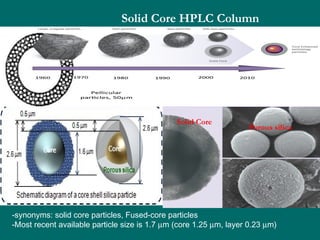
-synonyms: solid core particles, Fused-core particles
-Most recent available particle size is 1.7 µm (core 1.25 µm, layer 0.23 µm)
Solid Core HPLC Column
Solid Core
Porous silica
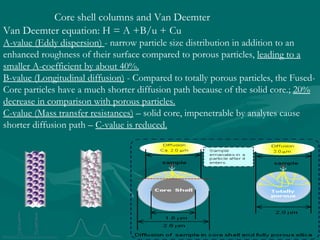
Core shell columns and Van Deemter
Van Deemter equation: H = A +B/u + Cu
A-value (Eddy dispersion) - narrow particle size distribution in addition to an
enhanced roughness of their surface compared to porous particles, leading to a
smaller A-coefficient by about 40%.
B-value (Longitudinal diffusion) - Compared to totally porous particles, the Fused-
Core particles have a much shorter diffusion path because of the solid core.; 20%
decrease in comparison with porous particles.
C-value (Mass transfer resistances) – solid core, impenetrable by analytes cause
shorter diffusion path – C-value is reduced.
Vendors and Available phases
Vendor
Column/product
name
Average
particle
diameter
(μm)
Shell
thickness
(μm)
Stationary phase chemistry
Advanced Material
Technology
Halo 2.7 0.50
C18, C8, HILIC, RP-amide, phenylhexyl,
pentafluorophenyl
Advanced Material
Technology
Halo Peptide-ES
160 Å
2.7 0.50 C18
Agilent Poroshell 300 5 0.25 C18, C8, C3
Agilent Poroshell 120 2.7 0.50 EC-C18, SB-C18
Sigma–Aldrich Ascentis Express 2.7 0.50
C18, C8, HILIC, RP-amide, phenylhexyl,
pentafluorophenyl
Sigma–Aldrich
Ascentis Express
Peptide-ES 160 Å
2.7 0.50 C18
Phenomenex Kinetex
2.6
1.7
0.35
0.23
C18, XB-C18, C8, HILIC,
pentafluorophenyl
Macherey-Nagel Nucleoshell 2.7 0.5 RP-18, HILIC
Thermo Scientific Accucore 2.6 0.50
C18, aQ, RP-MS, HILIC, phenylhexyl,
pentafluorophenyl
Sunniest SunShell 2.6 0.5 C18
Commercially not
available
Eiroshell
1.7
1.7
0.35
0.25 C18
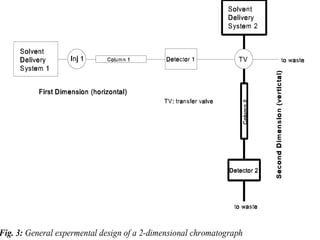
2D HPLC
Chromatographic technique in which the injected sample is separated by
passing through two different separation stages. This is done by injecting
the eluent from the first column onto a second column. Typically the
second column has a different separation mechanism, so that bands that are
poorly resolved from the first column may be completely separated in the
second column. (For instance, a C18 column may be followed by a phenyl
column.) Alternately, the two columns might run at different temperatures.
The second stage of the separation must be run much faster than the first,
since there is still only a single detector. Can also adopt in GC, CE,
SEC,SFC.
Multidimensional Protein Identification Technology (MudPIT) is a
separation technique which utilized two chromatography techniques back
to back and can be coupled to silica capillary. Typically the column consist
of strong cation exchanger (SCX) followed by reversed phase (RP) material.
HPLC APPLICATION RECENT DEVELOPMENT STATIONARY PHASE MATERIAL Dr suman presentation

HPLC APPLICATION RECENT DEVELOPMENT STATIONARY PHASE MATERIAL Dr suman presentation

  • 2.
    2 Chromato-graphy / -graph/Chromato-graphy / -graph / -gram / -grapher-gram / -grapher • Chromatography:Chromatography: Separation techniqueSeparation technique • Chromatograph:Chromatograph: InstrumentInstrument • Chromatogram:Chromatogram: ObtainedObtained “Picture/Spectra”“Picture/Spectra” • Chromatographer:Chromatographer: PersonPerson
  • 3.
    Invention of ChromatographybyInvention of Chromatography by M. TswettM. Tswett Ether CaCO3 Chlorophyll ChromatoChromatography ColorsColors
  • 4.
    Comparing Chromatography toComparingChromatography to the Flow of a River...the Flow of a River... Base Water flow Light leaf Heavy stone
  • 5.
    5 Mobile Phase /StationaryMobile Phase / Stationary PhasePhase • A site in which a moving phaseA site in which a moving phase ((mobile phasemobile phase) and a non-) and a non- moving phase (moving phase (stationarystationary phasephase) make contact via an) make contact via an interface that is set up.interface that is set up. • The affinity with the mobileThe affinity with the mobile phase and stationary phasephase and stationary phase varies with the solute.varies with the solute. →→ SeparationSeparation occurs due tooccurs due to differences in the speed ofdifferences in the speed of motion.motion. Strong Weak Mobile phaseMobile phase StationaryStationary phasephase
  • 7.
    7 Separation Process andChromatogramSeparation Process and Chromatogram forfor Column ChromatographyColumn Chromatography Output concentration Time ChromatogramChromatogram
  • 8.
    8 Pump Sample injection unit (injector) Column Columnoven (thermostatic column chamber) Detector Eluent (mobile phase) Drain Data processor Degasser Flow Channel Diagram for High PerformanceFlow Channel Diagram for High Performance Liquid ChromatographLiquid Chromatograph
  • 11.
    11 ChromatogramChromatogram tR t0 Intensityofdetectorsignal Time Peak tR :Retention time h A t0 : Non-retention time A : Peak area h : Peak height
  • 12.
    Retention Factor,Retention Factor,kk tR t0 Strengthofdetectorsignal Time tR: Retention time t0: Non-retention time 0 0R t tt k − =
  • 13.
    13 Theoretical Plate Number,TheoreticalPlate Number, NN W W1/2 H1/2 H 2 . 21 R R / R W t W 2 2 2 π 545 16 • = = = Area Ht t N
  • 14.
  • 16.
    16 Objectives of PretreatmentObjectivesof Pretreatment • To improve sensitivity and selectivityTo improve sensitivity and selectivity • To improve the accuracy of quantitative valuesTo improve the accuracy of quantitative values • To protect and prevent the deterioration ofTo protect and prevent the deterioration of columns and analytical instrumentscolumns and analytical instruments • To simplify measurement operations andTo simplify measurement operations and proceduresprocedures • To stabilize target substancesTo stabilize target substances
  • 17.
    17 Filtration and CentrifugalSeparationFiltration and Centrifugal Separation • In general, filter everyIn general, filter every sample before injection!sample before injection! • It is convenient to use aIt is convenient to use a disposable filter with a poredisposable filter with a pore diameter of approx. 0.45diameter of approx. 0.45 µµm.m. • Centrifugal separation isCentrifugal separation is applicable for samples thatapplicable for samples that are difficult to filter.are difficult to filter. Filter Syringe
  • 18.
    18 DeproteinizationDeproteinization • PrecipitationPrecipitation – Additionof organic solvent (e.g., Acetonitrile)Addition of organic solvent (e.g., Acetonitrile) – Addition of acid (e.g., Trichloroacetic acid,Addition of acid (e.g., Trichloroacetic acid, Perchloric acid)Perchloric acid) – Addition of heavy metal or neutral salt(AmmoniumAddition of heavy metal or neutral salt(Ammonium Sulfate)Sulfate) • UltrafiltrationUltrafiltration
  • 19.
    19 Solid Phase ExtractionSolidPhase Extraction (1) Conditioning (2) Sample addition (3) Rinsing (4) Elution Solvent with low elution strength Solvent with high elution strength Target component Unwanted components
  • 20.
    20 Pre-Column DerivatizationPre-Column Derivatization •OPA Reagent (Reacts with Primary Amines)OPA Reagent (Reacts with Primary Amines) o-phthalaldhyde (OPA) + R-NH2 N-R S-R’ R’-SH NO2 2,4-dinitrophenylhydrazine (2,4-DNPH) + CHO CHO  2,4-DNPH (Reacts with Aldehydes and Ketones) O2N NHNH2 C=O R R’ NO2 O2N NHN=C H+ R R’
  • 22.
    HPLC ApplicationsHPLC Applications Chemical Environmenta l Pharmaceuticals ConsumerProducts Clinical Polystyrenes Dyes Phthalates Tetracyclines Corticosteroids Antidepressants Barbiturates Amino Acids vitamins Bioscience Proteins Peptides Nucleotides Lipids Antioxidants Sugars Polyaromatic Hydrocarbons Inorganic Ions herbicides
  • 23.
    23 Qualitative AnalysisQualitative Analysis Identificationbased on retention timeIdentification based on retention time
  • 24.
    Identification based onretention factor and response
  • 25.
  • 26.
    Spectral Peak Identificationby PDA The use of selective detectors and spectrometers can greatly increase the confidence in the peak assignment. Detector systems such as Diode Array UV Spectrometers are able to record unique spectra for each peak within the sample chromatogram. The spectra may be recorded in ‘real time’ as the eluent can be directly introduced into the detector system.
  • 27.
    Peak Purity Peak puritycan be established by taking the ratio of two signals (wavelengths) across the peak(s) of interest. If the peak is pure, then the ratio of the two signals should be constant across the peak. If the peak is impure, then the ratio between the two signals (wavelengths) will change across the peak as the spectral differences caused by the interfering peak change the signal ratio.
  • 28.
    Spectral Characterization Mass Spectrometricdetectors can be configured to produce fragmentation patterns that can be assigned to analyte moieties, so building up a ‘picture’ of the analyte molecule. The spectral peaks and patterns combined with the molecular (pseudomolecular) weight acquired can be used to characterise the analyte molecule.
  • 29.
    29 Quantitative AnalysisQuantitative Analysis •Quantitation performed with peak area orQuantitation performed with peak area or height.height. • Calibration curve created beforehand using aCalibration curve created beforehand using a standard.standard. • - External standard method- External standard method – Absolute calibration curve methodAbsolute calibration curve method – Internal standard methodInternal standard method – Standard addition methodStandard addition method
  • 32.
    Peak Height orPeak Area Peak area is mostly used. In HPLC peaks may be tailed. In this case, peak heights may vary (although area will remain constant), area vales are more repeatable. A disadvantage of peak-area methods is that they are more affected by neighboring peaks. For trace analysis, when the peak of interest is very small, use peak height for calculations, this reduces the error sustained in small changes in peak start and end time variation.
  • 33.
    Area %/ Height% (Normalization)
  • 35.
    External Standard Quantitation TheESTD procedure uses absolute response factors. The response factor is normally calculated as amount / area of the analyte in the calibration sample. Response factors are normally viewed as a single point calibration curve, using the origin to determine the second point for the regression line – this approach is often called ‘Single Point Calibration’.
  • 37.
    37 Calibration Curve forAbsoluteCalibration Curve for Absolute Calibration Curve MethodCalibration Curve Method C1 C4 C3 C2 Concentration Area A1 A2 A3 A4 C1 C2 C3 C4 A1 A2 A3 A4 Concentration Peakarea Calibration curveCalibration curve
  • 38.
    A line ofbest fit (regression line) is used to join the points of the curve obtained. The line of best fit is usually given a ‘Correlation Coefficient’ which is the square root of the regression coefficient and gives a measure of how well the data points fit a straight line. The intercept of the regression equation indicates systematic error – a large positive or negative value may indicate an inherent error within the sample preparation, concentration or analysis .The slope of the line indicates the analytical ‘sensitivity’.
  • 39.
    The Matrix Effect Thematrix effect problem occurs when the unknown sample contains many impurities. If impurities present in the unknown interact with the analyte to change the instrumental response or themselves produce an instrumental response, then a calibration curve based on pure analyte samples will give an incorrect determination Suggested method: 1. Internal Standard Method 2. Standard Addition Methods
  • 41.
    Internal Standard Method Internalstandards are used to adjust for variations in analytical response due to instrumental and/or matrix effects and variations in the amount of sample due to variable injection volumes. •It must have similar chemical properties to the target substance. •Its peak must appear relatively near that of the target substance. •It must not already be contained in the actual samples. •Its peak must be completely separated from those of other sample components. •It must be added at a concentration that will produce a peak-area or peak height ratio of about unity with compound(s) of interest • It must be stable; unreactive with sample components, column packing, or mobile phase • It is desirable for it to be commercially available in high purity •Are added in the concentration range 0.3 – 0.5 portion of the expected MAXIMUM analyte concentration
  • 42.
    Drug Substance InternalStandard Cholesterol compounds 19-hydroxycholesterol Phenolic acid 2,3,4 trihydroxybenzoic acid Thuringiensin Adenosine Monophosphate Oxolinic Acid Nalidixic Acid Chlormadinone Acetate Medroxyprogesterone-17-Acetate Acetylsalicylic Acid Salicylic Acid Sorbitol Methyl Nonadecanate Simvastatin Lovastatin Diazepam And Oxazepam Prazepam
  • 43.
    43 Calibration Curve forInternalCalibration Curve for Internal Standard MethodStandard Method C1 C4 C3 C2 Concentration Area A1 A2 A3 A4 C1/CIS C2 /CIS C3 /CIS C4 /CIS A1/AIS A2 /AIS A3 /AIS A4 /AIS Concentration of target substance / Concentration of internal standard Areafortargetsubstance/Areaforinternalstandard Calibration curveCalibration curve Target substance Internal standard CIS CIS CIS CIS AIS AIS AIS AIS
  • 44.
    44 Advantages of InternalAdvantagesof Internal Standard Method (1)Standard Method (1) • Not affected by inconsistencies in injection volume.Not affected by inconsistencies in injection volume. 10 µL injected 9 µL injected CX / CIS AX / AIS X IS X IS Same areaSame area ratioratio
  • 45.
    45 Advantages of InternalAdvantagesof Internal Standard Method (2)Standard Method (2) • Not affected by the pretreatment recovery rate.Not affected by the pretreatment recovery rate. 100% recovery rate 90% recovery rate CX / CIS AX/AIS X IS X IS Same areaSame area ratioratio
  • 47.
    Standard Addition MethodsStandardAddition Methods  Better method to use when matrix effects can be substantialBetter method to use when matrix effects can be substantial  Standards are added directly to aliquots of the sample, therefore matrixStandards are added directly to aliquots of the sample, therefore matrix components are the same.components are the same.  Procedure:Procedure: • Obtain several aliquots of sample (all with the same volume).Obtain several aliquots of sample (all with the same volume). • known and unknown are the same analyteknown and unknown are the same analyte • Spike the sample aliquots ==> add different volume of standardsSpike the sample aliquots ==> add different volume of standards with the same concentration to the aliquots of samplewith the same concentration to the aliquots of sample • Dilute each solution (sample + standard) to a fixed volumeDilute each solution (sample + standard) to a fixed volume • Measure the analyte concentrationMeasure the analyte concentration
  • 48.
    48  Standard additionusually involves the addition of an increasing increments of a standard solution to sample aliquots of the same size (spiking).
  • 49.
    49  Glucose inblood serum isGlucose in blood serum is determined spectrophotometrically bydetermined spectrophotometrically by the formation of athe formation of a colored complexcolored complex withwith o-toludineo-toludine.. Six identicalSix identical 50.050.0 µµL samplesL samples ofof blood serum were treated withblood serum were treated with increasing amount of knownincreasing amount of known standardsstandards of glucose.of glucose. The following results were obtained:The following results were obtained: What is the glucose concentration inWhat is the glucose concentration in the blood serum samples.the blood serum samples. Example of Standard Addition Data
  • 50.
    The magnitude ofthe x-intercept is the concentration of the glucose in the original solution. To understand why this is so, consider the absorbance at the following two values: •at x = 0, the value of y is the absorbance of the solution with no added standard (i.e., it corresponds to the concentration of silver that we ultimately want). •at the x-intercept, there is no absorbance. Thus, the magnitude of the difference between x=0 and the x-intercept is the concentration of silver that is needed to produce the signal for the original solution of interest! Our job now is to determine the x-intercept.
  • 51.
    51  The valueof glucose in the original sample is found by determiningThe value of glucose in the original sample is found by determining the x-intercept by extrapolation, i.e.,the x-intercept by extrapolation, i.e., finding the value of x when y = 0.finding the value of x when y = 0.  Or by using the values shown by the Linear Fit and the form of theOr by using the values shown by the Linear Fit and the form of the linear equationlinear equation y = mx + by = mx + b 0 = 0.006580 = 0.00658xx + 0.229+ 0.229 Solving for x,Solving for x, xx = -0.229/0.00658 == -0.229/0.00658 = - 34.8- 34.8 µµg.g.  The amount of glucose in unknown glucose sample, that had noThe amount of glucose in unknown glucose sample, that had no standard glucose was added, isstandard glucose was added, is 34.8034.80 µµg.g. Since the volume was 50.0Since the volume was 50.0 µµL, the [Glucose] = 34.8L, the [Glucose] = 34.8 µµg / 50g / 50 µµL orL or 11 µµg/g/µµL. This could also be expressed as [Glucose] = 0.696 mg/mLL. This could also be expressed as [Glucose] = 0.696 mg/mL
  • 53.
  • 54.
  • 55.
    New generation oforgano-silane material incorporates ethylene bridges into porous silica. Tetraethoxysilane + Bis(tetraethoxysilyl)ethane = Polyethoxysilane. • Provide pH stability from 1-12 • Five times more durability than earlier hybrids. •The homogenous surface offers some steric selectivity. Ethylene Bridged Hybrid [BEH] HPLC Column.
  • 56.
    Ethylene Bridged Hybrid[BEH] HPLC Column. BEH C18 BEH ShieldRP18 BEH C8 BEH Phenyl BEH HILIC BEH Amide Ligand Type Trifunctonal C18 Monofunctional Embedded Polar Trifunctional C8 Trifunctional Phenyl-Hexyl Unbonded BEH Particle Trifunctional Carbamoyl Ligand Density 3.1μmol/m2 3.3μmol/m2 3.2μmol/m2 3.0μmol/m2 n/a 7.5 μmol/m2 Carbon Load 18% 17% 13% 15% Unbonded 12% Endcap Style Proprietary TMS Proprietary Proprietary N/A None pH Range 1-12 2-11 1-12 1-12 1-9 1-11 Temp.Limit 60 o C 45o C 60 o C 60 o C 45 o C 90 o C Pore Diameter 130AO 130AO 130AO 130AO 130AO 130AO Surface Area 185m2 /g 185m2 /g 185m2 /g 185m2 /g 185m2 /g 185m2 /g Particle Sizes 1.7,2.5,3.5,5 μm 1.7,2.5,3.5,5μm 1.7,2.5,3.5,5μ m 1.7,2.5,3.5,5μ m 1.7,2.5,3.5 ,5μm 1.7,2.5,3.5,5 μm
  • 57.
    Charged Surface Hybridcolumn When the silica surface, including both inner-pore area and outer-pore surface, is covalently modified by silyl ligands bearing charges, an opposite charges—can be permanently attached to the outer-surface by electrostatic attraction while being excluded from entering the pores. As a result, a material with a charged inner-pore surface and an oppositely- charged exterior surface can be created. CSH 130 C18= BEH 130 Base particle + low level of basic moieties + tri functional C18 / End cap. •Positive surface charge and Acidic pH. •Used for impurity profiling in stability indicating methods and/or forced degradation studies . The advantages of CSH Technology include: · Superior peak shape for basic compounds · Increased loading capacity · Rapid column equilibration after changing mobile phase pH · Improved batch to batch reproducibility · Exceptional stability at low and high pH.
  • 59.
    High strength silicacolumn When compared to ethylene-bridge-containing BEH and CSH particles, the higher silanophilicity of the 100% silica HSS particle offers significant advantages including increase polar compound retention and significantly different selectivity. Additionally, the HSS particle possesses the mechanical strength necessary to tolerate UPLC pressures up to1034 bar. It is designed to provide different selectivity for basic compounds when compared to traditional high coverage, fully endcapped C18 chemistries. This is due to the increased silanol activity on the silica particle surface when bonded at intermediate ligand densities with no endcapping.
  • 61.
    -synonyms: solid coreparticles, Fused-core particles -Most recent available particle size is 1.7 µm (core 1.25 µm, layer 0.23 µm) Solid Core HPLC Column Solid Core Porous silica
  • 63.
    Core shell columnsand Van Deemter Van Deemter equation: H = A +B/u + Cu A-value (Eddy dispersion) - narrow particle size distribution in addition to an enhanced roughness of their surface compared to porous particles, leading to a smaller A-coefficient by about 40%. B-value (Longitudinal diffusion) - Compared to totally porous particles, the Fused- Core particles have a much shorter diffusion path because of the solid core.; 20% decrease in comparison with porous particles. C-value (Mass transfer resistances) – solid core, impenetrable by analytes cause shorter diffusion path – C-value is reduced.
  • 64.
    Vendors and Availablephases Vendor Column/product name Average particle diameter (μm) Shell thickness (μm) Stationary phase chemistry Advanced Material Technology Halo 2.7 0.50 C18, C8, HILIC, RP-amide, phenylhexyl, pentafluorophenyl Advanced Material Technology Halo Peptide-ES 160 Å 2.7 0.50 C18 Agilent Poroshell 300 5 0.25 C18, C8, C3 Agilent Poroshell 120 2.7 0.50 EC-C18, SB-C18 Sigma–Aldrich Ascentis Express 2.7 0.50 C18, C8, HILIC, RP-amide, phenylhexyl, pentafluorophenyl Sigma–Aldrich Ascentis Express Peptide-ES 160 Å 2.7 0.50 C18 Phenomenex Kinetex 2.6 1.7 0.35 0.23 C18, XB-C18, C8, HILIC, pentafluorophenyl Macherey-Nagel Nucleoshell 2.7 0.5 RP-18, HILIC Thermo Scientific Accucore 2.6 0.50 C18, aQ, RP-MS, HILIC, phenylhexyl, pentafluorophenyl Sunniest SunShell 2.6 0.5 C18 Commercially not available Eiroshell 1.7 1.7 0.35 0.25 C18
  • 65.
    2D HPLC Chromatographic technique inwhich the injected sample is separated by passing through two different separation stages. This is done by injecting the eluent from the first column onto a second column. Typically the second column has a different separation mechanism, so that bands that are poorly resolved from the first column may be completely separated in the second column. (For instance, a C18 column may be followed by a phenyl column.) Alternately, the two columns might run at different temperatures. The second stage of the separation must be run much faster than the first, since there is still only a single detector. Can also adopt in GC, CE, SEC,SFC. Multidimensional Protein Identification Technology (MudPIT) is a separation technique which utilized two chromatography techniques back to back and can be coupled to silica capillary. Typically the column consist of strong cation exchanger (SCX) followed by reversed phase (RP) material.

Editor's Notes

  • #3 There are many similar terms in this field and so let us clarify some of them. “Chromatography” is the name of the analytical technique itself. A “chromatograph” is an analytical instrument that is used to perform chromatography. The product names of the chromatographs given in the catalogs of analytical instrument manufacturers should all include this word. A “chromatogram” is produced by recording the results obtained with chromatography on recording paper (or some other medium). A “chromatographer” is a person who carries out a chromatography experiment.
  • #4 The Russian-Polish botanist M. Tswett is generally recognized as the first person to establish the principles of chromatography. In a paper he presented in 1906, Tswett described how he filled a glass tube with chalk powder (CaCO3) and, by allowing an ether solution of chlorophyll to flow through the chalk, separated the chlorophyll into layers of different colors. He called this technique “chromatography”.
  • #5 Chromatography can be often compared to the flow of a river. A river consists of a stationary riverbed and water that continuously moves in one direction. What happens if a leaf and a stone are thrown into the river? The relatively light leaf does not sink to the bottom, and is carried downstream by the current. On the other hand, the relatively heavy stone sinks to the bottom, and although it is gradually pulled downstream by the current, it moves much more slowly than the leaf. If you stand watch at the mouth of the river, you will eventually be able to observe the arrival of the leaf and the stone. However, although the leaf will arrive in an extremely short time, the stone will take much longer to arrive. This analogy represents the components of chromatography in the following way: River: Separation field Leaf and stone: Target components of sample Standing watch at the river mouth: Detector
  • #6 In chromatography, the field of separation is divided into two phases. One phase, called the “stationary phase”, does not move. The other phase, called the “mobile phase”, moves at a constant speed in one direction. The stationary phase and mobile phase make contact via an interface. They do not intermingle, and are kept in a steady state of equilibrium. In the river analogy, the riverbed corresponds to the stationary phase and the flowing water corresponds to the mobile phase. Let us suppose that some substance has been introduced into the flow of the mobile phase and led to the separation site. If this substance contains a component that is only weakly attracted by the stationary phase and a component that is strongly attracted by the stationary phase, the former component will be pulled along quickly by the flow of the mobile phase whereas the latter component will stick to the stationary phase and only move slowly. In this way, differences in the properties of the various components contained in the sample being analyzed give rise to differences in speed. This makes it possible to separate components from each other. Incidentally, in the river analogy, the interaction that determines the speed of motion is based on gravity (and buoyancy in water). In chromatography, various physical and chemical properties, such as solubility and the degree of adsorption, determine the dynamics of separation.
  • #8 The separation process for column chromatography is shown in the above diagram. After the eluent is allowed to flow into the top of the column, it flows down through the spaces in the packing material due to gravity and capillary action. In this state, a sample mixture is placed at the top of the column. The solutes in the sample undergo various interactions with the solid and mobile phases, splitting up into solutes that descend quickly together with the mobile phase and solutes that adsorb to the stationary phase and descend slowly, so differences in the speed of motion emerge. At the outlet, the elution of the various solutes at different times is observed. A detector that can measure the concentrations of the solutes in the eluate is set up at the column outlet, and variations in the concentration are monitored. The graph representing the results using the horizontal axis for times and the vertical axis for solute concentrations (or more accurately, output values of detector signals proportional to solute concentrations) is called a “chromatogram”.
  • #9 A high performance liquid chromatograph differs from a column chromatograph in that it is subject to the following performance requirements. Solvent Delivery Pump A solvent delivery pump that can maintain a constant, non-pulsating flow of solvent at a high pressure against the resistance of the column is required. Sample Injection Unit There is a high level of pressure between the pump and the column; a device that can inject specific amounts of sample under such conditions is required. Column The technology for filling the column evenly with refined packing material is required. Also, a material that can withstand high pressures, such as stainless steel, is required for the housing. Detector Higher degrees of separation have increased the need for high-sensitivity detection, and levels of sensitivity and stability that can respond to this need are required in the detector.
  • #12 Usually, during the time period in which the sample components are not eluted, a straight line running parallel to the time axis is drawn. This is called the “baseline”. When a component is eluted, a response is obtained from the detector, and a raised section appears on the baseline. This is called a “peak”. The components in the sample are dispersed by the repeated interactions with the stationary and mobile phases, so the peaks generally take the bell-shape form of a Gaussian distribution. The time that elapses between sample injection and the appearance of the top of the peak is called the “retention time”. If the analytical conditions are the same, the same substance always gives the same retention time. Therefore, the retention time provides a means to perform the qualitative analysis of substances. The time taken for solutes in the sample to go straight through the column together with the mobile phase, without interacting with the stationary phase, and to be eluted is denoted as “t0”. There is no specific name for this parameter, but terms such as “non-retention time” and “hold-up time” seem to be commonly used. Because the eluent usually passes through the column at a constant flow rate, tR and t0 are sometimes multiplied by the eluent flow rate and handled as volumes. The volume corresponding to the retention time is called the “retention volume” and is notated as VR. The length of a straight line drawn from the top of a peak down to the baseline is called the “peak height”, and the area of the raised section above the baseline is called the “peak area”. If the intensities of the detector signals are proportional to the concentrations or absolute quantities of the peak components, then the peak areas and heights are proportional to the concentrations of the peak components. Therefore, the peak areas and heights provide a means to perform the quantitative analysis of sample components. It is generally said that using the peak areas gives greater accuracy.
  • #13 If we hypothesize that the solute does not interact with the stationary phase at all, and remains within the eluent the whole time, then the corresponding peak would appear at t0. This means that the time obtained by subtracting t0 from the retention time, tR, can be regarded as time for which the solute stayed in the stationary phase. If a solute remains in the stationary phase for a relatively long time, it indicates that the retention strength for that solute is relatively high. It is therefore possible to express the strength with which a solute is retained by calculating the ratio of times that the solute remains in the stationary and mobile phases. This is called the retention factor. If the retention factor (k) is 1, it indicates that the solute remains in the stationary and mobile phases for the same time. If it is less than 1, it indicates that the solute is not retained to a significant degree before elution. If it is 3 or greater, it indicates that the solute undergoes significant interaction with the stationary phase before elution. One problem is the calculation of t0. In theory, the volume of the eluent inside the column can be calculated by multiplying the internal volume of the column (i.e., the volume of the cylinder) by the porosity of the packing material. Dividing this by the eluent flow rate gives t0. For example, if the inner diameter and length of the column are 0.46 cm and 15 cm respectively, the porosity is 0.6, and the eluent flow rate is 0.8 mL/min, then t0 can be calculated as follows: t0 = (0.232    15)  0.6  0.8 = 1.87 [min] In practice, however, because the porosity inside the column is hardly ever known, and the volume of other parts, such as tubing, affects the calculation, it is difficult to obtain an accurate value for t0. A working value can be obtained, however, by actually measuring the retention time for a solute that is known not to be retained by the stationary phase. With the reversed phase mode, substances such as nitrite ion and urea are often used.
  • #14 One theoretical way of handling chromatography is the “plate theory” model. This is based on the concept of handling the process of chromatography as repeated solvent extraction in a flask. The solute that enters the separation site is partitioned between the stationary and mobile phases according to a specific ratio. The mobile phase moves, so the solute partitioned in the mobile phase also moves, and is partitioned again. As this behavior is repeated again and again, substances with different partition coefficients are separated in a way that can be thought of as repeated solvent extraction performed to increase the degree of refinement. In this model, if one occurrence of solvent extraction is denoted as one “plate”, then the “theoretical plate number” is the number of plates corresponding to the extraction performed by the separation column. If the theoretical plate number is large, this means that extraction is performed a correspondingly large number of times, and indicates a relatively high level of separation performance. Although the formulas defining the theoretical plate number are given above, the reason why these formulas are used is not given here. (In fact, textbooks on the fundamentals and practical application of HPLC usually do not give the derivation of these formulas.) For more details, refer to specialized literature on the subject. For the purposes of this text, remember that the theoretical plate number is an indicator of the efficiency (performance) of the separation column.
  • #15 The resolution indicates the extent to which two peaks are separated or, from a different perspective, the extent to which they overlap. While the separation factor indicates only the positional relationship between two peaks, and does not indicate the degree of overlap, the resolution does, to a certain extent, indicate the degree of separation. The formulas used to obtain the resolution are given above. It can be seen that this parameter is equal to the ratio of the difference between the retention times of the two peaks and the average value of the two peak widths. If the distance between the peaks is large compared to the peak widths, they are well separated, whereas if the opposite is true, they are overlapping.
  • #17 The objective of quantitative analysis is to obtain correct quantitative values, so the ultimate objective of pretreatment is the same. If the samples cannot be injected directly into the HPLC, or if they can be injected but the desired separation or detection cannot be attained, pretreatment is performed. At the same time, the practical importance of performing pretreatment in order to protect the separation column cannot be ignored. Of all the units that make up an HPLC system, the separation column is the most prone to deterioration, and this deterioration has a significant effect on analysis results.
  • #18 In general, in order to prevent clogging of the column and the flow channels, filter all types of sample. In general, a membrane filter with a pore diameter of approx. 0.45 µm is used. Disposable types that can be attached to the tip of the syringe are commercially available. A filter made of a material that is suitable for the solvent must be used so, when purchasing a filter, select one that is suitable for the sample solvent to be filtered. If there is a large amount of suspended matter in the sample, or the sample volume is small, centrifugal separation may be more suitable than filtration. The volume of sample injected into an HPLC system does not exceed the order of a few hundred µL, so it should be sufficient to prepare a centrifuge tube with a capacity of approx. 1.5 mL together with a compatible centrifugal separator.
  • #19 Proteins may be denatured and precipitated when they are mixed with the eluent and, consequently, cause clogging. They may also adsorb strongly to the surface of the packing material, and adversely affect the performance of the separation column. Unless proteins are themselves the target substances, it is better to remove them before injection. Precipitation If an organic solvent or acid is added to a solution containing a protein, the protein is denatured and precipitated. This property can be used to remove proteins by applying centrifugal separation. One commonly used organic solvent is acetonitrile. In the analysis of blood serum and blood plasma, add at least twice the volume of acetonitrile to the sample, mix the two, perform centrifugal separation on the mixture, and inject the supernatant into the HPLC system. Because this method makes it possible to extract the target components at the same time, it is widely used. Two commonly used acids are 10% trichloroacetic acid and 6% perchloric acid. The procedure is the same as that for organic solvent. In the analysis of blood serum or blood plasma, however, only roughly half of the volume of the sample needs to be added. In addition, copper sulfate, zinc sulfate, and saturated ammonium sulfate are used as precipitants. Ultrafiltration The method of using an ultrafilter membrane to perform deproteinization in accordance with molecular size is relatively simple and is suitable for processing multiple samples. However, tt does have disadvantages, such as a low recovery rate for substances that adsorb to proteins easily and high running costs. As with standard filtration, various types of disposable ultrafilters are commercially available. There are types that apply air pressure and types that are set in centrifugal separators and subjected to centrifugal force.
  • #20 Solvent extraction has been widely used as an HPLC pretreatment method for some time. This method is used to separate and concentrate solutes using partition across a liquid-liquid interface. There is also a method used to perform separation and concentration using interactions such as adsorption and partition across a solid-liquid interface. This method is called “solid phase extraction” (SPE), and can be described as a pretreatment technique that directly applies the separation principles of liquid chromatography. Various types of SPE cartridges, which consist of 100 to 500 mg of the same type of packing material used in liquid chromatography packed into a small housing, are commercially available. Sample solution is passed through one of these cartridges, the target component is held, and then another solution is passed through the cartridge, causing the elution of the target component. The principle is the same as that used in liquid chromatography, so the points that apply to the various separation modes used in liquid chromatography can be applied to the setting of the pretreatment conditions. It is said that this method generally gives a better recovery rate than solvent elution, and is also superior in terms of reproducibility. The amount of organic solvent required is relatively small, so there is no need to be especially concerned about the discharge of harmful substances into the environment. Also, using suction and pressurization devices enables the batch processing of multiple samples. This method has traditionally been used for “purification”, which involves the extraction of target components from samples with complex compositions and the removal of unwanted components. In recent years, however, it has received attention for its capability as a “concentration” technique, with which large numbers of samples can be delivered and eluted using a relatively small amount of solvent. In the analysis of trace amounts of harmful organic substances (environmental pollutants) that are present in the environment, because the required level of sensitivity cannot be attained directly even with GCMS, let alone HPLC, concentration is required as pretreatment. With solvent extraction, the procedure is troublesome and harmful organic solvents must be used. With solid phase extraction, however, the procedure is simple and solvent consumption is low, making it suitable for the processing of multiple samples. This is why this method is now widely used.
  • #21 One technique used for sample pretreatment is “pre-column derivatization”. In cases where the target substance is not retained as it is by the column and cannot be separated from other components, or in cases where the detection sensitivity or selectivity is poor, this technique is used to convert the substance to another compound via a chemical reaction before introducing it into the HPLC system. The chemical reaction used in pre-column derivatization must satisfy the following requirements: A single derivative is produced from one target substance. The reaction must be quantitative, and not easily influenced by the sample matrix. The reaction products must be stable. The reaction products must separate from the unreacted derivatization reagent. On the other hand, because the chemical reaction takes place before introduction to the HPLC system, there are no restrictions on the reaction procedures (e.g., heating, filtration, or evaporative concentration) or time, and by setting a small scale for the volume of sample and reaction reagent, even expensive reagent can be used economically.
  • #24 With chromatography, there is hardly any information that helps ascertain the structure of target substances (unless a detector such as a mass spectrometer is used). In this sense, then, it must be conceded that chromatography is an analytical technique with a low level of qualitative capability compared to techniques such as NMR and FTIR. Basically, qualitative analysis in chromatography is performed according to whether or not the retention time coincides with that obtained for the peak of the standard sample. This means that identification based on the retention time is essentially the only qualitative tool available. The retention time is determined by the conditions listed below. When performing identification (or quantitative analysis), these conditions must be kept constant throughout the analysis of the standard sample and the actual sample. Column (packing material, column size) Eluent composition Eluent flow rate Temperature (column, solvent delivery system) There is always a possibility that other components contained in the sample coincidentally give peaks at the same retention time. In order to prevent the incorrect identification of these peaks, it is effective to connect a detector that can obtain spectra and use it to assist in identification. Two representative detectors that are used for this purpose are the photodiode array-type absorbance detector and the mass spectrometer (LCMS). For each peak that appears, the former can obtain a UV spectrum and the latter can obtain an MS spectrum. Another method used is to prepare (i.e., collect) the eluate corresponding to the time period during which the peaks appear and subject it to structural analysis with another analytical technique with superior qualitative capability.
  • #30 HPLC is generally regarded as an analytical technique that, as long as the appropriate conditions are maintained, can produce highly accurate quantitative values. In order to achieve a high level of quantitative accuracy, the equipment used must be capable of the following level of performance: The solvent delivery pump must have excellent constant flow performance. The components to be quantified must be sufficiently separated from other components. The sample introduction section must have excellent reproducibility. Variation of the column temperature must be minimal. The detector must have a good response, and its linearity must be wide. An excellent data processor must be used. If the above conditions are satisfied, analysis in which the coefficient of variation of quantitative values does not exceed 1% can be achieved with little difficulty. In some cases, peak area values are used to perform quantitative calculations, whereas in other cases, peak heights are used. It is said that, in general, using peak area values gives greater accuracy. Furthermore, because the recent advancement in data processing has made it possible to obtain area values easily, performing quantitation using area values is currently considered to be common. Before analyzing an actual sample, it is necessary to analyze a standard sample with a known concentration, and obtain a graphical representation of the relationship between the concentration and the peak area values. This representation is called a “calibration curve”.
  • #38 The procedure for the absolute calibration curve method, which is the most commonly used method, is described below. Prepare 3 or 4 standard solutions of the target substance with different concentrations, introduce the same quantities of these solutions to HPLC, obtain chromatograms, and measure the peak area values. By representing the concentrations of the target substance in the standard solutions on a horizontal axis and representing the corresponding peak areas on a vertical axis, create the kind of calibration curve shown above. Next, introduce an actual sample solution under the same conditions, obtain a chromatogram, and measure the peak area value. Calculate the concentration of the target substance in the actual sample by obtaining the concentration (horizontal axis) that corresponds to the measured peak area value (vertical axis) in the calibration curve. With this method, all measurements must be performed under exactly the same conditions.
  • #44 The procedure for the internal standard method, which is the second most commonly used method after the absolute calibration curve method, is described below. First, select a substance (the “internal standard”) other than the target substance. This substance must be stable, it must have similar chemical properties to the target substance, and its peak must appear near that of the target substance and be completely separated from the peaks of other sample components. Prepare 3 or 4 standard solutions with different concentrations of the standard substance (hereafter referred to as “X”) and the same concentrations of the internal standard (hereafter referred to as “IS”), introduce the same quantities of these solutions to the HPLC, obtain chromatograms, and measure the peak area values. Representing the value [Concentration of X / Concentration of IS] for the standard solutions on a horizontal axis and representing the value [Peak area of X / Peak area of IS] for the standard solutions on a vertical axis, create the kind of calibration curve shown above. Next, prepare a sample solution for measurement by adding IS to an actual sample at roughly the same concentration used with the standard solutions, introduce this solution under the same conditions, obtain a chromatogram, and measure the peak area value. Calculate the concentration of the target substance in the actual sample by obtaining the concentration ratio of X and IS (horizontal axis) that corresponds to the peak area ratio of X and IS (vertical axis), and multiplying this by the concentration of the added IS.
  • #45 Not only is the procedure for the internal standard method more troublesome than that for the absolute calibration curve method, an appropriate internal standard must be selected. What, then, are the advantages of using this method? One advantage is that it is not affected by inconsistencies in the injection volume. With the internal standard method, quantitation for both standard samples and actual samples is always based on the ratio with respect to the internal standard. If the injection volume decreases, although the peak area value for the target substance decreases by a corresponding amount, the peak area value for the internal standard also decreases by the same proportion. Therefore, the area ratio for the two remains constant, regardless of the injection volume, and the correct concentration can be obtained from the calibration curve.
  • #46 The quantitative values obtained with the internal standard method are not affected by the pretreatment recovery rate for exactly the same reason why they are not affected by inconsistencies in the injection volume. Note that this depends on a certain condition. The recovery rates for the target substance and the internal standard must be exactly the same for each sample. This is why they must have similar chemical properties. In cases where samples are injected in the HPLC system after undergoing complex pretreatment, it is better to use the internal standard method. Although it is not directly related to quantitation, the additive recovery rate can be calculated from the peak area values for the internal standard.