DERVATIZATION AND APPLICATION OF HPLC
                       DEPARTMENT OF PHARMACEUTICAL
                                CHEMISTRY
                                   MCOPS


SUBMITTED TO                                     SUBMITTED BY
Dr Suvarna G. kini                                Shikha Tyagi
Associate. Professor                               100602017
High-performance liquid chromatography (or high-pressure liquid chromatography,
HPLC) is a chromatographic technique that can separate a mixture of compounds and is
used in biochemistry and analytical chemistry to identify, quantify and purify the
individual components of the mixture.


High performance liquid chromatography is basically a highly improved form of
column chromatography.

Instead of a solvent being allowed to drip through a column under gravity, it is
forced through under high pressures of up to 400 atmospheres.

 That makes it much faster.

smaller particle size for the column packing material which gives a much greater
surface area for interactions between the stationary phase and the molecules flowing
past it.

This allows a much better separation of the components of the mixture.
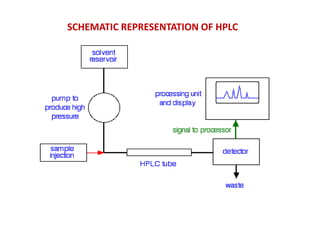
SCHEMATIC REPRESENTATION OF HPLC
LISTS OF STEPS NEEDED BEFORE ANYONE RUNS HPLC

Filter the solvents with membranes with 0.22-0.45 mm

Use clean and transparent reservoirs through which precipitates and
colloids can be distinguished.

Make sure that the solvents will be easily mixed with the previous solvents
in the same inlets . For example methanol or water should not be placed
instead of hexane directly, or any organic solvent should not be placed
directly instead of a buffer reservoir.

Degass the solvents and purge all the tubing that lead to the pump.

Connect the column carefully according to the flow direction marked on it
(do not connect directly to the detector).

Flow the appropriate solvents through the column at a low flow-rate (0.1-
0.5 ml/min) or reach the composition gradually using the appropriate
gradient.

 Select the appropriate wavelength (or other type of setting) in the
detector and wait for stable baseline .
Prepare the set of methods in the workstation

 Processing method for the data processing and the Report method for the
report of final results.

When the system and the methods are ready a blank run should be
performed to test the system and verify that it is clean from interferences
DERIVATIZATION
 Derivatization is a technique used in chemistry which transforms a chemical
compound into a product (the reaction's derivate) of similar chemical structure
called a derivative.

 Generally, a specific functional group of the compound participates in the derivatization
reaction and transforms the it to a derivate of deviating reactivity, solubility, boiling point
 melting point,aggregate state, or chemical composition.

 Resulting new chemical properties can be used for quantification or separation of the
compound
RATIONALE BEHIND DERIVATIZATION
In liquid chromatography, fluorescent derivatives can be prepared to render the
substances specifically detectable at high sensitivity.

To prepare fluorescent derivatives of phenols, and primary and secondary amines,
dansyl chloride (5-dimethyl aminonaphthalene-1-sulphonyl chloride) is strongly
recommended

To render involatile substances volatile for GC analysis, organic acids can be
esterified using boron trifluoride as a catalyst or directly with diazomethane.

the polarity of a solute needs to be drastically reduced to improve its
chromatographic behavior and reduce tailing. Polarity reduction can often be
achieved for amino, hydroxyl and thiol groups by acylation.

In LC analyses, UV chromaphores and fluorophores are often introduced into
sample molecules to increase their sensitivity to UV absorption and fluorescence
detection. Benzoyl chloride, m-toluol chloride and p-nitrobenzoyl chloride are
reagents that can add a benzene ring to a solute molecule and render it UV
absorbing.
SEVERAL CHARACTERISTICS ARE DESIRABLE FOR A DERIVATIZATION REACTION


The reaction is reliable and proceeds to completion.

Less unreacted starting material will simplify analysis.
Also, this allows a small amount of analyte to be used.

The reaction is general, allowing a wide range of substrates,

 yet specific to a single functional group,

reducing complicating interference.

The products are relatively stable, and form no degradation

 products within a reasonable period, facilitating analysis.
DERIVATIZATION TYPES


Pre column


Post column
PRE-COLUMN OFF-LINE DERIVATIZATION

When there is a mixture of many componds they may interfere in the separation and
resolution in such case we can derivatize the compound of interest to change its
properties so that it can be separated .

Merits :

(a) Requires no modification to the instrument i.e., a plus point when compared to
    the post-column methods

(b) Imposes fewer limitations with regard to reaction-time and conditions.

Demerits

(a) Formation of a stable and well-defined product is an absolute necessity.

(b) Presence of excess reagent or by products may invariably interfere with
separation.

(c) Very often derivatization may altogether change the chromatographic properties
of the sample which facilitated separation.
Nineteen amino acids in a standard mixture were separated using a GROM-SIL
OPA-1 column after precolumn derivatization with OPA /mercaptopropionic acid
and detected by fluorescence spectroscopy at 330 and 450nm.


Nineteen amino acids in a standard mixture were separated using a GROM-SIL OPA-1
column (150 x 4mm, Part No. GSOP10308S1504) after precolumn derivatization with
OPA/mercaptopropionic acid by gradient elution with

25mM sodium phosphate, pH 7.2 and THF 995/5

25mM sodium phosphate, pH 7.2, methanol and acetonitrile 50/35/15

Time - 41 minutes

Detection - Fluorescence spectroscopy at 330 and 450nm.

The amino acids separated were aspartic acid, glutamic acid, asparagine, serine,
glutamine, glycine, threonine, histidine, citrulline, 3-methylhistidine, alanine,
taurine, arginine, alpha-aminobutyric acid, tyrosine, valine, methionine, nor-valine
and tryptophan.
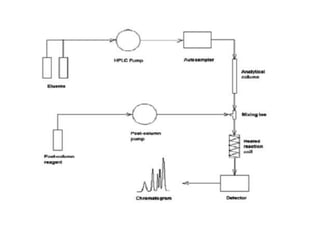
POST-COLUMN ON-LINE DERIVATIZATION

The following experimental parameters should be maintained

(a) Derivatization performed in a special-reactor strategically positioned between the column
and the detector.

(b) Reaction must be completed rapidly at moderate temperatures.

(c) Derivatization reaction need not even go to completion provided it can be made
reproducible.

(d) No detector-response should exist due to any excess reagent present.

(e) Reaction must be carried out in a medium other than the mobile-phase.

Merit : The main merit of post-column-on-line derivatization is that ideally the separation and
detection processes can be optimized individually
IMPORTANT CONSIDERATIONS IN POST COLUMN DERIVATIZATION

Reactants and conditions must be chosen so that conversion to the desired product(s)
takes place rapidly (usually < 1 minute) and reproducibly.

PCD system must ensure good mixing

If the conversion is not sufficiently rapid, it may be necessary raise the temperature,
incorporate a catalyst or in some other way accelerate the rate of derivatization.

completeness of reaction is not always a required result.

In many qualitative applications it may be sufficient that each analyte derivative be
formed in abundance great enough to generate a detectable signal.
REAGENTS FOR DERIVATIZATION
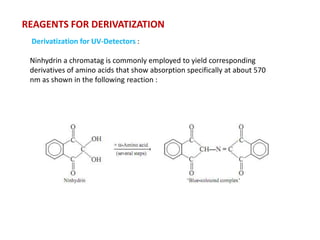
 Derivatization for UV-Detectors :

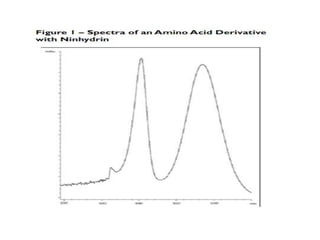
 Ninhydrin a chromatag is commonly employed to yield corresponding
 derivatives of amino acids that show absorption specifically at about 570
 nm as shown in the following reaction :
Derivatization for Fluorescence Detectors

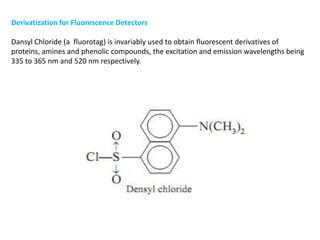
Dansyl Chloride (a fluorotag) is invariably used to obtain fluorescent derivatives of
proteins, amines and phenolic compounds, the excitation and emission wavelengths being
335 to 365 nm and 520 nm respectively.
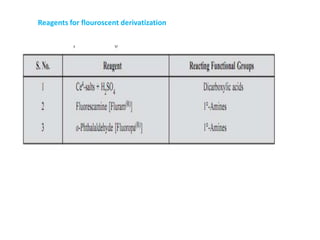
Reagents for flouroscent derivatization
APPLICATION
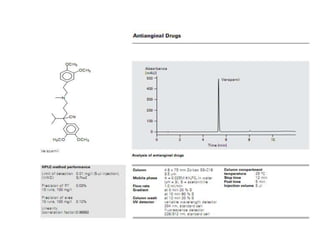
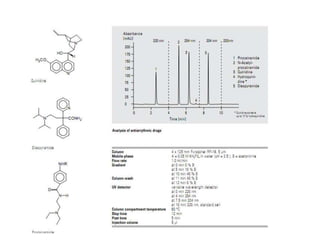
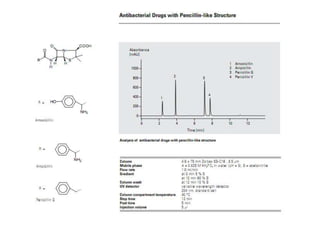
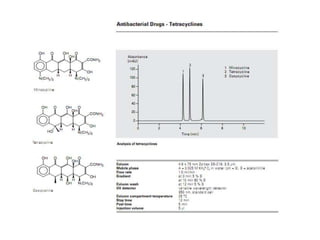
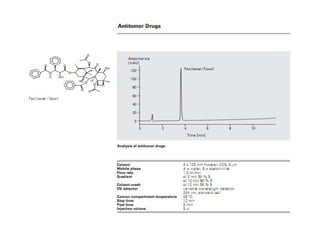
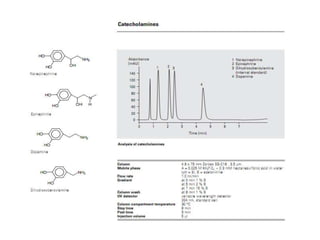
Drug manufacturing control requires high level and intensive analytical and chemical
support of all stages to ensure the drug's quality and safety


The pharmacopeia constitutes a collection of recommended procedures for
analysis and specifications for the determination of pharmaceutical substances,
excipients, and dosage forms.
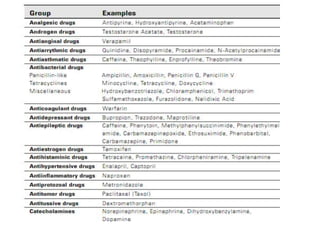
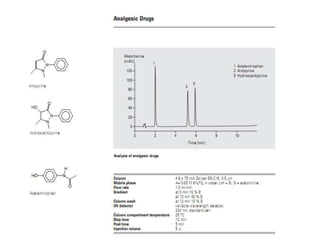
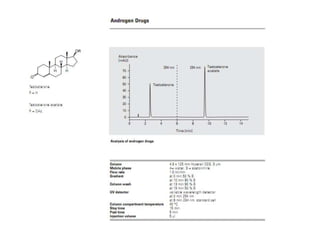
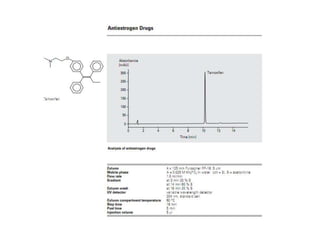
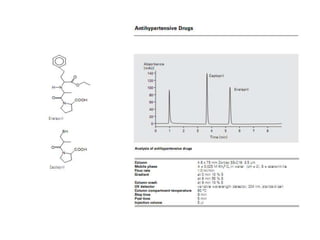
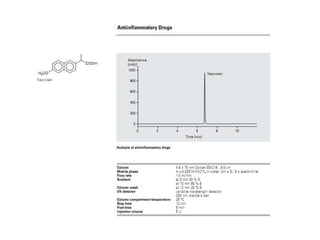
Used in Qualitative and Quantitative analysis.
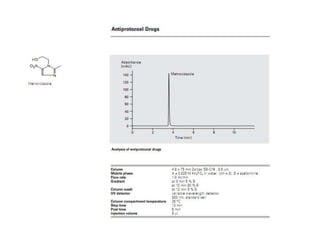
Used in the routine assay of new drugs as well as substitutes for the older
more

troublesome assays for marketed drugs.

Used in the studies of drug samples in biological fluids.

Isolation of natural pharmaceutical active compounds.

Control of microbiological process.

Used to study the impurity profile of the new drugs.
REFERENCES
http://chromatographyonline.findanalytichem.com/lcgc/Articles/Analysis-of-Voglibose-in
-Pharmace

www.sigmaaldrich.comutical-Formulatio/ArticleStandard/Article/detail/575615
THANK U

Hplc final

  • 1.
    DERVATIZATION AND APPLICATIONOF HPLC DEPARTMENT OF PHARMACEUTICAL CHEMISTRY MCOPS SUBMITTED TO SUBMITTED BY Dr Suvarna G. kini Shikha Tyagi Associate. Professor 100602017
  • 2.
    High-performance liquid chromatography(or high-pressure liquid chromatography, HPLC) is a chromatographic technique that can separate a mixture of compounds and is used in biochemistry and analytical chemistry to identify, quantify and purify the individual components of the mixture. High performance liquid chromatography is basically a highly improved form of column chromatography. Instead of a solvent being allowed to drip through a column under gravity, it is forced through under high pressures of up to 400 atmospheres.  That makes it much faster. smaller particle size for the column packing material which gives a much greater surface area for interactions between the stationary phase and the molecules flowing past it. This allows a much better separation of the components of the mixture.
  • 3.
  • 4.
    LISTS OF STEPSNEEDED BEFORE ANYONE RUNS HPLC Filter the solvents with membranes with 0.22-0.45 mm Use clean and transparent reservoirs through which precipitates and colloids can be distinguished. Make sure that the solvents will be easily mixed with the previous solvents in the same inlets . For example methanol or water should not be placed instead of hexane directly, or any organic solvent should not be placed directly instead of a buffer reservoir. Degass the solvents and purge all the tubing that lead to the pump. Connect the column carefully according to the flow direction marked on it (do not connect directly to the detector). Flow the appropriate solvents through the column at a low flow-rate (0.1- 0.5 ml/min) or reach the composition gradually using the appropriate gradient.  Select the appropriate wavelength (or other type of setting) in the detector and wait for stable baseline .
  • 5.
    Prepare the setof methods in the workstation  Processing method for the data processing and the Report method for the report of final results. When the system and the methods are ready a blank run should be performed to test the system and verify that it is clean from interferences
  • 6.
    DERIVATIZATION  Derivatization isa technique used in chemistry which transforms a chemical compound into a product (the reaction's derivate) of similar chemical structure called a derivative.  Generally, a specific functional group of the compound participates in the derivatization reaction and transforms the it to a derivate of deviating reactivity, solubility, boiling point melting point,aggregate state, or chemical composition.  Resulting new chemical properties can be used for quantification or separation of the compound
  • 7.
    RATIONALE BEHIND DERIVATIZATION Inliquid chromatography, fluorescent derivatives can be prepared to render the substances specifically detectable at high sensitivity. To prepare fluorescent derivatives of phenols, and primary and secondary amines, dansyl chloride (5-dimethyl aminonaphthalene-1-sulphonyl chloride) is strongly recommended To render involatile substances volatile for GC analysis, organic acids can be esterified using boron trifluoride as a catalyst or directly with diazomethane. the polarity of a solute needs to be drastically reduced to improve its chromatographic behavior and reduce tailing. Polarity reduction can often be achieved for amino, hydroxyl and thiol groups by acylation. In LC analyses, UV chromaphores and fluorophores are often introduced into sample molecules to increase their sensitivity to UV absorption and fluorescence detection. Benzoyl chloride, m-toluol chloride and p-nitrobenzoyl chloride are reagents that can add a benzene ring to a solute molecule and render it UV absorbing.
  • 8.
    SEVERAL CHARACTERISTICS AREDESIRABLE FOR A DERIVATIZATION REACTION The reaction is reliable and proceeds to completion. Less unreacted starting material will simplify analysis. Also, this allows a small amount of analyte to be used. The reaction is general, allowing a wide range of substrates,  yet specific to a single functional group, reducing complicating interference. The products are relatively stable, and form no degradation  products within a reasonable period, facilitating analysis.
  • 9.
  • 10.
    PRE-COLUMN OFF-LINE DERIVATIZATION Whenthere is a mixture of many componds they may interfere in the separation and resolution in such case we can derivatize the compound of interest to change its properties so that it can be separated . Merits : (a) Requires no modification to the instrument i.e., a plus point when compared to the post-column methods (b) Imposes fewer limitations with regard to reaction-time and conditions. Demerits (a) Formation of a stable and well-defined product is an absolute necessity. (b) Presence of excess reagent or by products may invariably interfere with separation. (c) Very often derivatization may altogether change the chromatographic properties of the sample which facilitated separation.
  • 11.
    Nineteen amino acidsin a standard mixture were separated using a GROM-SIL OPA-1 column after precolumn derivatization with OPA /mercaptopropionic acid and detected by fluorescence spectroscopy at 330 and 450nm. Nineteen amino acids in a standard mixture were separated using a GROM-SIL OPA-1 column (150 x 4mm, Part No. GSOP10308S1504) after precolumn derivatization with OPA/mercaptopropionic acid by gradient elution with 25mM sodium phosphate, pH 7.2 and THF 995/5 25mM sodium phosphate, pH 7.2, methanol and acetonitrile 50/35/15 Time - 41 minutes Detection - Fluorescence spectroscopy at 330 and 450nm. The amino acids separated were aspartic acid, glutamic acid, asparagine, serine, glutamine, glycine, threonine, histidine, citrulline, 3-methylhistidine, alanine, taurine, arginine, alpha-aminobutyric acid, tyrosine, valine, methionine, nor-valine and tryptophan.
  • 12.
    POST-COLUMN ON-LINE DERIVATIZATION Thefollowing experimental parameters should be maintained (a) Derivatization performed in a special-reactor strategically positioned between the column and the detector. (b) Reaction must be completed rapidly at moderate temperatures. (c) Derivatization reaction need not even go to completion provided it can be made reproducible. (d) No detector-response should exist due to any excess reagent present. (e) Reaction must be carried out in a medium other than the mobile-phase. Merit : The main merit of post-column-on-line derivatization is that ideally the separation and detection processes can be optimized individually
  • 14.
    IMPORTANT CONSIDERATIONS INPOST COLUMN DERIVATIZATION Reactants and conditions must be chosen so that conversion to the desired product(s) takes place rapidly (usually < 1 minute) and reproducibly. PCD system must ensure good mixing If the conversion is not sufficiently rapid, it may be necessary raise the temperature, incorporate a catalyst or in some other way accelerate the rate of derivatization. completeness of reaction is not always a required result. In many qualitative applications it may be sufficient that each analyte derivative be formed in abundance great enough to generate a detectable signal.
  • 15.
    REAGENTS FOR DERIVATIZATION Derivatization for UV-Detectors : Ninhydrin a chromatag is commonly employed to yield corresponding derivatives of amino acids that show absorption specifically at about 570 nm as shown in the following reaction :
  • 17.
    Derivatization for FluorescenceDetectors Dansyl Chloride (a fluorotag) is invariably used to obtain fluorescent derivatives of proteins, amines and phenolic compounds, the excitation and emission wavelengths being 335 to 365 nm and 520 nm respectively.
  • 18.
  • 19.
    APPLICATION Drug manufacturing controlrequires high level and intensive analytical and chemical support of all stages to ensure the drug's quality and safety The pharmacopeia constitutes a collection of recommended procedures for analysis and specifications for the determination of pharmaceutical substances, excipients, and dosage forms.
  • 20.
    Used in Qualitativeand Quantitative analysis. Used in the routine assay of new drugs as well as substitutes for the older more troublesome assays for marketed drugs. Used in the studies of drug samples in biological fluids. Isolation of natural pharmaceutical active compounds. Control of microbiological process. Used to study the impurity profile of the new drugs.
  • 34.
  • 35.