HPLC :
High
Performance (Pressure)
Liquid
Chromatography
1
2
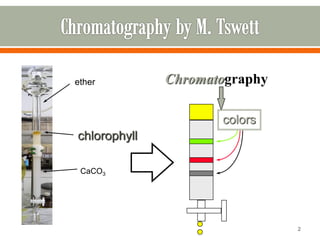
ether
CaCO3
chlorophyll
Chromatography
colors
3
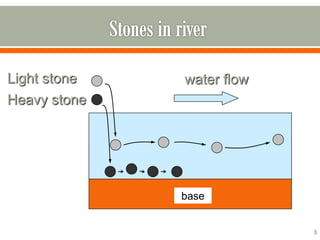
Light stone
Heavy stone
base
water flow
4
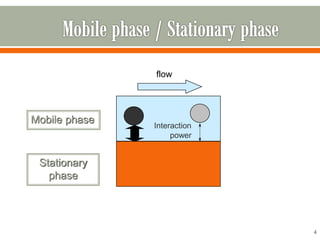
Mobile phase
Stationary
phase
Interaction
power
flow
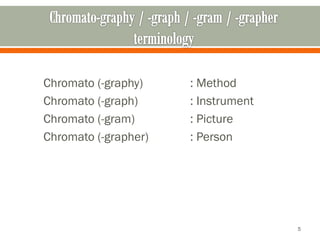
Chromato (-graphy) : Method
Chromato (-graph) : Instrument
Chromato (-gram) : Picture
Chromato (-grapher) : Person
5
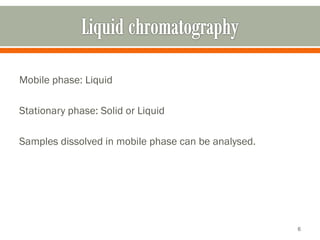
Mobile phase: Liquid
Stationary phase: Solid or Liquid
Samples dissolved in mobile phase can be analysed.
6
7
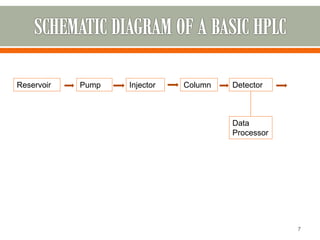
Reservoir Pump Injector Column Detector
Data
Processor
8
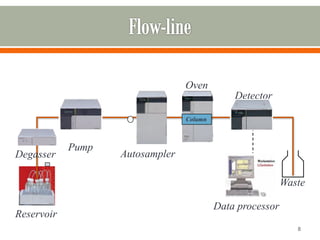
Pump
Autosampler
Column
Oven
Detector
Reservoir
Waste
Data processor
Degasser
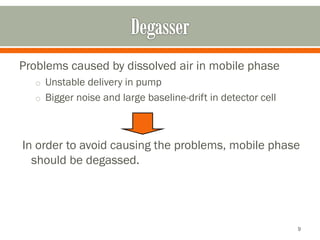
Problems caused by dissolved air in mobile phase
o Unstable delivery in pump
o Bigger noise and large baseline-drift in detector cell
In order to avoid causing the problems, mobile phase
should be degassed.
9
10
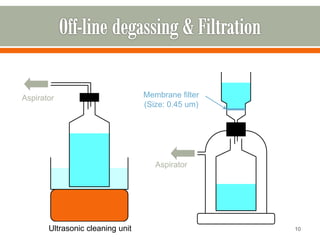
Aspirator
Ultrasonic cleaning unit
Aspirator
Membrane filter
(Size: 0.45 um)
11
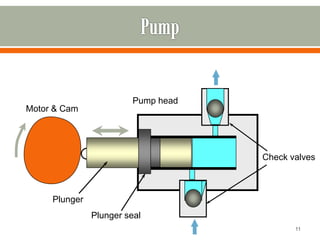
Motor & Cam
Plunger
Plunger seal
Check valves
Pump head
12
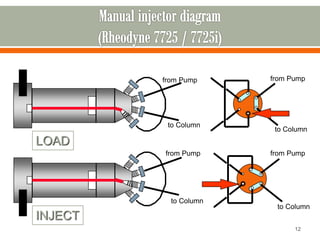
from Pump
to Column
from Pump
to Column
INJECT
LOAD
from Pump
from Pump
to Column
to Column
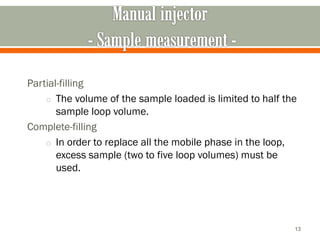
Partial-filling
o The volume of the sample loaded is limited to half the
sample loop volume.
Complete-filling
o In order to replace all the mobile phase in the loop,
excess sample (two to five loop volumes) must be
used.
13
14
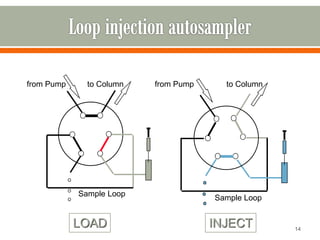
to Column
from Pump from Pump to Column
Sample Loop
LOAD INJECT
Sample Loop
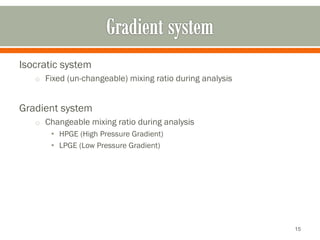
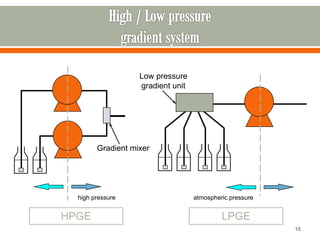
Isocratic system
o Fixed (un-changeable) mixing ratio during analysis
Gradient system
o Changeable mixing ratio during analysis
• HPGE (High Pressure Gradient)
• LPGE (Low Pressure Gradient)
15
16
HPGE
Gradient mixer
Low pressure
gradient unit
LPGE
high pressure atmospheric pressure
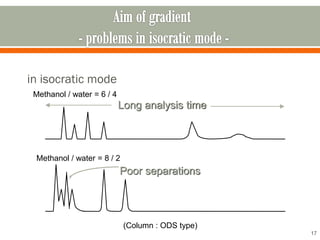
in isocratic mode
17
Long analysis time
Poor separations
Methanol / water = 6 / 4
Methanol / water = 8 / 2
(Column : ODS type)
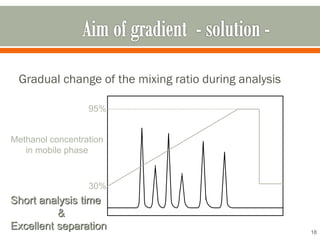
Gradual change of the mixing ratio during analysis
18
95%
30%
Methanol concentration
in mobile phase
Short analysis time
&
Excellent separation
Flow mode
o Isocratic flow / Binary gradient
Flow rate
o Isocratic flow: A.Flow
o Binary gradient: T.Flow, B.Conc
Pressure
o P.Max, P.Min
19
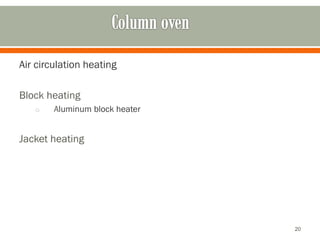
Air circulation heating
Block heating
o Aluminum block heater
Jacket heating
20
Oven temperature
T.Max
21
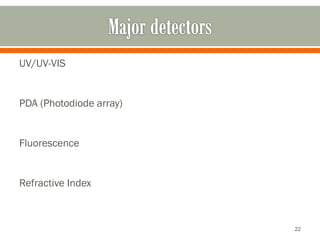
UV/UV-VIS
PDA (Photodiode array)
Fluorescence
Refractive Index
22
23
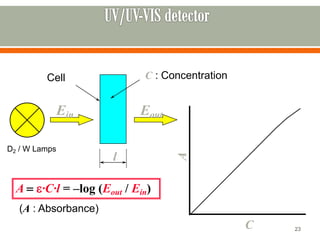
A = e·C·l = –log (Eout / Ein)
(A : Absorbance)
l
C : Concentration
Cell
Ein Eout
A
C
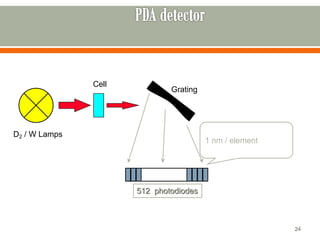
D2 / W Lamps
24
Cell
512 photodiodes
Grating
D2 / W Lamps
1 nm / element
25
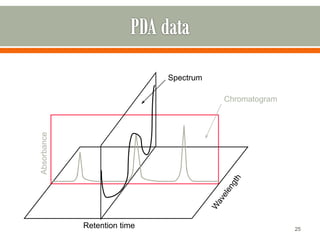
Retention time
Absorbance
Chromatogram
Spectrum
26
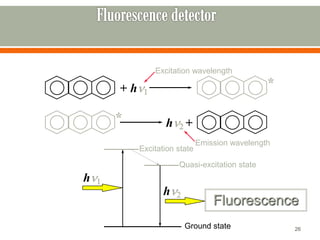
+ hn1
*
Excitation wavelength
Emission wavelength
Fluorescence
* hn2 +
hn1
hn2
Excitation state
Quasi-excitation state
Ground state
27
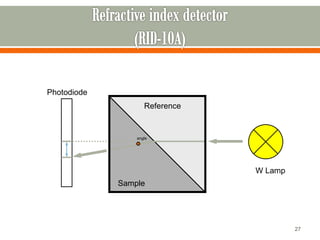
Sample
Reference
Photodiode
W Lamp
angle
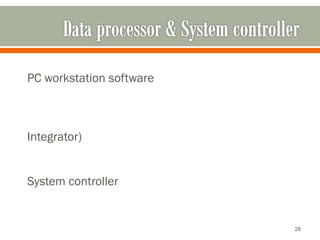
PC workstation software
Integrator)
System controller
28
29
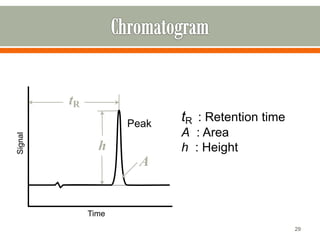
tR : Retention time
A : Area
h : Height
tR
Signal
Time
Peak
h
A
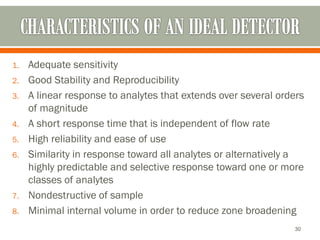
1. Adequate sensitivity
2. Good Stability and Reproducibility
3. A linear response to analytes that extends over several orders
of magnitude
4. A short response time that is independent of flow rate
5. High reliability and ease of use
6. Similarity in response toward all analytes or alternatively a
highly predictable and selective response toward one or more
classes of analytes
7. Nondestructive of sample
8. Minimal internal volume in order to reduce zone broadening
30
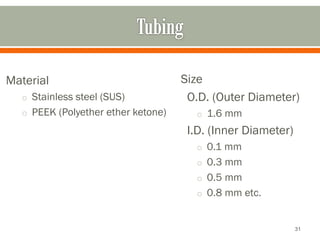
Material
o Stainless steel (SUS)
o PEEK (Polyether ether ketone)
Size
O.D. (Outer Diameter)
o 1.6 mm
I.D. (Inner Diameter)
o 0.1 mm
o 0.3 mm
o 0.5 mm
o 0.8 mm etc.
31
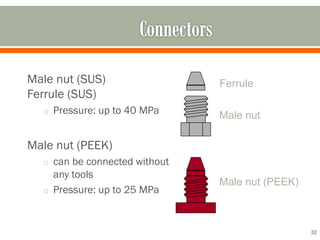
Male nut (SUS)
Ferrule (SUS)
o Pressure: up to 40 MPa
Male nut (PEEK)
o can be connected without
any tools
o Pressure: up to 25 MPa
32
Male nut
Ferrule
Male nut (PEEK)
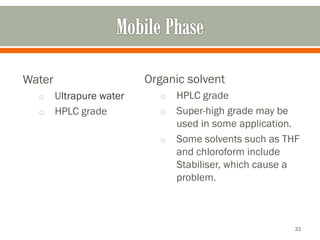
Water
o Ultrapure water
o HPLC grade
Organic solvent
o HPLC grade
o Super-high grade may be
used in some application.
o Some solvents such as THF
and chloroform include
Stabiliser, which cause a
problem.
33
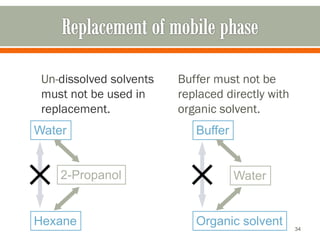
Un-dissolved solvents
must not be used in
replacement.
Buffer must not be
replaced directly with
organic solvent.
34
Water
Hexane
2-Propanol
Buffer
Organic solvent
Water
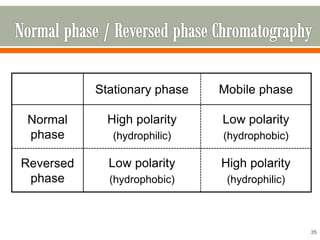
Stationary phase Mobile phase
Normal
phase
High polarity
(hydrophilic)
Low polarity
(hydrophobic)
Reversed
phase
Low polarity
(hydrophobic)
High polarity
(hydrophilic)
35
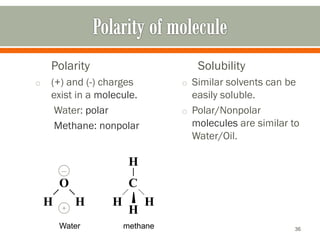
Polarity
o (+) and (-) charges
exist in a molecule.
Water: polar
Methane: nonpolar
Solubility
o Similar solvents can be
easily soluble.
o Polar/Nonpolar
molecules are similar to
Water/Oil.
36
O
H H
–
+
C
H H
H
H
Water methane
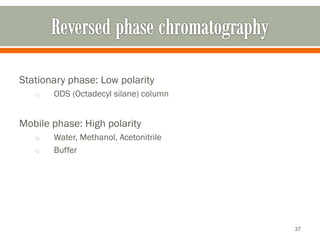
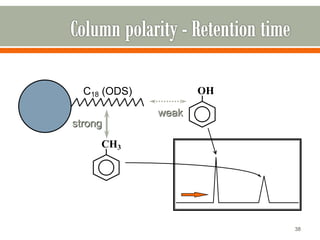
Stationary phase: Low polarity
o ODS (Octadecyl silane) column
Mobile phase: High polarity
o Water, Methanol, Acetonitrile
o Buffer
37
38
C18 (ODS)
CH3
strong
weak
OH
39
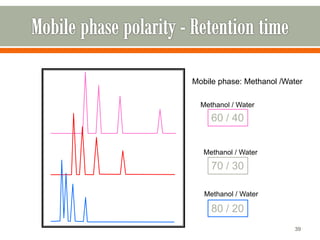
60 / 40
Mobile phase: Methanol /Water
80 / 20
70 / 30
Methanol / Water
Methanol / Water
Methanol / Water
40
W
W1/2
H1/2
H
2
R
2
2
/
1
R
2
R
π
2
55
.
5
16





 
=








=






=
Area
H
t
W
t
W
t
N
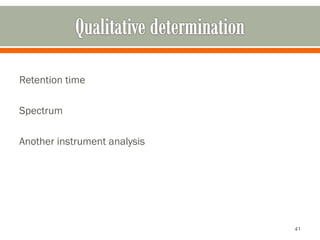
Retention time
Spectrum
Another instrument analysis
41
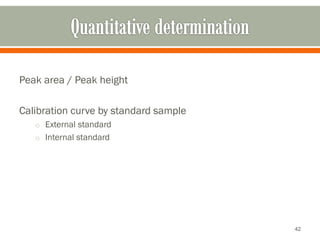
Peak area / Peak height
Calibration curve by standard sample
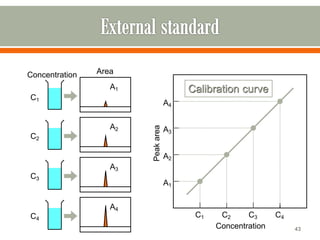
o External standard
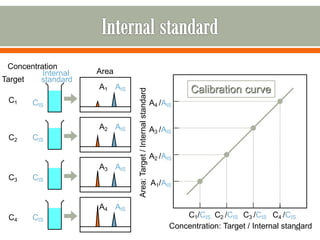
o Internal standard
42
43
C1
C4
C3
C2
Concentration Area
A1
A2
A3
A4
C1 C2 C3 C4
A1
A2
A3
A4
Concentration
Peak
area
Calibration curve
44
C1
C4
C3
C2
Concentration
Area
A1
A2
A3
A4
C1/CIS C2 /CIS C3 /CIS C4 /CIS
A1/AIS
A2 /AIS
A3 /AIS
A4 /AIS
Concentration: Target / Internal standard
Area:
Target
/
Internal
standard
Calibration curve
Target
Internal
CIS
CIS
CIS
CIS
AIS
AIS
AIS
AIS
standard
1. It is sensitive
2. It is readily adaptable to accurate quantitative determinations
3. It is suitable for separating nonvolatile species
4. It is suitable for separating thermally fragile species
5. Due to its widespread applicability to substances that are of
prime interest to industry, to many fields of science and to the
public.
45
• Confidence in the Analytical Method and the Result
produced is important.
• What is confidence?
• The method should have been validated prior to the
Analytical Investigation i.e. thoroughly tested to show
that the method gives ACCURATE results for the type of
sample being analysed.
• If we are concerned about the ACCURACY of a result, then it
is obvious that concern should extend all the way from
SAMPLING to the publication of the final RESULT.
46
• Thus what areas would you consider to be important in
producing an ACCURATE analysis?
• The sampling procedure should produce a representative
sample
• The sample should not become contaminated or alter
chemically during storage
• There should be no contamination of the sample within the
laboratory or during the analysis
• Any losses in extraction, separation and concentration
procedures should be minimized
47
• There should be no interference in the final analysis from
other components in the sample.
• Results should be correctly calculated and archived for
future reference.
• Thus the overall methodology needed or employed to
minimize the potential errors is referred to as QUALITY
ASSURANCE.
• The measures employed to ensure the validity of
individual results is referred to as QUALITY CONTROL
48
1. Sampling and sample storage procedures which ensure
that the sample is truly representative and that it reaches
the laboratory unchanged
2. Sampling and analysis in duplicate
3. Specifications within the analytical scheme for reagent
purity and apparatus cleanliness
4. Repeated checks on the instrument performance
5. Traceability in any standards used. This means that the
stated concentrations in any standard used must be
traceable back to primary international standards
49
6. Inclusion in each analytical batch of additional of
additional samples of known composition. These will
confirm the RELIABILITY of the method and could include
the ff:
a. Blank Samples – samples made up as close as possible in
composition to the unknown, excluding the compound being
determined. These are introduced before stages in the in the
analysis when contamination is likely. A positive determination of
the analyte in the blank would indicate contamination.
b. “Spiked” Samples – these are samples to which a known quantity
of the compound being determined has been added. A valid
analysis of the spiked and unspiked sample will be able to
determine accurately the quantity added.
50
Certified Reference Materials (CRMs) – these are
materials similar in type to the unknown sample and
have an accurately determined composition.
51

CHEM 361 HPLC.pdf