How to write Introduction of
Thesis
Dr. Ghizal Fatima
Assistant Professor,
Department of Biotechnology
ERA’S LUCKNOW MEDICAL COLLEGE AND
HOSPITAL
LUCKNOW, INDIA
GHIZALFATIMA8@GMAIL.COM
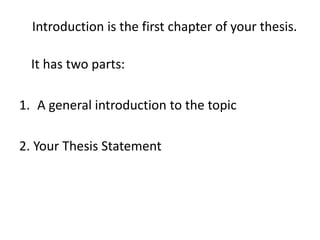
Introduction is the first chapter of your thesis.
It has two parts:
1. A general introduction to the topic
2. Your Thesis Statement
• What should be included in the introduction?
• The introductory paragraph should include
the thesis statement, a kind of mini-outline
for the paper: it tells the reader what the
thesis is about. The last sentence of this
paragraph must also contain a transitional
"hook" which moves the reader to the first
paragraph of the body of the paper.
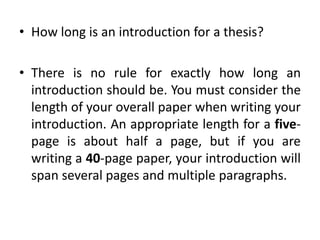
• How long is an introduction for a thesis?
• There is no rule for exactly how long an
introduction should be. You must consider the
length of your overall paper when writing your
introduction. An appropriate length for a five-
page is about half a page, but if you are
writing a 40-page paper, your introduction will
span several pages and multiple paragraphs.
• Introductions can be tricky.
• Because the introduction is the first portion of
your thesis that the reader encounters.
• A good introduction presents a broad
overview of your topic and your thesis, and
should convince the reader that it is worth
their time to actually read the rest of your
thesis.
Start your introduction broad, but not
too broad.
• Your introduction should provide the reader
with a sense of what they should expect out
of your essay, not to expound upon every
piece of knowledge ever developed by man.
Go ahead and start relatively broad, then
narrow to your thesis, but make sure you’re
still on topic.
• The introduction is the first chapter of your
thesis and thus is the starting point of your
thesis.
• You describe the topic of your thesis,
• formulate the problem statement
• and write an overview of your thesis.
Purpose of Introduction
• Introduce the topic. What is the purpose of
the study and what is the topic?
• Gain the reader’s interest. Make sure that you
get the reader’s attention by using clear
examples from recent research.
• Demonstrate the relevance of the
study. Convince the reader of the scientific
and practical relevance.
Parts of the Introduction
A clear introduction often consists of the
following parts
• Motivation
• relevance of the research
• Current scientific situation (Put review of
Literature)
• Objective of the study
• Brief description of the research design
Motivation (Problem indication)
• What is the motive for your research? This can
be a recent research or something that has
always interested you. By choosing an
interesting example, the reader is immediately
encouraged to read the rest of your
introduction.
Relevance of the research
• Using arguments, state the scientific relevance
of your research. You can do this by citing
scientific articles and combining them.
• Also, highlight here the discussion chapters of
studies that you are going to use for your own
research.
• Next, explain how your work will benefit the
patients, importance of your research.
Scientific validity related to the
theme of your research
• In this element of the introduction, you will
specify the most important scientific
articles that relate to your topic and you
briefly explain them.
• Thus, you show that many studies have been
conducted around the topic, and that you
won’t get stuck due to finding too little
information on your topic.
Objective, problem statement and
research questions
• In this part, you describe the objective of your
study and the problem statement that you have
formulated.
• Pay attention: there is a difference between the
objective and the problem statement. To answer
the problem statement, you can use research
questions.
• These are sometimes also called sub-questions. If
you use hypotheses instead of research
questions, you can also note them here.
• The basis of the hypotheses is the conceptual
framework.
• However, sometimes you are not yet able to
formulate hypotheses, because you are first
going to conduct a literature review.
• In this case you develop the hypotheses and
the conceptual framework later, after
the literature review.
Brief description of the research
design
• Later in your research, you develop
the research design in detail. However, in the
introduction you also provide a brief summary
of your research design. How, where, when
and with whom are you going to conduct your
research?
Thesis outline
• Here, you briefly describe how your thesis is
constructed.
• Summarize each chapter briefly in one
paragraph at the most, but preferably in one
sentence.
• Make sure your thesis outline is not
repetitively phrased because it does not vary
its word choice.
Begin with your thesis
• Often, the research proposal or the action
plan is a good start for writing your
introduction.
• You will notice that you already have written
many parts of the introduction in your thesis.
• Although the introduction is at the beginning of
your thesis, this placement doesn’t mean that
you must finish the introduction before you can
start the rest of your chapters.
• The further you get in your research, the easier it
will be to write a good introduction that is to the
point.
• Thus, it’s no disaster if you can’t write a perfect
introduction right away. Take up the introduction
again at a later time and keep writing and editing
until you arrive at a nice whole Introduction
Verb tenses
• To introduce your subject and indicate what
you wish to discuss, you should use the simple
present tense.
• Background information is written in
the simple past tense or present perfect tense.
Length of the introduction
• There are no specific requirements with regard to
the length of your introduction. Thus, there’s no
need to squeeze everything together on just one
page, like with the abstract.
• But you do need to write to the point. Don’t
repeat yourself and only write down what’s
actually important to introduce your topic and
research.
Checklist: Introduction
• The introduction of the research is written with a stimulating topic.
• The topic is limited.
• The scientific relevance is demonstrated (not applicable to all
theses).
• The practical relevance is demonstrated.
• The most important scientific articles about the topic are
summarized (not applicable to all theses).
• The objective is formulated.
• The problem statement is formulated.
• The conceptual framework is determined.*
• The research questions or hypotheses are formulated.**
• The research design is described briefly.
• The thesis overview is added.
• Basically, a good introduction provides the
reader with a brief overview of your topic and
an explanation of your thesis.
• A good introduction is fresh, engaging, and
interesting.
• Successful introductions don’t rely on
irrelevant information to demonstrate their
point.
• Be brief, be concise, be engaging.

How to write introduction of thesis

  • 1.
    How to writeIntroduction of Thesis Dr. Ghizal Fatima Assistant Professor, Department of Biotechnology ERA’S LUCKNOW MEDICAL COLLEGE AND HOSPITAL LUCKNOW, INDIA GHIZALFATIMA8@GMAIL.COM
  • 2.
    Introduction is thefirst chapter of your thesis. It has two parts: 1. A general introduction to the topic 2. Your Thesis Statement
  • 3.
    • What shouldbe included in the introduction? • The introductory paragraph should include the thesis statement, a kind of mini-outline for the paper: it tells the reader what the thesis is about. The last sentence of this paragraph must also contain a transitional "hook" which moves the reader to the first paragraph of the body of the paper.
  • 4.
    • How longis an introduction for a thesis? • There is no rule for exactly how long an introduction should be. You must consider the length of your overall paper when writing your introduction. An appropriate length for a five- page is about half a page, but if you are writing a 40-page paper, your introduction will span several pages and multiple paragraphs.
  • 5.
    • Introductions canbe tricky. • Because the introduction is the first portion of your thesis that the reader encounters. • A good introduction presents a broad overview of your topic and your thesis, and should convince the reader that it is worth their time to actually read the rest of your thesis.
  • 6.
    Start your introductionbroad, but not too broad. • Your introduction should provide the reader with a sense of what they should expect out of your essay, not to expound upon every piece of knowledge ever developed by man. Go ahead and start relatively broad, then narrow to your thesis, but make sure you’re still on topic.
  • 7.
    • The introductionis the first chapter of your thesis and thus is the starting point of your thesis. • You describe the topic of your thesis, • formulate the problem statement • and write an overview of your thesis.
  • 8.
    Purpose of Introduction •Introduce the topic. What is the purpose of the study and what is the topic? • Gain the reader’s interest. Make sure that you get the reader’s attention by using clear examples from recent research. • Demonstrate the relevance of the study. Convince the reader of the scientific and practical relevance.
  • 9.
    Parts of theIntroduction A clear introduction often consists of the following parts • Motivation • relevance of the research • Current scientific situation (Put review of Literature) • Objective of the study • Brief description of the research design
  • 10.
    Motivation (Problem indication) •What is the motive for your research? This can be a recent research or something that has always interested you. By choosing an interesting example, the reader is immediately encouraged to read the rest of your introduction.
  • 11.
    Relevance of theresearch • Using arguments, state the scientific relevance of your research. You can do this by citing scientific articles and combining them. • Also, highlight here the discussion chapters of studies that you are going to use for your own research. • Next, explain how your work will benefit the patients, importance of your research.
  • 12.
    Scientific validity relatedto the theme of your research • In this element of the introduction, you will specify the most important scientific articles that relate to your topic and you briefly explain them. • Thus, you show that many studies have been conducted around the topic, and that you won’t get stuck due to finding too little information on your topic.
  • 13.
    Objective, problem statementand research questions • In this part, you describe the objective of your study and the problem statement that you have formulated. • Pay attention: there is a difference between the objective and the problem statement. To answer the problem statement, you can use research questions. • These are sometimes also called sub-questions. If you use hypotheses instead of research questions, you can also note them here.
  • 14.
    • The basisof the hypotheses is the conceptual framework. • However, sometimes you are not yet able to formulate hypotheses, because you are first going to conduct a literature review. • In this case you develop the hypotheses and the conceptual framework later, after the literature review.
  • 15.
    Brief description ofthe research design • Later in your research, you develop the research design in detail. However, in the introduction you also provide a brief summary of your research design. How, where, when and with whom are you going to conduct your research?
  • 16.
    Thesis outline • Here,you briefly describe how your thesis is constructed. • Summarize each chapter briefly in one paragraph at the most, but preferably in one sentence. • Make sure your thesis outline is not repetitively phrased because it does not vary its word choice.
  • 17.
    Begin with yourthesis • Often, the research proposal or the action plan is a good start for writing your introduction. • You will notice that you already have written many parts of the introduction in your thesis.
  • 18.
    • Although theintroduction is at the beginning of your thesis, this placement doesn’t mean that you must finish the introduction before you can start the rest of your chapters. • The further you get in your research, the easier it will be to write a good introduction that is to the point. • Thus, it’s no disaster if you can’t write a perfect introduction right away. Take up the introduction again at a later time and keep writing and editing until you arrive at a nice whole Introduction
  • 19.
    Verb tenses • Tointroduce your subject and indicate what you wish to discuss, you should use the simple present tense. • Background information is written in the simple past tense or present perfect tense.
  • 20.
    Length of theintroduction • There are no specific requirements with regard to the length of your introduction. Thus, there’s no need to squeeze everything together on just one page, like with the abstract. • But you do need to write to the point. Don’t repeat yourself and only write down what’s actually important to introduce your topic and research.
  • 21.
    Checklist: Introduction • Theintroduction of the research is written with a stimulating topic. • The topic is limited. • The scientific relevance is demonstrated (not applicable to all theses). • The practical relevance is demonstrated. • The most important scientific articles about the topic are summarized (not applicable to all theses). • The objective is formulated. • The problem statement is formulated. • The conceptual framework is determined.* • The research questions or hypotheses are formulated.** • The research design is described briefly. • The thesis overview is added.
  • 22.
    • Basically, agood introduction provides the reader with a brief overview of your topic and an explanation of your thesis. • A good introduction is fresh, engaging, and interesting. • Successful introductions don’t rely on irrelevant information to demonstrate their point. • Be brief, be concise, be engaging.